



Palo Alto, United States, October 12th, 2026, Chainwire
Trace, the onchain registry for rights-cleared AI training data with more than 250 million verifiable receipts, brings its training data to Sui and Walrus to power the next generation of AI models.
Sui Foundation and The DATA Foundation today announced that the DATA Network and its Trace registry are joining the Sui stack, bringing a live supply of rights-cleared AI training data onto the infrastructure Sui has built for AI workloads. Walrus, the data platform with integrity proofs anchored on Sui, becomes the default storage layer for applications operated by DATA Foundation. Separately, the DATA Network will be upgraded to run as a protocol natively on Sui.
The upgrade gives AI labs a single place to source real-world training data they are allowed to use, with its provenance recorded by Trace and the original file stored and access-controlled on Walrus.
The data AI needs next
The next generation of AI models is constrained by access to real-world data. The open internet has been scraped, and the data that comes next must be sourced from people, with consent and with provenance that regulators and legal teams will accept. The EU AI Act and ongoing litigation over training data have made provenance a procurement requirement for labs.
The data those models need sits with people rather than on the open web: a nurse describing a patient’s night in her own words, a dashcam recording of a rainy commute in Jakarta, a factory technician’s hands as they diagnose a fault, or a customer call conducted in Bengali. It is personal and often regulated, and it belongs to the people who generated it.
Trace, launched by DATA Foundation in June as an onchain registry for AI training data, was built for exactly this kind of data. It records the origin of each contribution and the rights attached to it, and settles payment to the person who contributed it. It has registered more than 250 million contributions since launch and now processes over 3M receipts per day on average. Applications writing to Trace include Kled, the largest opt-in human data marketplace with over 1.5 billion records being onboarded, along with Numo and Oto, applications that already license data to frontier AI labs and robotics companies.
Why Sui and Walrus
Sui represents every asset as a programmable object, allowing datasets and their licenses to be managed onchain like tokens. Independent transactions execute in parallel and settle in under a second, making the network capable of handling millions of daily registrations. Walrus extends this capability to large files: it stores massive AI datasets efficiently and ensures data is only readable by licensed buyers. No other network offers storage, access control, and ownership tracking built natively into a single ecosystem, together with verifiable compute.
Trace now adds a flagship supply of rights-cleared data, with existing demand from the AI labs that license it today. The result of the integration will be stronger provenance guarantees and tamper evidence. Today a Trace record proves that a file was registered and when, and with Walrus, Trace will be able to hold an encrypted, immutable copy of the contributed file itself as a reference guarantee. The hash of the record can be regenerated from the data itself rather than from metadata an application supplied, and any later processing of the file can be checked against the original.
The upgrade is backed by a long-term strategic investment. Sui Foundation is investing $30 million in the DATA Network, establishing the largest institutional stake in the network, alongside the continuing holdings of PIP Labs and the DATA Foundation. Furthering the alignment, SY Lee, Chairman of Poseidon and CEO of PIP Labs, joins Sui Foundation as Strategic Advisor.
The protocol upgrade
DATA Network will be upgraded to run as a protocol natively on Sui, and its independent chain will be retired. $DATA continues as the token of the DATA protocol on Sui, carried over one-to-one, with holder economics and governance rights at least equivalent to today. Locked and vesting positions carry over unchanged. In parallel, Walrus becomes the default storage layer for DATA Foundation applications.
Adeniyi Abiodun, Co-Founder and Chief Product Officer at Mysten Labs, the original contributor to Sui and Walrus, said: “The AI industry has reached the point where the open internet has been read, and the next frontier is defined by access to datasets with the consent and provenance that regulators require. Sui and Walrus were built to be the home where AI data is stored, licensed, and paid for, capable of operating at the scale these systems demand. The migration of DATA Network and Trace to our stack now brings massive volumes of high-quality, rights-cleared data that is already serving the world’s frontier AI labs.”
SY Lee, Chairman of Poseidon and CEO of PIP Labs, said: “The next generation of AI will be trained on data that lives with people rather than on the open web, and that data needs consent and provenance built in, along with a way to pay the people it comes from, and Trace was built to be that layer. It now becomes part of the Sui stack alongside Walrus, backed by one of the strongest engineering organizations in the industry and with Sui Foundation as the network’s largest strategic holder. This is the right home for the network we built, and I am looking forward to helping Sui make it the data layer for AI.”
Andrea Muttoni, CEO of DATA Foundation, said: “Training data is critical for continuously expanding the frontier, and making sure it is traceable, auditable and cleared to use is just as important for AI safety as it is a precursor for data quality. With Trace, we have been tracking hundreds of millions of data assets. Joining forces with Sui now allows us to build out more of the stack, offering more than just an audit trail, like encrypted reference file storage and potentially fully verifiable TEEs for evals and fine tunings in the future.”
The existing DATA Network will continue to operate until the upgrade is complete, and a detailed timeline and holder transition plan will be published prior to the upgrade.
About DATA Foundation
DATA Foundation supports the DATA Network, the protocol for tracking provenance of the real-world data AI models need. Through Trace, each contribution is registered with its provenance receipt and a full audit trail. Applications building on the network include Kled, Numo, Oto, and others. Formerly Story Foundation, the organization refocused on AI training data in June 2026. The DATA Network is being upgraded to run as a protocol on Sui.
About Sui
Sui, where money moves as freely as messages, is a next-generation Layer 1 blockchain built for onchain finance and agentic infrastructure. Founded by the core team behind Meta’s stablecoin initiative and powered by an object-centric model, Sui makes assets, permissions, and user data programmable and verifiable. Sui’s primitives offer everything necessary to create high-performance finance and AI-native applications. Learn more at sui.io.
About Walrus
Walrus is the data platform built for the demands of AI. It lets builders, enterprises, and AI agents move data across apps and models, protect it with built-in access rules, and make it verifiable by anyone. As AI takes actions with consequence, the data it runs on has to be provable. Created by the cryptographers and distributed systems engineers behind Sui and Meta’s first stablecoin initiative. walrus.xyz
Media contacts
DATA Foundation: [email protected]
Sui Foundation: [email protected]
Contact
Head of Communications
HV
DATA Foundation
[email protected]
Luxembourg, Luxembourg, October 8th, 2026, Chainwire
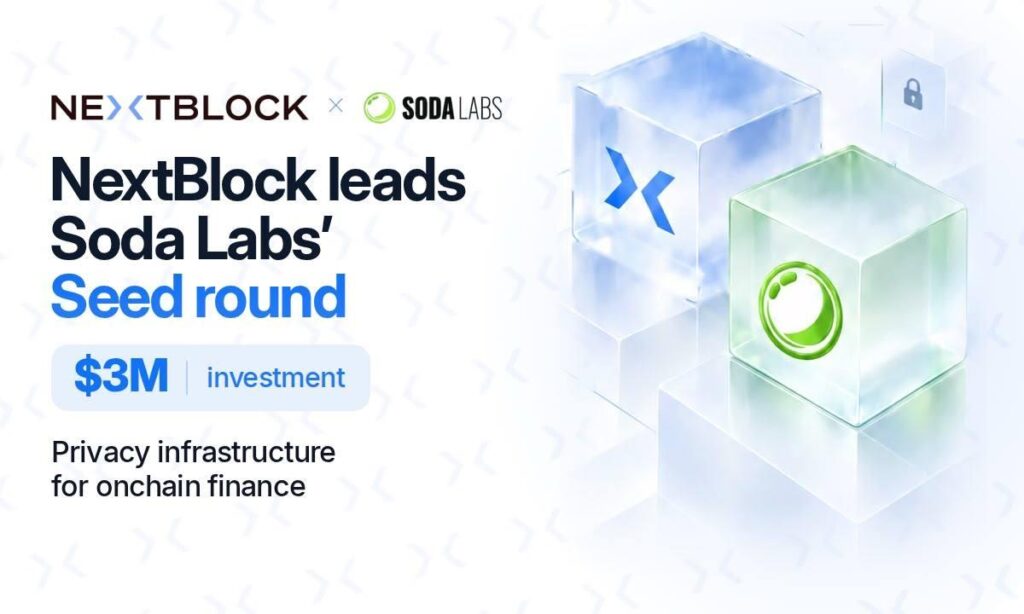
NextBlock has invested $3 million in Soda Labs’s seed round, funding the company’s entire closed round as it expands its programmable privacy infrastructure for financial activity on public blockchains.
Over the past two and a half years, Soda Labs has developed a cryptographic privacy solution combining garbled circuits with multiparty computation (GC-MPC). It relies on standard, battle-tested cryptography such as AES and SHA256. Its privacy engine runs on ordinary cloud CPUs with no specialized hardware, enabling private computation while applications stay connected to existing public blockchain infrastructure.
Soda’s technology has already processed more than 100 million transactions on the COTI network, where it supports deployed applications including tokenization platform Zoniqx and perpetuals exchange PriveX. PriveX has processed more than $20 billion in trading volume, while Zoniqx is onboarding issuers across multiple asset classes and jurisdictions.
“What attracted us to Soda was not only the underlying cryptography, but the practicality of the technology for the financial workloads we believe will matter most onchain,” said Pieter van Poecke, Founder and General Partner of NextBlock. “Soda already had a working product and paying customers. We believe its differentiated technical IP, deeply technical founding team and strong commercial instincts give the company a compelling foundation for its next phase.”
The capital gives Soda Labs the room to focus over the next 12 to 18 months on scaling commercial adoption and execution.
The investment comes as Soda Labs extends its architecture from gcEVM, its Ethereum Layer 2 privacy layer that remains live on COTI, to Soda Bubble: a chain-agnostic coprocessor for programmable privacy. Bubble is designed to process developer-defined workloads originating from different blockchains without exposing the underlying private data publicly or to Soda Labs itself.
The Bubble Validator Network enables participants to mathematically verify that computations involving private data have been performed faithfully. Soda Labs is expanding the network as Bubble goes live across major EVM ecosystems, including Ethereum, Polygon, Arbitrum and Base. Expansion to non-EVM networks, including Solana, is also underway.
Soda Labs expects to publish updated performance benchmarks in the coming weeks. According to the company, its latest testing was conducted on Arbitrum and measured the complete transaction lifecycle on the live network, including encryption, MPC computation, consensus and settlement, rather than the cryptographic operation in isolation.
The company reports that the results represent a five- to tenfold improvement over its previously published benchmark. Soda Labs also reports that its garbled-circuit MPC architecture can deliver approximately 10 to 100 times greater throughput and 100 to 1,000 times lower cost per transaction than currently available alternatives, while operating on standard cloud CPUs. The new benchmark results have not yet been publicly released.
The new capital will support Soda Labs’ go-to-market strategy, the expansion of its validator network and blockchain coverage, team growth and integrations with banks, payment companies, tokenization platforms and other financial infrastructure providers. The company is also working with financial and infrastructure organizations on several undisclosed pilots, with the objective of converting them into production deployments.
“Public blockchains already have the liquidity, users and financial applications. What they lack is a way for regulated money to move without showing everyone everything,” said Avishay Yanai, Co-Founder and CEO of Soda Labs. “Bubble gives banks, payment companies and tokenization platforms privacy with controlled disclosure, on the chains they already use. This round lets us take it from pilots to production.”
About NextBlock
NextBlock is a Luxembourg-based, thesis-driven venture capital firm investing at the intersection of blockchain and programmable cryptography. The firm backs companies building foundational infrastructure for privacy-preserving computation, encrypted systems and institutional digital finance, with investments spanning technologies such as multiparty computation, garbled circuits, fully homomorphic encryption, zero-knowledge systems and post-quantum cryptography. NextBlock invests globally in technical teams translating advances in cryptography and computer science into commercially deployable infrastructure and applications.
About Soda Labs
Soda Labs builds confidentiality infrastructure for real-world onchain finance. Its Bubble privacy layer uses garbled-circuit multiparty computation (GC-MPC) to enable private transactions and computation across public blockchains while supporting selective disclosure and compliance requirements. Bubble is live across Ethereum, Polygon, Arbitrum, Base and COTI, with additional networks planned. Soda Labs’ technology is designed for financial use cases including payments and stablecoins, institutional DeFi, tokenization, asset management and banking infrastructure. The company was founded by Avishay Yanai (CEO), PhD in cryptography, and Meital Levy (CTO), PhD in algorithms, who together bring more than 20 years of experience in security.
Contact
Avishay Litani
[email protected]
Tallinn, Estonia, October 8th, 2026, Chainwire
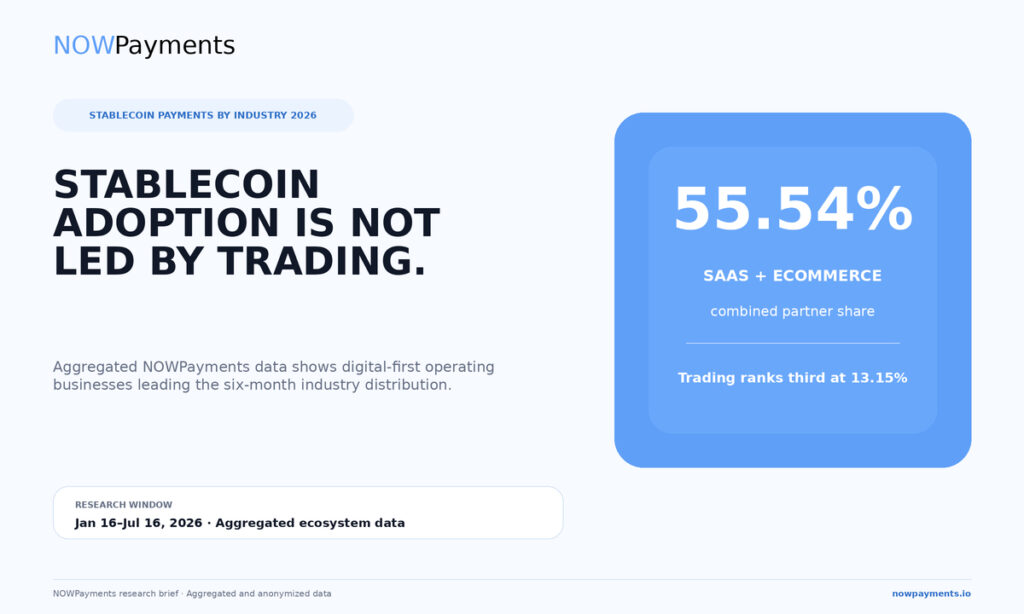
SaaS and eCommerce increased their combined share from 48.26% to 55.54%, while Trading moved from 14.07% to 13.15%.
Businesses can build stablecoin infrastructure around the wrong problem.
The mistake is treating stablecoins primarily as a coin-and-network decision. For a digital business, they may need to support a much broader set of operating workflows, including billing, checkout, settlement, payouts, and reconciliation.
Which of those workflows matters most depends on the business model.
New aggregated data from NOWPayments shows the industry mix shifting toward businesses that use payments as part of their day-to-day operations. Between January 16 and July 16, 2026, SaaS and web services accounted for 27.78% of classified partners. eCommerce Marketplaces followed at 27.76%. Together, the two sectors represented 55.54% of the sample. During the same period in 2025, their combined share was 48.26%. The increase of 7.28 percentage points represents a 15.08% year-over-year rise in their combined share.
Trading remained an important part of the sample, but its share moved in the opposite direction. It declined from 14.07% in 2025 to 13.15% in 2026, leaving trading in third place behind SaaS and eCommerce.
The clearest upward shift came from SaaS. Its share increased from 15.58% to 27.78% in one year, closing a gap of 17.10 percentage points with eCommerce. The emerging picture is not stablecoins replacing trading. It is stablecoin adoption expanding into the operating infrastructure of digital businesses.
Unless otherwise stated, industry-distribution figures compare January 16 to July 16, 2025, with January 16 to July 16, 2026.
The Partner Mix Is Shifting Toward Operational Use Cases
In 2025, eCommerce marketplaces led the dataset at 32.68%. SaaS and Web Services followed at 15.58%, with Trading close behind at 14.07%.
One year later, SaaS had increased its share by 12.20 percentage points to 27.78%. eCommerce stood at 27.76%, leaving only 0.02 percentage points between the two sectors. Their combined share rose from 48.26% to 55.54%. More than half of the classified partners in the 2026 sample therefore came from two sectors built around digital transactions, recurring services, and online customer relationships.
The rest of the partner mix changed more gradually.
Financial Services moved from 9.00% to 6.35%. Gambling and iGaming increased from 6.20% to 6.87%, and adult platforms rose from 4.99% to 5.89%. Charity declined from 2.27% to 1.40%, while TGE/Presale moved from 2.12% to 1.35%.
These figures measure changes in each industry’s share of the sample. They do not measure absolute partner growth. A category may lose share because another category expanded faster.
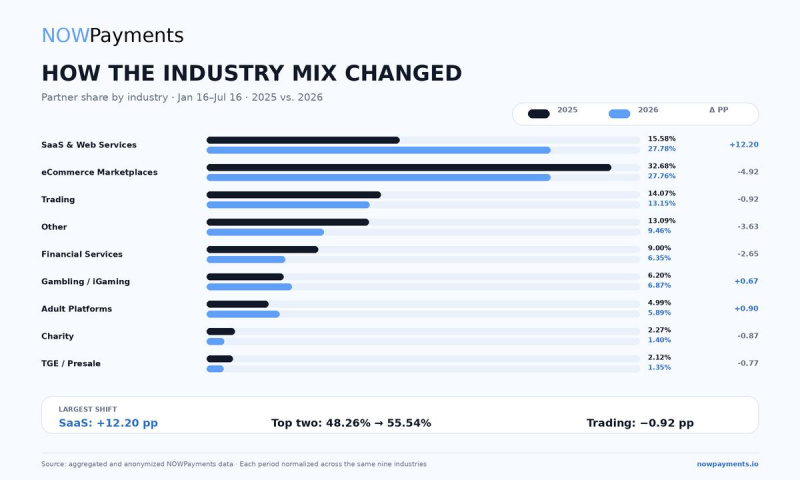 Methodology: Each percentage represents an industry’s share of the full aggregated partner sample classified across the same nine categories. The comparison covers January 16 to July 16 in both 2025 and 2026. Each period was normalized independently. Absolute partner counts are not disclosed, and percentages are rounded to two decimal places. The findings describe partner distribution within the NOWPayments dataset, not payment volume, transaction value, or market-wide industry share.
Different Business Models Need Different Stablecoin Workflows
The industry data becomes useful when it is translated into the operating questions each business model may need to solve.
For a SaaS company, stablecoin payments may need to connect with recurring billing, invoice matching, account activation, renewals, settlement, and financial reconciliation.
A marketplace may need stablecoins to work across a longer flow. The payment can begin at checkout and continue through refunds, seller settlement, affiliate commissions, and other payouts.
Trading platforms face a different set of requirements. Their priorities may include asset and network coverage, confirmation policies, liquidity, and treasury controls.
These are potential workflow drivers, not a universal description of every company in each category. The point is that the same stablecoin can serve all three sectors while performing a different operational job in each one.
This is why a business should define the workflow before choosing the asset and network.
The Network Mix Also Changes by Industry
The successful-payment data shows that industry differences extend to network usage.
USDT on TRON accounted for 54.58% of the measured successful-payment sample within eCommerce marketplaces. Its share was 12.04% in trading and 9.60% in SaaS and web services.
Within this dataset, USDT TRC20 was about 4.5 times as prominent in eCommerce as in Trading and 5.7 times as prominent as in SaaS.
The corresponding shares were 4.76% in Gambling and iGaming, 1.85% in Financial Services, 1.49% in Other, and 0.60% in Charity. Adult Platforms and TGE/Presale each recorded a 0% share in the analyzed sample.
The difference supports the same conclusion as the industry data. A stablecoin setup that fits one business model may not fit another.
For an eCommerce business, USDT on TRON may play a visible role in checkout activity. A SaaS company may see a different asset and network mix. Trading platforms may need broader coverage across both.
Businesses should validate these decisions against their own successful-payment data instead of importing the preferences of another industry.
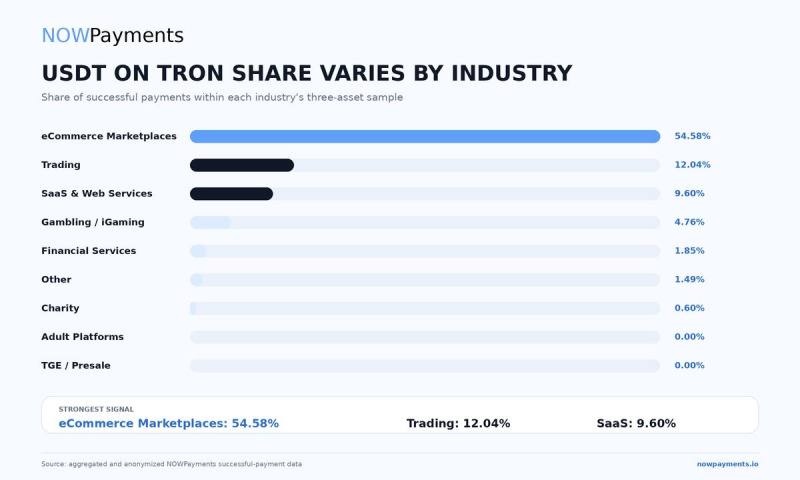
Methodology: Each percentage represents USDT TRC20’s share of the aggregated successful-payment sample within the corresponding industry. Absolute transaction counts are not disclosed. Failed, expired, refunded, and test transactions are excluded. The figures describe activity within the NOWPayments ecosystem and should not be interpreted as market-wide currency shares. A 0% result means that no successful USDT TRC20 payments were recorded in the analyzed sample for that category.
Build the Workflow Before Choosing the Rails
The five operating areas introduced at the beginning provide a practical framework for evaluating stablecoin infrastructure.
- Billing: Does the payment need to connect with invoices, subscriptions, renewals, or account access?
- Checkout: Which assets and networks produce completed payments for the company’s actual customers?
- Settlement: Which asset should the business receive, and when should funds become available?
- Payouts: Will funds need to move to sellers, affiliates, contractors, or customers?
- Reconciliation: How will the finance team match transactions with invoices, orders, and internal reporting?
Not every business needs all five. A SaaS platform may focus on billing and reconciliation. A marketplace may need checkout, settlement, and payouts. A trading platform may prioritize network coverage, liquidity, and treasury controls.
The company should first identify which workflows apply. Asset and network selection comes after that.
“The mistake is asking which stablecoin is best. The better question is: best for what?” said Kate Lifshits, Commercial Director at NOWPayments. “Businesses should define the billing, checkout, settlement, payout, and reconciliation flow first. The coin and network should serve that workflow – not the other way around.”
Lifshits explores the commercial side of crypto payments in her Cryptopolitan series, Crypto That Works for Business. The first column, The 22% Sales Boost Hiding in Your Crypto Checkout, examined how payment infrastructure can affect checkout performance. Future installments will continue looking at where crypto payments can increase revenue, lower costs, and remove operational friction.
Stablecoin strategy starts with the job the money needs to do. The coin and network come next.
About NOWPayments
NOWPayments is a crypto business ecosystem designed to help companies accept payments, automate mass payouts, manage stablecoin treasury, and scale global digital asset operations through a single infrastructure. The platform supports more than 350 cryptocurrencies, over 30 stablecoins, flexible settlement options, and enterprise-grade APIs.
Contacts
PR Manager
Angelina T
NOWPayments
[email protected]
Commercial Director
Kate L
NOWPayments
[email protected]

Las Vegas, NV, October 1st, 2026, Chainwire
Lowest Fee Bitcoin ATMs announced the launch of more than 400 cryptocurrency ATMs across the United States. The machines allow customers to purchase Bitcoin, Ethereum, USDT and USDC with cash at a stated flat 5% fee. Customers can also pre-register online before visiting an ATM.
Lowest Fee Bitcoin ATMs, a new nationwide low-fee Bitcoin ATM operator, launched today with an initial rollout of more than 400 Bitcoin ATMs across the United States, a footprint that places it amongst the largest Bitcoin ATM operators in the country on its first day. It also launched with a name that does most of the marketing department’s job for it. The brand charges a flat 5% Bitcoin ATM fee to buy Bitcoin, Ethereum, USDT or USDC with cash, displays the fee and exchange rate on screen before the customer confirms, and, as of today, lets first-time customers register online in about two minutes so they can skip onboarding at the machine entirely.
400+ Bitcoin ATM locations on day one
Most Bitcoin ATM operators in the U.S. run a few dozen machines. Lowest Fee Bitcoin ATMs opens with more than 400 Bitcoin ATM locations in the convenience stores, gas stations and shopping centers people already visit, with machines in Florida, California, Arizona and Texas among other states, as the first phase of a larger rollout.
“Four hundred machines is not a pilot. It’s a network,” said Quincy Mathis, Operations Manager at Lowest Fee Bitcoin ATMs. “We wanted to be one of the biggest Bitcoin ATM operators in the country on the day we opened, because a low fee only matters if there’s a machine near you. This is phase one.”
Buy Bitcoin, Ethereum, USDT and USDC with cash: coins, limits and one fee
Every Lowest Fee Bitcoin ATM sells Bitcoin (BTC), Ethereum (ETH), Tether (USDT) and USD Coin (USDC) for cash, all at the same 5% fee, all sent directly to the customer’s own wallet. No bank account or credit card is needed. The machines are non-custodial: the company never holds customer funds.
Bitcoin ATM daily limits are set by verification tier:
- Tier 1, phone number only: up to $2,000 per day
- Tier 2, government ID and Tax ID: up to $50,000 per day
Bitcoin ATM fees compared: what $1,000 buys
The typical Bitcoin ATM in the United States charges roughly 12% to 15% to buy, and some of the largest national brands charge 20% or more. Here is what that looks like when a customer walks up with $1,000 in cash:
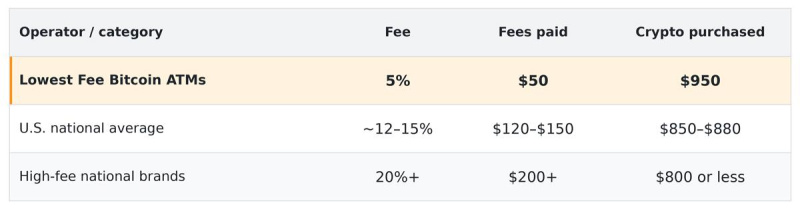
Illustrative, based on posted percentage fees only and before exchange rate. Many operators add an exchange-rate markup on top of the posted fee; Lowest Fee Bitcoin ATMs shows both the fee and the rate on screen before a transaction is confirmed. Industry figures reflect publicly reported U.S. Bitcoin ATM fee ranges. See how the Bitcoin ATM fees compare.
At a 20% machine, one dollar in every five never becomes crypto. At Lowest Fee Bitcoin ATMs, it’s one in twenty. The name is not subtle; neither is a 20% fee.
“We wanted a rate people can look at on the receipt and feel good about, not one they have to make peace with,” said Quincy Mathis. “Five percent, shown up front, with the exchange rate right next to it. That’s the whole pitch.”
Stablecoin ATMs are becoming the way people send money overseas
A growing share of customers are using the machines as USDT and USDC ATMs, buying dollar pegged stable coins to send money to family and friends overseas and to pay suppliers and contractors abroad. A customer inserts cash, the stable coins arrive in the recipient’s wallet within minutes, and the recipient holds dollars they can keep or cash out locally. No wire counter, no multi-day wait, and no bank account needed to send.
That makes the fee gap matter more, not less. Someone sending $1,000 home once a month pays about $600 a year in fees at a 5% machine, $1,440 to $1,800 at a typical machine, and $2,400 at a 20% machine. The difference is real money to the people who can least afford to lose it, which is why low fees matter most to remittance customers.
“The people using stable coins to support family abroad are exactly the people who shouldn’t be paying 20% for the privilege,” said Quincy Mathis.
How to use a Bitcoin ATM: four steps, under two minutes, now with online pre-registration
New with today’s launch is online Bitcoin ATM pre-registration. First-time customers can pre-register online before they ever visit a machine, so the first visit is as fast as the tenth. At any of the 400+ machines, they simply enter their phone number.
- Register online, once. About two minutes on a phone.
- Walk up and enter your phone number. The machine recognizes you. No paperwork at the kiosk.
- Pick a coin, scan your wallet, insert cash. Scan your wallet’s QR code and feed in the bills.
- Check the screen and confirm. The fee and exchange rate are displayed before you press anything. Crypto lands in your wallet within minutes.
Customers who would rather register at the machine still can. It just takes a little longer, and the company would like to gently point out that it no longer has to. A full walkthrough of how a Bitcoin ATM works is on the company’s website.
Compliance, briefly
Lowest Fee Bitcoin ATMs is a FinCEN-registered money services business, and every machine operates in compliance with federal and state regulations. Customer data is encrypted, and transactions are non-custodial and irreversible. No government agency, bank, utility or tech-support line will ever ask anyone to pay them at a Bitcoin ATM; if someone does, it is a scam. Common questions are answered in the company’s Bitcoin ATM FAQ.
Find a low-fee Bitcoin ATM near you
Lowest Fee Bitcoin ATMs are live now at 400+ locations across the United States, with further phases of the rollout to follow. Customers can find a Bitcoin ATM near them and pre-register at lowestfeebitcoinatms.com. New customers can use code LOWEST at the machine for 20% off the transaction fee, which brings the fee on that $1,000 transaction down to $40.
About Lowest Fee Bitcoin ATMs
Lowest Fee Bitcoin ATMs is a nationwide low-fee Bitcoin ATM operator whose initial network of more than 400 machines ranks among the largest in the United States. Customers can buy Bitcoin, Ethereum, USDT and USDC with cash for a flat 5% fee, with the fee and exchange rate displayed on screen before every transaction. The company is a FinCEN-registered money services business. Users can learn more at lowestfeebitcoinatms.com.
Contact
Marketing Director
Brian S. Smith
Lowest Fee Bitcoin ATMs
[email protected]
Chicago, United States, September 28th, 2026, Chainwire
AlgoQuant will deploy Liquid Mercury’s institutional-grade trading technology to scale its multi-strategy investment platform and enhance execution capabilities across global digital asset markets.
Liquid Mercury, a leading technology provider for digital asset marketplaces and crypto trading, announced today that it has been engaged by AlgoQuant Asset Management, an investment manager focused on solving inefficiencies in fast-evolving markets, to provide trading technology and infrastructure services.
The engagement will enable AlgoQuant to leverage Liquid Mercury’s institutional-grade trading technology and infrastructure to enhance its multi-strategy investment platform. AlgoQuant will gain access to deep liquidity, advanced execution capabilities, and professional-grade trading tools that support the firm’s commitment to quantitative excellence, risk integrity, and operational resilience.
Liquid Mercury’s battle-tested platform combined with AlgoQuant’s sophisticated quantitative strategies provides a powerful foundation for executing complex digital asset trades across global markets. This technology integration allows AlgoQuant to maintain 24/7 trading operations while scaling talent, capital, and technology without compromising precision.
With a team spanning key global financial and digital asset markets, AlgoQuant operates as a multi-strategy investment platform designed to perform across diverse market environments. Through Liquid Mercury’s platform, AlgoQuant will benefit from access to top-tier liquidity providers, low-latency infrastructure, and comprehensive middle and back-office tools designed to meet the demands of institutional asset managers operating in digital asset markets.
“AlgoQuant came to us with very specific infrastructure requirements that are unique to their sophisticated quantitative strategies,” stated Liquid Mercury CEO, Tony Saliba. “What sets Liquid Mercury apart is our ability to shape our tech stack to meet each client’s distinct needs. This level of customization isn’t something firms can always find off the shelf, but our battle-tested platform was built with the flexibility to adapt while maintaining institutional-grade standards. We’re honored to provide the tailored technology infrastructure that will support AlgoQuant as it continues to scale its investment platform.”
“Liquid Mercury has been an excellent technology partner for AlgoQuant Asset Management,” said Alexander Goncharov, President of AlgoQuant Asset Management. “We are very pleased with their sophisticated technology stack, collaborative approach, and willingness to tailor the platform to our specific needs. Their infrastructure delivers the speed, reliability, and precision required in today’s digital asset markets while integrating seamlessly with our proprietary systems and workflows.”
About AlgoQuant Asset Management
AlgoQuant is an investment manager with a clear mission: to solve inefficiencies in fast-evolving markets. From day one, the firm has been focused on building a platform that can scale talent, capital, and technology without compromising precision. At the heart of AlgoQuant’s model is a commitment to quantitative excellence, risk integrity, and operational resilience.
AlgoQuant operates as a multi-strategy investment platform with global reach, featuring team members and trading teams based in key global financial and digital asset markets. The firm’s structure supports 24/7 execution, oversight, and engagement with global allocators.
Further information can be found at www.aq.io
About Liquid Mercury
Liquid Mercury powers professional crypto trading and digital asset marketplaces. Founded by legendary trader Tony Saliba, who was featured in Jack Schwager’s “Market Wizards,” Liquid Mercury is the #1 choice for sophisticated buy-side and institutional sell-side trading professionals moving into crypto.
Mercury Pro is an institutional-grade trading platform designed specifically for professional traders navigating crypto derivatives and spot markets. The platform offers sophisticated trade execution tools including DMA routing, staging, execution algorithms, and anonymous multi-dealer RFQ to source block liquidity. Traders can manage all orders and trade data in a single platform with real-time views of balances and account positions.
Key capabilities include access to crypto derivatives at leading onshore and offshore exchanges, institutional-sized pricing with top OTC liquidity providers, and a wide range of spot products across leading exchanges. The platform supports both single-leg and multi-leg orders in net price structures, with low-latency infrastructure built for high-frequency and algorithmic trading strategies.
Liquid Mercury integrates with world-class custodians including Fireblocks, Gemini, and BitGo, and provides comprehensive APIs (FIX, WebSocket, and REST) for automated trading and workflow customization. Built by professionals for professionals, Liquid Mercury combines battle-tested trading technology with deep liquidity access and best-in-class workflow automation.
For more information about Liquid Mercury and the $MERC token, users can visit www.liquidmercury.com or merc.liquidmercury.com.
Disclaimer
This press release is for informational purposes only and does not constitute an offer to sell, or a solicitation of an offer to buy, any securities or fund interests in any jurisdiction. Any offer or solicitation of interests in any fund managed by AlgoQuant Asset Management Corp will be made only by definitive offering documents, and only to eligible investors in accordance with applicable law. No statement in this press release is, or should be construed as, a representation as to the past or future performance of any fund or strategy managed by AlgoQuant.
Contact
Director
Kent Egan
Liquid Mercury
[email protected]
George Town, British Virgin Islands, September 28th, 2026, Chainwire
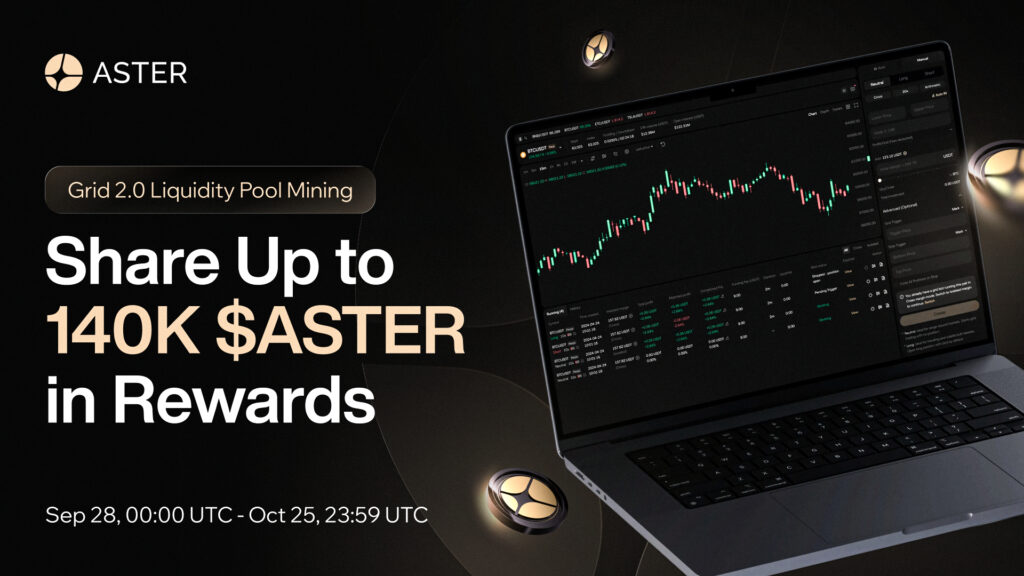
Aster, the privacy-first onchain trading platform backed by YZi Labs, today announced the launch of its Liquidity Pool Mining campaign, a four-week incentive campaign featuring a total reward pool of up to 140,000 $ASTER and running from September 28 to October 25, 2026 (UTC). To celebrate the launch of Perpetual Grid 2.0, the program is open to all Aster users running Perpetual Grid strategies on eligible trading pairs.
Rewards will be distributed hourly based on each eligible Grid’s share of trading volume. The base reward pool is set at 10,000 $ASTER per epoch, with additional rewards available based on market conditions and trading activity on the platform. Participation is automatic, with no registration required.
“As Aster continues to bring more emerging assets and opportunities onchain, we’re also focused on building the tools traders need to navigate increasingly dynamic markets. Perpetual Grid offers a flexible way to capture opportunities amid market volatility, and Grid 2.0 takes this experience further with greater flexibility and independence. This upgrade is another step toward our broader vision of building the frontier of onchain trading,” said Leonard, CEO at Aster.
Incentivizing Automated Perpetual Trading
The campaign builds on Aster’s expanded Perpetual Grid infrastructure, giving users a new way to participate in automated trading while earning additional $ASTER rewards from eligible Grid activity. Both Maker and Taker volume count toward the campaign, while manual trading and activity outside the Grid strategy are excluded.
An Estimated Bonus APY is also displayed to provide an indication of potential annualized $ASTER rewards based on recent campaign activity. The estimate can change as trading volume, participating Grids and other campaign conditions change, and does not guarantee future rewards or returns.
Grid 2.0 Separates Automated and Manual Strategies
Alongside the campaign, the newly upgraded Perpetual Grid 2.0 enables Grid strategies to operate independently from users’ regular Perpetual trading. Each Grid runs through a dedicated Grid Bot subaccount, keeping its positions and margin separate from the main Perpetual account.
With support for both Cross and Isolated Margin, users can run automated Grid strategies while continuing to trade Perpetuals manually, including on the same trading pair. Isolated Margin supports up to 50 independent Grid strategies per account, with no per-pair limit.
Discover Strategies Through Grid Marketplace
Aster’s Grid Marketplace further simplifies strategy discovery by allowing users to browse active Grid strategies and review metrics such as PnL, ROI, runtime, price range, leverage and trading activity.
Users can use an existing strategy as a starting point through Copy, or switch its direction through Reverse, turning a Long strategy into Short or vice versa. Copied or reversed strategies remain independent from their source and do not automatically synchronize with the original Grid.
The Liquidity Pool Mining campaign is available on designated eligible trading pairs, with the Week 1 eligible pairs including OURA/USD1, POLYMARKET/USD1, and META/USD1. The reward pool is shared across participating pairs. Individual rewards are determined by each Grid’s eligible trading volume relative to the total eligible volume generated during the relevant hourly period.
More eligible trading pairs may be added in subsequent weeks to reflect the latest market trends. For more information about the campaign, eligible trading pairs and current campaign parameters, please visit the official campaign page.
About Aster
Aster is a privacy-first onchain trading platform backed by YZi Labs, with unique features like Hidden Orders to protect user trading activity. It pioneers the frontier of on-chain trading through perpetual futures, spots, and earn products for top-trending assets, including RWAs, memes, and core crypto markets. It is powered by Aster Chain, a Layer 1 blockchain built to power the future of decentralized finance.
Users can learn more about Aster on the official website or follow Aster on X.
Contact
Marketing Manager
Lola Chen
[email protected]

Miami, Florida, September 24th, 2026, Chainwire
A Metalayer Capital strategy backed by an initial institutional allocation uses GLDY as the long leg of a delta-neutral gold trade, creating a new channel for demand for Streamex’s yield-bearing tokenized gold, with follow-on investments anticipated.
Streamex Corp., a Nasdaq-listed a technology company building the future of the commodity markets through tokenization, has secured a commitment of institutional capital, a test of whether tokenized commodities can draw buyers beyond individual investors.
A leading institutional investor has made an initial $1 million allocation, with follow-on investments anticipated, to a relative-value strategy that uses GLDY, Streamex’s gold-backed token, as its long gold position, according to a person with knowledge of the matter who isn’t authorized to speak on behalf of the company. The strategy is run by Metalayer Capital, a systematic investment manager, through its Aureon Relative Value Fund, the person said. Metalayer Capital was founded by former Two Sigma executives. Metalayer Capital declined to comment.
The strategy pairs GLDY with an offsetting short position in gold-linked perpetual futures, so it is designed to be largely indifferent to whether gold prices rise or fall, the person said. It aims instead to earn the yield GLDY pays, which Streamex targets at 3.5% a year in additional gold generated through a gold-leasing program.
For Streamex, the significance lies in the mechanics: money deployed into the long position goes into GLDY, adding to the assets under management on which the company earns fees.
The initial allocation of $1 million is final, with follow-on investments anticipated, and its significance lies in who is buying: it suggests that tokenized securities such as GLDY are drawing interest not only from accredited individual investors but also from the institutional investor community.
In August, Streamex laid out a list of goals for the following 90 days. “Converting the first institutional allocations into GLDY was at the top of that list,” said Henry McPhie, the company’s co-founder and chief executive. He called the arrangement “a fundamentally different growth channel than selling to one investor at a time.”
Beyond the initial $1 million, the rest of the commitment remain at the purview of the investor, and there is no assurance that any additional amount of GLDY will be bought.
The companies have other ties. Metalayer also acts as a liquidity provider for GLDY on certain trading venues and can mint and redeem the token directly with the issuer, the person said. Streamex doesn’t manage or sponsor the fund and isn’t compensated based on money the fund raises.
GLDY is offered only to eligible investors under exemptions from securities registration, and its holders to date have largely been accredited investors seeking yield. Streamex has made six consecutive monthly distributions on the token, most recently in September, and publishes its gold reserves through a Chainlink proof-of-reserves feed.
Contact
Yaroslav Provada
[email protected]
Tallinn, Estonia, September 21st, 2026, Chainwire
NOWPayments today published new empirical data analyzing six months of enterprise payout activity, offering a comparative performance benchmark across TRON, BNB Smart Chain, Solana, Bitcoin, and Ethereum to help businesses select optimal blockchain rails based on speed, transaction volume, and cost efficiency.
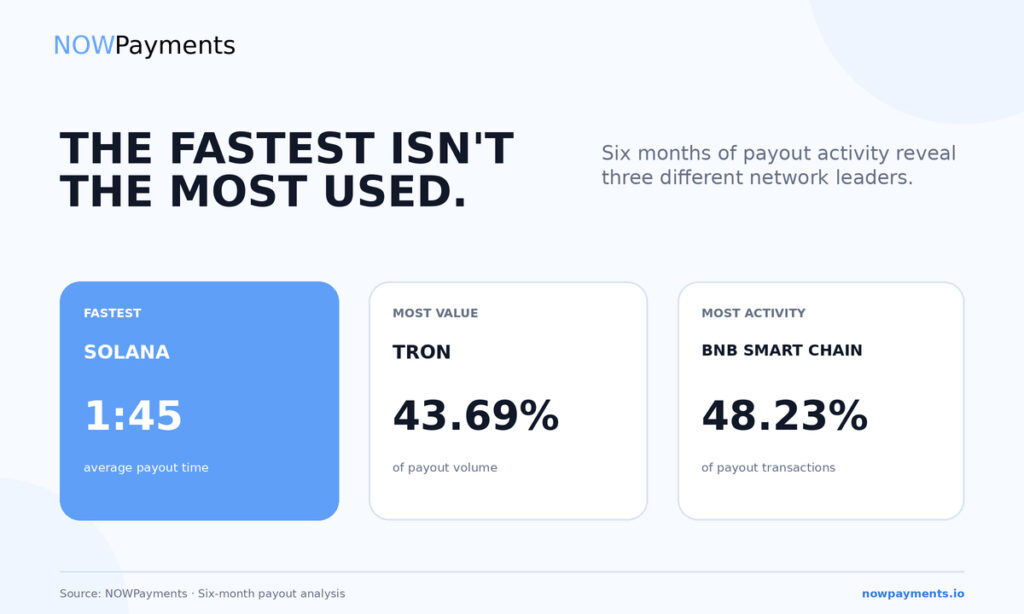
The dataset reveals distinct operational advantages depending on transfer priorities: Solana recorded the fastest average payout speed at 1 minute and 45 seconds while accounting for 3.08% of volume and 3.86% of transactions. TRON led in total monetary volume at 43.69%, and BNB Smart Chain handled the largest share of individual payout transactions at 48.23%.
High-Frequency Payouts Put BNB Smart Chain in the Lead
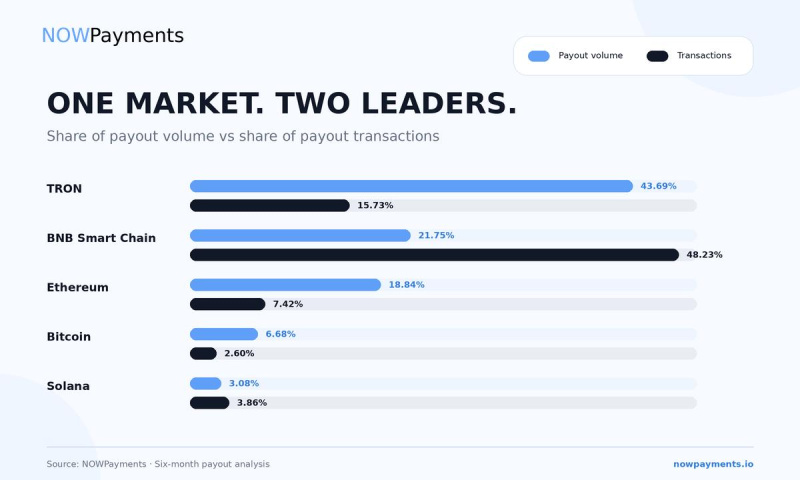
Together, TRON, BNB Smart Chain, Ethereum, Bitcoin, and Solana accounted for 94.04% of payout volume and 77.84% of payout transactions during the period analyzed.
BNB Smart Chain accounted for 48.23% of transactions, compared with 15.73% for TRON. Its share of payout volume was lower at 21.75%.
The network handled far more individual transfers without carrying the largest share of value, a pattern consistent with higher-frequency, lower-value payouts in the NOWPayments dataset.
Higher-Value Payouts Put TRON in the Lead
TRON moved 43.69% of payout volume, more than twice BNB Smart Chain’s 21.75% share, despite accounting for a much smaller share of transactions.
Based on those shares, the average TRON payout was approximately 6.2 times larger than the average BNB Smart Chain payout during the period. The networks served different payout patterns: TRON carried more value, while BNB Smart Chain handled far more individual transfers.
Ethereum ranked third by volume at 18.84% and represented 7.42% of transactions. Bitcoin accounted for 6.68% of volume and 2.60% of transactions, while Solana represented 3.08% of volume and 3.86% of transactions.
The data suggests a practical framework for matching the network to the payout flow:
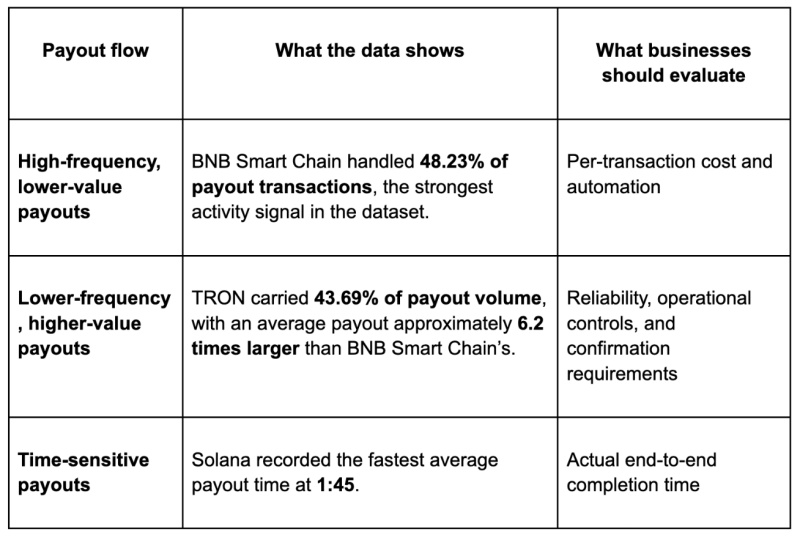 The data offers a starting point, not a universal network recommendation.
When Speed Matters, Solana Leads
Solana led on speed with an average payout time of 1:45. Bitcoin followed at 2:53, ahead of TRON at 3:08 and BNB Smart Chain at 3:13. Ethereum recorded the longest average at 5:56.
The gap between the fastest and slowest networks was 4 minutes and 11 seconds. Every network in the comparison still averaged less than six minutes, while TRON and BNB Smart Chain were separated by only five seconds.
The fastest network was not the most widely used. That points to a broader principle: crypto infrastructure should be evaluated across the full movement of funds, not by a single headline metric.
Kate Lifshits, Commercial Director at NOWPayments, applies the same data-first approach in Crypto That Works for Business, her Cryptopolitan series on the commercial impact of crypto payments. The first column, the 22% Sales Boost Hiding in Your Crypto Checkout, examined checkout performance; future editions will cover other points where payment infrastructure affects revenue, costs, and growth.
“The useful question is not which network tops a leaderboard. It is what a specific payout flow needs to optimize: value, frequency, speed, or cost,” said Kate Lifshits, Commercial Director at NOWPayments.
When Cost Matters, The Best Route May Not Be a Blockchain Network
When minimizing payout costs is the priority, comparing blockchain networks may be the wrong place to start.
NOWPayments allows businesses to send payouts to ChangeNOW Pro wallets with no network or service fees within the ecosystem. Creator Andy Tries Coding publicly tested the route and reported receiving a fee-free payout in under five seconds.
Recipients are identified by email and confirm the transfer before funds move, so businesses do not need to collect wallet addresses at the beginning of the payout process. An interactive guide walks through the process from payout creation to recipient access.
The takeaway is simple: define the payout flow first, then select the network or route. Value, frequency, speed, and cost will not point every business to the same answer.
About NOWPayments
NOWPayments is a crypto business ecosystem designed to help companies accept payments, automate mass payouts, manage stablecoin treasury, and scale global digital asset operations through a single infrastructure. The platform supports more than 350 cryptocurrencies, over 30 stablecoins, flexible settlement options, and enterprise-grade APIs.
Contacts
PR Manager
Angelina T.
NOWPayments
[email protected]
Commercial Director
Kate L.
NOWPayments
[email protected]
Sydney, New South Wales, Australia, September 20th, 2026, Chainwire
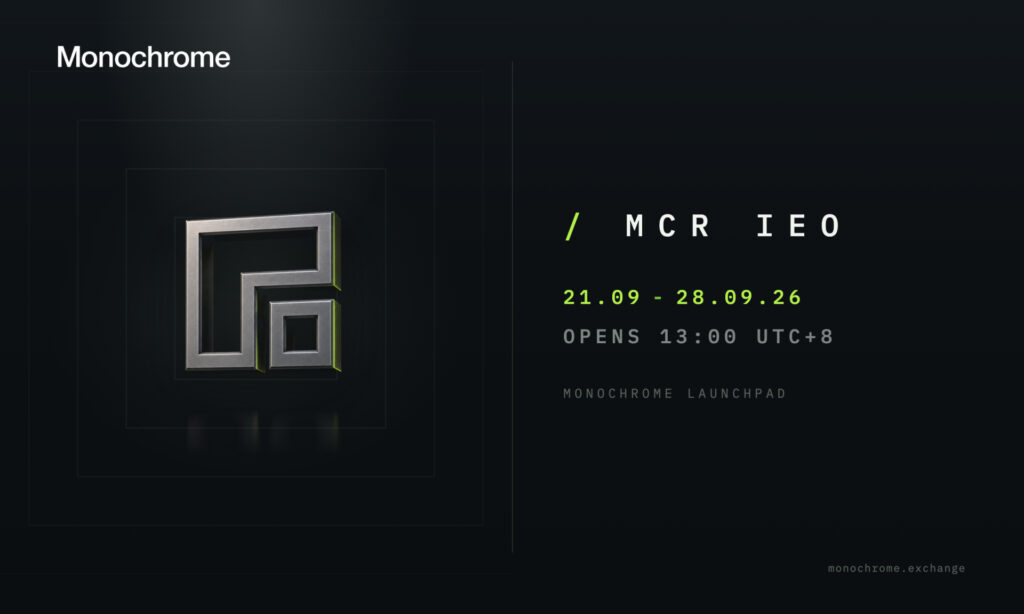
Monochrome Exchange, a multi-asset trading platform, has announced the Initial Exchange Offering (IEO) of its native utility token, MCR. The platform aims to consolidate crypto, equities, bonds, and real-world assets into a single venue where trades settle on-chain. The exchange is currently live, featuring over 260 active markets.
MCR Initial Exchange Offering Details
- Date: September 21, 13:00 UTC+8 to September 28, 13:00 UTC+8
- Location: Monochrome Launchpad (monochrome.exchange/launchpad)
- Token Price: $0.88 per MCR
- Public Sale Supply: 10,500,000 MCR (5% of total supply)
- Vesting Schedule: 1-month cliff from Token Generation Event (TGE), followed by 3-month linear vesting
- Commitment Asset: USDT
- Subscription Limits: No minimum; maximum of $100,000 per account
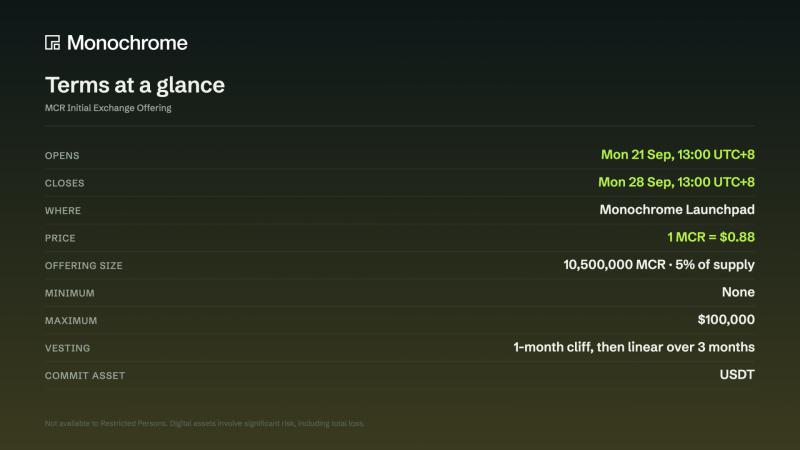 The MCR offering will take place directly on the Monochrome Exchange platform. Users can participate by depositing USDT and committing funds on the offering page during the designated seven-day window. Following the one-month cliff after the TGE, MCR tokens will vest linearly and be credited directly to user accounts.
Live Platform Offerings
Monochrome Exchange currently supports trading across four asset classes from a single account balance:
- Crypto: Spot and perpetual markets.
- Equities: Nearly 150 markets, including tokenized exposure to US and Hong Kong equities (e.g., AAPL, NVDA, TSLA, BYD).
- ETFs and Indices: Over 30 options including SPY, QQQ, and XLE.
- Commodities: Gold, silver, platinum, crude oil, Brent, natural gas, and copper.
- Pre-IPO Markets: Tokenized exposure to private companies, including OpenAI and Anthropic.
Leadership and Backing
Monochrome Exchange was founded by Jeff Yew, former Chief Executive Officer of Binance Australia, where he led local operations for the world’s largest cryptocurrency exchange by trading volume. He subsequently founded Monochrome Asset Management, the investment manager behind the first direct-holdings spot Bitcoin ETF of its kind admitted to trading on Cboe under an ASIC-issued Australian Financial Services Licence.
Yew has over a decade of experience across exchange operations, digital asset licensing and the design of regulated investment products. “Tokenisation has produced a large number of assets that barely trade,” said Jeff Yew. “The harder problem has always been the market underneath them: liquidity, settlement, and compliance that holds up. We listed the markets first and are offering the token second.”
Monochrome Exchange operates as a separate entity from Monochrome Asset Management. Jeff Yew’s professional history does not extend any licence, authorisation or regulatory status of any Monochrome affiliate to Monochrome Exchange or to the MCR token.
How It Works
The offering is conducted entirely within the Monochrome Exchange platform. Participation follows four steps:
- Account. Participants open a Monochrome Exchange account and enable two-factor authentication.
- Deposit. USDT is deposited to the exchange account. Deposits are credited once confirmed on-chain.
- Commitment. Funds are committed on the offering page during the seven-day window, which opens on 21 September at 13:00 UTC+8 and closes on 28 September at 13:00 UTC+8, or earlier if the allocation is filled. There is no minimum subscription and a maximum of $100,000 per account.
- Distribution. MCR is held against the participant’s account from the Token Generation Event. No tokens unlock during the first month. Following the cliff, the allocation vests linearly over three months and is credited automatically as it unlocks.
No external wallet, bridge or on-chain transaction is required at any stage, and no claim transaction is necessary.
MCR Tokenomics and Deflationary Mechanism
The maximum supply of MCR is capped at 210,000,000 tokens. Tokens allocated to the team and advisors are locked for 12 months, followed by a 36-month linear vesting schedule.
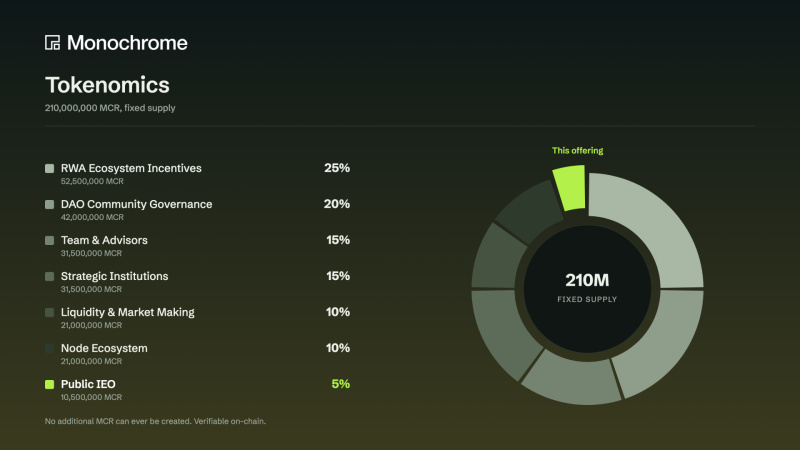 $MCR Tokenomics
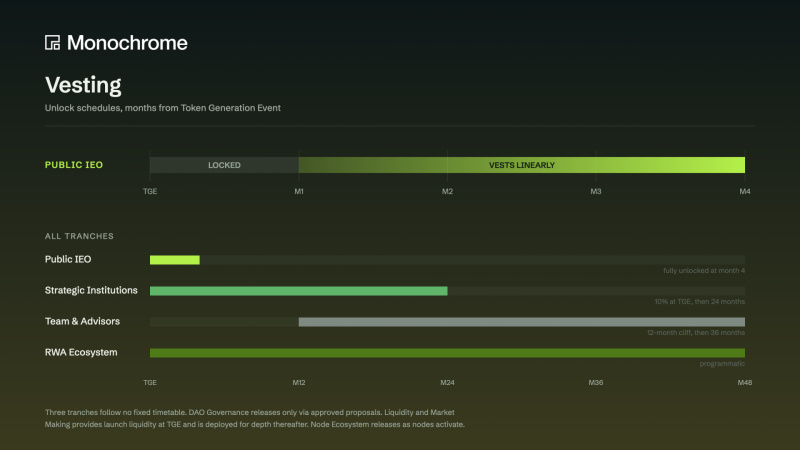 Vesting Schedule
The token incorporates a buy-back and burn mechanism driven by platform activity:
- 20% of net platform profit will be used to buy back MCR from the open market quarterly.
- 25% of all Launchpad and Digital IPO fee revenue will be added to the buy-back allocation.
- Purchased tokens will be sent to a verifiable burn address to reduce the circulating supply.
Token Utility
MCR serves multiple functions within the Monochrome ecosystem:
- Fee Discounts: Holders receive trading fee discounts ranging from 10% to 50%, tiered by holdings.
- Exclusive Access: MCR acts as the access token for Launchpad offerings and upcoming Digital IPOs, with allocations weighted by user balances.
- Staking: Users can stake MCR to earn rewards, increase allocation weight, and qualify for the node program.
- Governance: Holders can participate in voting on platform listings, Launchpad parameters, and treasury deployment.
Digital IPOs and Leadership
Monochrome Exchange is developing a Digital IPO framework designed to streamline the public listing process by moving issuance, subscription, allocation, and settlement on-chain. MCR will be required to participate in these offerings. The platform schedules its first Digital IPO for Q1 2027.
The exchange was founded by Jeff Yew, former CEO of Binance Australia and founder of Monochrome Asset Management. Yew brings a decade of experience in exchange operations and digital asset licensing. Monochrome Exchange operates as a separate entity from Monochrome Asset Management. Jeff Yew’s professional history does not extend any license, authorization, or regulatory status of Monochrome affiliates to Monochrome Exchange or the MCR token.
About Monochrome
Monochrome Exchange is a multi-asset trading venue where crypto, equities, ETFs, commodities and pre-IPO markets trade from a single account and settle on-chain. The platform currently lists more than 260 markets, including tokenised exposure to US and Hong Kong equities, index and sector ETFs, precious metals and energy, and private companies including OpenAI and Anthropic.
Monochrome Exchange was founded by Jeff Yew, former Chief Executive Officer of Binance Australia and founder of Monochrome Asset Management, the investment manager behind the first direct-holdings spot Bitcoin ETF of its kind admitted to trading on Cboe. MCR is the native utility token of the exchange, used for trading fee discounts, allocation in Launchpad offerings and Digital IPOs, staking and governance.
Monochrome Exchange is a separate entity from Monochrome Asset Management and operates independently of it.
Socials
Website: monochrome.exchange
Twitter: x.com/Monochrome_EN
Disclaimer
MCR is a utility token and does not confer ownership, dividends, profit-sharing, or redemption rights. Digital assets carry significant risks, including total loss. Users are advised to review the full documentation, risk factors, tokenomics, and vesting schedules at docs.monochrome.exchange prior to participation.
Contact
Jeff Yew
Monochrome
[email protected]
PANAMA CITY, Panama, September 15th, 2026, Chainwire
BingX today announced its strategic evolution into a multi-asset trading platform and will further its strategy through “Connect Markets. Unlock Opportunities.”, bringing crypto and traditional markets together through an integrated trading experience. The move reflects BingX’s ambition to help traders identify emerging market opportunities, understand the forces shaping them and act across asset classes through a united platform.
Guided by its mission to empower traders to navigate and act on global markets, BingX envisions a world where every market is within reach. The company’s expanded offering reflects this vision, bringing together crypto and traditional markets in one place as the boundaries between asset classes continue to narrow.
As economic developments, market narratives and investment opportunities become increasingly interconnected, monetary policy, macroeconomic conditions and market sentiment can influence both digital and traditional assets. BingX is expanding beyond its crypto-native foundations, combining broader market access with deep liquidity, AI-powered trading tools and market expertise.
The BingX multi-asset platform is built around four strategic pillars:
Trading: Trade Confidently with Multi-Asset Market Access
BingX combines its crypto-native offering, including crypto futures, spot and copy trading, with an expanding range of TradFi products across stocks, forex, indices and commodities. The platform offers one of the industry’s broadest perpetual futures selections across traditional assets, alongside deep order-book liquidity across selected major TradFi futures assets.
Experience: Connecting Market Intelligence with Execution
AI-powered insights, signals and trading tools help traders navigate market developments and identify potential opportunities. TradingView integration provides advanced charting and analysis, while deep liquidity supports execution across key markets. Together, these capabilities give traders a more direct path from market analysis to execution.
Opportunities: Capture What’s Moving Across Markets
BingX brings together market research, industry expertise, educational resources and community engagement to give traders a broader view of developments across crypto and traditional finance. By covering the narratives and forces shaping different markets, BingX aims to make it easier for users to identify areas of interest and explore opportunities beyond a single asset class.
Reliability: Built on Trust
As BingX broadens its market coverage, reliability remains a core foundation of the platform. BingX supports its trading environment with 100% Proof of Reserves and its Shield Fund. These measures reflect the company’s continued focus on security, transparency and operational resilience as it evolves into a multi-asset trading platform.
“Our evolution into multi-asset is a natural progression for BingX as markets become increasingly interconnected,” said Kevin Lee, Chief Strategy Officer at BingX. “Traders today are not necessarily thinking in terms of one asset class. They are looking at the broader market and considering where conditions, narratives and opportunities are developing. Our role is to give them access, infrastructure and perspective to navigate that landscape from one platform.”
About BingX
Founded in 2018, BingX is the world’s leading multi-asset trading platform, serving more than 40 million users worldwide. From crypto to traditional markets, BingX connects users with a broad range of assets and opportunities across global markets through one unified platform.
With perpetual futures, TradFi offerings, spot trading and copy trading, alongside AI-powered innovations, BingX delivers a reliable, intelligent, and responsive trading experience designed to help traders navigate evolving markets and act on opportunities with greater confidence and efficiency.
BingX has been the Principal Partner of Chelsea FC since 2024 and became the Official Team Partner of Scuderia Ferrari HP in 2026.
For media inquiries, users can contact: [email protected]
For more information, users can visit: https://bingx.com/
Contact
BingX Media
BingX
[email protected]