


BlackRock’s head of digital assets, Robbie Mitchnick, has suggested that most major asset managers are not viewing Bitcoin through the lens of day-to-day payments when evaluating its role in portfolios.
In a recent podcast appearance, Mitchnick emphasized that institutions are largely focused on Bitcoin’s store-of-value appeal rather than its potential as a global payment technology.
“I think for us, and most of our clients today, they’re not really underwriting to that global payment network case,” Mitchnick said.
“That’s sort of maybe out-of-the-money-option-value upside,” he added.
The comments highlight a continued divide between the vision of Bitcoin as digital cash and the practical considerations driving institutional adoption today.
Focus Remains on the Digital Gold Narrative
Mitchnick explained that the speculative nature of Bitcoin’s payment utility means investors remain more committed to the asset’s “digital gold” narrative.
He said Bitcoin may still evolve into a widely used payment tool, but that scenario involves more uncertainty than its role as a store of value.
He described the payments thesis as “a little bit more speculative,” adding that institutions prioritize the resilience and long-term investment use case rather than transactional adoption.
Significant Scaling Needed for Bitcoin Payments
According to Mitchnick, substantial technical progress would be required before Bitcoin could realistically compete with traditional payment networks.
“There’s a lot that needs to happen in terms of Bitcoin scaling, Lightning, and otherwise to make that possible,” he said.
The comments echo broader industry concerns around the future of Bitcoin scaling solutions.
Earlier analyses, including an August 2024 report from Galaxy Research, warned that many Bitcoin layer-2 networks — especially “rollups” — may struggle over the long term, despite current enthusiasm around faster and cheaper transaction layers.
Other blockchain networks are being used for a variety of real-world purposes, including sending payments and powering online bingo sites.
Stablecoins Surging Ahead in Payments Sector
While Bitcoin’s payment future remains uncertain, Mitchnick said stablecoins have already demonstrated clear adoption.
He described the sector as “hugely successful,” noting that stablecoins offer “massive product market fit as a payment instrument as a way of moving value around efficiently.”
Mitchnick said stablecoins are poised to grow well beyond their existing uses in trading and decentralized finance.
“Stablecoins have the potential to greatly expand where they are used today, going beyond just the sort of crypto trading ecosystem and DeFi to actually doing retail remittance payments, corporate, multinational, cross-border transactions, and capital market settlement activity,” he said.
He added that while Bitcoin could compete in certain payment categories — such as retail remittances — institutional investors still view that scenario as uncertain.
“At some point it is possible, but it’s a more speculative thing to underwrite at this point,” he said.
Stablecoin Momentum Influencing Long-Term Bitcoin Forecasts
The rapid growth of stablecoins has already influenced how analysts model Bitcoin’s long-term value.
ARK Invest CEO Cathie Wood recently said that the sector’s accelerating expansion forced her to revise her earlier projections for Bitcoin’s 2030 valuation.
“Stablecoins are usurping part of the role that we thought that Bitcoin would play,” she said.
Wood previously expected Bitcoin to hit $1.5 million by the end of the decade, but now believes reducing that estimate by roughly $300,000 may be justified given stablecoin adoption.
“I think emerging markets are huge in this regard and we’re starting to see institutions in the United States focused on new payment rails,” she said.
Industry Leaders Expect Full Transition to On-Chain Money
The trend toward stablecoin-based payment systems appears to have strong support among industry builders.
Tether co-founder Reeve Collins told Cointelegraph in September that he expects “all currency” to transition into stablecoin form by 2030, reflecting a broader shift toward on-chain financial infrastructure.
That outlook contrasts with the more cautious stance on Bitcoin’s payment potential, underscoring how digital assets may take on distinct roles within future financial systems.

Pump.fun co-founder Sapijiju has pushed back strongly against accusations that the Solana-based project cashed out more than $436 million in stablecoins, calling the claims “complete misinformation.”
The allegations originated from blockchain analytics firm Lookonchain, whose report suggested the project may have moved large sums of USDC to exchange wallets.
Sapijiju denied the interpretation in an X post, clarifying that none of the transferred stablecoins had been sold.
He said the USDC came from the PUMP token’s initial coin offering and that the movement reflected an internal treasury process rather than a liquidation event.
“What’s happening is a part of Pump’s treasury management, where USDC from the $PUMP ICO has been transferred into different wallets so the company’s runway can be reinvested into the business,” Sapijiju said.
“Pump has never directly worked with Circle.”
Treasury Processes or Sell-Off? Dispute Intensifies
Treasury management typically refers to how a crypto project organizes capital from revenue, reserves and crowdfunding.
How these funds are moved, stored and allocated can vary widely, and transfers do not always indicate selling pressure.
The Pump.fun founder argued that the redistributed funds were part of routine internal planning.
However, Lookonchain’s report carried considerable weight in the crypto community.
The firm claimed that since mid-October, wallets linked to Pump.fun had transferred $436 million in USDC to Kraken, sparking speculation of a major cash-out.
The timing raised additional suspicion because the transfers occurred as Pump.fun’s revenue fell sharply.
According to DefiLlama, monthly revenue dropped to $27.3 million in November, the lowest since July.
Mixed Analyst Reactions and Further Data Insights
Despite the controversy, data from DefiLlama, Arkham and Lookonchain showed that Pump.fun-associated wallets still held over $855 million in stablecoins and approximately $211 million in Solana.
Those findings reinforced arguments that the transfers did not represent an exit or wholesale liquidation.
Yet not all analysts were convinced.
Nicolai Sondergaard of Nansen suggested that the transfers could signal preparations for future selling, while EmberCN argued that the funds may have come from institutional private placements rather than market dumps.
Community Divided Over Motives and Transparency
The Pump.fun community expressed sharply divided reactions.
Some users accepted the treasury explanation, while others argued that the statement raised more concerns than it resolved.
X user Voss criticized conflicting elements in the co-founder’s post, writing: “Definitely didn’t just contradict yourself on a post you had 10 hrs to respond to.”
Another user, EthSheepwhale, dismissed the clarification and blamed Pump.fun for “price manipulation via airdrops,” pointing to the token’s continued decline.
PUMP traded at $0.002714, down 32% from its ICO price of $0.004, and nearly 70% below its September peak of $0.0085, according to CoinGecko data.
Others took a more neutral stance.
Some argued the focus should be on transparency regarding reserves rather than internal wallet flows.
User Matty.Sol defended the project’s autonomy, writing, “Nothing wrong even if it’s true. It’s your own revenue tho.”
Another user, Oga NFT, said treasury movements were common after ICOs and that the real question was whether stablecoin reserves properly backed the circulating supply.
Calls for Audits Grow as Industry Scrutinizes the Case
The dispute has sparked renewed calls for third-party audits and real-time reserve disclosures, especially for large projects operating in the memecoin sector.
For now, Pump.fun maintains that its treasury actions have been misinterpreted, while Lookonchain’s analytics continue to influence public perception.
As the debate continues, the controversy highlights the growing tension between transparency expectations and treasury autonomy within the crypto industry.

Bitcoin investor Strategy is facing scrutiny after a steep decline in its share price this year, but long-term data shows the company’s Bitcoin-driven model remains far more resilient than short-term charts suggest.
Google Finance data shows Strategy’s stock has dropped nearly 60% over the past year and more than 40% year-to-date.
The stock was trading near $300 in October but has since fallen to around $170.
Despite Declines, Bitcoin Holdings Still in Profit
Some investors have interpreted the slump as evidence that Strategy’s approach has been “exposed.”
However, BitcoinTreasuries.NET data shows the company acquired its Bitcoin at an average cost of $74,430.
With Bitcoin trading near $86,000, Strategy remains up about 16% on its overall Bitcoin purchases.
The company’s long-term stock performance also paints a different picture.
Over the past five years, Strategy shares have climbed more than 500%.
For comparison, Apple gained 130% over the same period, while Microsoft increased by 120%.
Even over two years, Strategy’s stock rose 226%, outperforming Apple’s 43% and Microsoft’s 25%.
Why Investors Are Shorting Strategy
The recent price decline may have less to do with Bitcoin’s fundamentals and more to do with how institutional investors hedge their crypto exposure.
In a CNBC interview, BitMine chairman Tom Lee said Strategy has become the most convenient vehicle for hedging Bitcoin.
“Someone can use MicroStrategy’s options chain, which is so liquid, to hedge all of their crypto,” he said. “The only convenient way to hedge someone’s long is to short MicroStrategy or buy puts.”
This dynamic has effectively turned Strategy into a pressure valve for the broader crypto market, absorbing volatility, hedges and short positions that may not reflect its underlying business strategy.
Strategy Expands Its Bitcoin Holdings
Despite the turbulent market, Strategy continues building its Bitcoin treasury.
Chairman Michael Saylor reaffirmed his commitment to the company’s approach, writing on X that he “won’t back down.”
On Nov. 17, the company announced the purchase of 8,178 BTC for $835.6 million.
The acquisition — significantly larger than its typical weekly purchases — brought Strategy’s total holdings to 649,870 BTC, valued at nearly $56 billion.
Liquidity Slowdown Adds to Market Pressure
On Nov. 6, crypto market-maker Wintermute attributed recent market weakness to slowing liquidity flows across stablecoins, exchange-traded funds and digital asset treasuries.
The firm said inflows in all three areas had flattened, contributing to widespread price pressure.
Data from DefiLlama shows digital asset treasury inflows fell from almost $11 billion in September to just $2 billion in October — an 80% decline following the liquidation of around $20 billion in crypto positions.
Inflows decreased further in November, reaching about $500 million as of Monday, marking a 75% drop from October.
Despite these conditions, Strategy’s long-term performance continues to outpace major tech benchmarks, underscoring the company’s conviction in Bitcoin even amid near-term turbulence.

Grayscale has described Chainlink as a central force in the next major phase of blockchain adoption, calling the project the “critical connective tissue” that links decentralized systems with established financial infrastructure.
In a recent report, the asset manager said Chainlink’s expanding suite of tools positions it as foundational middleware for tokenization, cross-chain interoperability and applications that rely on real-world data.
The firm argued that Chainlink’s capabilities now stretch far beyond providing oracle feeds.
“A more accurate description of Chainlink today would be modular middleware that lets on-chain applications safely use off-chain data, interact across blockchains, and meet enterprise-grade compliance needs,” Grayscale wrote.
The report added that this broad utility has pushed LINK into the top tier of non-layer-1 crypto assets by market capitalization, excluding stablecoins.
Tokenization Seen as Chainlink’s Biggest Opportunity
Grayscale noted that tokenization remains the clearest area where Chainlink’s value becomes evident.
Most traditional assets are still recorded on centralized ledgers, meaning they must be tokenized and connected to external data before they can operate in a programmable blockchain environment.
“We expect Chainlink to play a central role orchestrating the process of tokenization, and it has announced a variety of partnerships, including with S&P Global and FTSE/Russel, that should help it do so,” the report continued.
The market for tokenized assets has expanded sharply, rising from $5 billion to more than $35.6 billion since early 2023, according to data from RWA.xyz.
Banks, Asset Managers and Chainlink Complete Cross-Chain Settlement Pilot
Chainlink’s technology has already been used in early tokenization pilots involving major institutions.
In June, Chainlink, JPMorgan’s Kinexys network and Ondo Finance carried out a cross-chain delivery-versus-payment settlement between a permissioned payment network and a public blockchain test environment.
The pilot connected JPMorgan’s Kinexys Digital Payments network with Ondo Chain’s testnet for tokenized real-world assets.
Using the Chainlink Runtime Environment as the coordination layer, the test successfully exchanged Ondo’s OUSG tokenized US Treasurys fund for fiat settlement without either asset leaving its native chain.

Bitcoin traders posted noticeably more optimistic commentary on Friday after the likelihood of a US Federal Reserve rate cut in December surged sharply within a 24-hour period.
The CME FedWatch Tool showed the probability of a rate cut rising to 69.40% on Friday, up from 39.10% the previous day.
Some analysts argue the shift could provide the catalyst needed to stabilize Bitcoin’s recent price decline.
Crypto analyst Moritz wrote, “Let’s see if that’s enough to find a bottom here for now,” as Bitcoin traded near $85,071 and remained down roughly 10% over the past week.
Dovish Fed Commentary Sparks Market Reaction
The rise in rate-cut expectations followed comments from New York Federal Reserve president John Williams, who said the central bank could lower rates “in the near term” without jeopardizing inflation progress.
Bloomberg analyst Joe Weisenthal pointed to the remarks as the cause for the surge in futures pricing.
Not everyone is convinced the shift will lead to immediate relief.
Economist Mohamed El-Erian warned that investors should not get “carried away,” but broader sentiment across the crypto market leaned bullish.
Crypto commentator Mister Crypto summarized the mood by noting, “Usually this would be bullish.”
Analysts Highlight a Potentially “Bullish Setup”
Crypto analyst Jesse Eckel described the backdrop as highly favorable, saying, “If you zoom out, the setup is unfathomably bullish.”
Eckel added, “I don’t know why we keep going lower,” arguing that markets appear to be moving from a tightening cycle to an easing one.
Another analyst, Curb, said, “Crypto will explode in a massive rally,” if cuts arrive as many traders now expect.
Rate cuts historically benefit higher-risk assets such as cryptocurrencies by reducing the yield advantage of traditional savings vehicles.
Coinbase Institutional Says Odds Were Previously Mispriced
Coinbase Institutional also weighed in, saying in an X post that markets have been underestimating the probability of a cut.
“While markets are leaning toward ‘no cut’ this time, we believe the odds for a rate cut are actually mispriced,” the firm said.
The post noted that inflation signals and tariff-related economic research support a case for reducing rates sooner than expected.
Despite the boost in sentiment, the broader crypto market continues to show weakness.
The Crypto Fear & Greed Index fell to an “Extreme Fear” score of 14 on Friday, marking one of its lowest readings in recent weeks.

Every trader has asked the same question at some point: “What’s the best option strategy for this stock right now?” Option Samurai’s Analyzer feature gives you a direct, data-driven answer. Instead of running separate scans or manually testing trades, you can define a stock scenario – and the Analyzer will find the optimal strategy automatically.
Whether you’re expecting a rally, a pullback, or range-bound action, this tool compares every supported strategy side by side, calculating expected value, probability of profit, and return using real options data.
Define Your Stock Scenario
Start by entering your ticker, price target, and date, like this:
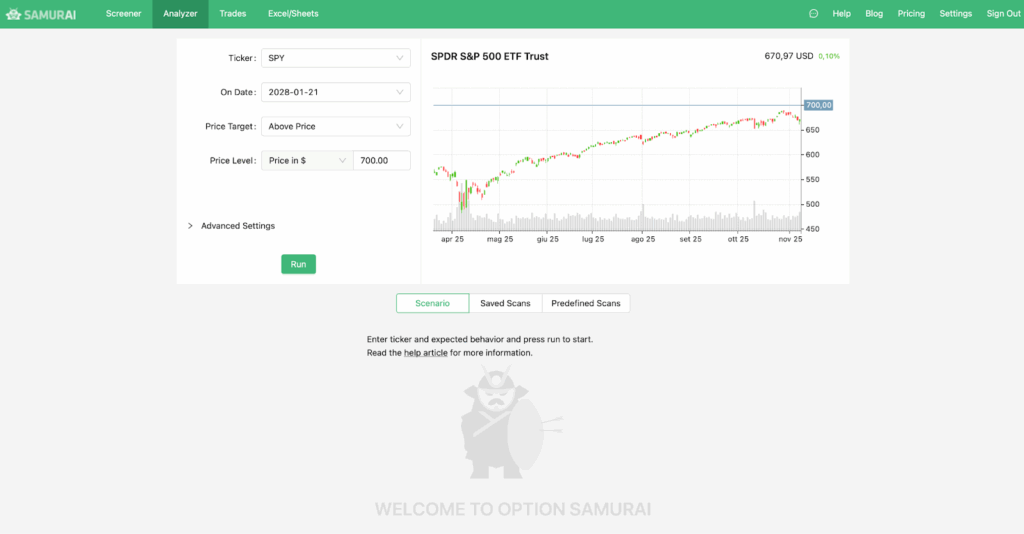
You can choose between directional or range-based targets, such as:
- Above or Below a certain price
- Between two price levels
- Outside a range
As you input your scenario, a chart updates showing recent price action and the target range you’re planning for. This makes it easier to visualize your thesis before running the analysis.
Let the Analyzer Do the Work
Once you define your scenario, Option Samurai uses its next-gen screening options tools to scan all supported strategies – calls, puts, spreads, condors, covered calls, and more – and calculates which one offers the best balance between expected return and probability of profit.
Each strategy appears on its own card, showing:
- Expected P/L and risk (calculated with a Monte Carlo simulation)
- Probability of profit (from the Black–Scholes model)
- Return on risk and breakeven levels
- A P&L chart with your target, breakeven, and expiration lines clearly marked
You can even slide between prioritizing maximum return or maximum probability of profit – letting you tailor results to your own risk profile.
Hover over the chart to compare different trades or even benchmark them against a simple buy & hold position.
Explore Related Scans and Saved Ideas
Below the main results, you’ll find two additional tabs:
- Saved Scans: Lists all the custom scans where your ticker already appears – helpful if you’ve found setups for it before.
- Predefined Scans: Shows all the built-in scans that currently include that stock.
Both are clickable, so you can jump directly from the Analyzer into the screener for deeper filtering or customization.
This feature is especially useful when you’ve analyzed a specific stock and want to see how it also fits across different strategies in your saved workflows.
Bonus: Fine-Tune Advanced Settings
For traders who like precision, the Analyzer includes advanced simulation controls to adapt results to your style:
- Include unbalanced spreads – expands the search to asymmetrical iron condors or butterflies.
- Bid/ask level – switch between mid or conservative pricing.
- Volatility source – use implied, realized, or custom volatility.
- Drift – simulate bullish or bearish directional bias, or link to the risk-free rate automatically.
These settings allow you to test realistic market conditions instead of textbook ones – especially valuable if you trade events or short-term volatility.
Turn Analysis into Action
Once you’ve found your preferred trade, click “Trade” to open it directly in your Trade Log or send it to your connected broker.
You can tweak strikes, expiration, or quantity – and instantly see how the expected value and probability metrics update. It’s the fastest way to go from idea to execution using real data and clearly defined risk.
Final Thoughts: From Scenario to Strategy in One Click
Option Samurai’s Analyzer takes the guesswork out of options strategy selection.
By running Monte Carlo simulations and comparing every possible trade side by side, it helps you find the most efficient strategy for your price outlook – long, short, or neutral.
Instead of asking “Which strategy should I use?” you’ll know exactly which one fits your scenario, risk tolerance, and timeframe.
Start your free trial today (no credit card required) and discover the most effective option strategy for any stock, any outlook, and any market condition – instantly.

Danielle Sassoon, one of the U.S. attorneys involved in prosecuting former FTX CEO Sam Bankman-Fried, testified Thursday in a Manhattan court amid allegations tied to a deal made with ex-FTX executive Ryan Salame.
The hearing, held in the U.S. District Court for the Southern District of New York, centered on whether prosecutors had improperly induced Salame’s guilty plea — and whether Michelle Bond, his then-girlfriend, was promised that she would not be charged.
Sassoon was asked about her role in Salame’s guilty plea, which resulted in a sentence of more than seven years in prison. According to court papers, her team indicated they would “probably not continue to investigate [Salame’s] conduct” if he pleaded guilty.
Bond’s legal team argues that this statement effectively pressured Salame into pleading guilty so that she would avoid prosecution. Bond faces campaign finance charges related to a $400,000 payment allegedly made via FTX funds, which her attorneys describe as part of a “sham consulting agreement.”
During her testimony, Sassoon struck back at the idea that she offered any sort of deal. “I’m not in the business of gotcha or tricking people into pleading guilty,” she declared.
Sassoon also suggested that Salame’s lawyers used the notion of non-prosecution of Bond as a “negotiating tactic,” rather than a genuine promise. She said, “if the lawyers truly believed it was a credible claim, they would have made it directly to me.”
Bond has pleaded not guilty to counts including conspiracy to make unlawful campaign contributions, receiving excessive contributions, and acting as a conduit for funds.
The hearing continues to draw attention because Bond is one of the last remaining defendants connected to the criminal fallout from FTX’s collapse in November 2022.
Salame, for his part, began serving his sentence in October 2024. Other former FTX executives — including Caroline Ellison, Nishad Singh, and Gary Wang — have also pleaded guilty; the latter two received time-served sentences.
Sam Bankman-Freid, meanwhile, remains incarcerated after being convicted and sentenced to 25 years in prison in August 2023.
Bond’s lawyers are seeking dismissal of her charges, arguing that prosecutors improperly leveraged Salame’s plea to bring criminal liability against her.

Tech and crypto markets saw renewed optimism in after-hours trading on Wednesday after Nvidia delivered quarterly results that surpassed expectations, helping to ease concerns that investor enthusiasm for artificial intelligence had grown overheated.
The semiconductor giant reported record revenue of $57 billion for the third quarter ended Oct. 26, a 62% climb year-over-year and significantly above the $54.7 billion expected by analysts.
Nvidia also announced quarterly profit of $31.9 billion, up 65% from last year, with full-year forecasts indicating demand for AI-related products remains robust.
The upbeat report arrived amid a stretch of weakness for tech equities, as investors feared the sector’s rapid AI-driven gains could be unsustainable.
Crypto and Tech Stocks Move Higher After Hours
Shares of Nvidia climbed more than 5% to $196 in post-market trading after closing the session at $186.52.
The positive earnings surprise triggered a broader rebound across crypto-linked companies, with Coinbase, Strategy and Circle Internet Group all seeing modest after-hours increases following declines earlier in the day.
Crypto exchange Bullish also gained about 1% after the bell, reversing a portion of its 3.7% drop despite reporting its strongest quarter since going public.
Major tech stocks including Apple, Microsoft, Alphabet, Amazon and Meta likewise moved higher in extended trading, reflecting improved sentiment across the broader sector.
Bitcoin and Ether Recover from Intraday Lows
The upbeat earnings report provided a lift to Bitcoin, which has suffered more than 10% losses over the past week during a broader market downturn.
Bitcoin dipped to $88,540 late Wednesday, its first time below $89,000 since late April.
The world’s largest cryptocurrency later climbed back toward $91,500 shortly after Nvidia released its earnings, easing some downward pressure.
Ether experienced a similar trajectory, falling to $2,873 — its lowest level since mid-July — before recovering above $3,000.
Analysts say the correlation between crypto assets and tech stocks appears to have strengthened as investors continue to treat both sectors as high-risk plays responsive to macro conditions.
Nvidia’s robust results, they say, may offer short-term relief to markets that have been rattled by concerns over rate policy, slowing growth and potential froth in AI-driven valuations.

Senator Tim Scott, the chair of the Senate Banking Committee, says he expects progress on a major crypto market structure bill as early as next month.
He told Fox Business that he aims to schedule a markup with the goal of sending the legislation to President Donald Trump early next year.
Scott said negotiations with Democrats remain ongoing, but he accused them of delaying action.
“Next month, we believe we can mark up in both committees and get this to the floor of the Senate early next year so that President Trump will sign the legislation making America the crypto capital of the world,” Scott said.
A Push for Regulatory Clarity
Lawmakers have been working to define the regulatory roles of the SEC and CFTC, particularly following the House’s passage of the CLARITY Act earlier this year.
That bill outlined the responsibilities of the two agencies and established rules defining when a token qualifies as a commodity or security.
The Senate has been developing its own version of the proposal, with the Agriculture Committee responsible for commodity oversight and the Banking Committee leading securities-related sections.
Both committees released discussion drafts over the past several months, leaving room for further negotiations before a final version is introduced.
Industry Leaders Call for Action
Supporters of the bill say that clearer federal rules are urgently needed to keep crypto businesses from moving offshore.
Coinbase CEO Brian Armstrong said in a video message that he has been in Washington pushing for the bill, adding that he believes lawmakers are making tangible progress.
“Senate banking is also working nights and weekends to get the next iteration of their text out, so we’ve got a good chance, I think, of a markup for this bill in December, hopefully get it to the president’s desk shortly thereafter,” Armstrong said.
“This would be a big milestone to get crypto unlocked with clear rules in the US, which would benefit all companies,” he said.
What Happens Next
If the Senate passes its version, the two chambers will need to reconcile their respective drafts.
Once a final bill is approved, it would be sent to President Trump for signature.
Republicans currently hold 53 seats in the Senate, compared to 47 for Democrats, meaning bipartisan backing will still be required to reach the 60 votes needed for passage.
The coming weeks will determine whether the long-delayed effort to build a national crypto framework will finally move forward.

Crypto investment products saw their heaviest weekly outflows since February, with $2 billion exiting global exchange-traded products amid falling risk appetite.
CoinShares reported on Monday that crypto ETPs experienced a 71% surge in outflows compared with the prior week, marking the third consecutive week of withdrawals and bringing the three-week total to $3.2 billion.
Monetary Uncertainty and Whale Selling Pressure the Market
James Butterfill, head of research at CoinShares, attributed the outflows to shifting expectations around monetary policy and selling activity from large crypto-native investors.
These factors pushed total assets under management in crypto ETPs down to $191 billion, a notable decline from the October peak of $264 billion.
United States Leads the Outflow Trend
The U.S. accounted for the overwhelming majority of withdrawals, totaling $1.97 billion.
Germany, however, was one of the few markets to see inflows, accumulating $13.2 million, diverging from the broader global pattern.
Outflows Spread Across Multiple Regions
Several other jurisdictions also recorded significant capital flight.
Switzerland saw $39.9 million in outflows, while Sweden lost $21.3 million.
Hong Kong, Australia and Canada posted combined redemptions of $23.9 million.
Bitcoin and Ether ETPs Hit the Hardest
Bitcoin investment products faced nearly $1.4 billion in outflows last week, representing around 2% of total Bitcoin ETP assets.
Ether funds experienced close to $700 million in redemptions, equating to roughly 4% of their total assets.
Smaller Altcoin ETPs Not Spared
Solana ETPs lost $8.3 million, and XRP products saw $15.5 million in outflows, highlighting broad-based weakening across single-asset offerings.
Investors Shift to Diversified and Short-Bias Products
While single-asset funds experienced selling pressure, multi-asset ETPs attracted $69 million in new inflows over the past three weeks.
The trend suggests investors are seeking broader market exposure and lower volatility as macro uncertainty rises.
Short-bitcoin products also gained traction, posting $18.1 million in inflows over the same period, reflecting a modest increase in hedging behavior.