


Binance’s new art competition is set to put one lucky winner’s design front and center on the helmet of Alpine Formula One team’s racing driver, Pierre Gasly, during the Abu Dhabi Grand Prix on November 26, 2023.
Crypto giant Binance has unveiled an exciting helmet design contest, inviting submissions for the artwork that will grace Gasly’s headgear.
The talented creator will have their masterpiece displayed proudly on Gasly’s helmet, a notable figure who secured victory at the 2020 Italian Grand Prix.
Gasly enthusiastically shared his thoughts on the collaboration with Binance, emphasizing the opportunity it offers to connect with the worlds of both Formula One and cryptocurrency in a novel and imaginative manner.
The call for designs is open to everyone, irrespective of whether they are Binance users, welcoming a diverse range of Formula One fans to join in.
The deadline for submitting designs is September 8, and the fortunate victor will be unveiled by September 15.
Emphasizing the significance of artwork that echoes Binance’s values and pioneering spirit while simultaneously resonating with the motorsport community, Gasly asserted that the winning design will serve as a testament to their shared innovation.
READ MORE: Digital Currency Group Reaches Agreement with Genesis Creditors for Potential Recovery
He eagerly anticipates showcasing the triumphant creation at the esteemed Abu Dhabi Grand Prix.
As an extra perk, the chosen designer will receive a personally autographed replica of the helmet from Gasly.
Binance’s strategic partnerships extend beyond the racing track; the exchange has previously aligned with prominent figures such as soccer icon Cristiano Ronaldo and top-tier football clubs to enhance fan engagement.
Despite the intricate regulatory landscape that Binance navigates, the platform continues to forge connections with influential celebrities to maintain its prominence among cryptocurrency investors.
Most recently, on August 21, Binance unveiled a collaboration with music legend The Weeknd for a groundbreaking Web3-powered concert tour, titled “After Hours Til Dawn”.
In an exciting twist, Australian fans will have access to two unique non-fungible tokens (NFTs) — Souvenir NFTs and Tour NFTs — offering fresh avenues to interact with The Weeknd’s music and persona.
In a display of their commitment, Binance pledged a generous $2 million donation to The Weeknd’s XO Humanitarian Fund as part of this unprecedented partnership.
Other Stories:
dYdX Unlocks $14.02 Million in DYDK Tokens for Community and Trader Rewards
Federal Judge Overturns SEC’s Denial of Grayscale’s Bitcoin ETF
Grayscale Bitcoin Trust’s Negative Price ‘Discount’ Expected to Reverse by 2024

The Cambridge Bitcoin Electricity Consumption Index (CBECI), renowned for assessing Bitcoin’s energy usage, has undergone its inaugural methodology update since its inception in 2019.
Launched in July 2019, CBECI aimed to furnish data-backed insights into Bitcoin mining’s energy intensity and environmental consequences.
In an exclusive conversation with Cointelegraph, lead researcher Alexander Neumueller outlined the index’s role in estimating Bitcoin network electricity consumption.
Neumueller emphasized its role in presenting comprehensible data to the general public.
The revamped methodology accentuates recent trends in Bitcoin mining hardware and hash rates. Researchers scrutinized whether CBECI accurately depicted these dynamics.
They concentrated on unraveling the causes behind significant hash rate growth in recent years, attributed to more powerful contemporary mining equipment superseding older counterparts.
The absence of detailed hardware data posed a challenge, limiting CBECI’s precision in assessing hardware variety and prevalence.
To surmount this, researchers devised a simulation that approximates daily hardware distribution, utilizing performance and power data from actual hardware.
The prior methodology presumed that all profitable hardware models released in the last five years contributed equally to the network hash rate.
This inadvertently led to an overrepresentation of aging hardware during lucrative mining periods.
The team recognized the overrepresentation of older equipment and the underrepresentation of newer models.
READ MORE: Digital Currency Group Reaches Agreement with Genesis Creditors for Potential Recovery
This realization spurred the methodology’s alteration.
Neumueller’s team then cross-referenced hash rate increments with US import data on recent Bitcoin mining hardware.
Public sales data from mining hardware manufacturer Canaan supplemented this analysis.
The CBECI encompassed diverse data points and visualizations, encompassing Bitcoin network power demand, a mining map depicting hash rate distribution, and a greenhouse gas emissions index.
These indexes yield three distinct estimates for each sector, providing a range for these metrics.
The broader discussion encompassed varying viewpoints on Bitcoin’s environmental impact.
Critics alleged Bitcoin undermined ecological progress, while proponents contended that the mining industry could aid environmental efforts.
Neumueller highlighted the intricate nature of the field and the dearth of information, enabling selective data interpretation and biases.
In sum, CBECI’s revamped methodology aligns with evolving Bitcoin mining hardware trends, rectifying previous discrepancies.
The index’s comprehensive insights and visuals offer a multifaceted perspective on Bitcoin’s energy consumption and emissions impact.
Other Stories:
Grayscale Bitcoin Trust’s Negative Price ‘Discount’ Expected to Reverse by 2024
Federal Judge Overturns SEC’s Denial of Grayscale’s Bitcoin ETF
dYdX Unlocks $14.02 Million in DYDK Tokens for Community and Trader Rewards
Binance, a prominent cryptocurrency exchange, has released a statement urging its users to transition their holdings of the Binance USD (BUSD) stablecoin into alternative assets, including a newly introduced stablecoin.
This move comes as part of Binance’s strategy to gradually phase out its support for BUSD, with plans to conclude this process by February 2024.
The decision aligns with Paxos’ intention to cease BUSD redemption around the same time.
This statement marks Binance’s first official acknowledgment of the matter, following reports from several users who shared images of a notification on their mobile app detailing the forthcoming discontinuation of BUSD support.
In an effort to facilitate this transition, Binance is actively encouraging users to engage in trading or converting their BUSD balances into First Digital USD (FDUSD), a stablecoin unveiled by the Hong Kong-based trust company First Digital Group in June. Notably, FDUSD made its debut listing on the Binance exchange in late July.
Binance highlights that conversions and trades involving BUSD and FDUSD will be exempt from fees.
READ MORE: Grayscale Bitcoin Trust’s Negative Price ‘Discount’ Expected to Reverse by 2024
As of August 30, Binance has also removed eight BUSD trading pairs.
Additionally, Binance had previously incentivized BUSD use by offering fee-free trading pairs for FDUSD paired with Bitcoin and Ether.
The decision to discontinue BUSD support by Binance appears to be a response to actions taken by regulatory authorities.
Specifically, on February 13, the United States Securities and Exchange Commission (SEC) issued a wells notice alleging that BUSD was an unregistered security.
This notice was directed at Paxos, the entity behind BUSD. Concurrently, the New York Department of Financial Services ordered Paxos to halt the issuance of BUSD.
In conclusion, Binance’s recent statement signifies its intention to phase out support for the Binance USD stablecoin (BUSD) by February 2024, aligning with Paxos’ plans.
The exchange encourages users to transition to the First Digital USD (FDUSD) stablecoin and has taken steps to facilitate this change, including fee-free conversions and trades.
This move appears to be influenced by regulatory developments involving BUSD and Paxos.
Other Stories:
Digital Currency Group Reaches Agreement with Genesis Creditors for Potential Recovery
dYdX Unlocks $14.02 Million in DYDK Tokens for Community and Trader Rewards
Federal Judge Overturns SEC’s Denial of Grayscale’s Bitcoin ETF
New York, US, September 1st, 2023, Chainwire
In a significant stride towards revolutionizing data privacy and verification, zkPass, the innovative privacy-preserving protocol for private data verification, announces that its Pre-alpha Testnet is open for public testing.
A Glimpse into the Future: zkPass Pre-alpha Testnet
The zkPass Pre-alpha Testnet presents a transformative approach to private data verification. Built on the bedrock of Multi-Party Computation (MPC), Zero-Knowledge Proofs (ZKP), and Three-party Transport Layer Security (3P-TLS), zkPass introduces TransGate—a gateway empowering users to selectively and privately validate their data from any HTTPS website. This encompasses diverse data types, including legal identity, financial records, healthcare information, social interactions, work history, education, and skill certifications. zkPass achieves these verifications securely and privately, obviating the necessity to reveal or upload sensitive personal data to third parties.
The Power of Scalability
zkPass can be readily incorporated into multiple application scenarios, including composable decentralized identity passes, DeFi lending protocols based on off-chain credit, privacy-ensured healthcare data marketplaces, and dating apps featuring verifiable zkSBTs, etc. Wherever there is a need for trust and privacy, zkPass can provide a solution.
By employing cryptographic technologies like MPC, ZKP, and others, zkPass enables users to validate their private data through the verification of their HTTPS-based web session—eliminating the need for file uploads or the exposure of sensitive details.
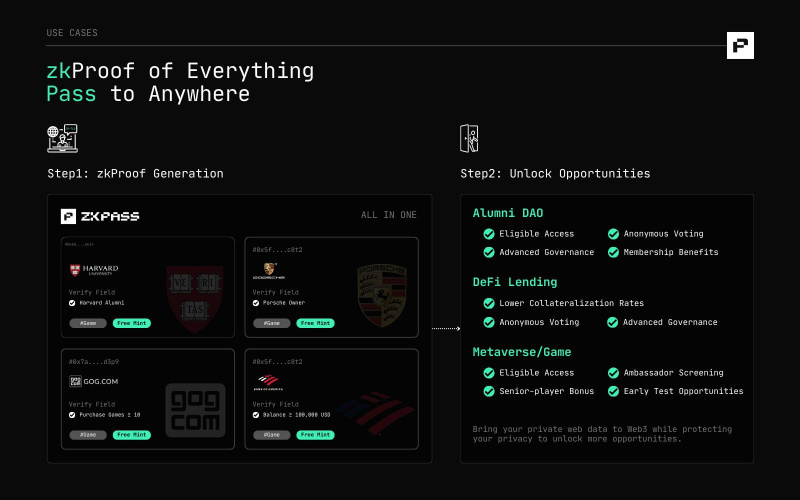
For example, through zkPass, Alice can prove:
- Based on her server response to the Steam/GOG website, she has purchased 10+ games with 100+ hours of gameplay and is not required to disclose any other private information about her account to a third party.
- Based on her server response with the Harvard Alumni website, she has a Bachelor’s degree and is an alumnus of Harvard University, but does not disclose any of her other superfluous personal data.
- Based on her server response with the Porsche website, she owns a Porsche, but does not disclose her frame number, purchase order, or other private data.
- Based on her server response with the bank’s website, she owns assets greater than $100K, but does not disclose any of her specific account assets, transfer records, or other private data.
zkPass can be applied in various scenarios to enhance user experience, trust, and privacy:
- The Metaverse/GameFi program is looking for gaming ambassadors to participate in a test and offer a reward, and they can easily verify that Alice is their target user.
- Alice can seamlessly access the Alumni DAO via her zkPass zkSBT while ensuring privacy and trustworthiness.
- Alice leveraged her RWA ZKPs to establish a reputation for high ratings, which allowed her to access a DeFi lending platform and secure lower mortgage and borrowing rates, ultimately boosting her capital efficiency.
By redesigning the TLS protocol to Three-party TLS, zkPass makes it seamless for any HTTPS-based website to be used as a trusted data source for provenance of zero-knowledge metadata without having to authorize any APIs.
Open Invitation to Shape the Future
zkPass launched its Pre-alpha Testnet in July, receiving an overwhelming response with over 200,000 waitlist signups. Currently, tens of thousands of whitelisted users have already generated more than 100,000 zero-knowledge proofs, each representing their respective private data, identity, or ownership.
User feedback holds immense importance as it helps refine and enhance their solution. The public release of the Pre-alpha Testnet extends a warm invitation to technology enthusiasts, privacy advocates, and individuals who deeply value secure data practices. This invitation aims to shape the future landscape of data privacy alongside zkPass collectively.
Participating in the Pre-alpha Testnet not only grants users early access to an advanced solution but also empowers them to actively contribute towards its improvement. This collaborative effort is a key driver in tailoring zkPass into a privacy-focused protocol that empowers users in an increasingly data-centric world.
How to Get Involved
Getting involved in zkPass’s Pre-alpha Testnet is simple:
- Users can Install the TransGate Extension from Google Chrome Web Store.
- Interested users join pre.zkpass.org to be a part of the Pre-alpha Testnet and experience firsthand the power of private data validation.
More tutorial details can be found on the doc wiki and engage with the zkPass community. Users are invited share their insights, and become an integral part of shaping this groundbreaking technology.
About ZkPass
zkPass is an advanced privacy-preserving protocol for private data verification. It allows users to securely and selectively validate their data from any HTTPS website, making it highly versatile for various applications, including banking and DeFi lending protocols. zkPass is the ideal solution whenever trust and privacy are essential.
Contact
Mason Bennett
[email protected]
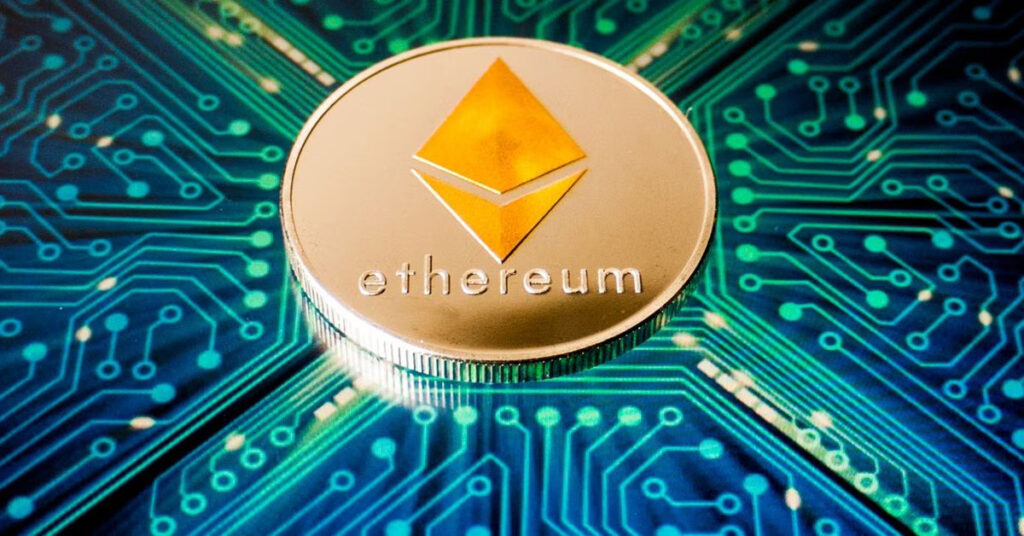
Arkham Intelligence, a crypto analytics platform, has unveiled Robinhood, a financial services firm and crypto trading platform, as a significant holder of Ether (ETH) and the proprietor of the fifth-largest ETH wallet.
This wallet boasts a substantial sum of approximately $2.54 billion in cryptocurrency.
The announcement made on Arkham’s X (formerly Twitter) account highlighted that while the recognition of Robinhood’s possession of the third-largest Bitcoin wallet had garnered notable attention, its identification as the owner of the fifth-largest ETH wallet had received comparatively less recognition.
It is important to note that these funds are designated as user balances under Robinhood’s custody.
As per the data from BitInfoCharts, the most substantial Bitcoin wallets globally belong to Binance and Bitfinex, indicating their significant holdings in the crypto sphere.
Arkham Intelligence’s findings further disclosed that Robinhood’s associated wallet also contains various other cryptocurrencies, including 122,076 BTC (equivalent to $3.3 billion), a staggering 34.1 trillion Shiba Inu tokens (approximated at $277.8 million), 4.9 million Chainlink tokens (approximately $29.7 million), and 2.6 million Avalanche tokens (about $29.6 million).
Despite Robinhood’s prominence in traditional stock trading, its involvement in cryptocurrency trading has experienced a decline.
READ MORE: Digital Currency Group Reaches Agreement with Genesis Creditors for Potential Recovery
In the second quarter, its crypto revenue dwindled to $31 million from the preceding quarter’s $38 million.
Recently, on August 30th, Robinhood disclosed the expansion of its wallet product offerings.
This extension incorporates features such as custodial services, as well as sending and receiving capabilities for Bitcoin and Dogecoin.
This augmentation is a direct response to the growing demand from users for enhanced support, as explicitly stated by the company.
During its initial launch in March, Robinhood Wallet rolled out self-custody services, catering to the Polygon and Ethereum networks.
The wallet also provided a selection of various tokens, including Compound, Polygon, SHIB, Solana, Uniswap, and the USD Coin stablecoin.
In conclusion, Arkham Intelligence’s revelations about Robinhood’s considerable holdings of Ethereum and other cryptocurrencies, coupled with the expansion of Robinhood’s wallet functionalities, signify the company’s continuous efforts to address user needs and diversify its offerings in the dynamic crypto landscape.
Other Stories:
Grayscale Bitcoin Trust’s Negative Price ‘Discount’ Expected to Reverse by 2024
dYdX Unlocks $14.02 Million in DYDK Tokens for Community and Trader Rewards
Federal Judge Overturns SEC’s Denial of Grayscale’s Bitcoin ETF
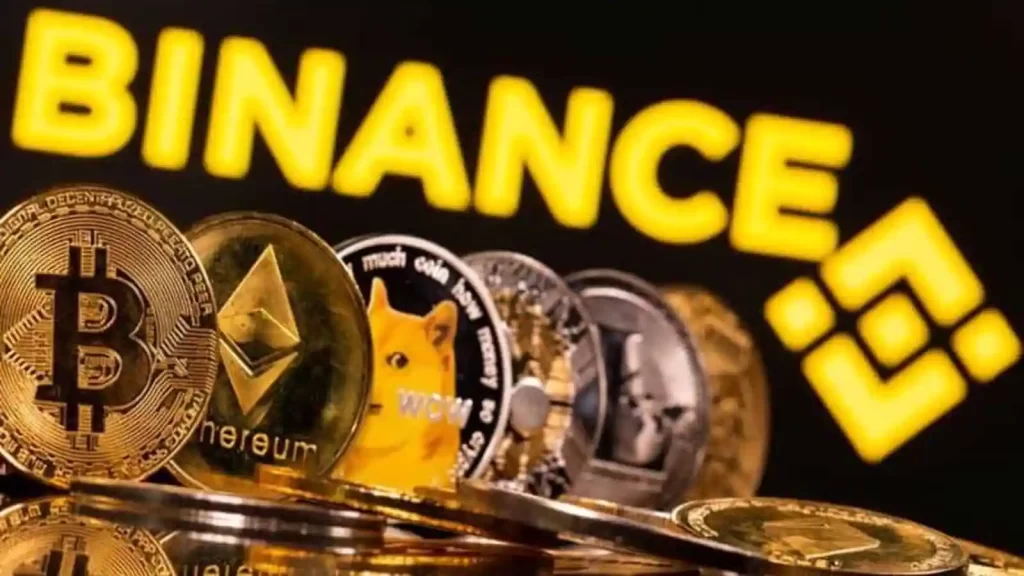
Binance Australia’s General Manager, Ben Rose, expressed his confidence in the eventual decisions of Australian regulators regarding digital asset laws in the country.
Speaking at the Intersekt Fintech conference in Melbourne on August 31, Rose emphasized the government’s commitment to crypto policy development and believed that the right outcomes would be achieved.
This optimism contrasted with recent challenges faced by the crypto industry, including Binance Australia.
Regulatory scrutiny and banking restrictions had impacted the exchange, with payments firm Cuscal severing ties due to perceived scam and fraud risks on May 18.
Consequently, Binance Australia suspended Australian dollar trading pairs and deposits, facing additional hurdles as major banks like Westpac and National Australia Bank restricted transfers to “high-risk exchanges.”
Ben Rose acknowledged these difficulties but stressed Binance’s dedication to restoring banking connections and fiat services for its one million Australian customers.
He engaged in constructive discussions with regulatory bodies like the Treasury and ASIC, indicating positive industry-regulator collaboration.
Rose remained confident that Australia’s pivotal decision-making process, particularly in framing licensing frameworks, would have a significant impact.
He had just participated in a round table with the Treasury and ASIC, witnessing productive engagement between stakeholders.
Similarly, Christian Westerlind Wigstrom, from Monoova, an Australian payments provider, shared insights on the ongoing discussions between crypto exchanges and policymakers.
READ MORE: What’s New in Crypto Staking This Year
Wigstrom acknowledged banks’ concerns about scams and urged nuanced conversations between regulators, banking entities, and crypto industry leaders.
Wigstrom emphasized the need to address scams proactively and collaboratively, rather than resorting to blanket bans on crypto-related fund transfers.
He believed that such an approach would lead to a more effective solution to the persisting issue of scams within and beyond the crypto sector.
In terms of regulatory progress, Australian Treasury Assistant Secretary Trevor Power projected the introduction of crypto-specific legislation for Australian crypto firms in 2024.
This timeline indicates the government’s ongoing commitment to establishing comprehensive regulations for the crypto industry within the country.
Overall, Binance Australia’s Ben Rose and other industry stakeholders expressed confidence in Australia’s regulatory journey, hoping for timely decisions that would both safeguard the industry and foster innovation.
The ongoing dialogue between regulators, financial institutions, and crypto leaders was seen as a positive step toward achieving these goals.
Other Stories:
BlockFi Advances Fund Recovery Efforts with Court Application
South Korean Parliamentary Subcommittee Rejects Expulsion Motion Over Cryptocurrency Controversy
Bitcoin Holds Strong Above $27,000 as Traders Maintain Bullish Outlook

Abu Dhabi, UAE, 30 August, 2023 – Valicit Marketplace, the first decentralized ticketing platform built on the Venom blockchain, is thrilled to announce that more than 230,000 tickets were sold to the Numi Stories Club 404 Grand Opening on Venom testnet. The tickets give players early access to multiplayer functionality in the Numi metaverse’s Numi Stories game.
Despite the massive demand, the Valicit Marketplace enabled users to buy or resell tickets with confidence. Using the power of Venom blockchain, Valicit guarantees that every ticket sold is valid and authentic. Through its blockchain-based API solutions,Valicit ensures the authenticity and security of ticket transactions, preventing frauds, scams, and scalping that’s rampant on traditional online ticketing platforms. Additionally, it provides comprehensive control over the secondary market, facilitating both buying and selling of tickets.
Available on Android and iOS, Numi Stories is the ultimate rhythm action mobile game that lets players chart their own narrative, engage with VTubers, embark on dance battles, and tailor their characters using NFTs from the Numi Club. Numi Stories is reminiscent of popular rhythm games like Dance-Dance-Revolution but with a unique RPG twist.
Numi is the first worldwide metaverse platform built on the Venom blockchain for thought leaders, followers, and innovators. Venom emphasizes scalability, security, and user experience, making it an ideal choice for powering Numi. By utilizing blockchain technology, Numi ensures transparency, traceability, and the ownership of digital assets within the metaverse.
Mohammad Binyamin Chaudhry, the Founder & President of Valicit, stated, “Launching on the Venom testnet has been an exhilarating journey for us at Valicit. The ticket sales we’ve witnessed so far have truly been mind blowing, reaffirming our belief in the power of blockchain. This is just the beginning of our journey and we will continue our efforts to shape the future alongside the Venom blockchain.”
Numi CEO Victor Tumasov said, “Numi was thrilled to be chosen as one of the first projects on Venom to be incorporated into the Valicit ticket platform. For us the ability to sell tickets to events in our metaverse is a very interesting possibility that gives us a lot of potential cool use cases. For the first event we have chosen our PvP mode where Venom users will be able to test their mettle against each other in an amazing dance off in our mobile game.”
To be part of this unique experience:
- Launch Valicit’s portal to purchase your ticket with Venom testnet tokens for the Numi Stories’ PvP battle
- After purchasing the ticket, a link will be provided to stories.numi.net. Choose your platform (iOS or Android) and download the game
- Register your Numi ID, connect Venom Wallet, and complete the in-game tutorial
- Enter PvP battle at Club 404, a prominent location on the in-game map, in Numi Stories
- While in-game leaderboards are under development, daily leaderboards will be posted on Twitter
The PvP battle will end on Tuesday, September 5th at 19:59 UTC. The Top 100 players will be awarded with the exclusive NFT premium RadLad set. All NFTs earned can be accessed both in-game and on club.numi.net.
About Valicit
Valicit is a decentralized application taking on the ticketing industry. Through its blockchain-based API solutions, Valicit ensures the authenticity and security of ticket transactions. The platform gives users and event organizers the ability to verify the legitimacy of tickets using blockchain authentication. Additionally, it provides comprehensive control over the secondary market, facilitating both buying and selling of tickets.
About Venom Foundation:
Venom Foundation, operating as a decentralized network licensed by the Abu Dhabi Global Market (ADGM), is at the forefront of driving the advancement of global Web3 projects. As the world’s first compliant blockchain, Venom provides a secure and reliable blockchain with regulatory oversight by the ADGM, Venom serves as a trusted platform for governments, institutions and enterprises, ensuring compliance with regulatory requirements.
To enhance its capabilities, Venom has developed a range of in-house decentralized applications (dApps) and protocols on its blockchain. With features such as dynamic sharding, low fees, high-speed transactions, and scalability, Venom has the potential to serve as the foundational infrastructure for a thriving global ecosystem of Web3 applications. Its exceptional transaction speeds and limitless scalability enable it to meet the evolving needs of a rapidly growing user base.
For media inquiries, please contact: Muhammad Junaid, Principal, [email protected]
Disclaimer: This release is for informational purposes only and should not be construed as financial promotion.

Staking, the act of locking one token into a smart contract to earn the same or a second token as reward, is one of the industry’s oldest use cases. It sounds so simple, and yet this act has proven the key to securing blockchain networks worth billions of dollars, all through a bond system that incentivizes working for the collective good.
In 2023, staking is more vital than ever thanks to PoS becoming the dominant consensus mechanism across L1 and L2 coupled with the rise of staking derivatives that are unlocking deeper liquidity onchain. With innovation continuing apace, you can be forgiven for having missed some of the key staking developments that have occurred in crypto this year. Here’s what’s new – and what’s still to come in the world of onchain staking.
The Rise of Restaking
One of the most powerful new capabilities to emerge from staking is restaking: the ability to use the same stake to secure multiple protocols. EigenLayer is at the forefront of this trend, pioneering a solution that allows staked ETH to be used to safeguard cryptoe-conomic activity on other chains. One of the year’s most hyped projects, EigenLayer is opening in phases, causing maximum FOMO whenever the ETH staking cap is raised. Aided by airdrop rumors, expect the interest in Eigen to rise to a crescendo in Q4.
To Stake or Not to Stake
If staking is a net good for crypto ecosystems, why is it so controversial with lawmakers? It basically comes down to the rewards that stakers can earn: some financial regulators, the SEC in particular, believe this makes staking tokens potential securities and that exchanges should be barred from offering this service. In the US, exchanges have been forced to wind up their staking programs this year, but all is not lost. Recent court cases, not least Grayscale’s appeals win against the SEC, have given the industry confidence to fight back against regulators. Don’t be surprised if staking becomes de rigueur in the US once more in the near future.
Babylon Sets Out Its Stake
What’s Bitcoin got to do with staking? It is, after all, the primary network to have stubbornly clung to Proof of Work all these years, with no signs of it pulling an ETH and embracing PoS. Be that as it may, Bitcoin may have a future to play in securing Proof of Stake chains according to Babylon. The team behind Babylon network have released a lite paper that details the first ever trustless and self-custodian BTC staking protocol that can be used by PoS chains.
Like the restaking proposed by EigenLayer, Babylon’s litepaper proposes using a non-native asset to secure other chains. This solves problems associated with finding sufficient collateral to secure emerging networks. Led by Babylon founder David Tse and his research team, the paper’s authors propose a cryptographic scheme that harnesses Bitcoin’s scripting language to secure PoS chains.
Ethereum Staking on Demand
US exchanges might have had to rein in their staking programs, but other entities are expanding theirs. Crypto.com has rolled out onchain staking for ETH, SOL, and DOT. Meanwhile, Bitget Wallet has launched its own ETH staking service with gas fee subsidies to reduce costs for users.
Elsewhere, in Dubai, custodial crypto staking is now available after the Virtual Asset Regulatory Authority (VARA) revised its Custody Services Rulebook. Finally, back in the US, the IRS has declared staking rewards as taxable income. While no one relishes paying more tax, the clarity this brings will allow more US citizens to participate in staking in knowledge of their total liabilities.
Bitcoin is maintaining its recent gains, as traders remain optimistic about the bullish trajectory of its price. Despite briefly retreating from the highs above $28,000, the cryptocurrency has not experienced a complete retrace of its recent upward move.
Encouragingly, Bitcoin’s price action on lower timeframes is being supported by a crucial moving average, effectively safeguarding the $27,000 mark.
This trend is highlighted by data from Cointelegraph Markets Pro and TradingView.
Of particular significance is the resilience displayed by BTC/USD in adhering to a long-term trend line that was previously lost as support in August.
This trend line corresponds to the 200-day exponential moving average (EMA), positioned at $27,180.
Although there were instances where hourly candle closures fell below this level toward the end of August, such occurrences failed to initiate a significant breakdown.
Instead, Bitcoin remains closely aligned with the 200-day EMA as the month concludes.
Prominent trader Moustache, known for insights on market trends, noted the positive development, observing that Bitcoin has reclaimed the daily EMA 200-Line.
Expressing confidence in this trend, Moustache dismissed the likelihood of a more favorable entry point occurring in the near future.
This view contrasts with the bearish outlook propagated by various reputable sources, many of whom anticipate a return to levels as low as $25,000.
READ MORE: Digital Currency Group Reaches Agreement with Genesis Creditors for Potential Recovery
However, trader Jelle echoes Moustache’s optimism by underscoring the importance of Bitcoin’s ability to sustain itself above the $27,000 threshold.
Jelle described the current market behavior as conducive to further upward movement, citing a brief spike followed by a shallow retrace and maintenance above a key high-timeframe (HTF) level.
In the midst of the ongoing discussions about Bitcoin’s performance, analyst Rekt Capital advised caution due to prevailing market conditions.
Some previously crucial bull market moving averages are currently acting as resistance, adding an air of uncertainty to the situation.
Further insight from Material Indicators, a monitoring resource, suggests that Bitcoin’s trajectory could complete a full circle.
For a renewed push towards higher local highs, a resurgence of bullish sentiment is deemed essential. The proprietary trading tools of Material Indicators identify $27,760 and $24,750 as pivotal levels to monitor on the upside and downside, respectively.
This assessment underscores the delicate balance between the potential for continued gains and the looming risk of a downward reversal.
Other Stories:
Grayscale Bitcoin Trust’s Negative Price ‘Discount’ Expected to Reverse by 2024
Federal Judge Overturns SEC’s Denial of Grayscale’s Bitcoin ETF
dYdX Unlocks $14.02 Million in DYDK Tokens for Community and Trader Rewards

The parliamentary ethics subcommittee in South Korea has voted against the expulsion of Kim Nam-kuk, a former member of the Democratic Party, the main opposition group.
This decision was reported by the local news agency Yonhap on August 30.
On August 29, the subcommittee dismissed the motion to expel Kim Nam-kuk, with a 3-3 split between the ruling People Power Party (PPP) and the Democratic Party (DP).
The motion required a majority vote to be approved, which did not materialize.
This move comes after Kim faced significant backlash earlier this year due to revelations that he possessed over $4.5 million worth of Wemix (WEMIX) tokens, developed by South Korean blockchain game creator Wemade.
The Wemix tokens had been tradable on major South Korean exchanges until a local court ordered their removal from platforms in late 2022.
Kim’s ownership of Wemix tokens raised serious concerns about potential conflicts of interest, misuse of insider information, and potential involvement in money laundering.
This controversy played a role in expediting the creation of a legal framework mandating that officials disclose their cryptocurrency holdings, including assets like Bitcoin (BTC), in South Korea.
READ MORE: Argo Blockchain Shows Resilience with 50% Reduction in Half-Year Losses
The requirement for cryptocurrency holdings disclosure is not unique to South Korea.
In July, the country’s Financial Services Commission introduced a new bill stipulating that all companies issuing or possessing cryptocurrencies must disclose their holdings starting from 2024.
In another cryptocurrency-related development, the city of Cheongju in South Korea announced in mid-August that it would initiate the seizure of cryptocurrencies from local tax defaulters.
This initiative compels cryptocurrency exchanges such as Upbit and Bithumb to report on these individuals who have failed to meet their tax obligations.
In conclusion, South Korea’s parliamentary ethics subcommittee’s rejection of the motion to expel Kim Nam-kuk, despite concerns surrounding his cryptocurrency holdings, reflects the ongoing debate and regulatory efforts in the country regarding the transparency and accountability of cryptocurrency-related activities.
This decision aligns with broader initiatives to enhance disclosure and monitoring of cryptocurrency assets within South Korea’s regulatory framework.
Other Stories:
Europe Welcomes First-Ever Bitcoin ETF
Shibarium Surpasses 100,000 Wallets in 24 Hours Post-Relaunch
Anticipation Grows as Bitcoin Halving Nears, Experts Predict Surge Beyond $100,000