


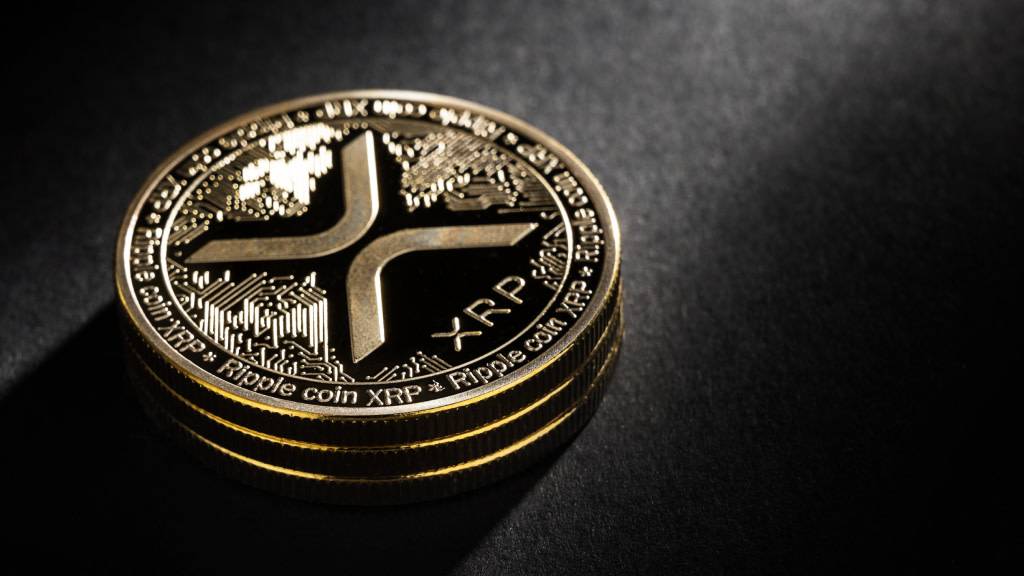
XRP managed to stay above a critical support range that has been stabilizing its price through most of 2025.
Market participants are watching closely to see if holding this level, combined with falling exchange balances, could spark a broader recovery in 2026.
Exchange Holdings at Multi-Year Low
Data from Glassnode reveals that the amount of XRP stored on exchanges has fallen dramatically over the past two months.
From October 8 to this week, the total supply on exchanges declined from 3.76 billion tokens to roughly 1.6 billion.
These levels have not been observed since August 2018, highlighting a significant shift in holder behavior.
Traders often view reduced exchange balances as an indication that holders are moving assets into private storage or long-term holdings.
LeviRietveld, a trader and analyst, noted on X:
“$XRP supply tightens with about 1.5 Billion left on exchanges. Bullish, grab yours now!”
The drop coincided with unprecedented net outflows, as 1.4 billion XRP moved off exchanges on October 19 alone.
Institutional Accumulation and Reduced Selling Pressure
Large holders are typically behind such outflows, moving their tokens to cold storage or investment products.
This kind of activity lowers immediate selling pressure and can create conditions for price growth.
A trader known as Skipper observed:
“ETFs are draining $XRP from exchanges, tightening liquidity. XRP is now entering a more structural phase.”
He added that shrinking liquidity is changing how XRP’s price is determined, suggesting stronger potential for a recovery.
Strong Support Around $1.78
XRP’s price recently found support in the $1.60 to $1.84 range, a zone that has consistently held buyers throughout 2025.
According to Glassnode, $1.78 represents a particularly important level where over 1.8 billion tokens were previously acquired.
Should this zone hold, XRP could see renewed momentum and possibly a breakout on the weekly charts targeting higher levels around $3.79.
Analyst VipRoseTr stated:
“A breakout from the downtrend channel signals a possible bullish reversal.”
However, a failure to hold $1.78 could limit upside potential, leaving XRP range-bound until fresh bullish drivers emerge.

Spot Bitcoin exchange-traded funds experienced heavy withdrawals during Christmas week, with investors pulling hundreds of millions of dollars from US-listed products despite relatively stable Bitcoin prices.
Data shows that a combined $782 million flowed out of spot Bitcoin ETFs over the holiday period, marking one of the most pronounced short-term pullbacks since the products launched earlier this year.
The largest single-day outflow occurred on Friday, when ETFs tracking Bitcoin recorded $276 million in net redemptions.
BlackRock’s IBIT led the declines, with nearly $193 million leaving the fund in one session, while Fidelity’s FBTC saw $74 million in outflows.
Grayscale’s GBTC continued its longer-running pattern of smaller but persistent redemptions during the same period.
As a result, total net assets held across US spot Bitcoin ETFs fell to approximately $113.5 billion by the end of the week, down from levels above $120 billion earlier in December.
This decline occurred even as Bitcoin traded near the $87,000 level, showing little immediate price reaction to the ETF withdrawals.
Longest outflow streak since autumn
Friday’s withdrawals extended a negative trend that has now lasted six consecutive trading days, making it the longest stretch of ETF outflows since early autumn.
Across that six-day window, cumulative net outflows exceeded $1.1 billion, highlighting a clear pause in institutional inflows after months of strong demand.
Market participants note that holiday periods often exaggerate flow data due to thinner liquidity and reduced trading desks.
Vincent Liu, chief investment officer at Kronos Research, said the Christmas timing was a key factor behind the recent moves.
“As desks return in early January, institutional flows typically re-engage and normalize,” Liu said.
He added that Bitcoin ETF outflows during late December should not be interpreted as a structural shift in demand.
Expectations turn toward January and beyond
Looking ahead, Liu expects conditions to improve as institutions return from the holidays and capital allocation patterns reset for the new year.
He also pointed to macroeconomic factors that could become supportive for crypto-linked investment products.
“Rates markets are already pricing ~75–100 bps of cuts, pointing to easing momentum. Next, bank-led crypto infrastructure keeps scaling, reducing friction for large allocators,” Liu said.
Despite that optimism, some analysts see the recent data as part of a broader cooling trend.
Glassnode has reported that both Bitcoin and Ether ETFs have entered a sustained phase of net outflows, with the 30-day moving average of flows remaining negative since early November.
Because ETFs are widely viewed as a proxy for institutional sentiment, prolonged withdrawals may signal a period of reduced appetite for crypto exposure as overall market liquidity tightens.

Stani Kulechov, founder and chief executive of Aave Labs, has rejected allegations that he attempted to sway a controversial governance vote by purchasing large amounts of Aave tokens.
The claims emerged after reports that Kulechov had bought approximately $15 million worth of AAVE tokens shortly before a community proposal failed to pass.
“These tokens were not used to vote on the recent proposal, and that was never my intention. This is my life’s work, and I am putting my own capital behind my conviction,” Kulechov said.
Governance Concerns and Community Backlash
Members of the Aave community accused Kulechov of increasing his voting power to favor Aave Labs in a vote involving control of brand assets.
The proposal sought to bring Aave’s intellectual property under the control of the Aave decentralized autonomous organization, which governs the protocol.
More than 55% of participants voted against the proposal, while over 41% abstained and only 3.5% voted in favor.
Even before voting concluded, criticism mounted that the proposal had been rushed and bypassed standard governance processes.
Fees Dispute Sparks Controversy
The debate intensified after a DAO member known as EzR3aL raised concerns about fees generated through a recent integration with decentralized exchange aggregator CoW Swap.
According to the claim, those fees were directed to a wallet controlled by Aave Labs rather than the DAO.
EzR3aL argued that such fees belong to the DAO and should not have been redirected without community approval.
The issue quickly escalated into broader concerns about transparency and alignment between Aave Labs and token holders.
Communication Gaps Acknowledged
Kulechov acknowledged shortcomings in how Aave Labs has communicated its relationship with the DAO.
He said the company has not clearly explained how its products generate value for AAVE token holders.
“In the future, we’ll be more explicit about how products built by Aave Labs create value for the DAO and AAVE token holders,” he added.
Disputed Authorship of Proposal
The proposal was listed under the name of Ernesto Boado, a former chief technical officer at Aave Labs.
Boado later stated that the submission was made without his knowledge or consent.
He said he would not have approved the proposal had he been consulted prior to its publication.
The episode has renewed debate within the Aave ecosystem about governance safeguards and the separation between builders and token holders.

Trust Wallet users lost approximately $7 million in a coordinated exploit that unfolded on Christmas Day, capping off a year marked by growing concerns over wallet security.
The attack targeted desktop users running Trust Wallet’s browser extension version 2.68.
The company confirmed the breach in a public statement and urged users to immediately upgrade to version 2.89.
Attack Planned Weeks in Advance
Blockchain security firms revealed that the exploit had been in preparation since early December.
Yu Xian, co-founder of cybersecurity firm SlowMist, said attackers began laying the groundwork as early as Dec. 8.
“The attacker started preparations at least on [Dec. 8], successfully implanted the backdoor on [Dec. 22], began transferring funds on [Christmas Day], and thus was discovered.”
The malicious code included a backdoor that harvested users’ personal information and transmitted it directly to servers controlled by the attacker.
Binance Founder Pledges User Compensation
Changpeng Zhao, co-founder of Binance, which owns Trust Wallet, addressed the incident publicly.
Zhao said the stolen funds would be fully covered, reassuring affected users amid growing scrutiny.
Trust Wallet claims to serve around 220 million users globally, making the incident one of the more visible wallet security failures of the year.
Wallet Exploits on the Rise
The Trust Wallet incident fits into a broader pattern of increasing personal wallet compromises.
Blockchain analytics firm Chainalysis reported that personal wallet hacks accounted for 37% of the total value stolen in 2025, excluding a major exchange breach earlier in the year.
While $7 million is relatively small compared to some historic exploits, it still underscores persistent vulnerabilities in wallet software.
In February 2024, Axie Infinity co-founder Jeff Zirlin lost $9.7 million worth of Ether in a suspected wallet exploit.
Insider Activity Raises Alarm
Several industry observers raised concerns that the Trust Wallet exploit may have involved insider access.
Onchain investigator ZachXBT estimated that “hundreds” of users were affected by the attack.
Some analysts pointed to the attacker’s ability to submit a malicious version of the browser extension as a red flag.
“This kind of ‘hack’ is not natural. The chances of insider is high,” intergovernmental blockchain adviser Anndy Lian wrote.
Zhao later agreed that the exploit was “most likely” the result of insider involvement.
Familiarity With Source Code Questioned
SlowMist’s Xian noted that the attacker demonstrated deep familiarity with Trust Wallet’s source code.
That knowledge enabled the precise insertion of backdoor functionality without triggering immediate detection.
The incident has intensified calls for stricter internal controls, code audits and extension distribution safeguards across the crypto wallet industry.
Market Context
This incident comes amid the crypto market experiencing a drawdown and retail interest plummeting to bear market lows.
Bitcoin is currently trying to hold the $87,000 support level, but many crypto traders are cautious about the future outlook for the coming months.
Social sentiment surrounding XRP has dropped sharply, falling into what analysts describe as the “fear zone,” a condition that has historically preceded notable price rebounds.
The shift in mood comes as the token continues to trade well below recent highs, despite signs of resilience from institutional investors.
Negative sentiment reaches extreme levels
Market intelligence firm Santiment said social media commentary around XRP has turned unusually pessimistic.
“XRP is seeing far more negative social media commentary than average,” the firm noted, adding that this increases the likelihood of a “strong price rebound.”
Historical data suggests similar sentiment extremes have coincided with rallies.
The last two instances of comparable fear occurred in late November and early December, when XRP went on to rally 22% and 11% respectively over the following days.
“Historically, this setup leads to price rises,” Santiment said.
“When retail has doubts about a coin’s ability to rise, the rise becomes significantly more likely.”
Price action remains under pressure
Despite the potential contrarian signal, XRP has struggled to regain upward momentum.
The token slipped nearly 2% over the past 24 hours, trading below $1.85.
That leaves XRP down almost 50% from its seven-year high of $3.66.
Still, several analysts argue the pullback does not necessarily signal deeper weakness.
“XRP sentiment is ugly again. But the money doesn’t look scared,” said analyst DefiPeniel, pointing to steady inflows into recently launched spot ETFs.
Institutional flows support long-term confidence
According to DefiPeniel, institutional participation paints a very different picture from retail sentiment.
“These investment products have seen a perfect streak of inflows since launch,” he said, noting that assets under management have climbed beyond $1.2 billion.
The contrast between muted price action and sustained capital inflows suggests longer-term confidence remains intact.
“Markets don’t bottom when vibes improve,” DefiPeniel added.
“They bottom when price holds and sentiment breaks.”
Key resistance levels dominate the chart
From a technical perspective, XRP faces several hurdles before a sustained recovery can take shape.
The price must first break above a multi-month descending trendline near $1.92 and hold it as support.
Beyond that, heavy resistance lies between $1.96 and $2.00, an area where investors accumulated roughly $1.5 billion worth of XRP.
A daily close above $2 would open the path toward a move into the $2.10 to $2.50 range.
That zone contains multiple major moving averages, including the 50-day SMA, 50-week EMA and 50-week SMA.
Downtrend risks remain
Not all analysts are convinced a turnaround is imminent.
XRP remains “still in a strong downtrend,” according to trader C3_trading.
The analyst noted repeated rejections between $2.50 and $2.70 and said a decisive breakout is needed to change the broader trend.
“Wait for a breakout above $2.50 for trend shift, otherwise expect continuation lower,” he said.
On the downside, a failure to hold above $1.80 could expose XRP to a retest of $1.75 and potentially the April low near $1.61.
A break below that level would significantly raise the risk of a deeper slide toward $1.25 and even $1.00 in 2026.

Bitcoin’s network hashrate dropped by 4% in the month leading up to December 15, a trend that some analysts view as a potential bullish indicator for the cryptocurrency’s price.
VanEck analysts Matt Sigel and Patrick Bush described the move as a “historically bullish contrarian signal” in a report on Monday.
They noted that when hash rate compression continues over extended periods, positive forward returns for Bitcoin tend to occur more frequently and with higher gains.
Since 2014, Bitcoin has posted positive 90-day forward returns 65% of the time when its 30-day hashrate declined, compared with 54% when the hashrate increased.
Looking further ahead, negative 90-day hashrate growth has been followed by positive 180-day returns 77% of the time, with an average gain of 72%, outperforming periods of hashrate growth, which produced 61% positive returns.
This trend is encouraging for miners, as a potential rise in Bitcoin’s price could increase profitability or allow previously unprofitable miners to resume operations.
Bitcoin is currently trading around $88,400, down nearly 30% from its October 6 all-time high of $126,080.
The breakeven electricity price for mining on a Bitmain S19 XP rig has fallen nearly 36%, from $0.12 per kilowatt-hour in December 2024 to $0.077/kWh by mid-December.
The drop in hashrate, the steepest since April 2024, is believed to be driven by the shutdown of approximately 1.3 gigawatts of mining capacity in China.
Analysts suggest that a portion of this energy could be redirected to meet rising demand in artificial intelligence, potentially reducing Bitcoin’s network power by around 10%.
Despite the decline in some regions, nations continue to support Bitcoin mining.
Up to 13 countries, including Russia, France, Bhutan, Iran, El Salvador, the UAE, Oman, Ethiopia, Argentina, Kenya, and recently Japan, are backing mining operations.
The recent hashrate drop highlights the cyclical nature of the industry, where shifts in capacity and energy usage can create opportunities for investors and miners alike.
As Bitcoin miners navigate changing conditions, industry observers are watching network trends closely for early signals of market movements.

Bitcoin demand growth has slowed sharply since October 2025, raising concerns that the market has entered another bearish phase.
According to analysts at CryptoQuant, the slowdown reflects a broader shift in investor behavior following multiple demand surges earlier in the cycle.
CryptoQuant analysts said Bitcoin demand unfolded in three distinct waves during the current market cycle.
The first wave emerged in January 2024 following the launch of US-listed Bitcoin exchange-traded funds.
The second wave followed the outcome of the 2024 US presidential election.
The third wave was driven by what analysts described as a Bitcoin treasury company bubble.
Demand Growth Falls Below Trend
CryptoQuant warned that demand growth has now dropped below its long-term trend.
“Demand growth has fallen below trend since early October 2025. This indicates that the bulk of this cycle’s incremental demand has already been realized, removing a key pillar of price support.”
The decline has been particularly visible in the final quarter of 2025.
Apparent Bitcoin demand fell during the period, signaling weaker accumulation across the market.
Institutional participation has also shown signs of contraction.
CryptoQuant noted that Bitcoin held in ETFs declined by approximately 24,000 BTC in the fourth quarter of 2025.
This behavior marked a sharp contrast to the aggressive accumulation seen during the same period in 2024.
Derivatives and Technical Signals Turn Bearish
Additional indicators from derivatives markets are reinforcing the bearish narrative.
Funding rates for perpetual futures have dropped to their lowest levels since December 2023.
Lower funding rates suggest reduced appetite for leveraged long positions among traders.
Technical analysis has also deteriorated.
Bitcoin has broken below its 365-day moving average, a level widely viewed as a critical long-term support.
The cryptocurrency continues to trade well under that threshold, which currently sits near $98,172.
CryptoQuant analysts said this breakdown further supports the view that Bitcoin has entered a bear market phase.
Hope for 2026 Amid Persistent Market Fear
Despite the bearish indicators, not all analysts share a pessimistic long-term outlook.
Some continue to forecast stronger Bitcoin prices in 2026, citing potential interest rate cuts and renewed demand.
Lower interest rates are typically seen as favorable for risk assets, including cryptocurrencies.
However, broader sentiment remains subdued.
According to the Crypto Fear and Greed Index, overall market sentiment is firmly in fear territory.
Expectations for near-term monetary easing also remain limited.
Only 22.1% of investors expect the Federal Open Market Committee to cut rates at its January meeting.
Political pressure has added another layer of uncertainty.
US President Donald Trump attempted to pressure Federal Reserve Chair Jerome Powell to lower interest rates during 2025.
Powell’s term is set to expire in May 2026, and potential successors are reportedly being reviewed.
Market participants are watching closely for signs that policy shifts could alter Bitcoin’s trajectory in the years ahead.

Crypto asset manager Bitwise has taken the first step toward launching a new exchange-traded fund tracking the Sui token.
The firm submitted a Form S-1 filing with the US Securities and Exchange Commission on Thursday to offer the “Bitwise Sui ETF.”
The proposed fund is designed to track the spot price of Sui, the native token of the layer 1 blockchain, Sui Network.
Coinbase Custody has been named as the custodian for the potential ETF, although Bitwise has not yet disclosed what the ETF’s ticker will be.
Bitwise recently included Sui in its crypto index fund, signaling growing confidence in the asset.
Despite a surge of crypto ETF filings in 2025, a spot SUI ETF has not yet debuted in the US market.
Canary Capital and 21Shares submitted applications in March and April, with 21Shares’ SEC review deadline coming next month.
Earlier this month, the SEC approved a 2x leveraged SUI ETF from 21Shares and passed general listing standards that make it easier for crypto ETFs to launch.
Launched in mid-2023, SUI currently ranks as the 31st largest cryptocurrency by market capitalization, valued at $4.98 billion.
A publicly traded ETF for SUI would likely boost demand, giving the SUI community increased exposure to institutional investors.
Bitwise Expands Crypto ETF Offerings
Bitwise recently added SUI to its 10 Crypto Index ETF on the New York Stock Exchange.
The firm emphasized that the Sui blockchain is “designed to make digital asset ownership fast, private, secure, and accessible.”
In addition to the potential SUI spot ETF, Bitwise launched a spot XRP ETF this year, supplementing its existing Bitcoin and Ether ETFs.
Bitwise researcher Ryan Rasmussen told the Bankless podcast that the crypto ETF market is poised for rapid growth in 2026.
“From here we are going to accelerate forward at ridiculous speed,” Rasmussen said.
Industry observers anticipate more than 100 new crypto ETF products could hit the market next year.
Bitwise’s move underscores the firm’s ongoing strategy to increase exposure to emerging crypto assets.

The Federal Deposit Insurance Corporation (FDIC) has unveiled a proposal outlining how regulated banks could issue payment stablecoins, marking a key step in implementing the US GENIUS Act.
The 38-page document, posted on the FDIC’s website, details the approval requirements for payment stablecoin issuance by subsidiaries of FDIC-supervised institutions.
The framework is now open for public consultation before moving to the next stage of rule-making, according to Bloomberg.
How the FDIC Plans to Oversee Stablecoins
Under the proposal, banks seeking to issue payment stablecoins must do so through a subsidiary.
The FDIC would assess both the subsidiary and the parent institution against criteria outlined in the GENIUS Act.
These criteria cover the ability to meet stablecoin issuance standards, financial condition, management quality, redemption policies, and other safety and soundness considerations.
Once approved, the FDIC would act as the primary federal regulator for the subsidiary’s stablecoin activities.
The agency, responsible for insuring deposits and supervising banks, has recently expanded its oversight role in digital assets.
This includes re-evaluating the use of reputational risk in supervising banks, a shift that could affect how financial institutions engage with crypto-related businesses.
Washington’s Stablecoin Framework
The GENIUS Act, or Guiding and Establishing National Innovation for US Stablecoins, passed the Senate in June and was signed into law by President Donald Trump in July.
It sets a regulatory framework for payment stablecoins, requiring issuers to maintain one-to-one reserves in US dollars or other approved liquid assets.
President Trump’s signing of the bill was attended by executives from Coinbase, Circle, Robinhood, and Gemini, reflecting strong industry support.
Some participants see the legislation as a way to strengthen US dollar liquidity and expand its global influence via stablecoins, a view shared by US Treasury Secretary Scott Bessent.
The global stablecoin market has now surpassed $300 billion, largely driven by US dollar-pegged tokens.

JPMorgan has taken another major step into blockchain-based finance by unveiling its first tokenized money market fund on a public network.
The new product, called the My OnChain Net Yield Fund, or MONY, is issued through the bank’s $4 trillion asset-management division and is now live on the Ethereum blockchain.
The move signals the growing willingness among major financial institutions to offer regulated investment products in tokenized form and distribute them through decentralized infrastructure.
A Major Expansion of JPMorgan’s Tokenization Strategy
The MONY fund was launched using Kinexys Digital Assets, JPMorgan’s proprietary tokenization platform.
It is being offered as a 506(c) private placement designed specifically for qualified investors who want exposure to U.S. dollar yields through blockchain-settled assets.
Investors can access MONY through Morgan Money, the firm’s institutional trading portal.
John Donohue, head of global liquidity at J.P. Morgan Asset Management, said the initiative underscores how blockchain can enhance product and transaction efficiency.
“With Morgan Money, tokenization can fundamentally change the speed and efficiency of transactions, adding new capabilities to traditional products,” he said.
Tokenized Access and Blockchain-Based Transfers
JPMorgan highlighted that the launch makes it the largest systemically important bank to issue a tokenized money market fund on a public blockchain.
The fund’s design allows investors to receive tokenized representations of their shares directly to blockchain addresses, which the bank says improves transparency and enables peer-to-peer transferability across the ecosystem.
The firm believes tokenization will increasingly allow a broader range of assets to be used as collateral within blockchain networks.
JPMorgan considers MONY a critical milestone in the development of institutional-grade blockchain financial tools.
“This marks a significant step forward in how assets will be traded in the future,” Donohue said.
Morgan Money Integrates On-Chain and Traditional Assets
The Morgan Money platform, launched in 2019, provides investors with a real-time liquidity dashboard and a single access point for operations.
JPMorgan said it is the first institutional liquidity trading portal to integrate both traditional and on-chain assets.
The bank believes this combination will help firms manage liquidity more efficiently while exploring the benefits of blockchain settlement.
Fund Structure and Supported Assets
According to the announcement, MONY invests exclusively in U.S. Treasury securities and repurchase agreements collateralized by Treasurys.
This maintains exposure to traditional low-risk, dollar-denominated instruments while giving clients the option to hold the fund’s tokens on-chain.
The fund supports daily dividend reinvestment.
Investors may also subscribe or redeem using either cash or stablecoins through Morgan Money, although the bank has not yet disclosed which stablecoins will be supported.
JPMorgan Deepens Its Presence in Blockchain Finance
The debut of MONY comes soon after JPMorgan executed the first transaction through its upcoming fund-tokenization system, Kinexys Fund Flow, which is expected to fully roll out in 2026.
The bank is steadily increasing the number of financial operations it performs on blockchain rails.
In a separate announcement last week, it said it issued a U.S. commercial paper for Galaxy Digital on the Solana blockchain, one of the earliest such debt issuances executed on a public chain.
The launch of MONY positions JPMorgan as a leading driver of tokenized financial markets, pushing the sector toward broader adoption of blockchain-based asset structures.