


Less than a month after announcing it was closing entirely, BitMart is now walking that back — partially. The exchange has hired White & Case as restructuring counsel with a roadmap due by September 9, a reversal that follows its July 26 shutdown announcement, which had originally cited market conditions and strategic reasons for closing.
The language shift is the real story here. BitMart is now considering a plan that could combine distributions to creditors with a phased restart of some operations rather than a full wind-down. Notably, the exchange’s own wording explicitly references “distributions to creditors,” a departure from its prior public messaging.
Timeline-wise, nothing about the original shutdown has been cancelled yet. BitMart suspended new registrations and deposits on July 26, put futures accounts into reduce-only mode, and scheduled full discontinuation of spot and futures trading for August 26 — with complete platform shutdown originally set for January 31, 2027. That August 26 trading cutoff still stands even as the restructuring option is explored, meaning the roadmap due September 9 arrives after user-facing trading ends, not before it.
On the advisory side, White & Case will work alongside BitMart’s other advisers to build out the restructuring framework — covering both how individual services could resume and how creditor distributions would be handled — with everything still subject to further legal, financial, operational and regulatory assessment.
Why it matters: this is the classic “orderly wind-down vs. restructuring” fork that mid-tier exchanges hit when liquidity problems surface, and the September 9 date is a disclosure deadline, not a payout date — anyone reading it as “money back by then” is getting ahead of what BitMart has actually committed to.
Ripple has received full authorization as a Crypto Asset Service Provider from Luxembourg’s financial regulator. The approval makes the company fully compliant under the EU’s Markets in Crypto Assets framework.
The CASP license makes Ripple one of a small group of digital asset firms fully authorized under MiCA, which came into full force on July 1. Firms without a license must now stop operating in the region entirely.
The MiCA framework completed its final transition period on July 1. The regime replaces national licensing systems with one framework covering the whole bloc.
Only about 210 of the more than 1,200 companies that used to operate in Europe managed to get licensed in time. The rest are legally required to stop serving EU customers.
Tether didn’t pursue MiCA compliance at all and watched its USDT get pulled from major European exchanges. Ripple now walks into the market as one of the few fully cleared players.
The CASP license builds on Ripple’s existing Electronic Money Institution license, also granted in Luxembourg. Together the two approvals cover both crypto and standard payment rails for European clients.
Ripple joins a growing group of major crypto firms authorized under MiCA, including Kraken, Coinbase, OKX, and Crypto.com. The company now holds more than 75 regulatory licenses worldwide.
Banks, fintechs and corporates can access Ripple’s cryptoasset and stablecoin payments infrastructure through a single integration. That covers collecting, exchanging and paying out funds across all 30 EEA countries.
Ripple’s UK and Europe boss Cassie Craddock said the company is now “fully compliant and ready to scale.” The remark frames the license as an operational milestone rather than a marketing moment.
The announcement barely mentions XRP itself. Most of the release focuses on Ripple’s payments business, with the token appearing mainly in the standard company description.
Ripple Payments has processed over $100 billion in volume across more than 60 markets. That track record gives the firm a tested base heading into a wider European rollout.
Whether this feeds into XRP’s price is a separate question from the compliance win. Most European payment volume through Ripple settles in RLUSD or fiat rather than on the XRP Ledger directly.
Palo Alto, United States, June 25th, 2026, Chainwire
Story rebrands as The DATA Foundation, launches DATA Network with flagship Kled AI integration, registering 1.5 billion user-contributed records on the platform
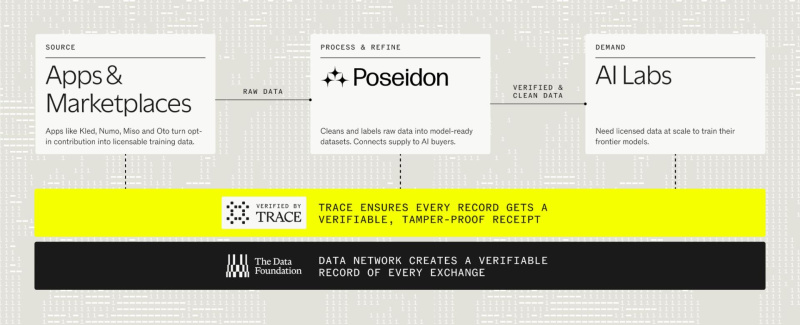
The Foundation also introduces Trace, the first public audit layer for consent, licensing, and data provenance at scale
Today, Story announces a strategic transition to become The DATA Foundation (“DATA”) and launches Trace, an onchain registry for AI training data provenance and licensing. The launch includes a flagship integration with Kled, the world’s largest opt-in human data marketplace, registering 1.5 billion user-contributed records on the Network. Andrea Muttoni becomes CEO of The DATA Foundation, and Kled’s founder, Avi Patel, joins in an advisor position as the Chief Data Officer.
AI’s Training Data Has Hit a Bottleneck
The shift to DATA reflects where the market is pulling hardest. AI training data has emerged as the most valuable and least solved category of IP. Frontier AI labs have hit a multi-billion-dollar data bottleneck, where the internet has been effectively exhausted for scraping. The remaining supply is either expensive and bespoke or legally undocumented, leaving labs without a way to source data at scale, prove its provenance, or guarantee its quality.
The legal stakes are rising, as frontier labs stake out market-defining products on data sourced through opaque networks, often without clear records of consent or jurisdiction. Scraped and undocumented data is no longer an option for enterprise-grade AI.
“The challenge in AI has shifted from compute and architecture to sourcing and provenance. As the scrapable web fractures, the question for labs now is who is keeping the receipts,” said Andrea Muttoni, CEO of The DATA Foundation. “With Kled, we combine full data transparency and auditability with the largest pool of AI training data on the planet.”
Building the Infrastructure for Trusted AI Data
DATA builds on the original mission to deliver a data and intellectual property (IP) layer for the internet, recognizing that the form of data and IP that is most critical in this era is AI training data. DATA Network brings essential infrastructure for training AI, anchored by a flagship integration with Kled. Starting today, Kled’s licensing rails and contributor receipts run on DATA Network with added support for stable coin payouts, which involves registering a staggering 1.5 billion user-contributed records with programmatic legal safeguards.
“Frontier labs have exhausted the supply of high-quality, human-generated public text available on the open web. Suppliers showing data-sourcing provenance will win the next decade of deals, and that’s our bet,” said Avi Patel, CEO and founder of Kled and part-time advisory CDO of The DATA Foundation. “Instead of sourcing data blindly, Kled’s data marketplace and DATA’s auditable chain of custody converge on what labs actually need to license data with confidence and transparency.”
Trace Launches as the Public Audit Layer for AI Training Data
Trace, The DATA Foundation’s public audit and search platform, also launches today alongside the Kled integration. Trace generates immutable, confidential receipts for every contribution, allowing labs to verify the legitimacy of datasets in seconds. For every single record uploaded by users worldwide, a receipt on DATA will be generated, enabling upstream compensation for contributors’ data and intellectual property. This addresses an urgent need for a verifiable and compliant AI training data market, which has become a legal and operational minefield.
A Wider Contributor Network
DATA’s thesis was validated by Poseidon, the AI data processing project incubated by Story, which cleans, normalizes, and scores raw human data for authenticity and quality, ensuring every record that reaches a buyer is model-ready. Poseidon’s early traction with frontier labs proved the AI training data opportunity. Backed by a16z and now running entirely on DATA, its contributor app Numo is live today, bringing thousands of contributors into the AI economy in exchange for real-time payouts.
“We started Story to build an IP layer for the internet, and the most important IP of this era is the data you can’t scrape: how a surgeon’s hands move, how a robot grips, how people speak, drive, and work in the real world,” said SY Lee, CEO of PIP Labs and strategic adviser to The DATA Foundation. “DATA is where that conviction goes next: an end-to-end network that proves real-world data’s origin, licenses it, and pays the people who made it. “
Token Migration and Ecosystem Continuity
The $IP token migrates to $DATA one-to-one with no action required from existing holders. Migration guidance, exchange timing, and an FAQ are available here.
About The DATA Foundation
Data is the biggest bottleneck in frontier AI. The data models need most either sits siloed with people and companies, or doesn’t exist yet, and won’t, until incentives are aligned to create it. DATA Network is the world’s AI audit rails built to answer the three questions every lab asks: can you source data at scale, prove where it came from, and guarantee its quality? Contributor apps including Numo and Kled supply opt-in human data; Trace gives every record a public, tamper-proof receipt; Poseidon turns it into model-ready datasets, so frontier AI can keep advancing on a foundation it can trust. $IP is now $DATA. More information available at datafdn.org.
Contact

Mahe, Seychelles, June 10th, 2026, Chainwire
Whale.io has launched native Prediction Markets for the 2026 World Cup, giving players direct access to match betting backed by a combined $90,000 prize pool – including a $40,000 USDT raffle and five weeks of $10,000 weekly sports tournaments. Whale.io is giving users the chance to turn their football knowledge into real rewards with a seamless, on-platform prediction experience. This launch brings new betting markets on World Cup 2026 matches directly into the Whale.io ecosystem. Whether you’re a casual fan or a seasoned predictor, you can now engage with the biggest football event in a fun, transparent, and potentially profitable way.
$40,000 USDT Raffle – Predict & Win Big
To celebrate the launch, Whale.io is dropping a $40,000 USDT Raffle open to all participants in the World Cup 2026 Prediction Markets. Here’s how it works:
- Place any prediction market bet of $2 or more on a World Cup 2026 market on Whale.io.
- Each qualifying bet automatically grants one ticket in the Raffle.
- Predict more → stack more tickets → increase your chances of winning.
There are no complicated leaderboards to grind and no minimum win requirements. Every single qualifying prediction you make enters you into the draw. The more you play, the better your odds. Every $2 = 1 ticket. It’s that simple: Predict. Compete. Win Big. The raffle gives every participant – from high-volume predictors to occasional players – a fair shot at sharing the $40,000 USDT prize pool.
$50,000 Sports Tournaments – 5 Weeks of Action
On top of the Prediction Markets and raffle, Whale.io is running Sports Tournaments for the next 5 weeks with a total prize pool of $50,000 USDT – that’s $10,000 USD in prizes every single week of World Cup. These weekly tournaments reward the sharpest sports bettors across all major events, giving consistent performers multiple ways to win big during this massive football season. This combined offering – Prediction Markets, the $40K raffle, and $50K in weekly tournaments – delivers one of the most rewarding sports experiences available in crypto right now.
Why Whale.io Prediction Markets Stand Out
All markets run directly on the Whale.io platform – fast, secure, and fully integrated with your existing Whale balance. No bridging, no external sites. Users can easily manage positions, track predictions, and enjoy the thrill of World Cup 2026 as it unfolds. Combined with Whale.io’s signature massive cashback, instant payouts, and strong focus on transparency, this launch reinforces Whale.io’s position as the go-to destination for players who want both entertainment and real earning potential. Whether you’re passionate about football or simply love turning insights into profits, now is the perfect time to join the action. World Cup 2026 Prediction Markets are live now. Head over to whale.io/wc2026, explore the new markets, place your first predictions, and start collecting raffle tickets today. The biggest football event of the year is here – and so are the biggest rewards.
About Whale.io
Whale.io is a crypto-native online casino and sportsbook. The platform features exclusive Whale Originals games, a full sportsbook, Prediction Markets, Daily Cashback, and a strong emphasis on transparency. With $WHALE as its native utility token, Whale.io continues to build one of the most rewarding ecosystems in crypto gaming.
Users can discover the future of Whale.io Casino and Whale Prediction Markets by checking them out here:
More information available on whale.io/wc2026
Whale socials: https://linktr.ee/whalesocials_tg
Contact
Whale Spokesperson
Whale.io
[email protected]
Grand Cayman, Cayman Islands, May 20th, 2026, Chainwire
A new protocol-level feature enables peer-to-peer stablecoin transfers on Sui without requiring users to hold SUI, dropping current stablecoin transfer fees to $0.00.
Sui, where money moves as freely as messages, today announced the launch of gasless stablecoin transfers, a new protocol-level feature that enables users and businesses to send supported stablecoins on Sui without paying gas fees or managing a separate SUI token balance. With the feature now rolling out to validators, stablecoin transfer fees are $0.00 on the Sui network.
With support live from major stablecoins, including USDsui, suiUSDe, AUSD, FDUSD, USDB, USDC, and USDY, the feature is designed to simplify payment workflows and remove one of the largest friction points in stablecoin mass adoption: the requirement to hold a separate token to complete transactions.
Fireblocks, the enterprise platform securing more than $14 trillion in digital asset transactions, has integrated the new solution prior to the rollout as part of Sui’s broader payments ecosystem expansion. In addition, many institutional custodians and retail-facing wallets will support gasless transactions at launch, enabling users to send select stablecoins without holding or spending SUI on transaction fees.
“Stablecoins are becoming a core part of global finance, but the infrastructure around them still creates unnecessary complexity,” said Adeniyi Abiodun, Co-Founder and CPO of Mysten Labs, the original contributor to Sui. “From the start, we’ve said it should not cost individuals fees to move their own money. With gasless stablecoin transfers, we are one step closer in making Sui the global rail for payments, whether they are for businesses, AI agents, and consumers.”
Fireblocks’ support further strengthens the institutional accessibility of Sui’s payments infrastructure by enabling enterprises and financial service providers to securely access and manage stablecoin activity on the network through trusted digital asset infrastructure.
“The future of payments will run on stablecoin rails, but the experience for institutions still needs to catch up,” said Ran Goldi, SVP Payments & Network at Fireblocks. “Sui is making all the right moves, with gasless stablecoin transfers that removes a major point of friction for enterprises building onchain payment flows and customer experiences.”
Gasless stablecoin transfers represent a structural change to how single and batched peer-to-peer transfers of supported stablecoins operate on Sui Mainnet and are not a subsidy, sponsorship program, or temporary promotional initiative. In a competitive market where margins are everything, the launch positions Sui as the default stablecoin infrastructure for businesses looking to cut complexity and overhead costs, traders who are tired of failed transactions or the friction of fees, and AI agents, who will objectively choose the cheapest path of least resistance to execute autonomous payments.
Since August 2025, Sui has surpassed $1 trillion in stablecoin transfer volume, while its stablecoin ecosystem has continued to expand rapidly across institutional, retail, and developer use cases. Sui’s horizontally scalable architecture and object-centric design allow the network to support high-frequency payment activity with predictable performance and low operational overhead, making it well-suited for emerging payment applications, agentic commerce, and enterprise-grade financial systems.
These new protocol mechanisms work by dramatically cutting processing costs, and gasless stablecoin transfers build on that foundation to eliminate gas pre-funding and volatile treasury management entirely. The result is simpler infrastructure for institutions, and an operational and cost model that makes agentic commerce and autonomous systems work. Free transfers mean gas fees never rival or exceed the value of the payment itself, making micropayments viable at any scale.
Recent momentum across the Sui ecosystem underscores rising demand for scalable financial infrastructure and stablecoin-based payments. In 2026 alone, four SUI exchange-traded products from 21Shares, Grayscale, and Canary Capital launched globally, expanding institutional access to the Sui ecosystem. At the same time, marquee stablecoin initiatives, including Bridge-issued Sui Dollar (USDSui) and Ethena-issued eSui Dollar (SuiUSDe), have continued to expand Sui’s growing digital dollar ecosystem and strengthen its position as infrastructure for internet-scale finance.
Gasless stablecoin transfers are now rolling out on Sui Mainnet. To learn more about payments on Sui, visit https://www.sui.io/payments.
Contact: [email protected]
About Sui
Sui, where money moves as freely as messages, is a next-generation Layer 1 blockchain built for scalable finance and global payments. Founded by the core team behind Meta’s stablecoin initiative and powered by an object-centric model, Sui makes assets, permissions, and user data programmable and ownable. Sui’s primitives offer builders everything they need to create high-performance payments and financial applications, including instant agentic payments. Users can learn more at sui.io.
About Fireblocks
Fireblocks is the world’s most trusted digital asset infrastructure company, empowering organizations of all sizes to build, manage and grow their business on the blockchain. With the industry’s most scalable and secure platform, we streamline stablecoin payments, settlement, custody, tokenization, trading, accounting operations, and compliance reporting — enabling everything from institutional finance to consumer-facing digital experiences across the largest ecosystem of banks, payment providers, stablecoin issuers, exchanges and custodians. Thousands of organizations — including Worldpay, BNY, Galaxy, and Revolut — trust Fireblocks to secure more than $14 trillion in digital asset transactions across 150+ blockchains. Users can learn more at fireblocks.com.
Contact
Sui Foundation
[email protected]
London, United Kingdom, May 18th, 2026, Chainwire
Quantography Labs announced the early-access release of Lock.com, a hardware-free crypto wallet built around an isolated, air-gapped security approach.
Lock.com is now available to early access users. The platform separates private key storage from network-connected systems, removing the need for dedicated hardware wallet devices.
Hardware wallets have long been the standard for protecting digital assets. But they come with a trade-off: users must trust the device, the manufacturer, and the supply chain behind it.
Lock.com removes that dependency by separating the signing environment from the broadcasting environment. Private keys remain on a fully offline signer, while transactions are created and broadcast on a connected device. Private keys never touch the internet. The system is designed to work with devices users already own, removing the need for purpose-built hardware.
Lock.com was built out of frustration with how crypto security works today. Too many people are still losing funds in ways that shouldn’t be happening, not because self-custody failed, but because the software environment around the hardware was never built to the same standard. Lock wanted to close that gap structurally
Lock.com is designed to function as an isolated crypto wallet without relying on third-party hardware manufacturers or proprietary device supply chains. The architecture integrates post-quantum cryptographic standards, specifically ML-DSA signatures and ML-KEM key encapsulation alongside the isolated signing model.
The early access phase is focused on gathering user feedback ahead of general availability. Early access enrolment is available at https://www.lock.com/
About Quantography Labs
Quantography Labs is an investment and technology firm focused on secure finance, digital assets, and applied research. The company develops privacy-focused, quantum-ready systems designed to advance the future of digital asset security and infrastructure. Lock.com is its first publicly released product.
Users can learn more about Lock.com’s isolated crypto wallet architecture: https://www.lock.com/
Contact
Neal Taylor
[email protected]
Abu Dhabi, UAE, May 14th, 2026, Chainwire
MSU 2.0 to unveil IP expansion strategy, featuring AI creation tools and a unified on-chain content hub.
MapleStory N marks its first anniversary with major gameplay milestones, sustained ecosystem growth, and new updates to deepen player engagement.
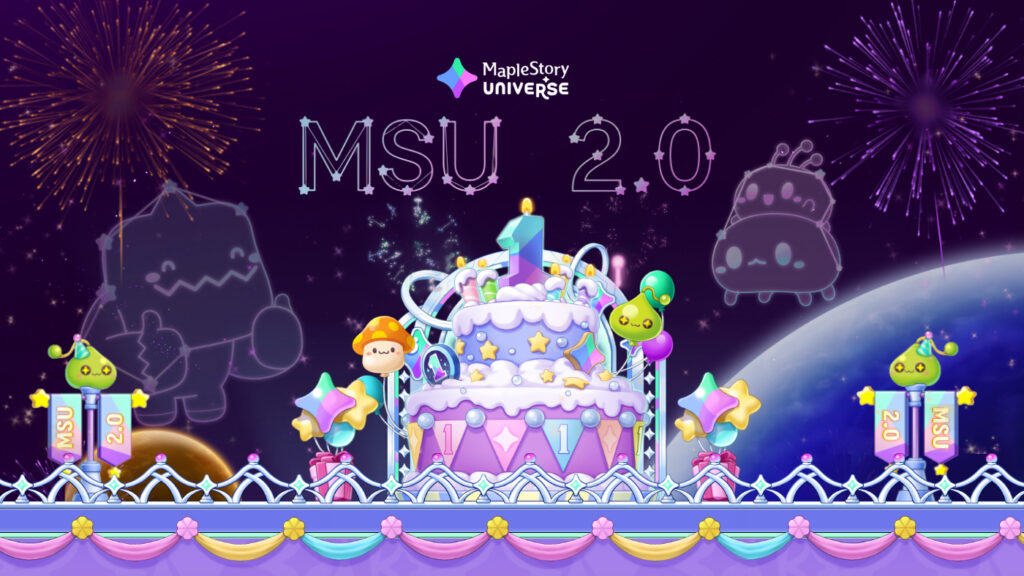
MapleStory Universe (MSU), the blockchain-powered expansion of Nexon’s iconic MapleStory franchise, today marks its first anniversary following the launch of MapleStory N on May 15, 2025. Over the past year, the platform has recorded more than 150 million cumulative on-chain transactions and surpassed 3.82 million accounts registered, reflecting sustained participation from a global player base and continued development of the ecosystem.
One year in, MSU is entering its next phase with the introduction of MSU 2.0, an expansion designed to transform how intellectual property (IP), builders, and players interact in a shared digital environment, supported by AI creation tools and on-chain infrastructure. MSU 2.0 will be implemented throughout 2026 to 2027, as new features will be progressively developed and released for the builders.
A Benchmark Launch That Set a New Standard
MSU launched in May 2025 as one of the largest debuts in the Web3 gaming ecosystem. Built on the MapleStory IP, the pre-launch Scroll NFT campaign recorded approximately 1.7 million scrolls minted, officially confirmed as the largest NFT mint in Avalanche network history. On launch day, MSU-related weekly active addresses on the Avalanche network increased by 549 percent, reflecting strong user interest and anticipation surrounding the title’s release.
Following launch, the marketplace has continued its strong performance, with more than 446,716 buyers and sellers transacting daily on average. To date, MSU has accounted for 23.3% of total activity on the Avalanche network, representing a substantial share of activity across leading chains. MSU’s native NXPC token was also listed on seven major exchanges at launch, including Binance, Bybit, Upbit, and Bithumb.
Sunyoung Hwang, CEO, Nexpace, said: “What began as one of the largest launches in Web3 gaming has developed into a platform built for long-term participation. In the past year, we focused on building the infrastructure and discipline required to support our community over the long term. Ever since then, MSU has evolved beyond a single game into infrastructure for creation, commerce, and participation. That shift defines what it means for an IP to become an economic system and a foundation for the next generation of online worlds.”
Introducing MSU 2.0, the Next Chapter for MapleStory Universe
MSU is now advancing into its next phase through the rollout of MSU 2.0, an expansion designed to turn IPs from friction-heavy, abstract assets into programmable, on-chain commerce. Designed to broaden participation across the ecosystem and support new forms of creation, distribution, and commercialization, MSU 2.0 reflects the continued evolution of MapleStory Universe from a single game environment into a scalable platform.
Hwang added: “MSU 2.0 is the next phase of our growth journey. Our goal is to expand the role of IP from something people experience to something they can actively build with, share, and grow together, akin to an infinite IP playground. From here, our priority is to build the infrastructure that will support a larger and more connected IP ecosystem.”
At the core of MSU 2.0 is VIBE IP, a new tech stack built on two foundational pillars that redefine what it means to build with IP on-chain. The first pillar transforms IP access by providing builders access to gameplay and behavioral data from MapleStory N through dedicated APIs, turning IP from brand assets to living, data-rich foundation to create on in accordance with applicable privacy laws. The second pillar establishes an on-chain builder economy on the Henesys chain, built on an Avalanche L1streamlining IP licensing, revenue settlement, and payments into a single system.
Together, these pillars are supported by blockchain infrastructure and AI-powered creation tools. Blockchain allows seamless licensing, payment and settlement, fully on-chain, while AI-powered “vibe coding” allows anyone’s idea to become a full-scale product, enabling broader participation in building and launching IP-driven content. This foundation positions MSU to onboard additional Nexon IPs over time, building an AI-powered and On-chained IP multiverse, with the VIBE IP tech stack gradually rolling out in phases over the coming months.
MapleStory N One-Year Anniversary Update
MapleStory N, the flagship game by MSU, has delivered a series of milestones over the past year that reflect sustained player engagement across the ecosystem. The year-end winter update generated more than 130,000 user inflows, with approximately three-quarters representing new users. This update also drove in-game spending to its highest level since the immediate post-launch period, with player spending outpacing rewards distributed, reflecting a more active and sustainable in-game economy driven by deeper engagement.
Building on this momentum, MapleStory N is now more accessible to mainstream players. Casual users can engage with the game like any traditional MMORPG, with less blockchain hurdle. Web3 features have been refined to deliver meaningful value while maintaining a seamless gameplay experience, making the platform easier for a broader audience to adopt.
As MapleStory N enters its second year, the development team will roll out waves of in-game updates at an accelerated pace, expanding gameplay and introducing new challenges. This will be supported by a steady cadence of major releases throughout the year, including highly anticipated Black Mage update and other milestone content. MSN will also introduce a new MVP system designed to provide ongoing benefits to dedicated players and keep them motivated to continue playing. Starting with the MVP system, MSN plans to continuously expand the program by introducing more diverse criteria and rewards, ensuring that a wider range of players can be recognized and rewarded over time. For more information, users can visit the official website.
About NEXPACE
NEXPACE, an innovative blockchain company based in Abu Dhabi, pioneers an IP-expansion initiative powered by blockchain technology and NFTs to build a community-driven ecosystem. With a mission to redefine interactive entertainment, NEXPACE creates a vibrant space for exploring, sharing, and engaging with diverse content and gameplay crafted by community members.
At the heart of NEXPACE’s ecosystem are principles of transparency, security, and trust, empowering builders to freely share their ideas and enabling users to enjoy immersive experiences. By fostering a culture of creative expression, NEXPACE envisions a secure, collaborative environment that unites ecosystem participants in a thriving digital community.
Contact
PR Manager
Bee Shin
Wachsman
[email protected]
Dubai, UAE, May 12th, 2026, Chainwire
NEXST, the AI-driven entertainment infrastructure building the next generation of immersive fan engagement, today announced that its native token, $NXT, will begin trading globally on May 12, 2026 across major crypto trading platforms, including OKX Boost, KuCoin, MEXC, and LBank.
The $NXT TGE will mark the launch of the core utility asset powering the NEXST AI Entertainment ecosystem and its on-chain fan economy. By integrating immersive VR experiences featuring Tier-1 artists, Japanese idol IP-based social gaming, and AI-powered social platforms, NEXST is bringing the multi-trillion-dollar entertainment economy on-chain.
$NXT Official Listing Schedule
The $NXT token powers the NEXST AI Entertainment ecosystem — enabling AI-driven fan engagement, immersive experiences, governance, and the tokenization of next-generation entertainment economies.
Trading Begins on May 12, 2026 (UTC)
08:00 UTC OKX Boost
10:00 UTC KuCoin /MEXC /LBank
Token Information
- Ticker: $NXT
- Network: BNB Smart Chain
- Total Supply: 600,000,000 $NXT
- Circulating supply at TGE: Only 1.34% (including liquidity. No VC/investors unlock on TGE)
- Team lock: 12 months
Capturing the Multi-Trillion Dollar Entertainment Industry
The global entertainment and media market is currently valued at approximately $2.8 trillion, fueled largely by the passion of dedicated fanbases. However, the majority of this value has historically been captured by centralized platforms.
NEXST introduces a model that tokenizes collaborations with established K-POP artists and Japanese idol intellectual property across its AI and VR products. This approach is designed to enable fans to participate in the value generated by these collaborations, with transactions recorded on-chain to enhance transparency within the existing ecosystem.
From Fragmented Events to “Fan Continuity”
At the core of NEXST is a concept referred to as “Fan Continuity.”
Traditional fan experiences are transactional and fragmented; a concert ticket or a piece of merchandise is often a one-off purchase and involvement. NEXST redefines this journey by tokenizing every interaction. Powered by an AI-driven infrastructure, actions such as attending a VR concert, engaging with AI personas, or purchasing RWA-backed assets create persistent rights on the blockchain.
These rights persist and evolve over time, unlocking deeper value, exclusive rewards, and unique access. NEXST acts as the bridge between traditional entertainment and Web3, transforming isolated events into a lifecycle of continuous participation and ownership.
A Tangible On-Chain Economy for Entertainment
NEXST distinguishes itself through a suite of products backed by global IP partnerships:
- Immersive VR & Social Gaming: High-fidelity VR experiences with popular K-POP idols and interactive social games featuring Japanese idol IPs.
- AI Social Media & Prediction Markets: A next-generation platform where creators and fans interact through AI-generated content and engage in prediction markets.
- RWA (Real World Asset) Integration: Tokenizing physical assets like artist trading cards to provide fans with verifiable ownership and secondary market liquidity.
The Dawn of a New Global Fandom
The listing of $NXT on OKX Boost, KuCoin, MEXC, and LBank marks a pivotal milestone in scaling the “Fan Continuity” vision. As the infrastructure matures and its presence expands across these premier global exchanges, fans worldwide will finally have the tools to transform their enthusiasm into a measurable, liquid asset, ushering in a new era of the AI-driven creator economy.
About NEXST
NEXST is an AI-driven entertainment infrastructure that tokenizes the full spectrum of fan experiences. By bridging traditional entertainment with Web3 through its proprietary “Fan Continuity” framework, NEXST ensures that fan engagement creates persistent rights and unlocks long-term value, empowering fans to become true stakeholders in the entertainment world.
NEXST Products & Official Channels
Xmersive (VR & RWA platforms) https://xmersive.nexst.inc/
Idol IP Mini Game: https://linktr.ee/dearstgame
Trade: OKX Boost, KuCoin, MEXC, LBank
Official HP: nexst.io
Official X: https://x.com/NEXST_AI
Media contact: [email protected]
Contact
PR Manager
Yumiko Skurr
NEXST
[email protected]
Dubai, U.A.E, May 11th, 2026, Chainwire
MultiBank Group’s crypto arm mb.io, brings African gold on-chain by partnering with Kings Orbis, EON3 Group, and Mavryk.
Institutional gold tokenisation programme to be powered by mb.io RWA, with vaulting in Dubai under LBMA-approved custody, dedicated supply from EON3 Group, and Mavryk as the Layer 1 blockchain and RWA tech infrastructure partner.
mb.io, the crypto arm of MultiBank Group, has confirmed an institutional partnership with Kings Orbis, EON3 Group Ghana Ltd, and Mavryk to develop an institutional-grade tokenisation programme for physically-backed gold sourced from West Africa. The partnership unites four institutional roles in a single architecture: mb.io RWA as the regulated tokenisation marketplace, Kings Orbis as programme coordinator, EON3 Group as the dedicated institutional supply partner, and Mavryk as the Layer 1 blockchain and RWA tech infrastructure partner.
Senior representatives of all four partners attended the World Peace Summit in Kumasi, Ghana on Friday, 24 April 2026, where they participated in discussions held under the Pillars of Peace movement. The visit included a private audience with His Majesty Otumfuo Osei Tutu II, Asantehene King of the Ashanti Kingdom, who has expressed his personal support for the success of this partnership. The meeting underscored the cultural significance of West African gold and the responsible institutional framework the partnership is designed to deliver.
The Ashanti Kingdom, one of West Africa’s most historically significant kingdoms, has been synonymous with gold for centuries. The region was known globally as the “Gold Coast” for its unmatched gold reserves and has produced gold for over 700 years, supplying global trade routes and shaping the cultural and economic identity of modern Ghana. This collaboration brings that legacy on-chain, making Ashanti gold accessible to a global investor base for the first time in a digitally native, fractionally tradeable form.
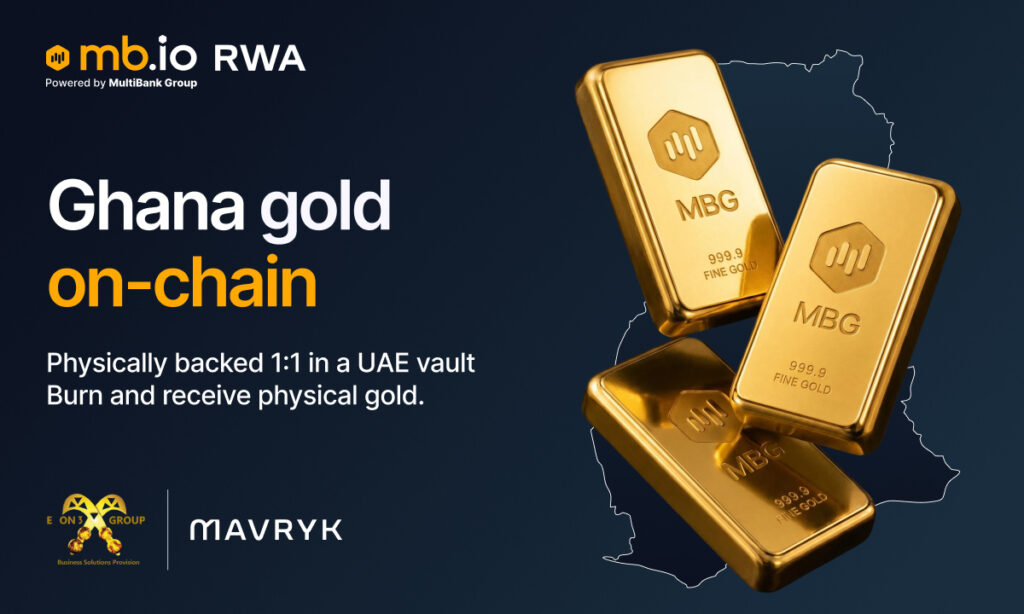
Each token represents direct ownership of the underlying physical gold, vaulted in Dubai under institutional-grade custody. Beyond commodity-grade gold, the partnership will also tokenise a curated collection of Gold Art — physical artworks crafted from and inspired by Ashanti gold — honouring the cultural legacy of His Majesty Otumfuo Osei Tutu II, the Asantehene and a globally recognised advocate for the Pillars of Peace movement.
The programme that mb.io, Kings Orbis, EON3, and Mavryk are developing together is built to change that. It gives international investors access to African gold in a digital, fractional format. Physical backing is independently verified at every stage.
Under the architecture being developed, each token will represent direct institutional ownership of the underlying physical gold, vaulted in Dubai under LBMA-approved institutional custody. Kings Orbis is structuring the programme on a single founding principle: every token in circulation must be backed by an independently verified physical asset, with institutional oversight at every stage of the lifecycle, from sourcing and refining through vaulting, tokenisation, and secondary trading.
The program is delivered through mb.io RWA, MultiBank Group’s digital asset and tokenization arm. mb.io runs a regulated crypto exchange and will be launching a dedicated marketplace for tokenized real-world assets. Self-custodial wallets and on-chain compliance are built into the platform from the ground up.
mb.io is a globally regulated cryptocurrency exchange, placing it among a small group of tokenization platforms with genuine regulatory backing in one of the world’s most active digital asset jurisdictions.
The African gold programme is one of the largest initiatives currently in active development on mb.io RWA, which is being built to support institutional-grade tokenization across multiple asset classes.
The programme is powered by Mavryk, mb.io’s dedicated Layer 1 blockchain and RWA tech infrastructure partner. Mavryk’s purpose-built infrastructure provides the technical foundation for issuing, settling, and trading tokenised physical gold at institutional scale, with the compliance hooks, lifecycle controls, and interoperability that regulated programmes require. Mavryk has been integrated as the dedicated Layer 1 across mb.io’s RWA programme, ensuring a consistent technology stack across asset classes.
Comments from the partners
Zak Taher, CEO of mb.io and Chief Business Officer of MultiBank Group, said: “This partnership represents a defining moment for real-world asset tokenisation. By bringing the heritage and value of Ashanti gold on-chain through mb.io RWA, we are giving global investors access to one of the world’s oldest and most trusted stores of value in a fully digital, fractional, and regulated form. The additional Gold Art collection adds an extraordinary cultural dimension to this initiative, connecting tradition, art, and finance in a way that has never been done before.”
Christian Rainer Arndt, Managing Partner of DEVPRAG FZCO and principal of Kings Orbis FZCO, said: “Kings Orbis has been built on the principle that institutional-grade tokenisation requires institutional-grade architecture, verified supply, regulated custody, and independent oversight at every stage. Our supply partnership with EON3 Group Ghana Ltd anchors the programme in a credible institutional supply chain, and this partnership with mb.io and Mavryk brings the platform, the infrastructure, and the programme coordination into a single institutional framework. We are progressing carefully and look forward to sharing more in due course.”
Richard Ofori Atta, Chairman of EON3 Group Ghana Ltd, said: “EON3 has spent years building the operational foundations to bring African gold to international markets in physical form, particularly through our minting and refining work in producing investment-grade bullion. With this partnership, we now take that work into its next chapter, digitising and tokenising African gold under institutional architecture, in collaboration with Kings Orbis, mb.io, and Mavryk. It is a natural and important evolution that opens new pathways for African gold as a credible, transparent, and globally accessible institutional asset.”
Alex Davis, Co-Founder and CEO of Mavryk, said: “Mavryk was built specifically for real-world assets, with a focus that makes a programme like this possible at institutional scale. Tokenising African gold is precisely the kind of initiative our infrastructure was designed for, and a partnership we are proud to be part of. Together with mb.io, Kings Orbis, and EON3, we are powering this programme as the dedicated Layer 1 and RWA tech partner across every stage of the architecture.”
About mb.io
mb.io is the digital asset and tokenisation arm of MultiBank Group. Built for institutional and retail participants, mb.io operates a regulated cryptocurrency exchange and the dedicated mb.io RWA marketplace for tokenised real-world assets, supported by self-custodial wallet infrastructure, on-chain compliance, and direct integration with MultiBank Group’s wider regulatory and distribution footprint. Operated by MEX Digital FZE and licensed by Dubai’s Virtual Assets Regulatory Authority (VARA), mb.io is positioned as a regulated home for institutional-grade tokenisation programmes, with real-world asset issuance running on Mavryk as the dedicated Layer 1 infrastructure. Users can learn more at mb.io.
About MultiBank Group
MultiBank Group, established in California, USA in 2005, is a global leader in financial derivatives, digital asset trading, and institutional ECN solutions. With over 2 million clients in 100+ countries and a daily trading volume exceeding $35 billion, the Group offers a broad range of brokerage, cryptocurrency, and asset management services, catering to both retail and institutional clients through its ecosystem of platforms, including MEX Exchange and mb.io. Renowned for innovative trading solutions, robust regulatory compliance, and exceptional customer service, MultiBank Group is regulated by 18+ top-tier financial authorities across five continents. Users can learn more at multibankgroup.com.
About Kings Orbis
Kings Orbis is a structured digital asset programme series administered by Kings Orbis FZCO, a DMCC-licensed entity in Dubai, with implementation by DEVPRAG FZCO (DMCC Licence No. DMCC-1017125). Kings Orbis is built to bring institutional-grade governance, transparency, and lifecycle integrity to real-world asset tokenisation, with a programme architecture designed around verified physical asset backing and independent institutional oversight.
About EON3 Group Ghana Ltd
EON3 Group Ghana Ltd, headquartered in Accra, Ghana, is an African gold institutional enterprise active in the responsible sourcing, refining, and physical minting of African gold into investment-grade bullion. Through licensed and compliant channels, EON3 Group works with established refining and supply networks across the continent to deliver institutional-grade gold supply to international markets.
About Mavryk
Mavryk is a next-generation Layer-1 blockchain purpose-built to bring real-world assets on-chain. Combining tokenisation infrastructure, scalable DeFi applications, and institutional TradFi partnerships, Mavryk delivers compliant, scalable, and interoperable RWA infrastructure for partners across the financial ecosystem. mb.io has integrated Mavryk as its dedicated Layer 1 partner for all RWA tokenisation initiatives. Users can learn more at Mavryk.org.
Contact
Mr.
Nikolas Neofytou
mb.io
[email protected]

Wyoming, United States, April 27th, 2026, Chainwire
PoW to PoS to PoB: Nexus AiCOS v1.1 Defines “Proofs of Behavior” as the On-Chain Basel III Credit Standard for the AI Agent Civilization on Base
Nexus AiCOS, the pioneering on-chain identity and credit primitive for the agentic economy, officially announces the release of Whitepaper v1.1 Axiom Edition. This definitive technical blueprint establishes Proofs of Behavior (PoB) as the arbiter of credit for autonomous entities, mapping the fundamental evolution of decentralized trust from Proof of Work (PoW) to Proof of Stake (PoS), and now to Proofs of Behavior (PoB).
Moving beyond speculative hype and aesthetic visuals, Nexus AiCOS v1.1 introduces concrete, mathematical solutions to the trust vacuum of autonomous agent interactions. v1.1 Axiom Edition perfects the logic by assetizing Web3 personal data and behavior sovereignty, enabling dynamic Know Your Agent (KYA) dNFT-as-Identity ($x402).
Core Innovation: Logic-as-Contract
In line with the protocol’s core axiom, “In Logic We Trust, In Behavior We Prove,” Nexus AiCOS has operationally proved its logic by deploying its C-Score calculation and Axiom verification exclusively as open-source, auditable smart contracts on Base Testnet. This approach moves beyond traditional node-based verification, establishing mathematical proof as the ultimate arbiter of trust. The protocol defines the C-Score Architecture, a neural network-based credibility framework calculated across four key mathematical axioms:
- F1: Capacity (PoRT: Power/Capacity Settlement History, 30%)
- F2: Velocity (PoB: Behavior/Velocity Spend Discipline, 30%)
- F3: Verification (Identity Verification & KYB, 20%)
- F4: Credit Risk (Counterparty Risk & Network Safety, 20%)
“Our v1.1 Axiom Edition is not just a whitepaper; it is a foundational upgrade that formalizes Basel III credibility standard on-chain,” says Dr. Tony, Founder of Nexus AiCOS.
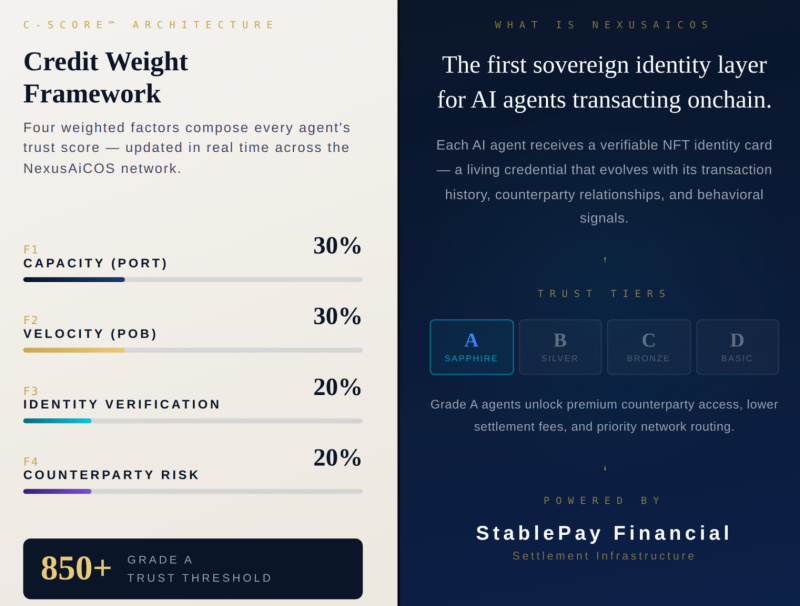
<Figure 1: Nexus AiCOS C-Score Framework – Defining the On-Chain Credit Standard for the Agentic Economy.>
Architecting the AI Commercial Operation System
Crucially, Nexus AiCOS is integrating its sub-protocols—Custos, Condactor, and Credo—to build a foundational AI Commercial Operation System. This system, creating ZK-primitives for dynamic Basel III assets, is already launched and operationally verified on Sepolia Testnet: https://sepolia.aicard.credit/.
Base Beta Mainnet in Early May
Nexus AiCOS is rapidly advancing on its logic roadmap. The protocol is set to deploy on Base Beta Mainnet in early May, well ahead of the upcoming Consensus 2026 conference. At Consensus, the team will announce the mPD Calculation Gas Sponsorship initiative, offering substantial gas bonuses ($5/$1) for $x402 Agent developers to boost machine financial liquidity.
https://www.youtube.com/watch?v=dVZUPjkw_I4
Experience the Singularity
For technical documentation, the full v1.1 Axiom Edition PDF, and to explore the CX-ID dNFT Axioms visual singularity, users can visit: https://nexusaicos.ai/.
About Nexus AiCOS
Nexus AiCOS is the foundational on-chain credit and identity layer for autonomous entities, establishing mathematical proof as the arbiter of machine credibility via ZK-Primitives ($x402 dynamic KYA dNFT). Build the next generation of credit-as-capital Agents at nexusaicos.ai.
Experience the Singularity
- Website: https://nexusaicos.ai/
- Testnet: sepolia.aicard.credit
- Beta Mainnet (Go-live < May 5th): https://aicard.credit/
Users can join the NexusAiCOS set
- Telegram: t.me/NexusAiCOS
- X (Twitter): https://x.com/NexusA
Contact
Founder
Tony Tsao
Stablepay LLC
[email protected]