



San Francisco, USA, January 27th, 2026, Chainwire
What Brave helped mainstream for private browsing, Anuma brings to AI with private, user-owned memory and AI Portal-based interoperability powered by ZetaChain 2.0.
ZetaChain today announced the beta launch and public waitlist for Anuma, a privacy-first AI interface built on ZetaChain 2.0. ZetaChain also introduced ZetaChain 2.0, a new AI interoperability layer designed to help developers build applications and agents that work across AI models, preserve private user context, and monetize globally without backend infrastructure.
ZetaChain Core Contributor Ankur Nandwani previously co-created Basic Attention Token (BAT), which powers the Brave browser ecosystem with over 100M monthly active users. Brave helped mainstream privacy-first browsing by blocking trackers and ads by default. Anuma applies that same “privacy and user control by default” approach to the next major consumer interface of AI where context and memory increasingly define user experience.
AI adoption is accelerating at internet scale: McKinsey notes that ChatGPT reached 100 million users in two months, and OpenAI has reported 800 million weekly active users by late 2025. Yet the ecosystem remains fragmented, with only 9% of consumers paying for more than one AI subscription across major assistants. This combination creates lock-in at the model layer and forces developers to repeatedly rebuild the same integration, routing, state, and billing infrastructure, while privacy and data are routinely shared across applications, agents, and model providers.
ZetaChain was built to address fragmentation in Web3 by enabling universal apps — applications that can natively access assets like BTC and execute across multiple blockchains through a single platform. In 2025, the ZetaChain network scaled to more than 11.5 million users and processed more than 225 million transactions. With ZetaChain 2.0, ZetaChain is extending this unification thesis to AI so applications can operate across both chains and models, with permissions and private context built in.
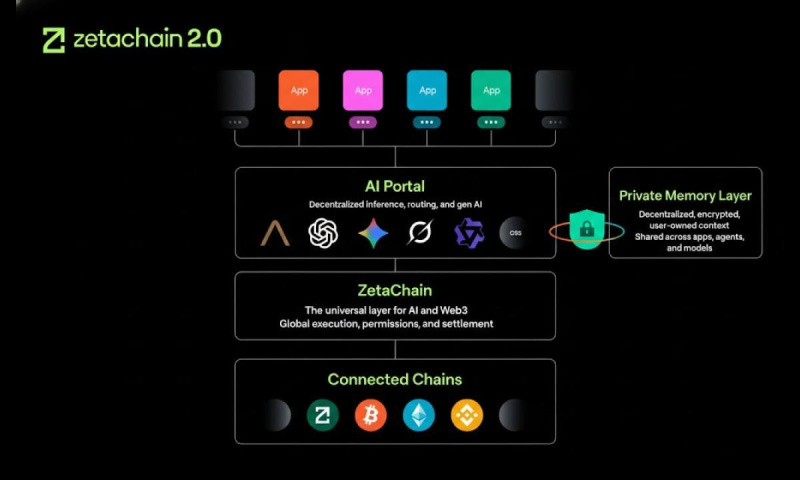
ZetaChain 2.0 is composed of two core components:
- AI Portal: A unified routing and execution layer that allows applications to access multiple AI model providers without lock-in, with built-in support for availability, fallback, and cost-performance optimization.
- Private Memory Layer: A protocol-level memory system designed to keep user context encrypted and permissioned, enabling persistent experiences across sessions while maintaining user control over what applications and agents can access.
Developer SDK and Platform
ZetaChain 2.0 is designed to scale as a developer platform. Alongside the protocol components, ZetaChain is releasing a developer SDK that packages private persistent memory, cross-model interoperability, and monetization primitives into a single toolkit. The goal is to make it straightforward to build privacy-first apps and agents that can maintain continuity across sessions, connect to multiple model providers, and support global monetization rails from onchain settlement to traditional payment processors without requiring teams to build bespoke infrastructure.
 Anuma: First Consumer Showcase
Anuma is the first consumer AI interface built on ZetaChain 2.0. The product provides access to multiple leading AI models through a single experience, supports switching between models without losing context, and is designed so memory remains private and user-controlled. Users can request early access through the public waitlist.
“Brave and BAT proved that privacy-first defaults can win at consumer scale,” said Ankur Nandwani, Core Contributor at ZetaChain. “We’ve already unified the blockchain experience at scale, powering more than 225 million transactions. ZetaChain 2.0 extends that same approach to AI, enabling the next generation of apps and agents that run across models and chains with private, permissioned memory and global monetization by default.”
In 2023, ZetaChain announced a $27 million funding round with participation from Blockchain.com, Human Capital, VY Capital, Sky9 Capital, Jane Street Capital, VistaLabs, CMT Digital, Foundation Capital, Lingfeng Capital, GSR, and others.
About ZetaChain
ZetaChain is the universal layer for AI and Web3, letting developers build apps that run across chains and models, keep memory private, and monetize without infrastructure. With native connectivity across major blockchains and an AI interoperability stack powered by a Private Memory Layer, ZetaChain is building the foundation for the next generation of apps, agents, and experiences.
Users can follow ZetaChain on X (Twitter) and join the conversation on Discord and Telegram.
Contact
CMO
Jonathan Covey
ZetaChain
[email protected]
Bucharest, Romania, January 26th, 2026, Chainwire
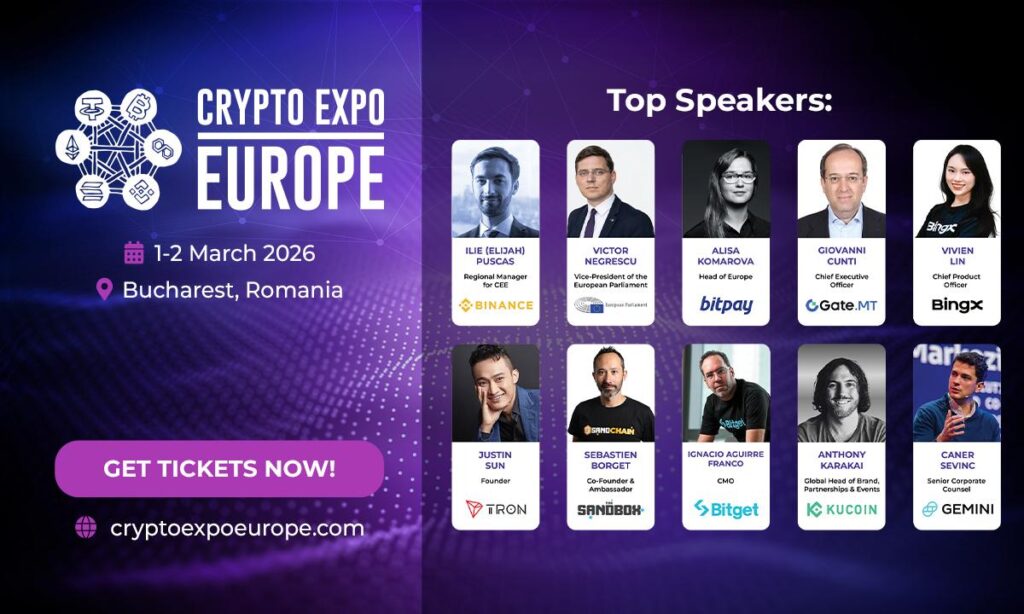
Crypto Expo Europe, Eastern Europe’s largest crypto and blockchain conference, has confirmed the first cohort of speakers for its 2026 edition. Set to return to Bucharest, Romania on March 1-2, the event brings together institutions, enterprises, regulators, and developers to discuss key themes that will define the industry in 2026.
Ticket sales have now opened for this year’s Crypto Expo Europe, with strong demand projected for Eastern Europe’s preeminent blockchain gathering. More than 3,000 delegates are expected to attend the Radisson Blu Hotel Bucharest in early March, where 5,000 square meters of expo space has been allocated for two days of talks, panel discussions, and workshops.
The first cohort of speakers announced for Crypto Expo Europe 2026 features numerous founders, investors, regulators, legal experts, and fintech leaders. These include Tron founder Justin Sun and The Sandbox Co-Founder Sebastien Borget.
The first list of speakers is completed by:
- Ilie (Elijah) Puscas, Regional Manager for CEE, Binance
- Victor Negrescu, Vice-President of the European Parliament
- Alisa Komarova, Head of Europe, Bitpay
- Giovanni Cunti, CEO, Gate.mt
- Vivien Lin, CPO, BingX
- Anthony Karakai, Global Head of Brand, Partnerships & Events, KuCoin
- Caner Sevinc, Senior Corporate Counsel, Gemini
- Ignacio Aguirre Franco, CMO, Bitget
- Sebastian Borget, Co-Founder & Ambassador, The Sandbox
- Justin Sun, Founder, Tron
Over the course of two days, dozens of speakers from across Web3 and TradFi will deliver insights on key opportunities, challenges, and emerging industry trends.
Sponsorship opportunities are now available for the Bucharest event, whose lead and gold sponsors are Bitget and BingX respectively. Gold sponsors confirmed so far include Coinzilla, Bazoom, and eToro. Many of the partners and speakers announced for Crypto Expo Europe 2026 are returning as longstanding supporters.
Ruxandra Tataru, Co-founder and CEO of Crypto Expo Europe, said: “Across four editions, Crypto Expo Europe has grown into one of the leading and largest crypto events in Europe. It’s a space where industry leaders, representatives of the European Parliament, regulators, and major companies meet in Bucharest to shape the future of digital finance. In the era of MiCA, the event plays a crucial role in bridging policy, business, and innovation that advance the entire blockchain ecosystem.”
Crypto Expo Europe 2026 comes at a moment when the European crypto market is entering a more structured phase, shaped by regulation, institutional interest, and renewed retail participation. The event will unite professionals spanning business, technology, compliance, and crypto markets, not just to exchange ideas but to forge significant deals and partnerships.
As one of the fastest-growing tech and crypto hubs in Eastern Europe, Bucharest will prove the perfect setting for the 2026 conference, bringing together attendees from more than 60 countries. On March 1-2, the event will highlight the innovations that are driving crypto adoption across the region while advancing blockchain understanding and adoption.
Tickets for the event are on sale now at https://cryptoexpoeurope.com/checkout
About Crypto Expo Europe
Crypto Expo Europe is Eastern Europe’s largest crypto and blockchain conference, serving as a gateway for institutions, enterprises, regulators, and developers shaping the future of digital finance. Hosted annually in Bucharest, the event attracts over 3,000 delegates from more than 60 countries, providing a platform for networking, workshops, and high-level panel discussions.
With a focus on bridging the gap between Web3 innovation and the evolving regulatory landscape of the MiCA era, Crypto Expo Europe unites the industry’s most influential leaders to foster partnerships and drive blockchain adoption across the continent.
Learn more: https://cryptoexpoeurope.com/
Contact
Marketing Manager
Alina Neagu
Crypto Expo Europe
[email protected]
Miami, Florida, USA, January 23rd, 2026, Chainwire
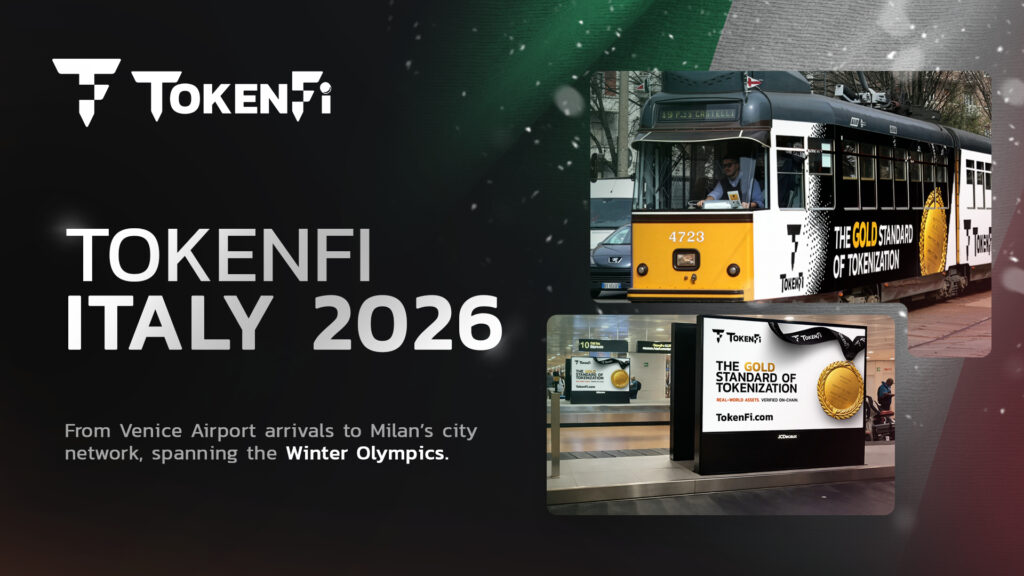
TokenFi, a next-generation platform focused on tokenization for real-world assets and digital economies, has launched a major branding and awareness campaign across Italy ahead of the 2026 Winter Olympics.
The four-week campaign will begin Jan. 26 and is strategically designed to capture the attention of a global, high-net-worth audience traveling to Italy for the Games.
As part of the initiative, TokenFi has secured a full digital arrivals takeover at Venice Marco Polo Airport, one of the primary international gateways for Olympic visitors, along with two fully wrapped trams operating across central Milan.
Targeting a premium global audience
The Winter Olympics draw a diverse international audience, including professionals, athletes, and spectators, some of whom are showing growing interest in blockchain and digital asset technologies.
With foot traffic across Italy’s airports and public transportation systems expected to surge during the Olympic period, TokenFi aims to position its brand in front of millions of international travelers aligned with the future of tokenized assets.
At Venice Marco Polo Airport, immersive digital displays will introduce arriving travelers to TokenFi from the moment they land, placing the brand front and center during one of the busiest travel periods Italy has ever experienced. In Milan, the fully wrapped TokenFi trams will operate on major routes throughout the city, serving as mobile billboards in Italy’s financial and cultural capital.
A shift toward real-world visibility for crypto brands
For the global crypto community, the campaign signals a broader shift in how blockchain companies approach brand building. Rather than relying solely on digital-native channels, TokenFi is placing its presence in iconic, high-traffic physical environments.
This approach has been pioneered by TokenFi and Floki, which have focused heavily on mainstream brand recognition as the digital asset industry matures.
“The 2026 Winter Olympics present a rare opportunity to place TokenFi in front of a truly global, highly influential audience,” Pedro Vidal, a TokenFi spokesperson said. “This campaign isn’t just about visibility, it’s about validating the role of tokenization on the world stage and energizing the crypto community as we enter a pivotal era for Web3 adoption.”
Positioning tokenization on the global stage
TokenFi’s presence across Venice and Milan underscores its ambition to play a leading role in the global tokenization movement. As interest in real-world asset tokenization accelerates among both institutional and retail investors, the company is using the Olympic spotlight to reinforce its brand at the intersection of finance, technology, and global culture.
The campaign will run throughout the Olympic season, maximizing exposure during peak international travel and setting the stage for TokenFi’s next phase of global growth.
About TokenFi
TokenFi is an innovative platform for crypto and asset tokenization, enabling users to launch or tokenize assets effortlessly. TokenFi is committed to revolutionizing the trillion-dollar tokenization industry by offering a user-friendly interface that requires no coding expertise.
Website: https://tokenfi.com
Twitter: https://twitter.com/tokenfi
Contact
Community Relations Officer
Pedro Vidal
TokenFi
[email protected]
VILNIUS, Lithuania, January 22nd, 2026, Chainwire
BTCC, the world’s longest-serving cryptocurrency exchange, reported record 2025 performance with $3.7 trillion in total trading volume and a global user base that reached 11 million, a 60% increase year-over-year. As the exchange approaches its 15th anniversary in 2026, it is shifting focus toward AI-enabled trading tools and expanded real-world asset offerings.
2025 Performance Highlights
For the full year, BTCC recorded $3.27 trillion in futures volume and $431 billion in spot trading volume. The exchange’s tokenized real-world asset (RWA) trading recorded significant growth, with quarterly volumes increasing from $1.2 billion in Q1 to $22.7 billion in Q4. Over the course of the year, total tokenized futures volume amounted to $53.1 billion.
Throughout 2025, BTCC maintained its commitment to transparency through monthly Proof of Reserves (PoR) reporting, with reserves consistently above 100%. The exchange also introduced product enhancements, including a site-wide UI refresh, an updated VIP program, and integration with TradingView for futures trading.
Global Expansion and Industry Recognition
In 2025, BTCC expanded its global presence through a variety of community events. The exchange participated in TOKEN2049 in Dubai and Singapore, hosted a Summer Festival in Tokyo, organized an MVP Night during Taipei Blockchain Week, and sponsored the Red Eagle Foundation’s charity golf events, which raised over $100,000 during the year.
Beyond events, BTCC strengthened its brand visibility through high-profile partnerships. The exchange partnered with NBA All-Star Jaren Jackson Jr. as its first global brand ambassador. The collaboration bridges sports and cryptocurrency communities by showcasing Jackson’s identity as an elite athlete, music producer, and crypto trader.
The exchange’s efforts were recognized with multiple industry honors, including the Best Centralized Exchange (Community Choice) award from BeInCrypto.
2026 Strategic Priorities
Building on 15 years of operational track record, BTCC has outlined three focus areas for the year ahead:
- AI-Powered Trading Features: Integration of AI across risk management and trade execution optimization tools designed for both professional traders and mainstream users.
- Real-World Asset Expansion: Following the 18-fold growth in tokenized asset trading volume in 2025, BTCC will significantly expand its RWA product suite with additional asset classes and new trading pairs.
- Next-Generation Trading Platform: Launch of a comprehensive trading system spanning derivatives, spot markets, and multi-asset matching engines, alongside a new wealth management feature offering diversified strategies for different risk profiles.
“15 years in this industry has taught us that the real risk isn’t change but standing still,” said Marcus Chen, Product Manager at BTCC. “Our focus for 2026 is translating operational experience into speed: building what traders need for where markets are heading, not where they’ve been.”
About BTCC
Founded in 2011, BTCC is a leading global cryptocurrency exchange serving over 11 million users across 100+ countries. Partnered with 2023 Defensive Player of the Year and 2x NBA All-Star Jaren Jackson Jr. as global brand ambassador, BTCC delivers secure, accessible crypto trading services with an unmatched user experience.
Official website: https://www.btcc.com/en-US
Contact
Aaryn Ling
[email protected]

The esports industry is experiencing rapid expansion, drawing audiences, investors, and sponsors from around the world.
Competitive gaming has evolved from niche communities into a global entertainment phenomenon, with millions tuning in to watch tournaments and live streams daily.
Revenue from esports, which includes sponsorships, advertising, media rights, merchandise, and ticket sales, has surged in recent years, highlighting the sector’s increasing commercial potential.
Market analysts predict that esports revenue will continue to grow as mainstream recognition and investment interest intensify.
Expanding Audience and Global Reach
The esports audience has grown exponentially, now encompassing hundreds of millions of viewers worldwide.
Platforms such as Twitch, YouTube Gaming, and specialized esports streaming services have made content accessible to fans anytime, anywhere.
Professional leagues and tournaments for games like League of Legends, Dota 2, Counter-Strike: Global Offensive, and Valorant regularly attract millions of live viewers.
The global reach of esports has enabled international teams to compete on stage, creating a truly cross-border fan culture.
As the audience expands, advertisers and sponsors are increasingly drawn to the sector, recognizing the engagement and brand visibility esports offers.
Sponsorships and Commercial Opportunities
Corporate sponsorships are a driving force behind esports growth.
Major brands in technology, energy drinks, apparel, and financial services are partnering with teams, events, and influencers to reach young, digitally engaged audiences.
Esports sponsorship deals can range from jersey branding and stadium signage to exclusive content partnerships and digital activations.
These deals provide crucial funding for professional teams, enabling them to attract top talent, enhance training facilities, and compete at the highest level.
Investors are also exploring esports franchises, similar to traditional sports team models, to capitalize on long-term growth potential.
Interactive Engagement
Esports betting is becoming increasingly popular, adding a new dimension to fan engagement.
Many online platforms now allow users to place wagers on your favorite esports teams and players, creating a participatory experience that extends beyond viewing.
Industry experts suggest that betting and fantasy leagues will continue to grow, providing both entertainment and revenue streams for operators and content providers.
Technological Advancements Fueling Growth
Technological innovations have played a pivotal role in the rise of esports.
High-speed internet, powerful gaming hardware, cloud gaming platforms, and improved streaming quality have made competitive gaming more accessible to players and viewers alike.
Virtual and augmented reality technologies are being explored as ways to enhance the esports viewing experience, potentially creating immersive arenas and interactive broadcasts.
Artificial intelligence is also being leveraged for performance analysis, coaching, and match predictions, giving professional teams an edge in training and strategy development.
These advancements contribute to higher-quality competition and richer experiences for both fans and participants.
Educational and Career Opportunities
The esports boom has created a wide range of educational and career opportunities.
Universities now offer scholarships for esports athletes, while courses in game design, production, and management prepare students for careers in the gaming ecosystem.
Professional esports players, streamers, analysts, commentators, and coaches have become viable career paths, supported by sponsorships, team salaries, and prize pools.
This professionalization of esports mirrors traditional sports, providing young talent with structured pathways and recognition for their skills.
Challenges and Future Outlook
Despite rapid growth, esports faces several challenges, including regulatory uncertainty, inconsistent monetization models, and concerns around player well-being.
Issues such as burnout, performance pressure, and online harassment are being addressed through better training, mental health support, and community guidelines.
The industry is also navigating how to standardize competition rules and enforce fair play across regions and tournaments.
Nevertheless, the future of esports looks promising, with sustained growth expected in audience numbers, investment, and technological innovation.
Global tournaments, franchised leagues, and interactive experiences are likely to drive further expansion, making esports a mainstream entertainment powerhouse.
As more stakeholders embrace esports, the sector continues to transform how people play, watch, and engage with competitive gaming on a global scale.

American television has a long history. It’s been a mainstay and influence on American culture for almost a full century. The trends are changing, new things are coming our way, and technology and the internet are reshaping our world as we speak. Yet, television persists. The forms of TV shows have changed over the years, and it takes something special for a TV show to be around for more than half a century.
One such show is The Price is Right, which has been around since 1956 with plenty of changes over the years. The version we have today was created in 1972 by Mark Goodson and Bill Todman, and had none other than Frank Wayne as its producer. The man behind the scenes was less popular and less well known than the hosts of this TV show, but he was a mastermind behind it. After all, he was in charge of the program from its creation in 1972 all the way until he died in 1988. Considering that the Price is Right is still going strong, this is a good moment to remind ourselves of the great Frank Wayne, and the influence he has had on the TV show The Price is Right and television shows of this kind in general.
Who Was Frank Wayne?
There is not much known about Frank Wayne, as he loved to live his life behind the scenes. Yet, his influence on television as we know it today cannot be neglected. Frank was born as Rocco Francis Rossi Jr., on July 9th, 1917. His life was marked by his work as a game show producer and host. The success a man that later was known as Frank Way achieved is more impressive when you know that he was born in an era where television did not exist, and still managed to lead it into its golden era, at least as far as televised game shows go. Born and bred in Boston, Massachusetts, Wayne spent the majority of his life being associated with Mark Goodson Productions.
Frank Wayne’s career was marked by the TV show The Price Is Right, for which he served as an executive producer from the show’s inception in 1972 all the way until his death in 1988. Even the current incarnation of the game draws roots from the show Wayne helped create. His work can never be overestimated, especially if you know that he was the man who was in charge of creating the show’s most iconic game, Plinko. This game was introduced in 1983, and since the 80s it has been a mainstay on the show and it remains the show’s most popular pricing game to this day. If you’re a fan of The Price Is Right, and their version of Plinko, you might be inclined to check out Stake Originals game Plinko, which does the original an honour in respecting the ways of old created by The Price Is Right.
While Plinko became the most popular game on the show, Frank Wayne was in charge of creating or introducing the majority of other games that have featured on the show throughout the years. The fact that The Price Is Right was like a child to Frank Wayne is seen through the fact that both of his sons Philip Wayne Rossi and Mark Wayne were also part of the team behind The Price is Right.
As we said, he was not only in charge of running The Price Is Right and creating and developing games for that one show, but also dedicated time and effort to different other television projects. The most notable shows he helped in creating and running include The Match Game in 1962 and Now You See It in 1974. He is also credited for being a writer on Beat the Clock in 1953, before becoming the show’s producer on a later date. The majority of his work was done under the wing of Mark Goodson-Bill Todman Productions, while one of the rare solo outings by Wayne was the show called Laugh Line which was hosted by the legendary Dick Van Dyke.
Frank Wayne died on March 18th, 1988 in his home in Los Angeles, California. He left everyone associated with The Price Is Right in grief following his passing. On the eve of his death, the production decided that he will be succeeded by the show’s long time host Bob Barker. Barker was also a long running producer who worked from Wayne’s death until 2007 when he decided to retire. Just like Wayne, Barker was a good producer as he was involved with decision making even before he officially took the role in the show’s production. After Wayne’s death, his son Phil Wayne was also part of the production crew and worked well with Bob Barker until the moment he also left the show.
The death of the show’s long running producer was marked on the show itself. A short tribute was recorded by the host, Bob Barker, and it was aired in the segment following the show, with a dedication to the work Frank Wayne was putting in to make the show one of the greatest of its kind in the television history. Barker stated that everyone who worked on the show has seen Frank as a member of the family and he wrapped up his tribute by saying just how much Wayne will be missed in years to come. The final message in the aftermath of the episode dedicated to Frank said: ” Frank Wayne July 9, 1917-March 18, 1988.”
While Frank Wayne is not with us anymore, and he hasn’t been for almost four decades, The Price Is Right still lives on. While the show has been popular for over a half a century it is possible that the younger generations reading this are not too familiar with its concept. If you want to learn more about it, we’re going to give you a short summary of the show and how it went from early days in the 70s to what we have today.
The Price Is Right: A Mainstay of American Television
What aided The Price Is Right surviving so long is the fact that it is a simple TV show. A simple and so thoroughly American that it encompassed generations with ease. As we said, the show came to life in 1972 as a revived version of the show that Mark Goodson and Bill Todman ran from 1956-1965, but now under the steady leadership of Frank Wayne. The show kept its name, The Price Is Right, but it expanded in every other sense, most notably by adding different gameplay elements some of which have never been seen on television.
The principle of the game is simple, as contestants compete in different games to determine the price of products they might eventually win. Participants are selected from the audience in the studio, and one of the main aspects that helped people get attached to the show is its catch phrase: “”Come on down!” The program first aired in 1972 with Bob Barker as its main host, and to date the longest running one. After him we’ve had the likes of Drew Carey, Johnny Olson, Rod Roddy, and Rich Fields being the face of the franchise but with all due respect none of them could replicate Bob Barker’s charisma.
A testimony to the greatness of The Price Is Right is the fact that the show has more than ten thousand aired episodes. At the moment it is the longest running game show in the United States. As you could have guessed, this show is a part of NAB Broadcasting Hall of Fame, and just last year it overcame Sábado Gigante, a Chilean TV show that aired for 53 years from 1962 to 2015.
The overall principle of the show makes it easy for the audience to follow both in the studio and in front of TVs. The Price Is Right consists of four parts. As more gameplay goes the number of contestants dwindles down from starting nine to eventual two that fight for the Showcase.
The show starts with four people from the audience being called to the Contestant’s Row, and they’re called upon with the famous catchphrase Come on Down!. After put there, each participant needs to make a bid on the sown prize. The goal is to hit the right price. Those who do get a $500 reward. Those who don’t get a consolation prize. After five games, each contestant that drops is replaced by a new one, before those who did the best job go onto the next stage of the show.
What follows are the steps that involve the rise in the price of the rewards, and the games get more complex. Some require skill, while others revolve around luck. Some are played for cash, some for cares, while you have many for different expansive items. The guessing of the price goes from groceries to luxury items. Pricing games evolved throughout time, with some being added and others removed. To date, we’ve had 77 different games going through the ranks at The Price Is Right TV show, with Plinko, available on Stake.com, still remaining one of the most popular ones.
The Price Is Right gets wrapped up with rounds called Showcase Showdown and Showcase, which are where the passion of the contestants gets heated and their price knowledge gets tested the most. To better understand how the show rewards those who play and watch, you simply need to tune into one episode or to watch some of the older ones. The best part of this show is that it gets even better on a rewatch.
Even if The Price Is Right is not your cup of tea, but you could see yourself enjoying such TV shows, it is good to know that this show has inspired numerous others that follow the same or similar principles. Just some that anyone could enjoy, even if in our eyes nothing compares to Bob Baker and The Price Is Right, are Press Your Luck, Jeopardy!, The Chase, Idiotest, Cash Cab, Supermarket Sweep, Let’s Make a Deal, and Deal or No Deal.
While television, internet, smartphones, and social media platforms offer plenty of things to watch and do, nothing will ever come close to the monumental TV show such as The Price Is Right. At the end of the day, this show has survived so much and has been on air in one form or another for more than 70 years. With more than 10 thousand episodes behind it, it has a blueprint on how things should be done, and has been doing them with perfection for decades.
The best part is that a TV show with such a long history was never marred by any scandal. Not even during the 1950s when it was established that many similar shows have been rigged. Another token of its quality and value that it has for television networks is the fact that The Price Is Right was aired on three different networks in ABC, CBS and NBC. With its legacy established early on with top hosts in Bob Barker and Frank Wayne in production roles, the people who succeeded only had to walk in the footsteps of those in front of them and not to change a recipe that worked so well for decades.
Lastly, the prizes on the show are not the only valuable things on the show. As we said, in 1983, Frank Wayne introduced the world of TV game shows with the unique game of Plinko. It’s a game played on a pinned board, from top of which Plinko chips are sent down. According to one of the show producers, Mike Richards, during the entire run of the show since the moment Plinko was introduced only 10 Plinko chips were manufactured, as they were expensive to make. Now, that’s the kind of effort and money you put into your product to make it one of the best ever.

The digital gaming industry is rapidly evolving, bringing both opportunities and regulatory challenges. Understanding these regulations is crucial for investors and businesses aiming to thrive in this dynamic environment. This article examines the complexities of the regulatory framework, highlighting key challenges and opportunities in the digital gaming sector.
As the digital gaming industry continues to grow, so does its complexity, particularly in terms of regulation. For those involved, whether you’re an investor or a business, grasping the intricacies of the regulatory landscape is vital. The industry’s expansion has brought increased scrutiny from regulators looking to safeguard consumers and ensure fair play. In such a competitive market, understanding these rules can mean the difference between success and failure. For those interested in exploring opportunities, online casino Australia platforms offer a glimpse into the regulatory challenges and market dynamics.
Understanding the current regulatory framework in digital gaming
The digital gaming sector is governed by a variety of regulations aimed at ensuring player safety and fair business practices. These rules vary by region, with each jurisdiction imposing its own set of standards. Companies must navigate these complexities to operate effectively and maintain consumer trust. Regulations cover everything from advertising practices to technical standards and data protection.
These regulations significantly impact how businesses operate and compete. Compliance can be costly, involving investments in technology and expertise. However, adhering to these standards can also provide a competitive edge by enhancing a company’s reputation. For investors, understanding these dynamics is essential for making informed decisions in a landscape where regulatory compliance affects market positioning.
Challenges digital gaming platforms face with regulations
Digital gaming platforms encounter numerous challenges when trying to comply with diverse regulations. One primary hurdle is the constantly changing environment, which requires companies to adapt swiftly to new rules. This can strain resources as businesses must continually update their operations and policies. Additionally, differing international standards complicate cross-border operations.
Despite these challenges, there are opportunities for those who navigate the landscape successfully. Companies that effectively manage regulatory requirements can gain a reputation for reliability and security, attracting more players. Furthermore, being proactive in compliance can help avoid costly penalties and disruptions, providing long-term benefits for both businesses and investors.
How future trends may shape digital gaming regulations
Looking ahead, you can expect regulatory trends to evolve as technology advances and consumer expectations shift. Regulators may impose stricter measures on areas like data privacy and responsible gaming practices. For companies operating in this space, staying informed about potential changes is crucial for strategic planning.
The implications of these trends extend to investors as well. As regulations tighten, investing in companies that prioritize compliance becomes increasingly important. For instance, platforms such as online casino nz may offer insights into how regional differences affect operations. Keeping abreast of these developments will be essential for anyone looking to invest wisely in the digital gaming sector.
Cryptocurrency adoption is widely expected to accelerate sharply in 2026, with industry observers pointing to a convergence of maturing technology, clearer regulation, and expanding real-world use cases as key drivers. After years of being viewed primarily as a speculative asset class, crypto is increasingly positioning itself as practical digital infrastructure capable of supporting payments, commerce, entertainment, and financial services on a global scale.
While market cycles will continue to influence prices, the next phase of crypto growth appears less dependent on hype and more rooted in everyday utility. This shift could see millions of new users entering the ecosystem, not to trade tokens, but to use blockchain-based tools in their daily lives.
From Investment Asset to Everyday Utility
One of the strongest signals pointing to increased adoption in 2026 is the growing emphasis on functional use cases rather than price speculation. Stablecoins, for example, are becoming central to crypto’s value proposition. Pegged to fiat currencies, they offer price stability while retaining the speed and borderless nature of blockchain transactions.
Stablecoins are increasingly used for cross-border payments, remittances, payroll, and business-to-business settlements. Compared to traditional banking rails, crypto-based transfers can settle in minutes rather than days and at a fraction of the cost. For individuals and businesses operating internationally, this efficiency is difficult to ignore and is expected to drive further adoption.
Beyond payments, decentralized finance platforms are continuing to evolve, offering services such as lending, borrowing, and yield generation without relying on traditional intermediaries. While still developing, these systems are becoming more user-friendly and better regulated, lowering the barrier to entry for mainstream users.
Tokenization and Digital Ownership
Another major catalyst for crypto adoption in 2026 is the tokenization of real-world assets. Tokenization allows physical or traditional financial assets — such as real estate, equities, commodities, or intellectual property — to be represented digitally on a blockchain.
This approach improves liquidity, enables fractional ownership, and reduces settlement times. For retail investors, tokenization can open access to asset classes that were previously difficult or impossible to enter. For institutions, it offers operational efficiencies and improved transparency.
As infrastructure improves and legal frameworks mature, tokenized assets are expected to move from niche experiments to mainstream financial products, further embedding blockchain technology into the global financial system.
Institutional Confidence and Regulatory Progress
Institutional involvement continues to play a significant role in legitimizing crypto for wider audiences. Major financial firms, payment providers, and technology companies are increasingly building crypto-related products or integrating blockchain solutions into their operations.
At the same time, regulatory clarity — while uneven across regions — is gradually improving. Clearer rules around custody, compliance, and consumer protection reduce uncertainty for both users and businesses. This environment encourages innovation while addressing long-standing concerns around risk and misuse.
As regulation becomes more predictable, it is likely to unlock further institutional participation, which in turn boosts confidence among retail users. Meanwhile, crypto influencers are continuing to play an important role in the growing adoption of crypto and blockchain worldwide.
Crypto Payments and Digital Identity
Consumer-facing applications are expected to be a major driver of adoption in 2026. Crypto payments are becoming easier to use through improved wallets, payment gateways, and integration with existing point-of-sale systems. For online commerce, crypto offers faster settlement and lower fees, particularly for international transactions.
Another emerging use case is digital identity. Blockchain-based identity solutions allow individuals to control their credentials and share only what is necessary, reducing fraud and improving privacy. These systems have potential applications across finance, healthcare, education, and online services, making crypto relevant to a much broader audience.
The Growing Role of Crypto in Online Casinos
One sector where crypto adoption is already accelerating is online gambling, particularly crypto-based casinos. These platforms leverage blockchain technology to offer faster payments, enhanced privacy, and greater transparency compared to traditional online casinos.
Crypto casinos allow players to deposit and withdraw funds almost instantly using digital currencies, avoiding the delays and fees often associated with banks and card providers. This is especially appealing in regions where access to conventional payment systems is limited or heavily restricted.
The use of blockchain also introduces provably fair gaming systems. By recording game outcomes on a public ledger or using smart contracts, crypto casinos can demonstrate that results are not manipulated, addressing long-standing trust issues in online gambling. Sweeps casino are also poised to benefit and grow in 2026.
Challenges Remain, but Momentum Is Building
Despite the optimism, challenges remain. Volatility, security concerns, and inconsistent regulation still pose obstacles to mass adoption. User education also remains critical, as many potential users are unfamiliar with wallet management and blockchain mechanics.
However, the overall trajectory points toward continued growth. Improved user interfaces, stronger security standards, and clearer rules are steadily addressing these concerns, making crypto more approachable for non-technical audiences.
Looking Ahead to 2026
By 2026, crypto is expected to be less about speculation and more about infrastructure. Payments, tokenized assets, digital identity, and entertainment platforms like online casinos are collectively pushing blockchain technology into everyday use.
As adoption expands across industries and demographics, crypto’s role in the global economy is likely to deepen. What was once considered a niche experiment is increasingly becoming a functional layer of the digital world — setting the stage for a significant surge in users and use cases in the year ahead.

In the second half of a tight match, attention turns into expectation. The crowd wants more than a result – it wants relevance.
This shift has been unfolding over the past few seasons, as sport increasingly competes for attention with formats built around participation – from multiplayer games and social platforms to creator communities and interactive streaming.
Deloitte’s latest Digital Media Trends research captured an uncomfortable reality for rights holders: around a third of Gen Z respondents say they don’t subscribe to streaming services specifically to watch sports. Instead, they prefer clips and highlights shared through social media. A separate Deloitte outlook makes the competitive pressure clear: when access becomes too complex or restrictive, younger audiences simply move on.
That context matters for 2026, a period when the fastest change is unfolding in the relationship layer around sport.
Why 2026 marks a turning point for fan engagement
The season ahead will be shaped by fan-driven decisions – small, frequent, measurable interactions that build loyalty through agency.
This shift is already taking shape in new formats designed around real participation. Arena Two is one example of how this thinking is being applied in practice. The platform connects live, real-world tournaments with interactive mechanics that allow fans to vote on in-game decisions, stake tokens to show support for teams, and earn rewards for engagement across football, cricket, MMA, and emerging entertainment formats.
As sports products evolve, Web3 is starting to function as infrastructure, giving fans a more active role during live competition. In emerging formats, supporters are beginning to take part in decision-making processes and, in some cases, co-own teams alongside athletes and team leaders. The ambition is straightforward: to create sports environments where fans influence outcomes through verifiable mechanisms such as voting and staking.
To understand how this shift plays out at the product level, we spoke with Omar Rahim, CEO of Arena Two, about what actually drives long-term engagement. In his view, the challenge isn’t introducing technology, but designing participation that feels natural to fans and meaningful to teams.
What really drives fan loyalty
But before introducing tokenisation, a more basic question needs an answer: why do fans follow a team or an athlete in the first place?
The obvious answer is “performance.” The true answer is “emotional connection.”
Fans connect with stories – a return after injury, composure under pressure, or moments that linger long after the final whistle. In traditional sport, this connection flows in one direction, with engagement measured through delayed signals like ratings or attendance.
The 2026 version of fandom compresses that loop. Lightweight, real-time signals are set to give fans a way to express intent – from tactical preferences to collective support during critical moments – creating a clearer, more immediate emotional readout.
This view aligns with a broader shift across the industry. As Pavel Shikhaleev, Head of Partnerships Operations at Cointelegraph, explains: “Sports tokenisation is moving away from hype toward real infrastructure that connects fans to teams in a meaningful way. The goal is not speculation, but sustained participation, recognition, and emotional ownership that lasts beyond major events. When Web3 is applied correctly, fandom becomes a measurable, long-term relationship rather than a fleeting spike in attention.”
When participation becomes measurable infrastructure
What matters most is what happens next. Signals must be verified, aggregated, and stored to create a reliable picture of fan engagement. “One wallet, one voice” therefore is not magic – Sybil risk remains real. But anti-Sybil tools are now part of Web3 design. For the first time, participation in sport can be measured at scale, provided systems are built to withstand pressure.
For team managers and commercial leaders, the implication is direct. Fan interest moves from assumption to observation. Patterns emerge in behaviour: belief rising during risk-taking phases, energy dropping when play slows, certain players triggering confidence in decisive moments. These insights feed directly into product strategy decisions.
Ownership, governance, and the economics of belonging
The second driver of fan loyalty is fairness, especially around rewards.
Fans have always contributed financially. Athletes have always been compensated. What remains limited is visibility into how fan contribution connects to athlete upside. Web3 introduces a more transparent mechanism. When communities allocate rewards through on-chain voting, outcomes are recorded by default. When distribution rules are declared upfront, post-hoc adjustments become harder to obscure. This transparency reshapes trust. Fans no longer rely on assurances; they can observe how systems behave.
Then come the bigger decisions, the ones that traditionally sit behind closed doors.
“Uniform design. Partnerships. Tournament formats. Even strategic priorities like where a team travels or which charitable causes it supports. In many clubs, fan involvement takes symbolic form – surveys, hashtags, design contests with predictable outcomes. Tokenised participation introduces a different model: governance that is measurable, timestamped, and repeatable. Adoption will follow when fan governance is treated as retention infrastructure,” Omar Rahim, ArenaTwo CEO reflects.
Finally, there’s fractional ownership – and the uncomfortable word that comes with it: profit.
“Co-ownership has the potential to make team financing more independent by widening participation beyond geography and legacy access. When fans in Lagos, Dubai, São Paulo, or Berlin can engage with a team’s trajectory without relying on proximity or season-ticket culture, the financing base broadens. Over time, it becomes less concentrated around local sponsors and matchday revenue, aligning with global community demand,” Omar continues.
Of course, this approach carries regulatory and reputational responsibility. Ownership-like participation requires clear communication around risk, incentive alignment, and long-term intent. Platforms that endure will prioritise emotional engagement first, with economic participation reinforcing commitment.
Web3 in sport is an inevitable movement that comes from changes in the attention market and rising expectations around participation. Sport now competes on interactivity without losing its soul. The 2026 season will favour athletes and organisations that treat fans as participants – measurable, respected, and involved in decisions that feel consequential.
Platforms that achieve this will earn something increasingly rare: loyalty that survives the algorithm.
Veteran trader Peter Brandt has said that the potential passage of the US Clarity Act is unlikely to have a meaningful short-term impact on Bitcoin’s price, despite growing confidence that the legislation could clear Congress as early as January.
Brandt argued that while the bill represents an important regulatory milestone, it does not fundamentally change Bitcoin’s valuation or long-term market dynamics.
“Is it a world-shaking macro development? Nope. Needed for sure, but not something that should redefine value,” Brandt said on Friday.
“Having an asset regulated, particularly an asset for which die-hard investors never wanted to be regulated, is not an earth-shattering event,” he added.
His remarks come as political momentum behind crypto market structure legislation continues to build in Washington.
Political Momentum Builds Ahead of January Push
White House crypto and AI czar David Sacks said on Thursday that lawmakers are closer than ever to passing the long-awaited bill.
“We are closer than ever to passing the landmark crypto market structure legislation,” Sacks said.
“We look forward to finishing the job in January,” he added.
The Clarity Act is designed to establish clearer rules around digital asset classification, oversight, and compliance in the US.
Industry participants have long argued that regulatory ambiguity has held back institutional adoption and innovation.
Despite that, Brandt does not believe clarity alone will spark a renewed surge in Bitcoin’s price.
Falling crypto prices are not stopping blockchain adoption, including in the iGaming space, as noted by Cardmates.
This iGaming-related portal is run by seasoned industry professionals. Deep expertise in the field guarantees up-to-date data and unbiased approach to every review published. The resource full of useful information, including:
- Recent industry news & updates.
- Compilations of the best and safest casino sites.
- The most demanded free slot demos to have fun.
- Promo codes for popular casino bonuses.
- Expert casino and poker site reviews.
Market Has Already Priced In Regulatory Progress
Brandt stressed that the legislation should be viewed as a structural improvement rather than a price catalyst.
“The Clarity Act would be positive because it would greatly clarify the regulatory structure for crypto assets,” he said.
However, he maintained that expectations around the bill are already reflected in current market pricing.
That view was echoed by Ledn chief investment officer John Glover, who said the market is unlikely to react sharply if the bill passes.
“I don’t expect this event to have a significant impact on the markets on day 1,” Glover said.
He added that any positive influence on prices would likely emerge gradually rather than immediately.
“It is another step toward broad-based acceptance of Bitcoin and ETH as investable assets, so over time I still expect the price trajectory to be up and to the right over time,” Glover said.
Bear Market Outlook Still Intact
While acknowledging the broader benefits of regulatory clarity, Brandt said his technical outlook for Bitcoin remains cautious.
He described Bitcoin as being in a bear market, though he noted that the Clarity Act slightly tempers his downside expectations.
Brandt said the legislation could mean his “downside bias is moderate,” rather than severe.
Even so, his longer-term chart-based projections point to the possibility of further declines.
“I believe the charts suggest that Bitcoin could trade down to the $60k level, likely in Q3 of 2026,” Brandt said.
Such a move would represent a substantial pullback from current levels and would test investor conviction during a prolonged correction phase.
Lawmakers Keep Pressure on Legislative Process
Beyond market participants, the Clarity Act remains a priority for pro-crypto lawmakers.
Wyoming Senator Cynthia Lummis, a member of the US Senate Banking Committee, has been one of the bill’s most vocal supporters.
On Dec. 9, Lummis said she wanted to take the next step in advancing the legislation in the coming days.
She acknowledged that the process has been challenging, particularly during bipartisan negotiations.
The senator said the crypto industry “was getting a little concerned” about the bill’s progress.
She also noted that draft versions were “changed so much every few days” as lawmakers worked to reach consensus.
Despite those hurdles, expectations remain high that the Clarity Act could finally provide the regulatory certainty the industry has been seeking, even if its impact on Bitcoin’s price proves muted in the near term.