


Tortola, British Virgins Island, December 17th, 2025, Chainwire
Space is the first 10x leverage prediction market on Solana where users trade real-world outcomes across crypto, politics, sports, technology, culture and beyond – getting paid for being right. Today, they announced the public sale of their native token, $SPACE.
The company has a token flywheel mechanism where 50% of revenue goes into buying back and burning $SPACE.
Space is built by the team behind UFO, a top 100 project in 2021 on CoinMarketCap that grew to $1.5B+ market cap with a large on-chain community. That success came from distribution and community, not insiders. The same ethos powers Space.
Core Features:
- Central Limit Order Book (CLOB) with 0% maker fees
- Up to 10x leverage on predictions, more than 1,000x gains
- Engineered user acquisition and retention loops
- 50% of revenue – buyback and burn
- Gamified points, ranks, and seasonal airdrops
- Liquidity and referral rewards
Backing
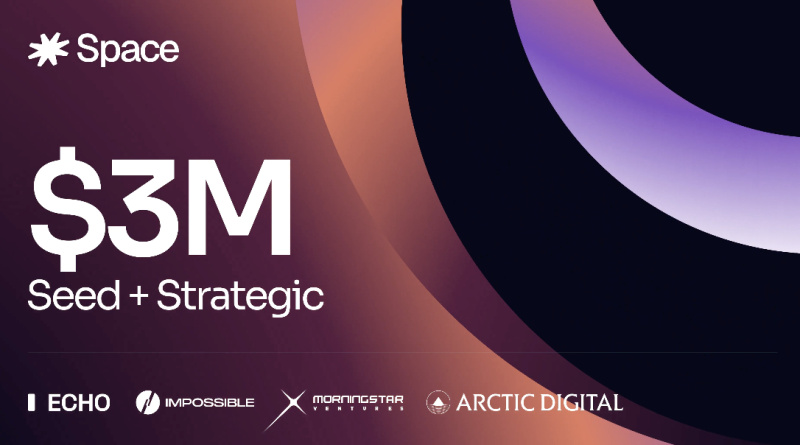
Space’s $3M seed and strategic round was led by Morningstar Ventures and Arctic Digital. Alongside a record breaking 1,360% oversubscribed raise on Echo and participation from investors on Curated by Impossible Finance.
Now they are opening ownership to the community.
Public Sale
The team believes the people who use, trade, build on and support Space should own a part of it. A public sale puts ownership in the hands of the community where everyone gets the same price.
Fair Price Discovery
The public sale uses a variable token distribution model. Tokens distributed are determined at the final market-clearing price. This ensures fair and efficient price discovery while guaranteeing all participants receive the same price.
Key Details:
Chain: Solana
Start: December 17th, 6:00 PM UTC
Target: $2.5M
Floor FDV: $50M
Ceiling FDV: $99M
FDV Curve: Linear ($0.05 → $0.099)
Vesting: 100% Unlocked at TGE
Accepted: USDC, USDT, SOL
Minimum Contribution: None
Maximum Contribution: None
How It Works:
- At the end of the countdown, sale.into.space will be open for contributions
- The sale starts at a floor valuation of $50M FDV and remains at this level until the $2.5M target is reached
- After the target is met, the sale enters price discovery, with FDV increasing linearly up to the $99M ceiling
- At the close of the sale, all participants pay the same clearing price
- In the event demand exceeds available tokens at the final price, the team will manage allocations and refund any excess contributions to ensure fair participation for all contributors
Tiers & Perks
Every 24 hours the participation tier will change, the earlier a user commits, the higher their tier and higher likelihood of getting their allocation filled: unlocking a larger bonus airdrop, lifetime-perks and benefits on the Space platform.
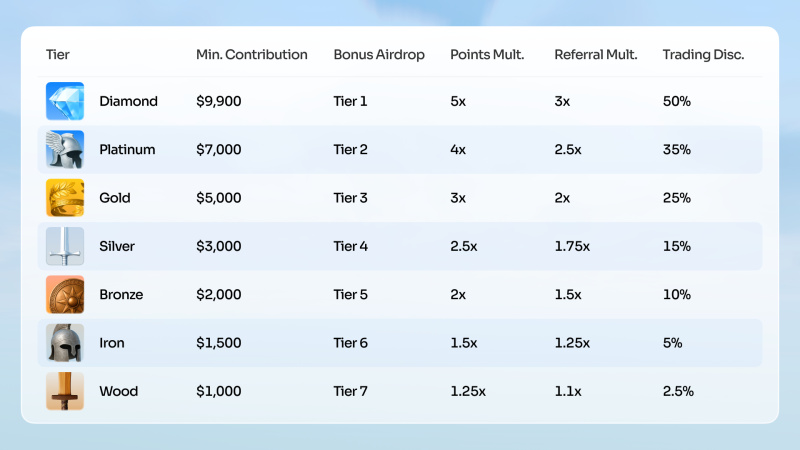
Minimum contribution is to unlock a tier and subsequent rewards. There is no minimum contribution to participate in the Public Sale.
Perk Benefits:
- Bonus Airdrop: Unlocks additional bonus token airdrop
- Points Multiplier: Earning points faster across airdrop seasons 1-4 (Q1-Q4 2026)
- Referral Multiplier: Lifetime bonus on trading fees from referred users
- Trading Fee Discount: Reduced fees on user’s trades for 12 months
Users’ total contribution is cumulative, but they can only achieve a tier if they hit the minimum during that tier’s active window. Once a user secures one, it’s theirs for life. Tier achievements transfer to their Space profile and come with additional benefits.
Allocation & Refunds
In the event of oversubscription, the team will manage allocations to ensure fairness.
Refunds of any excess contributions will be issued after the sale, with criteria disclosed once the sale concludes.
Tokenomics
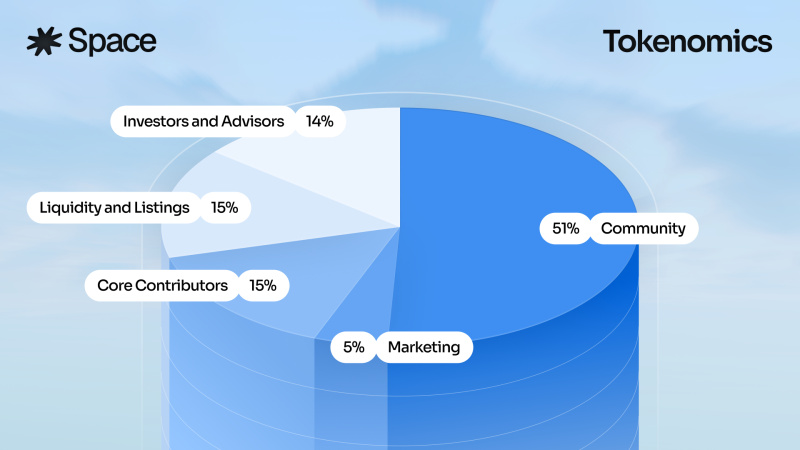
Total Supply: 1,000,000,000
Flywheel Mechanism
All platform fees fuel a self-sustaining cycle:
- 50% of revenue → Buyback & burn $SPACE
- 50% of revenue → Protocol treasury
What’s Next
Public Sale: December 17th, 6:00 PM UTC
Refunds: Immediately after sale closes
TGE: After public sale
Platform Launch: January 2026
In order Participate, users can:
- Go to sale.into.space
- Connect a self-custodial wallet (Phantom recommended)
- Desktop is recommended for the best user experience
- Select contribution amount in USDC, USDT, or SOL
- Sign and confirm transaction
Important: Do not send from a centralized exchange (CEX). Use a self-custodial wallet like Phantom.
About Space
Space is a leveraged prediction market built on Solana by the team behind UFO, a Top 100 project with a $1.5B+ market cap. It combines a central limit order book, 10x leverage, and zero maker fees to address liquidity challenges common in prediction markets. Space integrates gamified rewards, referral incentives, and a seasonal airdrop system to enhance user engagement.
The protocol raised $3 million, including a 1,360% oversubscribed round on Echo.xyz, with backing from Echo, Impossible Finance, Morningstar Ventures, and Arctic Digital. With 50% of platform revenue allocated to a buyback and burn mechanism, Space aims to provide a foundational layer for decentralized prediction markets, supporting traders, developers, and token holders.
Socials
Contact
Ace
Intodotspace Limited
[email protected]
Fernandina Beach, USA/Florida, December 15th, 2025, Chainwire
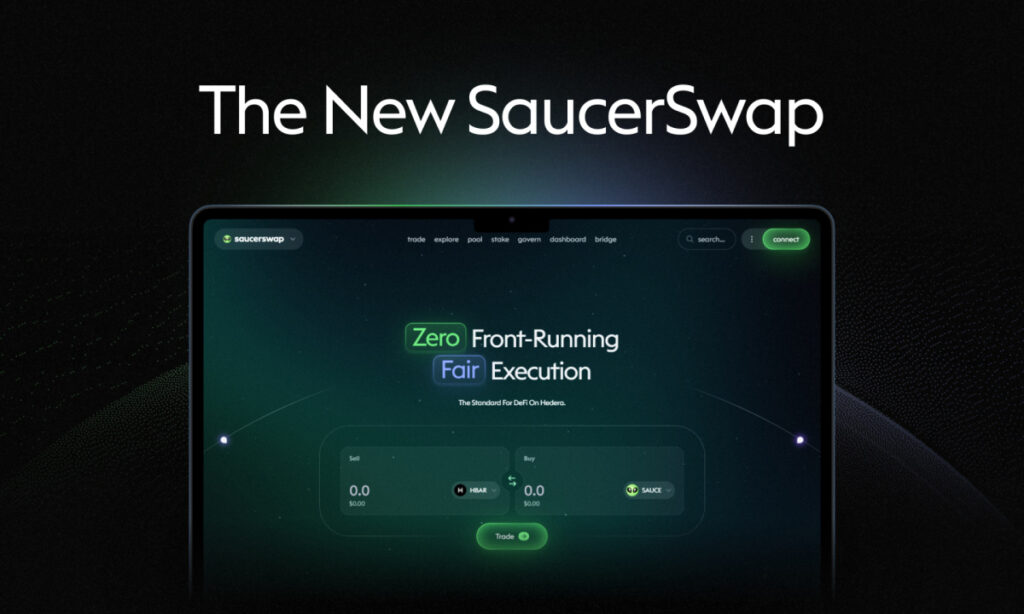
SaucerSwap Labs, the team behind Hedera’s leading decentralized exchange, today unveiled a fully redesigned platform and refreshed brand identity. The update delivers modernized navigation, integrated analytics, and a new visual design system while preserving the audited smart contracts and non-custodial architecture that users rely on.
“Whether you’re discovering Hedera DeFi for the first time or you’re a professional trader, everything has been rebuilt to feel fast, trusted, and intuitive,” said Peter Campbell, CEO and Co-founder of SaucerSwap Labs. “This is a serious workstation for capital.”
A New Era for Hedera’s Liquidity Protocol
Since launching in 2022, SaucerSwap has grown from an early-stage automated market maker into Hedera’s dominant DeFi protocol, routing the majority of on-chain liquidity and processing tens of millions of swaps. The redesigned platform brings the user experience in line with that scale, introducing clearer information architecture and analytics built directly into every workflow.
The launch also introduces a refreshed visual identity for SaucerSwap, including an updated logo, new color palette, and a modern design system that reflects the protocol’s evolution from startup to infrastructure.
Navigation Built Around Real Workflows
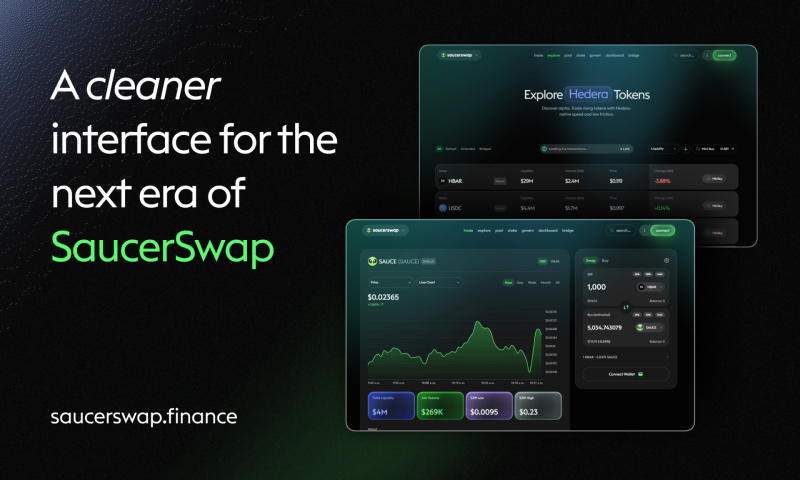
The platform is now organized into clear, action-driven sections. Trading, token discovery, liquidity provisioning, staking, governance, and portfolio monitoring each have dedicated views. Users can move from a token swap to providing liquidity, staking SAUCE, or voting on a governance proposal in seconds.
A bridge modal connects Hedera to external networks including Base and BNB Chain, making it easier to move capital in and out of the ecosystem.
The redesign standardizes how information is displayed across the platform: pair and pool charts, liquidity depth, fee APYs, LP position analytics, historical performance, and protocol health metrics all follow consistent visual patterns. These components are designed to scale with SaucerSwap’s roadmap, including the planned V3 protocol upgrade, perpetuals, limit orders, dollar cost averaging, and ETF-style products.
“The interface was designed so that complex features feel simple,” said Markus Bergvinson, Chief Strategy Officer at SaucerSwap Labs. “Whether it’s swaps today or advanced derivatives tomorrow, it all lives inside one consistent experience.”
Built for Every Type of User
The platform is tuned for different audiences. Retail users and newcomers get clear copy and guided flows that feel similar to modern banking apps. Advanced users and liquidity providers gain faster access to deeper analytics and more powerful LP tools. Builders and token projects can rely on the interface for token launches and liquidity programs. Professional partners can bridge assets from other networks and interact with a protocol that matches their expectations for security and longevity.
Protocol Unchanged, Experience Upgraded
The redesign does not change SaucerSwap’s audited smart contracts, non-custodial architecture, on-chain governance via SAUCE and xSAUCE, or any existing LP positions, stakes, or rewards. Everything users have built on SaucerSwap remains intact.
This launch marks the beginning of SaucerSwap’s next chapter: new design, new brand, and new capabilities, with the same mission of being the most efficient, accessible, and secure liquidity protocol on Hedera.
About SaucerSwap
SaucerSwap is Hedera’s leading decentralized exchange and liquidity protocol, enabling fast, low-cost token swaps with integrated analytics. Governed by the SaucerSwap DAO through SAUCE and xSAUCE, the protocol powers Hedera-native and cross-chain liquidity for retail users, builders, and institutional partners.
For more information, users can visit the SaucerSwap Docs and explore the new SaucerSwap platform.
Contact
CEO
Peter Campbell
SaucerSwap Labs LLC
[email protected]

The gambling industry is seeing a historic transformation. What used to be a business centered on resort destinations, gaming floors and slot machines has expanded rapidly into mobile betting, digital sportsbooks and interactive gaming platforms. This shift has redefined how consumers engage with gambling, making it more accessible, data-driven, and integrated into everyday digital life.
The surge in online gambling, driven by mobile adoption, regulatory changes and shifting consumer behavior, now shapes how online casino operators grow, how they compete and how investors should evaluate the industry.
For publicly traded casino stocks, this shift isn’t just creating a new revenue stream. It’s reshaping valuations, revenue mixes and long-term strategy across the sector.
Online gambling is surging worldwide
As impressive as the industry’s digital transformation looks from a high level, the real story becomes even clearer when you look at the numbers.
Europe’s digital growth
Europe is one of the clearest examples of the digital shift:
- The European gambling market reached €123.4 billion in gross gaming revenue in 2024, a 5% increase from 2023. (EGBA)
- €47.9 billion came from online gambling, making 39% of Europe’s total gambling revenue digital, up from 37% in 2023. (EGBA)
- Online casino games generated €21.5 billion, leading all online categories.
- Mobile now represents 58% of online gambling revenue and is projected to hit 67% by 2029. (SBC News)
Europe shows what a mature digital gambling market looks like: highly regulated, mobile-first and increasingly shifting revenue away from traditional retail casinos.
Online gambling in the United States
The U.S. remains the fastest-growing online gambling market in the world:
- U.S. commercial gaming revenue hit $71.9 billion in 2024, a record high. (Yogonet)
- iGaming (online casino) revenue grew 28.7% to $8.41 billion across states where it is legal. (AGA)
- Legal U.S. sports betting produced $13.71 billion in 2024 revenue, with bettors wagering $147.91 billion, 95% of it online. (Responsible Gambling Council)
Legalization, marketing, and consumer comfort with mobile platforms are driving adoption at a pace few industries can match.
Why this surge matters for publicly traded casino stocks
This explosive growth isn’t just changing how people gamble; it’s reshaping the financial and strategic landscape for the companies behind the world’s biggest casinos. As online revenue becomes a larger share of the pie, the entire investment outlook for casino stocks is evolving.
Digital revenue mix is changing company profiles: The rise of online sports betting and iGaming is changing revenue models. Physical casinos require heavy capital investment, like resort construction, hotel operations, labor and maintenance. By contrast online platforms are scalable, require less capex and often achieve higher long-term margins once marketing costs stabilize.
As a result, the companies that can shift a larger share of revenue toward digital channels are generally rewarded with higher valuations.
Investors prefer scalable, asset-light growth: Digital-first operators like DraftKings and Flutter have demonstrated how online scalability can drive revenue growth without the burden of physical expansion. Traditional operators like MGM, Caesars, Wynn, Penn are racing to build or acquire competitive digital platforms to complement their physical portfolios.
For investors, this means:
- Companies that execute well digitally may receive valuation upgrades.
- Those that lag risk losing market share and relevance.
Loyalty, cross-sell and data create competitive advantages: Casino operators with strong loyalty programs have a built-in advantage. They can cross-sell brick-and-mortar customers into digital platforms, reducing acquisition costs and increasing customer lifetime value.
Winners, losers and market positioning
Among publicly traded casino operators, the clear winners in the online gambling surge are those that invested early in digital platforms and mobile betting technology. Companies with established online casino offerings, strong sportsbook partnerships and robust user acquisition strategies are capturing the largest share of new digital revenue. These operators benefit from diversified earnings streams, higher-margin online products and the ability to scale quickly without the physical limitations of brick-and-mortar properties. As a result, they’re outperforming peers that rely heavily on in-person gaming and have been slower to modernize.
What investors should watch
Here are the most important metrics that signal long-term success:
1. Online revenue % of total
When this passes 25-40%, valuation multiples often expand.
2. YoY growth in iGaming and online sports betting
The U.S. iGaming growth of 28.7% in 2024 is a benchmark for strong momentum.
3. Customer acquisition cost (CAC)
Excessive promotional spending can turn fast-growing companies into unprofitable ones. Investors want to see CAC stabilize.
4. Monthly active users & retention
Digital operators depend on sticky, recurring revenue.
5. Regulatory footprint
Companies operating across more states or countries enjoy lower regulatory risk.
Risks and Headwinds
Even with massive growth, investors must consider:
- Regulatory uncertainty: tax increases, advertising bans, licensing restrictions.
- Marketing wars: acquisition cost spikes in competitive markets.
- Tech & compliance costs: cybersecurity, fraud prevention, identity verification.
- Economic pressure: downturns can reduce discretionary spending.
- User saturation: mature markets require strong retention strategies.
Online gambling isn’t just a trend; it’s changing the industry. Companies that embrace digital platforms and mobile wagering are best positioned to grow, while investors should watch for scalable online revenue and strong user engagement. The shift toward online casino and sports betting will continue to define the future of casino stocks.
Technologies that matter do not announce themselves with fireworks. They surface quietly, earn scrutiny, and then start changing behavior upstream before the rest of the market catches on. That is what is happening right now with molecular identity. Decision makers across manufacturing, recycling, compliance, and global trade are taking a closer look, not because it sounds futuristic, but because it solves problems that have lingered for decades.
At the center of that conversation sits SMX (NASDAQ: SMX). Not as a concept company or a lab curiosity, but as a platform that fits into how materials are already made. The growing interest is not about hype. It is about practicality. Once people understand how the technology integrates, most of the initial doubts evaporate.
The biggest misconception is scale. Skeptics often picture a backward-looking task, tagging every product already circulating through the global economy. That framing makes any system look impossible. But it also misses the point entirely. The real opportunity is not rewriting history. It is giving the future a memory.
Identity Starts Where Materials Are Born
Every industrial material has a moment of creation. Steel is poured during the heat stage. Plastics are blended as resin. Fibers are extruded. Metals are refined and purified. These are controlled, repeatable processes that happen every day at enormous scale. That is where molecular identity belongs.
Rather than attaching labels or relying on paperwork later, identity is embedded directly into the material during production. It becomes part of the substance itself. Invisible. Permanent. Functional. Once added, it travels wherever the material goes, through manufacturing, shipping, use, reuse, and recycling.
This matters because it removes friction. There is no need to overhaul factories or disrupt workflows. Manufacturers do not have to reinvent anything they already do well. They simply introduce a microscopic layer of intelligence at a stage they already control. That is why the system scales naturally. Production volume becomes the growth engine.
Existing materials do not suddenly become obsolete. They can remain untouched. And yes, identity can be added later when there is a reason to do so, such as protecting provenance or tracing a high-risk supply chain. But the real leverage comes from embedding identity at birth. That is where efficiency and consistency live.
Why Forward Integration Changes Everything Downstream
Once materials carry their own verifiable identity, the rest of the supply chain starts to behave differently. Recyclers gain certainty instead of assumptions. Regulators gain data instead of declarations. Brands gain clarity without adding complexity. Importers and exporters gain authentication that does not depend on documents that can be lost, altered, or forged.
The material tells its own story. That single shift reduces cost, waste, and dispute across multiple industries at once. It also closes gaps that have long been exploited, from counterfeit inputs to misreported recycling claims.
This is not a new pattern. Barcodes did not attempt to catalog every product already on shelves. RFID did not chase pallets after they shipped. Digital audits did not reconstruct decades of inventory logs. Each innovation became standard by embedding itself into what came next. Molecular identity follows that same logic, only deeper, at the material level.
Once that clicks, the conversation changes. The question stops being “How do you tag everything?” and becomes “Why would you keep producing materials without identity?”
A System That Grows With the World
Global production does not slow down. It renews itself daily. That constant motion is the advantage. By integrating at the source, molecular identity expands automatically alongside industrial output. New steel, new plastic, new fiber, new metal all enter the world already traceable, already verifiable.
That forward-facing model is why attention is growing. It aligns with how industries actually operate. It does not ask companies to fix the past before moving forward. It allows them to move forward smarter.
There is also a broader implication that should not be overlooked. When materials can prove what they are and where they have been, sustainability stops being a narrative exercise and starts becoming measurable. Cleaner supply chains are not achieved through better promises. They are achieved through better information.
This is why serious operators are leaning in. Not because the technology is flashy, but because it fits. It respects industrial reality while quietly upgrading it.
Materials have always moved through the world anonymously. That anonymity is no longer sustainable. Giving materials a memory does not complicate the system. It finally brings it up to speed.

Cryptocurrency faces a significant adoption barrier unrelated to regulatory frameworks or market volatility. Technical complexity prevents mainstream consumer participation, creating substantial obstacles for market expansion.
Approximately 28% of American adults hold cryptocurrency, yet new user acquisition has stagnated. This occurs despite increased institutional investment flows and improved regulatory clarity from federal agencies.
The development of a crypto wallet involves technical skills that are opposite to conventional financial products and services. Several blockchain networks in diverse mechanisms and fees, such as Ethereum, Bitcoin, and Solana, require users to manage seed phrases, personal keys, and recovery protocols.
Transaction execution presents additional challenges. Network fees fluctuate unpredictably, failed transactions incur costs, and incorrect address entries result in permanent asset loss. These operational risks discourage conservative investors from market participation.
Success Through Simplification
Several industry sectors have addressed complexity barriers by abstracting technical operations from user interfaces. Gaming platforms and payment processors show how this works, but top 10 crypto gambling sites offer the best examples, especially for sports betting. These sites have figured out how to make Bitcoin deposits and withdrawals just like any other payment method.
People bet on NFL matches, NBA matches, or even Premier League games without having to see wallet addresses or concern themselves with network charges. They deposit money, pick their bets, and cash out winnings through interfaces that look and feel like traditional sportsbooks, with potential tax advantages for gambling winnings adding further appeal.
Sports wagering demonstrates cryptocurrency’s practical advantages when technical barriers are removed from the user experience. Bettors access international markets previously unavailable through traditional channels, receive faster settlement than conventional sportsbooks, and maintain enhanced privacy protections. Blockchain technology delivers measurable operational benefits while remaining functionally invisible to users.
Payment processors, including Stripe and PayPal, have implemented comparable frameworks for merchant adoption. Retailers can accept cryptocurrency payments without blockchain expertise while customers complete transactions using digital assets. Merchants receive fiat currency settlements, eliminating volatility exposure concerns.
Technical Barriers Limit Market Participation
Research data confirms widespread comprehension difficulties among potential users. The Security.org 2025 Consumer Report documents plateauing growth rates despite institutional adoption developments and media coverage increases. Existing holders continue accumulating positions while new participants remain hesitant to enter markets.
International findings support domestic trends across developed economies. A global crypto survey across 34 countries identified understanding deficits as the primary adoption obstacle for 49% of respondents surveyed. Educational initiatives launched by exchanges and industry organizations have not significantly improved these comprehension metrics.
Current cryptocurrency holders often lack fundamental knowledge regarding their investment vehicles. Many cannot differentiate between public addresses and private keys or understand basic wallet functionality. Concerns about irreversible transaction errors limit user activity to purchasing and holding strategies rather than active utilization for payments or DeFi applications.
Commercial Implementation Faces Similar Obstacles
Business adoption encounters comparable technical implementation hurdles across sectors. CoinCover’s adoption research indicates 30% of surveyed non-users cite operational complexity as their primary concern regarding cryptocurrency integration. Small business operators frequently lack the necessary technical knowledge for cryptocurrency payment implementation.
Retail businesses express interest in Bitcoin payment acceptance but encounter significant operational challenges during implementation phases. Refund processing procedures, volatility management strategies, and multi-currency support requirements demand specialized expertise. Technical implementation requirements often exceed anticipated operational benefits for most traditional retailers.
These operational factors explain persistently low cryptocurrency payment adoption rates despite major banks launching blockchain initiatives and expressed merchant interest in digital asset acceptance.
Development Focus Shifts Toward User Experience
Industry development priorities have evolved to address usability concerns directly. Technology leaders increasingly recognize user experience challenges that exceed regulatory concerns as primary barriers preventing mass adoption. Innovation efforts emphasize operational simplification rather than comprehensive user education programs.
Account abstraction technologies under development could eliminate seed phrase management requirements through social recovery systems and multi-signature implementations. Cross-chain protocols are working to unify different blockchain networks into a single interface. Stablecoins help solve price volatility problems, with major stablecoin issuers expanding their services while crypto keeps its speed and efficiency benefits.
Future crypto applications will hide blockchain operations entirely. Users will access decentralization benefits and global connectivity without technical knowledge. Companies solving complexity barriers first will gain major competitive advantages. Currently, cryptocurrency remains limited to tech-savvy investors rather than mainstream users, but eventually it will allow crypto gaming platforms and decentralized finance to go mainstream.
Kraken has listed $KULA, the governance token of decentralised impact investment platform Kula, following the project’s deployment of capital into real-world initiatives representing more than $50 million in underlying asset value.
Kula operates at the intersection of impact investing and real-world asset tokenisation. Rather than tokenising financial instruments or yield, the platform focuses on tokenising governance rights, allowing communities and global participants to take part in decision-making around land, energy, and infrastructure assets.
Kula has supported seven projects to date, including a limestone concession in Zambia, hydropower development in Nepal, and electric mobility infrastructure across East Africa.
“Kula was designed to make previously inaccessible assets investable while giving communities a voice in how those resources are managed,” said Paul Jackson, CEO of Kula. “These are sectors traditional finance has often struggled to reach, particularly in emerging markets.”
The listing comes amid growing interest in real-world asset tokenisation, a sector projected to expand significantly as exchanges and institutions explore ways to bring off-chain economic activity on-chain.
Kula uses a hybrid governance structure that combines on-chain decision-making with legally compliant operational entities across jurisdictions. Since inception, the project has raised $25 million from aligned partners to support its expansion.
With the Kraken listing, Kula aims to broaden participation in its governance framework and scale community-led investment models across global markets.
The world’s biggest cryptocurrency exchange has been given the green light to begin operating in a Middle Eastern country.
Binance, which has daily trading volumes in the billions, has been given approval by Abu Dhabi’s Financial Services Regulatory Authority (FSRA) to operate its platform under a three-pronged exchange, clearing, and brokerage framework.
With Binance consistently enjoying high volumes of both traffic and trade, it is the number one site for most global trading activity. Its scale and liquidity also shape how Bitcoin circulates across different online environments, and that influence is often most visible in areas that rely on fast, borderless payments, such as online casino Bitcoin activity. Despite that, though, the exchange has never entirely settled down during the 10 years or so it has been established, but now it looks as if the United Arab Emirates could be its full-time home.
Under the regulations laid down by the FSRA, Binance will perform trading, custody, and settlement activities.
The company’s CEO, Richard Tang, said he was proud of how his exchange had been able to do the deal, suggesting that the move would help Binance deal with more trades and help more customers.
How Binance Will Operate In Abu Dhabi
In a statement, Binance said that Abu Dhabi’s Global Market center (ADGM) was well-known for having strong supervisory and regulatory oversight, and operating there would make it more credible in the eyes of the wider financial world and would give its customers more reassurance and protection.
Meanwhile, Tang added: “Achieving regulatory status through ADGM’s respected framework reflects our deep commitment to compliance, transparency, and user protection. ADGM is one of the most respected financial regulators globally, and holding an FSRA license under their gold standard framework shows that Binance meets the highest international standards for compliance, governance, risk management, and consumer protection.”
Binance will now operate in the Emirati capital as, in effect, three separate companies, all carrying the Nest branding. Nest Exchange will carry a license for spot and derivatives trading, while Nest Clearing and Custody has the required approval to carry out custody and clearing functions, and Nest Trading will deal with over-the-counter and off-exchange deals. This three-way split will allow each of the company’s offshoots to be regulated separately by the region’s authorities.
Binance On The Move?
The exchange has, however, remained tight-lipped about whether or not the move could represent a permanent location for the multi-billion-dollar business.
Although it was initially based in Hong Kong when it was set up by its now-disgraced founder Changpeng Zhao in 2017, it has been somewhat peripatetic since China banned cryptocurrency trading the following year.
Teng and his colleagues may remain somewhat tight-lipped about whether or not Binance’s main headquarters will be in Abu Dhabi, but with Teng having made clear that he is very keen on making sure the company complies with regulations, Binance looks closer to having a permanent home than it has in a long time.

Do Kwon, the South Korean cryptocurrency entrepreneur behind one of the biggest financial disasters in recent history, has been sentenced to 15 years in prison after his two digital coins collapsed in 2022, wiping out an estimated $40 billion and devastating up to a million investors worldwide.
The Manhattan federal court handed down the sentence on December 11, with US District Judge Paul Engelmayer describing the case as involving fraud at an “epic, generational scale.” The judge rejected recommendations from both prosecutors, who sought 12 years, and the defence team, who requested five years, and decided on a 15-year sentence.
The severity of the sentence underscores how catastrophically Kwon’s deception damaged investors worldwide. Following this scandal and other major crypto failures, many investors have become far more cautious about where they store their digital assets. Many individuals look for Top Anonymous Crypto Wallets that prioritize privacy and security features, wanting to ensure their funds remain protected independently of any single platform or entrepreneur’s control.
Kwon pleaded guilty in August to wire fraud and conspiracy to commit fraud, acknowledging that he had misled investors about how his stablecoin, TerraUSD, maintained its value. When TerraUSD began to fall below its intended $1 value in May 2021, Kwon secretly coordinated with a high-frequency trading firm to artificially purchase massive amounts of the token to prop up its price, while telling investors that an algorithm called Terra Protocol was handling everything automatically.
The Collapse That Triggered Industry-Wide Devastation
In May 2022, the entire scheme unraveled within days. Large sellers began dumping TerraUSD, causing it to lose its $1 peg and triggering panic across the market. As investors rushed to withdraw their funds, the collapse of Luna – the sister cryptocurrency linked to TerraUSD – followed immediately after.
The damage rippled far beyond Kwon’s companies. The collapse contributed to the downfall of major crypto lending firms, including BlockFi, Voyager Digital, and Genesis, and indirectly triggered the later collapse of the FTX exchange.
Kwon attempted to flee after the collapse, eventually being captured in Montenegro in March 2023 while attempting to board a flight to Dubai using a fake passport. He was extradited to the United States to face charges that originally included nine counts, though his guilty plea allowed prosecutors to dismiss seven of them.
Investor Stories and Restitution
During the sentencing hearing, victims described devastating personal consequences, with excerpts read from some of the more than 300 letters. One investor had placed $190,000 of his family’s life savings into TerraUSD and saw his investment plummet to $13,000. Judge Engelmayer emphasized that the combined losses from this fraud exceeded those from the FTX and OneCoin scandals combined.
As part of his sentence, Kwon was ordered to forfeit more than $19 million and make restitution to victims through bankruptcy proceedings. South Korea is also pursuing him on similar charges, where prosecutors have indicated they could seek a 40‑year sentence if he is convicted there. His plea arrangement leaves open the possibility that he could request a transfer to serve the remainder of his sentence in South Korea after completing at least half of his prison term in the United States.
George Town, British Virgin Islands, December 15th, 2025, Chainwire
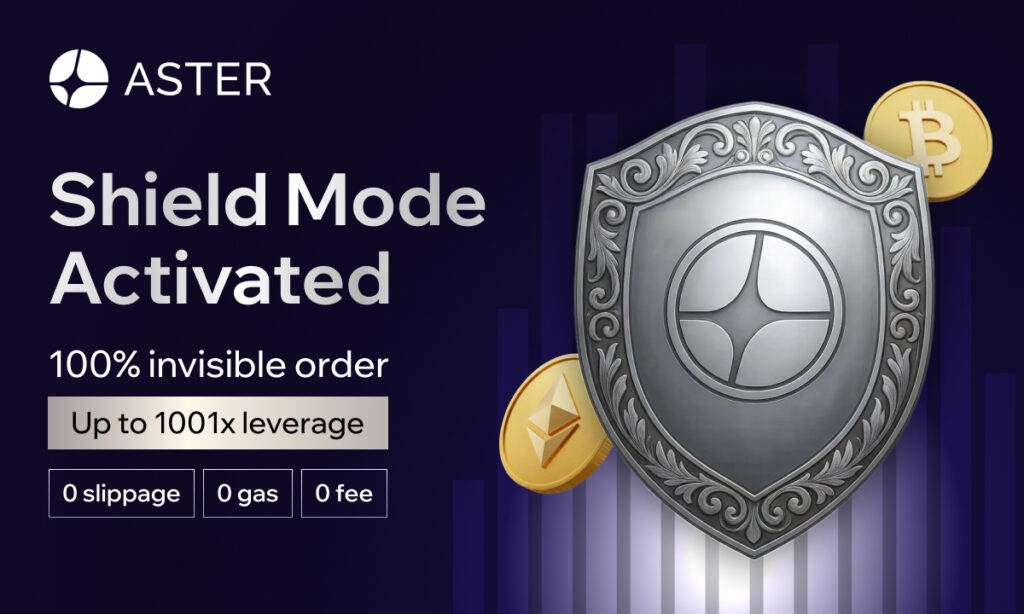
Aster, an on-chain trading platform focused on performance and privacy and supported by YZi Labs, has announced the launch of Shield Mode. This new feature, integrated into Aster Perpetual, introduces a protected trading option designed to offer high-leverage trading—up to 1001x—within a more secure and flexible on-chain environment.
Shield Mode represents a key milestone in Aster’s mission to build the next generation of on-chain trading platforms, designed to serve advanced traders while addressing the challenges of trading in fully transparent on-chain markets.
“Shield Mode reflects our belief that the future of on-chain trading isn’t just about leverage or speed—it’s also about control, discretion, and protection,” said Leonard, CEO of Aster. “We’re building a trading platform that allows traders to perform at the highest level without being forced to broadcast their strategies to the market.”
Evolving On-Chain Trading: From 1001x to Shield Mode
Aster’s 1001x product offers up to 1001x leverage, zero slippage, no opening fees, and fully on-chain settlement. As on-chain trading infrastructure evolved, participants became increasingly aware of the transparency-related trade-offs—particularly the exposure of trading strategies and intentions to the broader market.
In mid-2025, Aster introduced Hidden Orders on Aster Perpetual, enabling traders to conceal order price and size from the public order book while retaining access to available liquidity. This update was aimed at enhancing trading discretion within an on-chain environment.
Shield Mode builds on this foundation by introducing a more comprehensive protected trading mode, combining high-leverage performance with stronger protection of trading intent and a smoother, more controlled trading experience.
Shield Mode: A New Trading Mode on Aster
Shield Mode is a new trading mode built directly into Aster Perpetual, bringing the full 1001x trading experience into a single interface and account system.
The new mode simplifies how traders open and manage long or short positions by removing the need to interact with a public order book, while allowing seamless access to high-leverage trading without cross-chain switching, fragmented workflows, or frequent on-chain transaction signing.
Core features of Aster’s 1001x trading model remain intact, including up to 1001x leverage for BTC and ETH, zero slippage, and no opening fees. Shield Mode further improves efficiency by eliminating closing fees, removing gas costs entirely, and enabling faster trade execution. Together, these improvements set a new benchmark for cost-efficient, high-performance on-chain perpetual trading.
Flexible Fees, Designed for Different Trading Styles
Shield Mode is designed to support a flexible fee model, giving traders the ability to choose how they pay for trading based on their strategy and preferences.
In future updates, traders will be able to choose between Commission Mode, a transparent fixed percentage fee per trade designed for consistent and high-volume trading, and PnL Mode, a performance-based model where fees are only charged on profitable trades.
To celebrate the launch of Shield Mode, all Shield Mode fees will be waived until the end of the year.
This upcoming flexibility is intended to give traders greater control over trading costs and allow different trading styles to operate under fee structures that better match their risk profiles and trading behavior.
Building the Foundation for the Next Phase of Aster
Shield Mode reflects Aster’s broader vision beyond a single trading feature. By introducing a protected trading mode for on-chain markets, Aster gives traders greater discretion and stronger protection of their trading strategies.
By integrating the 1001x trading capability directly into Aster Perpetual, Shield Mode contributes to the ongoing consolidation of Aster’s core trading features into a unified system, aimed at streamlining access to high leverage and position management.
Combined with gas-free trading and zero fees, Shield Mode sets a new standard for efficiency and performance in on-chain perpetual trading. With this launch, Aster introduces additional features aimed at supporting professional and high-performance trading within the evolving landscape of on-chain finance.
About Aster
Aster is an on-chain trading platform offering high-performance perpetual and spot trading with MEV-aware trading mechanics, advanced order types such as Hidden Orders, and a protected trading mode, Shield Mode, across multiple chains. Beyond trading, Aster enables greater capital efficiency through Trade & Earn and supports ecosystem growth via Rocket Launch, which connects real traders with early-stage liquidity opportunities. Backed by YZi Labs, Aster is building toward its own Aster Chain and is currently running a multi-stage airdrop and incentive program to support its global community.
Users can learn more at Aster official website, or connect with Aster on the official X account.
Contact
PR & Content Manager
Lola Chen
Aster
[email protected]
Tampa, Florida, December 15th, 2025, Chainwire
The Geode Foundation, a registered 501(c)(3) nonprofit dedicated to fostering economic opportunity and community empowerment through blockchain innovation, today proudly announces the primary exchange listing of its native cryptocurrency, GEODE, on BitMart.com.
This milestone marks GEODE’s trading debut, opening the doors for broader adoption and liquidity in a project that has been quietly revolutionizing decentralized applications since its inception almost four years ago.
As the crypto market continues to evolve amid a pro-crypto regulatory landscape in the United States, Geode Chain stands out as a beacon of long-term sustainability and real-world utility. Built on a foundation of volunteer-driven development and a mission to “set humanity free,” Geode Chain integrates a robust Layer 1 blockchain with a fully deployed suite of native apps, enabling seamless access to the entire “Internet of Chains” in one unified ecosystem. This listing on BitMart – a trusted exchange serving millions of users worldwide – is not just a trading event; it’s a gateway for everyday people, the crypto curious, creators, and innovators to join a movement that’s been operating and building for years.
A Proven Foundation: MainNet Excellence and Native App Ecosystem
Launched in February 2023, Geode Chain’s MainNet has achieved an extraordinary record of zero downtime over 34 months of continuous operation – a testament to its resilient Nominated Proof of Stake (NPoS) consensus mechanism, which consumes 99% less energy than Proof of Work alternatives. This eco-friendly architecture allows users to participate using everyday devices like laptops, desktops, or even smartphones, democratizing access to blockchain technology without the need for specialized hardware. Complementing the chain is Geode’s native app suite, already fully built and deployed, empowering users to register intellectual property (IP) on-chain for immutable timestamps, endorse expertise among peers, and monetize creative works directly. The Life and Work App, for instance, lets users post work history, education, and “good deeds” while facilitating endorsements and IP protection. Additional Geode apps include social, private messaging, marketplace, and cross-chain dApp discovery – all designed to create a complete user-owned economy where value flows back to individuals, not intermediaries.
“Geode isn’t just another blockchain; it’s a 50-year vision for economic sovereignty,” said Dr. Kathryn Messegee, Founder at Geode. “With our MainNet’s unwavering reliability and apps already in users’ hands, we are proving that decentralization can be practical, and transformative from day one.”
Surging User Growth: A Thriving Community of Over 10,000 Active Participants
Geode Chain’s grassroots momentum is undeniable, with over 10,000 registered users and counting – a figure that reflects not just sign-ups, but active engagement. Remarkably, 40% of account holders contribute as ambassadors, product testers, or innovation team members, far surpassing typical blockchain retention rates. This organic growth stems from Geode’s “post-to-earn” programs, onboarding incentives and more which reward participation in everything from content creation to validator nominations. The project’s all volunteer global team, spanning developers, marketers, and governance experts, has fueled this expansion without relying on venture capital or fiat funding. Instead, Geode operates as a self-sustaining and self-funded project, promoting long-term tokenomics health. As users flock to the platform for its low-barrier to entry and real utility, Geode is positioning itself as the go-to hub for cross-chain interactions, where one app unlocks the decentralized world.
Leadership and Vision: Purpose-Driven Innovation for Generations
At the helm is the husband-wife team of Thomas and Kathryn Messegee. Thomas Messegee – hardware and software prototyping expert – serves as the technical team lead overseeing development. Dr. Kathryn Messegee, PhD – a mathematician, behavioral expert, former DARPA Program Manager – serves as the CEO, whose visionary leadership has guided Geode from concept to a mature ecosystem. With expertise in blockchain, smart contracts, and human-centered design, Dr. Messegee has assembled a distributed team of volunteers passionate about replacing centralized gatekeepers with user-governed tools. This includes on-chain governance for treasury decisions, code upgrades, and runtime parameters, ensuring the chain evolves with its community. Geode’s long-term roadmap extends far beyond today’s listing: a 50-year commitment to building an “entirely new economy” where GEODE can pay rent, buy groceries, and fuel global collaboration. By converging AI and blockchain, Geode envisions a decentralized future that accelerates innovation while prioritizing privacy, IP rights, and the Individual. As the project eyes expansions into AI-OS integrations, this listing accelerates the marathon toward a world where individuals – not corporations – control their digital destiny.
About The Geode Foundation
The Geode Foundation is a US based 501(c)(3) nonprofit organization on a mission to promote economic opportunity for all by increasing innovation, awareness, and access to decentralized applications (dApps) and on-chain activities. Founded in February of 2022 and headquartered in Florida, the Foundation oversees the development of Geode Chain – a Layer 1 blockchain and native app suite designed to bring the Internet of Chains into one accessible place for everyday people. With a focus on volunteer-driven progress and community governance, Geode empowers creators, educators, businesses, and individuals worldwide to thrive in a decentralized economy. For more information, users can visit geodechain.com or follow @GeodeChain on X at X.com/GeodeChain.
About BitMart
BitMart is the premier global digital asset trading platform. With millions of users worldwide and ranked among the top crypto exchanges on CoinGecko, it currently offers 1,000+ trading pairs with competitive trading fees. Constantly evolving and growing, BitMart is interested in cryptoʼs potential to drive innovation and promote financial inclusion. To learn more about BitMart, users can visit their website, follow their Twitter, or join their Telegram for updates, news, and promotions. Users can download the BitMart App to access cryptocurrency trading at any time and from any location.
Media Contacts
For more information, users can contact:
Geode: [email protected]
BitMart: [email protected]
Disclaimer
The information provided is for informational purposes only and should not be considered a recommendation to buy, sell, or hold any financial assets. All information is provided in good faith. However, we make no representation or warranty of any kind, express or implied, regarding the accuracy, adequacy, validity, reliability, availability or completeness of such information.
All crypto investments, including earnings, are highly speculative in nature and involve substantial risk of loss. Past, hypothetical, or simulated performance is not necessarily indicative of future results. The value of digital currencies can go up or down and there can be a substantial risk in buying, selling, holding, or trading digital currencies. You should carefully consider whether trading or holding digital currencies is suitable for you based on your personal investment objectives, financial circumstances, and risk tolerance. BitMart does not provide any investment, legal or tax advice.
Contact
Founder
Dr. Kathryn Messegee
Geode Chain
[email protected]