



Artificial intelligence is reshaping how digital transactions are monitored, verified, and protected, and the online gambling sector is one of the clearest examples of this shift. As more users move toward mobile and browser-based wagering, payment providers and gambling operators are turning to AI to reduce fraud, flag suspicious activity, and strengthen data security. Machine-learning models are increasingly being adopted across financial services to strengthen transaction integrity, and these same advancements are now making their way into gambling payment systems.
AI’s Role in Strengthening Fraud Detection
AI tools help online gambling platforms analyze thousands of micro-signals within a transaction, device behavior, login patterns, and session frequency to spot inconsistencies humans would miss. For users, this means fewer false declines and smoother verification when funding accounts or withdrawing. In early operational reports across the industry, platforms that use AI-driven monitoring describe fewer chargeback attempts and improved system responsiveness, which helps payment processors stay ahead of emerging fraud tactics.
To reflect this shift, the sector has seen a growing number of reviewers compiling evaluations of digital gambling platforms, including a huge accumulation of promos that were thoroughly reviewed. These reviews often highlight where AI-enhanced systems are contributing to safer, more reliable user transactions.
How AI Enhances Data Protection and Compliance
As gambling becomes increasingly digital, the ability to safeguard user data is essential. According to reporting on financial-technology security advancements, AI-based payment systems allow operators to encrypt information more strategically and monitor for potential breaches in real time. These capabilities help support compliance with strict data-handling regulations in regions where online wagering is legal.
AI also improves risk scoring for transactions involving new accounts or unfamiliar devices. This automated decision-making reduces the need for manual reviews and enables operators to respond quickly to threats without slowing down legitimate payments. For users, the result is a more stable and predictable system, where identity checks feel less intrusive yet remain secure.
AI and Real-Time Payment Verification
One of the biggest advantages of AI in online gambling is its ability to validate payments instantly. Machine-learning models can assess withdrawal requests, verify account ownership, and scan for abnormal behavior within milliseconds. This is especially important for platforms operating across multiple jurisdictions, each with different regulatory requirements.
Modern payment systems increasingly rely on automated decisioning powered by machine-learning applications, reflecting the ongoing AI trends, and at the same time helping gambling operators reduce waiting times and ensure faster approval of withdrawals and transactions.
A More Secure Future for Digital Gambling
AI is not eliminating risk in online gambling, but it is narrowing the window for fraud and making payment systems far more efficient. With more operators incorporating automated decisioning, predictive analytics, and behavioral risk scoring, users benefit from safer transactions and faster verification.
The ongoing integration of AI into payment infrastructure suggests the industry is moving toward a more accountable, transparent system. As fintech and digital payment systems evolve, it’s becoming clear that AI will remain central to how gambling platforms protect user transactions and shape the next generation of online gaming experiences.

In 2025, choosing a reliable Virtual Private Network (VPN) is essential for protecting privacy, securing personal data, and accessing global content, including sports streaming. With cyber threats increasing and streaming platforms tightening restrictions, the right VPN can make a significant difference in speed, security, and overall online experience. As more websites track user activity and governments introduce stricter digital regulations, having a trustworthy VPN has shifted from being optional to becoming a core part of everyday online protection. The best VPNs today not only safeguard your identity but also ensure uninterrupted streaming, faster browsing, and greater freedom across the internet.
Below are the five best VPN services in 2025, evaluated on performance, features, and overall value.
1. ExpressVPN – Best Overall VPN (Editor’s Pick)

Overview
ExpressVPN remains the #1 Best VPN provider in 2025 thanks to its unmatched combination of speed, security, and ease of use. It’s also ranked as the Best VPN for 2025 by CNET. Its Lightway protocol delivers fast and stable connections ideal for streaming, gaming, torrenting, and general browsing. The VPN reliably unblocks major streaming platforms with minimal buffering and strong global server performance.
TrustedServer technology, which runs servers entirely on RAM, ensures that no data is ever stored or retained. A strict no-logs policy, kill switch, split tunneling, and strong device support make ExpressVPN the most complete premium service available.
Exclusive DEAL (73% off with 4 Months Free – $3.49 per month)
Pros
- Extremely fast and stable global speeds
- Excellent streaming and unblocking capabilities
- Strong privacy with RAM-only servers
- Very easy to use across all devices
- Highly reliable kill switch and split tunneling
Cons
- Slightly more expensive than competitors
- Fewer simultaneous device connections than some rivals
2. Private Internet Access (PIA)

Overview
Private Internet Access ranks second due to its high degree of customizability, large server network, and transparency. PIA allows users to tailor encryption levels for speed or maximum security, making it appealing to advanced users and torrenters. Its open-source applications add trust and accountability, giving users full visibility into the VPN’s code.
PIA includes built-in ad and malware blocking, a strong no-logs policy, and support for up to ten simultaneous devices. While not always the fastest on long-distance connections, its flexibility and feature set make it one of the most dependable VPNs of 2025.
Exclusive DEAL (83% off with 2 Months Free – $2.19 per month)
Pros
- Highly configurable encryption and VPN settings
- Massive server network for strong global coverage
- Open-source apps for added transparency
- Great value with long-term pricing
- Supports many simultaneous connections
Cons
- Not as fast as ExpressVPN on some international servers
- Interface can feel complex for beginners
3. CyberGhost
Overview
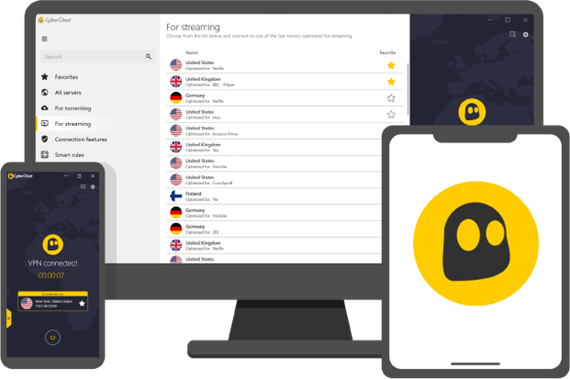
CyberGhost secures the third spot for offering a wide server network, streaming-optimized servers, and strong privacy features at an affordable price. It provides a simple, beginner-friendly interface while still offering quality performance for streaming, browsing, and general online security.
With servers dedicated to streaming and torrenting, CyberGhost makes it easy for less technical users to connect to the best option for their needs. It uses AES-256 encryption, has a clear no-logs policy, and offers automatic Wi-Fi protection, ensuring secure connections in public settings.
Exclusive DEAL (83% off with 2 Months Free – $2.19 per month)
Pros
- Large server network across many countries
- Dedicated streaming and torrenting servers
- Very easy to use for beginners
- Strong privacy protection and encryption
- Good pricing for long-term plans
Cons
- Not as customizable as PIA
- Speeds can vary depending on server selection
4. NordVPN

Overview
NordVPN ranks fourth for its advanced security features, fast NordLynx protocol, and extensive server options. It includes specialty servers for double VPN routing, Onion over VPN, and P2P activity, giving users advanced privacy control. NordVPN’s speeds are consistently strong, making it ideal for gaming, streaming, and everyday browsing.
The service includes a kill switch, split tunneling, ad blocking, and a firm no-logs policy. It works across all major platforms, including desktops, mobile devices, and smart TVs, with easy-to-navigate apps.
Pros
- Strong security features, including double VPN
- Fast NordLynx protocol for high-speed connections
- Great for streaming, gaming, and downloads
- Wide server coverage with specialty servers
- Reliable privacy protections
Cons
- More expensive than budget VPNs
- Some advanced features may overwhelm new users
5. Surfshark
Overview
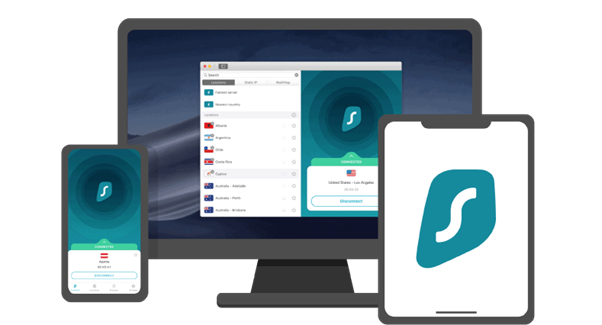
Surfshark is the fifth-best VPN of 2025, offering excellent value with unlimited device connections, strong encryption, and an intuitive interface. It includes security features such as CleanWeb for blocking ads and trackers, a kill switch, and a no-logs policy. Surfshark maintains strong speeds on most servers, making it a dependable option for streaming and browsing.
Its affordability, combined with its feature set, makes Surfshark a suitable choice for families, households with many devices, or users on a budget who still want top-tier security.
Pros
- Unlimited simultaneous device connections
- Excellent value for its price
- Strong privacy and encryption features
- CleanWeb blocks ads, trackers, and malware
- User-friendly apps
Cons
- Not as consistently fast as ExpressVPN
- Some features are locked behind higher-tier plans
Frequently Asked Questions About VPNs
1. What is a VPN and why do I need one?
A VPN, or Virtual Private Network, encrypts your internet connection and routes it through a secure server. This protects your data from hackers, keeps your online activity private, and allows you to access content restricted by region. In 2025, VPNs are essential for secure browsing, especially on public Wi-Fi networks.
2. Can a VPN slow down my internet connection?
Using a VPN can slightly reduce speed due to encryption overhead and server distance. However, top VPNs like ExpressVPN and PIA optimize their networks to minimize speed loss. Selecting a server near your location or using faster protocols like Lightway or WireGuard can reduce latency.
3. Are VPNs legal?
VPNs are legal in most countries, including the US, UK, Canada, and EU nations. Some countries, such as North Korea or Turkmenistan, restrict VPN use. It is always important to understand local laws before using a VPN in restrictive regions.
4. Can I use a VPN for streaming?
Yes, VPNs are widely used to bypass geo-restrictions and access streaming platforms. Leading VPNs like ExpressVPN, CyberGhost, and PIA offer servers specifically optimized for streaming services like Netflix, Disney+, Hulu, and BBC iPlayer.
5. How many devices can I connect to a VPN?
The number of simultaneous connections varies by provider. ExpressVPN allows up to 14 devices, PIA and Surfshark offers unlimited connections. Choosing a VPN with sufficient device support ensures all your gadgets remain protected.
6. Does a VPN keep my online activity completely anonymous?
While VPNs provide strong privacy and encrypt your connection, complete anonymity cannot be guaranteed. VPNs hide your IP address and location from websites and ISPs, but other factors like cookies, trackers, or browser fingerprinting can still reveal information. Combining a VPN with good privacy practices maximizes protection.

- Gaming revenue in the United States rose by 7.2% to hit $18.96 billion in Q3 of 2025.
- Traditional gaming recorded the most revenue in Q3, while iGaming recorded the most growth of all gaming verticals.
- The data shows that with expansions and technological innovation, gaming revenue in America could increase in the coming year.
The American Gaming Association (AGA) posted its revenue report, where gaming revenue rose by 7.2% year-on-year (YoY) to reach almost $19 billion. According to the AGA, this report from Q3 2025 is the 19th time that quarterly revenue rose YoY, and it is also the highest Q3 revenue ever recorded in American gaming.
Gaming is one of the most lucrative sectors in America’s entertainment industry, and since the start of 2025, states like Nevada, New Jersey, Pennsylvania, and Michigan have been breaking revenue records. This pattern has continued in Q3 2025.
Breaking Down The Numbers
The report also shows that online gaming and sports betting were the highest-gaining verticals in the gaming industry. Traditional gaming revenue increased by 3.5% to almost $13 billion, while sports betting and iGaming increased by 6.85% and 29.6% to $3.45 billion and $2.69 billion.
The gaming revenue for Q3 was affected by a slow September, where sports betting and brick-and-mortar casinos saw their revenue decrease YoY. Despite the dip, the overall Q3 report is impressive, indicating that there is still more room for growth in the industry.
Some of this growth is linked to how big the iGaming sector has become. More Americans like the convenience of playing online, so new casinos online keep entering the market. These newer platforms focus on players who want something a bit different from the big brands, with updated features and clearer reward systems.
Revenue From Casino Table Games and Slots
At the national level, the revenue from slots grew by 4.0% YoY while generating about $9.5 billion. Table games also grew 1.3% YoY and generated about $2.5 billion in revenue in Q3.
Land-based casinos saw their combined revenue increase by 3.5% to almost $13 billion. The revenue from these casinos grew YoY in July and also in August before shrinking in September.
Across the states, Nebraska, Virginia, and Illinois were the biggest gainers as 22 out of the 27 traditional casino markets saw their revenue go up on a YoY basis. Nebraska posted revenue growth of 63.5% while Virginia and Illinois recorded growth of over 35.5% and 20.4% respectively.
The sustained growth of traditional casinos shows that both online and traditional casinos can coexist and support the growth of the gaming sector and overall entertainment industry.
iGaming Continues to Expand
iGaming is one of the fastest-growing gaming verticals in America, and although some states have yet to legalize it, the data shows that they are missing out on significant revenue, which can be channeled in the form of taxes to benefit their economy.
In Q3, iGaming generated almost $3 billion from all seven states where it has been legalized. Compared to the revenue from Q3 2024, iGaming revenue grew by 29.6%. Out of all the seven states, Delaware gained the most as its iGaming revenue for Q3 grew by almost 89%.
With states like New Jersey, Pennsylvania, and Michigan setting new monthly records, total iGaming revenue in the country on a year-to-date basis stood at $7.82 billion, which is 29.7% higher than the revenue from Q1-Q3 2024. Pennsylvania broke its previous record of $238 million, which was set in March, by achieving $251 million in October. That record may also be broken in Q4.
Sports Betting Income Contracts Slightly
There was a sharp decline in sports betting revenue in September, and it caused the Q3 revenues for sports betting to contract slightly. The hold rate for sports betting in September fell to 8.36% while revenue declined by 21.15%.
Despite the weak performance in September, revenue from Q3 sports betting grew by 6.6% to reach a new record of $3.5 billion. Sports betting in Q3 also increased by 13.9% as the AGA reported that Americans spent $33 billion on sporting bets between July and September.
States With The Biggest Gains
Based on the commercial gaming revenue, 33 states saw their revenue increase in Q3. Some of the biggest gainers are Connecticut (24.6%), District of Columbia (23.7%), Illinois (17.0%), Michigan (18.2%), Nebraska (63.5%) and West Virginia (16.4%) while Oregon, Maine, North Carolina and Tennessee recorded declining revenues. The lowest was Oregon with 16.3% decline. The gaming sector in each of these states is good for their economy since it not only provides jobs to residents, but the state also generates taxes.
Revenue Generated from Taxes
An increase in revenue usually translates to an increase in tax payments, and in Q3, commercial operators paid about $4 billion in gaming taxes, which led to a 7.4% increase YoY. The taxes in this bracket exclude sports betting taxes and annual tax levies, which are paid to the national government.
What This Means For The Future
The gaming sector has faced some of the biggest regulatory challenges in 2025, but despite these challenges, revenue keeps increasing. This increase in revenue shows that the gaming sector has potential for the future.
Apart from being resilient, it also brings investments. Positive revenue number means that investors will be more open to backing operators and also introduce new innovations. These innovations would, in turn, lead to financial growth, which would push the gaming sector to break new revenue records.
Experts predict that with a strong finish in Q3, the total gaming revenue could cross $70 billion for the second year in a row. With brick-and-mortar casinos still leading the charge and more people warming up to online casinos, experts believe 2025 will end as a record-breaking year for gaming in America.
The 7.2% increase in Q3 revenue is a good sign for the gaming market in 2025. Lawmakers would need to focus on creating an enabling environment for the gaming industry to thrive and also attract more investment in the final quarter of 2025 and in 2026.

Bank of America plans to let its advisers talk openly about regulated crypto allocations next year, giving eligible clients the option to place a modest 1 to 4 percent of their portfolios into digital assets. The update applies across Merrill, Bank of America Private Bank, and Merrill Edge, which means a large number of investors will soon have access to guidance that previously required a client to start the conversation.
Before this policy change, advisers could respond to questions about digital assets but were discouraged from bringing them up unprompted. That arrangement left crypto in a kind of gray zone: available, but tucked away unless someone went looking for it. With more than 15,000 advisers now allowed to approach the topic as part of broader planning, digital assets will sit closer to traditional areas like equities and commodities. Even so, Bank of America continues to point out that crypto swings harder than most asset classes, so any allocation should be sized with care rather than excitement.
Away from financial markets, digital currencies continue appearing across daily online habits. People use them for subscription platforms, small retail purchases, and gaming services. Bitcoin casinos are part of that trend, operating with fast payments and support for a range of coins. Given the technology backing these decentralized currencies, coins like USDC, AVAX, and Polygon now play meaningful roles across different digital environments (source: https://casinobeats.com/online-casinos/bitcoin-casinos/). When adoption grows in these areas, it becomes easier to see why major banks feel more comfortable treating crypto as a legitimate point of discussion.
The bank’s recommended 1 to 4 percent range leaves room for different comfort levels. Investors who prefer a cautious entry can take the minimum route, while those prepared for sharper movements may choose something higher within the approved range. Bank officials continue to highlight the importance of knowing how unpredictable these markets can be. The emphasis is on understanding exposure, not chasing eye-catching numbers or the next big story.
A defining part of the updated approach is its reliance on regulated exchange-traded products instead of direct token storage. On January 5, 2026, advisers will begin covering four spot Bitcoin ETFs: BlackRock’s IBIT, Grayscale’s Bitcoin Mini Trust, Fidelity’s FBTC, and Bitwise’s BITB. These products have handled strong trading volume in the U.S. and allow clients to gain price exposure without managing digital wallets or private keys.
Bank of America’s move lands in familiar territory for other financial institutions. Morgan Stanley, Fidelity, BlackRock, and Vanguard have all released guidance in recent months, even while Bitcoin cooled from its early October high above 126,000 dollars. The asset remains down roughly ten percent for the year, yet interest continues at both professional and retail levels, suggesting that many investors now see crypto as a long-term consideration rather than a quick speculation.
The timing lines up with broader improvements in the country’s digital asset infrastructure. Regulated ETFs have helped reduce custody concerns and made price exposure simpler. Meanwhile, blockchain based tools and payments continue appearing across online commerce and entertainment. With those pieces in place, Bank of America’s updated approach treats digital assets as one element in a wider collection of choices. It acknowledges the growing presence of crypto across markets and online behavior while keeping client suitability front and center.

WhiteBIT, the largest European crypto exchange by traffic, has officially launched in the U.S. market. The platform whitebit.us is now accessible to millions of Americans.
WhiteBIT US is a separate, independent company within the global fintech ecosystem W Group, which currently serves 35 million clients worldwide.
The U.S. team, with offices in New York and Miami, plans to implement a business strategy focused on gradual expansion, functional development, and building strong, trust-based relationships with customers. In particular, during the launch in the U.S., the exchange’s native coin, WBT, has already been included in five S&P crypto indices, including the S&P Cryptocurrency Large Cap Index and the Cryptocurrency Broad Digital Asset (BDA) Index.
What are WhiteBIT’s expectations and plans for the U.S. market? What challenges have been encountered, and how will the local product evolve? We spoke with Volodymyr Nosov, the founder and president of W Group.
1. WhiteBIT has announced its entry into the US market. What are your business expectations for this market?
The U.S. is the largest cryptocurrency market in the world by key indicators, including capital volume and financial infrastructure. It generates the largest amount of institutional liquidity, with a high level of mass crypto adoption and enormous overall potential.
In the past year, the North American market generated more than $2.2 trillion in revenue, and the volume of cryptocurrency transactions in the region in 2025 increased by nearly 50% compared to the previous year.
Approximately 10–25% of Americans own cryptocurrency, and the U.S. ranks second globally in crypto adoption, according to Chainalysis, trailing only India.
Naturally, entering the U.S. market aligns with our long-term strategy. The growth opportunities here are enormous. Over the past year, the U.S. has made an incredible leap in blockchain innovation, and such momentum inspires us as we integrate into this market.
So we expect active development and anticipate strong results within a reasonable timeframe.
2. The U.S. market is highly competitive. How have you organized your business here, and what is your strategy?
We have obtained the Money Transmitter License (MTL) because our expansion in the U.S. must meet the highest standards. As we continue to grow, the number of licenses we hold will increase, as we aim to operate across the entire U.S. territory.
As for the organization of the business, WhiteBIT U.S. is an independent company, separate from WhiteBIT Global, with its own autonomous team, compliance, and legal structure. There will also be a separate supervisory board.
We plan to create new job opportunities in the U.S., expand our team, and develop innovative products that will strengthen the technological standing of the U.S. globally.
It’s a huge market, and there is much to be done. Particularly attractive for development are California, with its large population and strong tech orientation; New York, a financial hub with high standards for the crypto industry; Florida, known for its numerous pro-crypto initiatives; Wyoming, which has progressive blockchain legislation; and others.
3. What challenges have you faced in entering the U.S. market? Was it difficult, and how expensive was it?
One of the key challenges is to enter the U.S. market with competitive products. Our team has been working actively on this. The competition in the U.S. is immense, requiring an extremely innovative approach.
Additionally, the U.S. regulatory landscape is one of the most complex and dynamic in the world. Licenses are issued at the state level, and each state has its own regulatory rules, procedures, and requirements for applicants, including AML and KYC. Obtaining the Money Transmitter License required significant effort.

Adapting the product to the local market also demands substantial resources. Competition in the U.S. is fierce, requiring a highly innovative approach.
Financially, it is certainly a high-cost project. We are moving step by step, and our strategic plan is to raise around $2.5 billion in the U.S. over the next few years to scale operations, conduct marketing, develop products, and compete effectively.
4. How do you plan to earn the trust of American users and investors?
Our presence in the U.S. is the result of seven years of work by a team of top engineers and technical specialists. We have come to the U.S. to strengthen our leadership and to play big. And, of course, we introduced ourselves at Times Square.
We bring seven years of experience to the American audience. Our highest priority is security. WhiteBIT ranks in the top three globally for security among crypto exchanges, according to CER.live, and is the first crypto exchange in the world to achieve the highest level of certification under the Cryptocurrency Security Standard (CCSS), Level 3.
WhiteBIT has a powerful technical core capable of processing over a million orders per second, making it one of the fastest exchanges in the industry.
We are proceeding gradually. Currently, users have access to spot trading, instant exchange, and on/off-ramp services.
Over time, functionality will expand—particularly with fiat integrations, KYB (corporate onboarding), and institutional services, including custodial solutions and liquidity offerings.
5. We know your launch is accompanied by a communication video on Times Square.
New York is the financial heart of the world, where global capital converges. WhiteBIT maintains an office here. Naturally, launching our communication at Times Square is a powerful symbol of our readiness to operate at the level of the world’s financial center, side by side with the best in our field, the titans of financial business.
Our branding campaign launched at the end of November to mark WhiteBIT’s 7th anniversary and our new pivotal stage of development: entry into the American market. It highlights one of our core values — innovation and the trust placed in it. The campaign includes several short films showing how people’s daily lives improve through blockchain technology and how innovation creates a new digital economy.
Ultimately, our mission is to create accessible and secure modern financial tools that make users’ lives easier.
6. Parallel to the launch in the U.S. market, WBT has been included in 5 S&P indices. What prospects do you see as a result of this?
Yes, since the end of November, our native coin, WBT, has been included in five S&P indices: Broad Digital Asset, BDA Ex-MegaCap, LargeCap, LargeCap Ex-MegaCap, and Financials. This is the result of our professional team’s work and a very positive signal for both our coin and the market as a whole. It confirms the strong institutional relevance of WBT.
For example, inclusion in the S&P Cryptocurrency LargeCap Index reflects WBT’s substantial market capitalization (currently over $13 billion) and the coin’s high liquidity.
For us, it is especially important that WBT is no longer viewed merely as a currency or asset; it is now recognized as a recommended instrument for serious financial decisions. We expect WBT to soon appear in the portfolios of major fintech investors and hedge funds, which will further strengthen its liquidity and market capitalization.
It is crucial for us to build bridges between Web2 and Web3. Today, WBT’s role as a “bridge” between the crypto market and more traditional financial instruments — such as ETFs, funds, and index products — has become even more significant.

7. How quickly did WhiteBIT scale, and how was the W Group ecosystem formed?
WhiteBIT began as a local startup in Ukraine. Over time, it grew into the largest cryptocurrency exchange in Europe by user traffic. Today, WhiteBIT serves over 8 million customers across 150 countries. In 2024, annual trading volume on WhiteBIT reached $2.7 trillion.
Around WhiteBIT, we have built the W Group fintech ecosystem, which includes our own blockchain, Whitechain; the cryptocurrency payment gateway Whitepay; the marketplace white.market for trading CS2 skins; and two projects in Georgia — the first fully digital local bank, HashBank, and the first non-banking financial institution, PayUniCard.
We also run media projects: the ByHi Show, the world’s first entertainment show about the blockchain industry, and The Coinomist, an analytical and news platform covering the cryptocurrency market.
Today, our global group of companies employs over 1,300 people. WhiteBIT USA will also create many job opportunities, attracting top specialists from around the world and strengthening blockchain development in the U.S. market, as well as its technological role globally.
8. In which other markets does WhiteBIT operate?
Our products are popular in many countries, including Australia, Turkey, Georgia, Kazakhstan, Croatia, Italy, Argentina, Brazil, and others.
In total, we offer users a well-developed product line, and we are especially proud of our utility coin, WBT. Its value has increased more than 27 times since its launch. By the way, in October this year, WBT entered the top 9 most efficient cryptocurrencies, performing even in bear market conditions (according to Yahoo Finance), and was also ranked among the top 12 coins on CoinDesk.
9. You have many notable partnerships — VISA, Juventus FC, FACEIT. What can you tell us about plans for partnerships with U.S. companies or financial institutions?
Collaboration with strong partners helps us reinforce our positions in international markets while influencing the financial habits of millions of users, advancing their personal financial culture, and introducing them to the most innovative financial tools.
As for the U.S., we certainly plan to develop partnerships with local companies and key stakeholders. This market is extremely important for us, and we aim for deep integration of our services into the local financial infrastructure.
I cannot reveal details yet, but we have ambitious plans to build impactful partnership stories.
10. What impact do you expect WhiteBIT’s entry into the U.S. market to have on the overall development of the W Group ecosystem, and how might this change your role in the global crypto market?
The primary impact of WhiteBIT U.S. on our W Group ecosystem is that time-tested technologies and a strong American company will help elevate blockchain products to a new level, not only in the U.S. but also worldwide.
The primary goal of any business is to grow in volume and quality metrics. The U.S. is actively shaping financial and technological innovation and is one of the world’s largest and most lucrative markets.
Developing in the U.S. will allow us to attract new users, strengthen trust in our ecosystem from both retail customers and institutional investors, as well as regulators.
We are always open to development and want to achieve more. One of our goals is to become a public company and pursue an IPO.
11. Finally, I’d like to ask about ICTC 2025 by WhiteBIT, which has become a significant event in crypto trading. What is the goal of this event, and do you plan to continue organizing ICTC in 2026?
For the first time in history, we organized a live international crypto trading championship. We gathered top traders and demonstrated their skills in real-time, in front of a large audience. There were teams and individual players, and the viewers could see everything — strategies, decisions, and the whole process.
We set ourselves a big goal: to make crypto trading as exciting as major esports tournaments and attract a huge audience. Additionally, ICTC gave our community a chance to participate — one of the eight participants was chosen through a global qualifying round, showing that anyone with the right talent and passion can reach the top.
For us, it was essential to set a new standard for crypto trading events. In an unprecedented moment, the winner’s name was displayed on LED screens during the “El Clásico” football match — a combination of esports excitement, cryptocurrency, and world-class football.
With ICTC, we have set a global standard for live events in the cryptocurrency world. And yes, we plan to continue this in 2026.
After a recent reverse split, SMX (SMX) now trades with roughly 1,050,000 shares outstanding. That tight structure shaped the entire trajectory of its surge from $5 in November to $490 last Friday. Before breaking down the synthetic mechanics behind that move, the fundamentals deserve credit.
SMX has had a transformative 2025. The company expanded across plastics circularity, aerospace metals, textiles, hardware-level supply chain verification, and national authentication platforms. It delivered real commercial progress through six major partnerships. In other words, the business improved, and the market noticed.
But fundamentals alone rarely lift a microcap into triple-digit prices this fast. The behavior of the order flow signals that structural pressure was a major contributor. Retail traders rarely buy 100-share lots once a stock crosses $100, and they almost never buy meaningful size at $200, $300, or $400. Those rarely become lottery wins, for which SMX offered a ticket last week for $5. Price-insensitive buying usually belongs to participants who have no choice.
SMX Attracted Eyes for the Right Reasons
That doesn’t diminish SMX’s operational progress. It simply means the short side likely played a major role in amplifying the move. The volume reinforces that view. SMX traded roughly 3.8 million shares on Friday and about 6.5 million on Thursday. For a one-million-share float, that’s not a retail stampede. If this were purely retail-driven momentum, volume would usually explode. That’s because retail buys, sells, rebuys, sells, chases, buys, sells, etc. It creates a lot of circular volume.
Instead, Thursday and Friday stayed tight and controlled, which matches the behavior of forced buy-ins rather than speculative buying. It’s also likely the short position isn’t fully unwound yet.
Synthetic shorting explains why this unfolded the way it did. Synthetic positions were never the intention of SEC rules. They’re the accidental outcome of a system built on lending revenue, automation, and rehypothecation. Brokers earn interest when they lend shares. They’re allowed to lend the same share multiple times as long as positions remain collateralized. One real share can be lent, re-lent, and lent again. Synthetic supply multiplies. No regulator can realistically monitor thousands of microcaps constantly issuing new shares. Over time, the system drifted far beyond how it was designed to function. Here’s an example in SMX’s case.
The Loophole That Shorts Can Exploit…In This Case, Not
If SMX drew down from its $111 million ELOC and issued, say, 100,000 new shares in December, those shares wouldn’t simply add 100,000 shortable shares. They’d become the seed for several million synthetic short shares because each share can be borrowed and reborrowed repeatedly. That’s how small dilution events create disproportionate downward pressure. But this is where timing becomes everything.
If SMX issued zero new shares in December, which seems to be the intent, the float would stay locked at roughly 1,050,000 shares. With no fresh inventory, no broker can borrow new shares, no new shares can be rehypothecated, and synthetic short positions are exposed with nowhere to hide. When T+2 settlement hits, brokers who can’t deliver real shares are pushed into immediate forced buy-ins.
They can’t delay settlement. They can’t rely on future shares. They can’t avoid the clearing house. The squeeze still happens with zero dilution in December. In fact, it becomes even stronger because nothing weakens the structural pressure. This is how you get the rapid cascade from $20 to $40 to $80 to $200 and eventually $490 as synthetic layers collapse and brokers are forced to buy at rising prices.
What Happens Next Year?
Now consider the January scenario. Assume SMX doesn’t touch the facility at all in December. Then on January 5, the company sells 100,000 new shares. Those shares don’t settle into the float until January 7 or 8. But by January, the December squeeze has already played out. The synthetic short positions have collapsed. The forced buy-ins have already been completed. Shorts who failed to deliver in December already had to buy real shares at elevated prices. They couldn’t wait for potential January dilution. They couldn’t postpone settlement. They had to unwind into the market on the market’s terms.
So when the 100,000 shares settle in January, they don’t rescue December shorts, they don’t unwind December’s price action, they don’t erase the December squeeze, they don’t help brokers who already covered at $200 to $490, and they don’t instantly rebuild synthetic supply.
January dilution, if any, arrives in a clean market, not a pressured one. Rehypothecation takes time. It requires a borrowable supply, a willing broker, calm conditions, and multiple layers of re-lending. Immediately after a forced unwind, none of that exists. This is why delaying dilution until January protects the dilution period itself. The company gets capital with far less dilution than expected, the shorts get no bailout, and the stock’s structure remains intact.
SMX Holds the Cards AND Controls the Deal
With over $100 million available through its new facility, SMX now faces a choice. If it raises money through a structure that prevents share lending, such as placements with institutions that do not lend their inventory, the company can block rehypothecation before it begins.
Shares that cannot be lent cannot multiply into synthetic supply. If SMX times any use of its facility only after synthetic positions have collapsed, the company can add new shares without recreating the pressure that fueled years of downward distortion. The best time to dilute is after the unwind, not during it. Dilution after the collapse doesn’t rescue shorts, doesn’t weaken the pressure that already occurred, and doesn’t immediately rebuild the synthetic machinery. It allows SMX to strengthen its balance sheet, fuel its platform engine, and expand its strategic mission without destabilizing its stock price.
This combination of strategy and timing gives SMX something most microcaps never achieve: control. Control over capital formation, control over borrowing dynamics, and control over the structural forces that usually work against small companies. SMX earned this moment. Now it needs to protect it.

Vanguard recently announced that beginning December 2, 2025, Vanguard customers with brokerage accounts can now purchase certain, regulated, third-party mutual funds and ETFs that are associated with cryptocurrency. This marks a big moment in Vanguard’s history, especially after years of firm resistance to cryptocurrency. The development is a clear shift in their stance, yet the company is still handling digital assets with plenty of caution.
Vanguard claimed for many years that cryptocurrency is too volatile to possibly considered appropriate to hold in a long-term retirement account. This has been the rationale for denying requests to list things like spot Bitcoin ETFs and other similar products.With the new policy in place, Vanguard now treats crypto-linked funds the same way it handles other non-traditional asset classes.
What This Means for Investors
Vanguard oversees $11 trillion in assets and serves tens of millions of clients. Many of these investors prefer to keep their holdings under one roof for tax planning, reporting, and convenience. Until now, anyone interested in crypto exposure through regulated products often needed a second account at a different brokerage. The new policy removes that extra step and allows clients to pursue this exposure inside familiar systems.
Some investors may also look to independent market overviews in light of these updates, like Best Altcoins to Invest in, to get a clearer sense of which emerging assets are gaining traction. For example, in December 2025, Ethereum continues to hold a leading position among altcoins. It benefits from an active community of developers and steady progress on upgrades intended to support decentralized applications. Bitcoin Hyper has drawn interest for its attempt to provide a faster and more scalable environment for activity tied to the Bitcoin network. Maxi Doge, or MAXI, remains driven by online culture and community participation, attracting traders who follow short-term momentum and social-driven trends.
These examples illustrate how different the altcoin space can be in purpose and temperament. Some projects focus on infrastructure, others focus on culture and community sentiment. Investors who explore these areas can gain an additional sense of the range of assets that now fit within the larger crypto market.
Why Vanguard Updated Its Policy
Vanguard stated that the current group of crypto-linked funds has met its internal requirements related to liquidity, regulatory oversight, and the operational work needed to support trading. The firm noted that its brokerage systems can now handle these products with consistency and without additional strain.
Points to Consider
The updated policy does not guarantee that every crypto fund will appear on the platform. Vanguard will still decide which products meet its standards. Crypto-linked funds involve noticeable price swings, and altcoins vary widely in purpose, stability, and community interest. Tokens such as Bitcoin and Ethereum highlight the variety of approaches that define the market.
Investors who choose to add exposure may benefit from a measured approach. Vanguard’s change gives them another regulated option, but the fundamental risks of digital assets remain. A careful assessment of personal risk tolerance and investment goals still plays the central role in determining whether crypto-linked funds belong in a portfolio.

WhiteBIT’s coin (WBT) has been officially included in the S&P Cryptocurrency Broad Digital Market (BDM) Index, marking a significant milestone for both WhiteBIT and the broader fintech landscape of Central and Eastern Europe.
The S&P BDM Index — curated by S&P Dow Jones Indices — tracks the performance of leading digital assets that meet strict institutional criteria, including liquidity, market capitalization, governance, transparency, and risk controls. The addition of WhiteBIT coin reinforces the platform’s growing role in the global crypto economy and highlights the industry’s shift toward regulated, infrastructure-level players.
Beyond the inclusion in the Broad Digital Market Index, WhiteBIT’s native coin, WBT, has also been added to four additional S&P Dow Jones digital-asset indices, underscoring its emergence as a mature, institutionally relevant asset.
WBT now appears within several key benchmark families:
- S&P Cryptocurrency Broad Digital Asset (BDA) Index
- S&PCryptocurrency Financials Index
- S&P Cryptocurrency LargeCap Ex-MegaCap Index
- S&P Cryptocurrency LargeCap Index
These classifications require a multi-quarter record of liquidity stability, transparent price formation, and consistent market-cap behavior.
As the industry matures, index providers are expanding coverage beyond protocol-layer tokens, increasingly acknowledging the systemic role of exchanges and financial-infrastructure platforms. WhiteBIT’s coin presence in the BDM Index positions the company within the global map of institutional-grade digital-asset providers.
“Being recognized by S&P DJI is more than an index inclusion — it signals that crypto infrastructure from our region has reached global institutional standards,” said Volodymyr Nosov, CEO of WhiteBIT “This is a turning point not only for our company but also for the evolution of compliant crypto services worldwide.”
This expanded representation marks an important shift for WBT: from a utility token into a component integrated into global benchmark structures used by investment firms, ETF/ETN designers, and quantitative research platforms. Its presence in multiple institutional models means that WBT is now incorporated into the analytical frameworks that guide long-term allocation strategies, diversified exposure construction, and risk-adjusted portfolio modelling.
Market Performance: Resilient Growth and a New All-Time High
WBT’s inclusion comes after a period of stability and upward movement, reaching a new all-time high of $62.96 on November 18, 2025, despite broader market declines and changes external analyses noted WBT’s resilience. These factors contributed to meeting S&P’s criteria for classification.
Being part of S&P indices gives WBT a clear benchmark, making it easier to use in future financial products and long-term investment strategies.

The volatility inherent to cryptocurrencies is more than a buzzword. It fundamentally influences how crypto casinos operate, how players behave, and how the broader market evolves. According to data, the 30-day realised volatility of major digital currencies such as Bitcoin has ranged roughly between 30 and 45% in 2025, which is still far higher than traditional assets like stocks or fiat currencies. This persistent volatility shapes several critical dimensions in crypto gaming.

The Mechanics: Volatility in Numbers
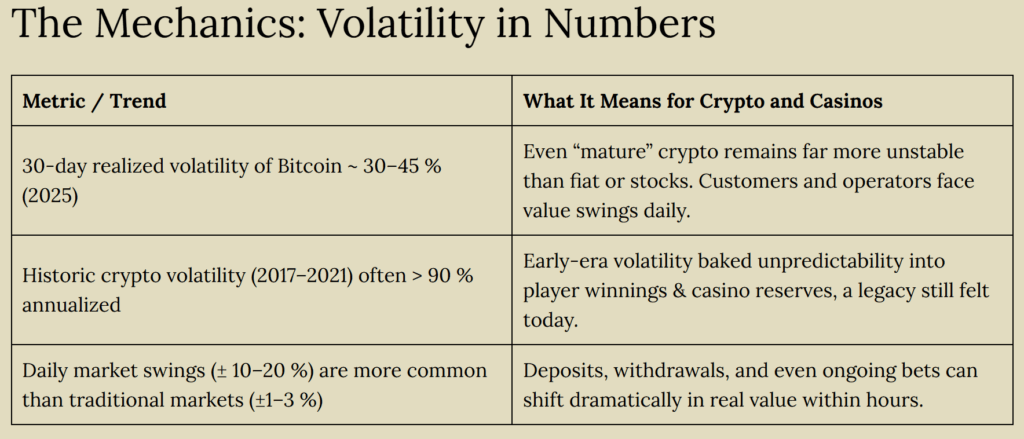
A high-volatility environment like this forces both operators and players to think beyond “win or lose”. They must also factor in currency risk.
Impact on Crypto Casinos: Revenue, Risk, and Stability
- Revenue & Cash-flow Stress: For casinos holding large crypto treasuries (deposits, player funds, reserves), price dips can erode their real-world value, potentially leading to insolvency risks or reduced ability to honour bonuses and payouts.
- Payout Uncertainty: Players might win a jackpot, but if the token collapses before withdrawal or conversion, the actual fiat value of that win could fall dramatically.
- Operational & Confidence Risks: Frequent swings can impair payment processing, create delays, or undermine trust, especially if users perceive the casino as financially unstable or unreliable.
- Push Toward Risk Mitigation: Some operators may increasingly favour or offer stablecoins (pegged to fiat) to reduce volatility exposure for both the casino and players.
In essence, volatility forces crypto casinos to adopt more rigorous financial and risk-management frameworks or face business instability.
Player Behaviour: From Gambling to Market-Driven Play
Volatility doesn’t just affect casinos. It fundamentally changes how players gamble.
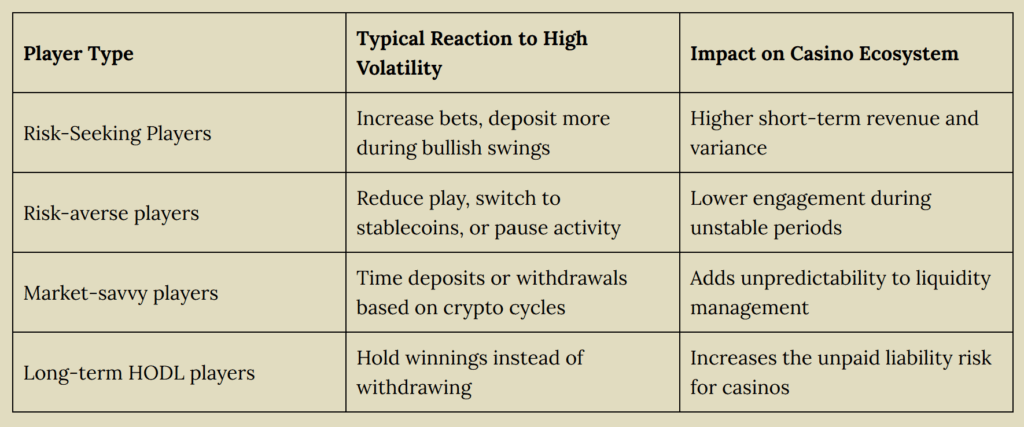
- Speculation + Gaming Hybrid: For some players, betting becomes inseparable from trading. They might place bets when markets are bullish, hoping for multiplied gains, or wait for market dips to deposit “cheap” tokens.
- HODL-style Winnings: Rather than immediately convert winnings to fiat, many choose to “HODL”. That would mean to keep the crypto, hoping for future appreciation. This, however, adds unpredictable risk.
- Risk-avoidance or Reduced Activity: Volatile swings may deter risk-averse players, especially if they fear that even a win could vanish in value before withdrawal.
- Strategic Timing: Experienced crypto-savvy gamblers may time deposits and withdrawals according to market cycles, effectively blending investing strategy with gaming behaviour
Market Stability & the Future of Crypto Casinos
The volatility of crypto markets, while risky, also acts as a powerful filter and driver of evolution in the crypto-casino industry.

- Selective Pressure: Only operators with strong financial management and liquidity resilience will thrive. Volatile markets weed out poorly capitalized casinos.
- Innovation Toward Stability: Use of stablecoins, hedging strategies, dynamic bonus/payout engineering, and risk-adjusted reserve models becomes more common to protect both casinos and players.
- Changing User Base: As gambling meets trading, casinos attract more “crypto-native” users; those familiar with markets, comfortable with swings, and willing to take on an extra layer of risk.
- Potential Regulatory Interest: As crypto-casinos grow, regulators may pay more attention, especially given volatility-driven risks to consumers. This could shape future compliance standards and transparency.
“When crypto markets surge, we often see a wave of aggressive deposits and high-stakes play; players feel capitalised and optimistic.” — Jonas Kyllönen, Crypto Casino Expert at Mr. Gamble.
Paavo Salonen, another Casino Expert at Mr. Gamble, added: “Volatility also demands that operators, like us, build strong liquidity buffers. A sudden crypto crash can turn yesterday’s profits into today’s solvency risk.”
According to Mr. Gamble’s analytics investigated over recent years, crypto volatility remains one of the top challenges, but also one of the main catalysts for innovation in gaming design, reserve management, and payout mechanisms.
Crypto volatility is a double-edged sword for the future of crypto casinos: It adds an extra layer of risk, destabilises payouts and operations, and challenges both players and operators to adapt. Yet, the very same volatility drives innovation, leading to more sophisticated financial infrastructure, hybrid models blending trading and gambling, and a new breed of crypto-native players.

Kyrgyzstan has officially launched USDKG, a gold-backed stablecoin pegged 1:1 to the U.S. dollar, with an initial issue of $50 million. The token is issued on Tron and fully audited by ConsenSys Diligence, with future expansion slated to include Ethereum support.
The issuer, OJSC Virtual Asset Issuer, is a state-owned entity under the Ministry of Finance, operating within the legal framework established by the 2022 Law on Virtual Assets of the Kyrgyz Republic. The initiative represents a first-of-its-kind model in Central Asia, merging sovereign oversight with blockchain transparency.
The launch ceremony was attended by Sadyr Japarov, President of the Kyrgyz Republic, Almaz Baketaev, Minister of Finance, and Biibolot Mamytov, CEO of Gold Dollar, the project’s operator. During the event, the dignitaries pressed a symbolic “Launch Issuance” button, officially initiating the circulation of USDKG tokens.

The issuance of USDKG is carried out by a company with 100% state participation, ensuring a high level of investor trust and institutional reliability. A total of 50,000,000 USDKG tokens have been issued, each fully backed by physical gold reserves. Operational control — including gold management — is delegated to a private company registered in the Kyrgyz Republic, under a contractual agreement with the USDKG issuer.
This separation of responsibilities ensures independent operational oversight and positions USDKG outside the classification of a Central Bank Digital Currency (CBDCs). The company responsible for managing USDKG’s gold reserves, has outlined plans to expand the backing to $500 million in the next phase, with a long-term target of $2 billion.
The stablecoin is fully compliant with FATF KYC/AML standards, and redemptions require standard identity verification. It is designed to facilitate financial inclusion.
Kyrgyzstan is among the first nations in the region to establish a comprehensive digital-asset regulatory framework, setting a precedent for state-supervised virtual currencies. Government representatives emphasized that such initiatives aim to enhance economic transparency and trade efficiency, rather than serve any geopolitical agenda. Officials also noted that USDKG complements, rather than competes with, the national monetary system.
The project reframes traditional narratives around state-issued and commodity-backed digital assets. Its gold collateral serves as a verifiable, inflation-resistant foundation, aligning with a growing market preference for transparent, real-asset-backed stablecoins. By combining physical reserves with on-chain verification, USDKG introduces a model of measurable stability uncommon in the current stablecoin landscape. The state-backed structure provides a clear regulatory framework built on accountability and public oversight.
The Kyrgyz initiative underscores a broader trend toward responsible digital-asset innovation in emerging markets. The government’s focus on regulatory discipline, transparency, and tangible reserves signals a pragmatic approach to blockchain-based modernization.
With USDKG, Kyrgyzstan positions itself as a regional first-mover in regulated asset-backed digital currencies — both bridging traditional finance and blockchain infrastructure and maintaining full sovereign oversight.