


Georgetown, Cayman Islands, September 1st, 2023, Chainwire
Kava Chain, a decentralized Cosmos-Ethereum interoperable Layer 1 blockchain, is now available on Fireblocks, an enterprise platform to manage digital asset operations and build innovative businesses on the blockchain. The integration will enable safe and secure access for Fireblocks customers to the expanding Cosmos DeFi ecosystem via the Kava Chain.
“With the integration of Kava Chain onto the Fireblocks Network, we’re excited to bring Kava’s innovative suite of DeFi app protocols and Cosmos DeFi access to our customers,” said Idan Ofrat, Co-founder and Chief Product Officer at Fireblocks. “In the past year, we have seen growing institutional interest in DeFi. Fireblocks’ defense-in-depth security and customizable Transaction Authorization Policy (TAP) allow our customers to safely explore and innovate in the DeFi arena without compromising their compliance and security requirements. We look forward to unlocking more opportunities for our customers in the future.”
Kava Chain has been steadily building and growing through the bear market. However, without a robust connection to an MPC (multi-party computation) custody technology provider, top-tier crypto institutions have not been able to engage with the dApps on-chain. The Fireblocks integration enables over 1,800 leading digital asset and crypto institutions to now custody KAVA tokens and access Kava-native assets, including Cosmos-native USDt — selected by Tether to be issued exclusively on Kava Chain.
This integration not only enhances institutional access to Kava but also allows Fireblocks customers to:
- Engage in DeFi opportunities on platforms within the Kava ecosystem, such as Curve, Kinetix, and Hover.
- Participate in market-making using Cosmos-native USDt on major exchanges.
- Explore new USDt DeFi opportunities on prominent Cosmos appchains.
“Kava Chain’s role in arbitrage market making is becoming increasingly significant. With the Fireblocks integration, centralized exchanges (CEXs) and major market makers have a more capital-efficient option for cross-chain arbitrage,” said Scott Stuart, Co-founder of Kava Chain. “Instead of incurring high gas fees on Ethereum, they can now utilize Kava to transfer USDt between ecosystems efficiently. We’re excited about the future and the value this integration brings to our community!”
For more updates, follow Kava Chain and Fireblocks on X (fka Twitter).
About Kava
Kava Chain (is a secure, lightning-fast Layer-1 blockchain that combines the developer power of Ethereum with the speed and interoperability of Cosmos in a single, scalable network. Committed to fostering innovation and growth, Kava Chain is a trusted choice for developers and users worldwide.
Contact
Marketing Manager
Guillermo
Kava
[email protected]

Binance’s new art competition is set to put one lucky winner’s design front and center on the helmet of Alpine Formula One team’s racing driver, Pierre Gasly, during the Abu Dhabi Grand Prix on November 26, 2023.
Crypto giant Binance has unveiled an exciting helmet design contest, inviting submissions for the artwork that will grace Gasly’s headgear.
The talented creator will have their masterpiece displayed proudly on Gasly’s helmet, a notable figure who secured victory at the 2020 Italian Grand Prix.
Gasly enthusiastically shared his thoughts on the collaboration with Binance, emphasizing the opportunity it offers to connect with the worlds of both Formula One and cryptocurrency in a novel and imaginative manner.
The call for designs is open to everyone, irrespective of whether they are Binance users, welcoming a diverse range of Formula One fans to join in.
The deadline for submitting designs is September 8, and the fortunate victor will be unveiled by September 15.
Emphasizing the significance of artwork that echoes Binance’s values and pioneering spirit while simultaneously resonating with the motorsport community, Gasly asserted that the winning design will serve as a testament to their shared innovation.
READ MORE: Digital Currency Group Reaches Agreement with Genesis Creditors for Potential Recovery
He eagerly anticipates showcasing the triumphant creation at the esteemed Abu Dhabi Grand Prix.
As an extra perk, the chosen designer will receive a personally autographed replica of the helmet from Gasly.
Binance’s strategic partnerships extend beyond the racing track; the exchange has previously aligned with prominent figures such as soccer icon Cristiano Ronaldo and top-tier football clubs to enhance fan engagement.
Despite the intricate regulatory landscape that Binance navigates, the platform continues to forge connections with influential celebrities to maintain its prominence among cryptocurrency investors.
Most recently, on August 21, Binance unveiled a collaboration with music legend The Weeknd for a groundbreaking Web3-powered concert tour, titled “After Hours Til Dawn”.
In an exciting twist, Australian fans will have access to two unique non-fungible tokens (NFTs) — Souvenir NFTs and Tour NFTs — offering fresh avenues to interact with The Weeknd’s music and persona.
In a display of their commitment, Binance pledged a generous $2 million donation to The Weeknd’s XO Humanitarian Fund as part of this unprecedented partnership.
Other Stories:
dYdX Unlocks $14.02 Million in DYDK Tokens for Community and Trader Rewards
Federal Judge Overturns SEC’s Denial of Grayscale’s Bitcoin ETF
Grayscale Bitcoin Trust’s Negative Price ‘Discount’ Expected to Reverse by 2024
New York, US, September 1st, 2023, Chainwire
In a significant stride towards revolutionizing data privacy and verification, zkPass, the innovative privacy-preserving protocol for private data verification, announces that its Pre-alpha Testnet is open for public testing.
A Glimpse into the Future: zkPass Pre-alpha Testnet
The zkPass Pre-alpha Testnet presents a transformative approach to private data verification. Built on the bedrock of Multi-Party Computation (MPC), Zero-Knowledge Proofs (ZKP), and Three-party Transport Layer Security (3P-TLS), zkPass introduces TransGate—a gateway empowering users to selectively and privately validate their data from any HTTPS website. This encompasses diverse data types, including legal identity, financial records, healthcare information, social interactions, work history, education, and skill certifications. zkPass achieves these verifications securely and privately, obviating the necessity to reveal or upload sensitive personal data to third parties.
The Power of Scalability
zkPass can be readily incorporated into multiple application scenarios, including composable decentralized identity passes, DeFi lending protocols based on off-chain credit, privacy-ensured healthcare data marketplaces, and dating apps featuring verifiable zkSBTs, etc. Wherever there is a need for trust and privacy, zkPass can provide a solution.
By employing cryptographic technologies like MPC, ZKP, and others, zkPass enables users to validate their private data through the verification of their HTTPS-based web session—eliminating the need for file uploads or the exposure of sensitive details.
For example, through zkPass, Alice can prove:
- Based on her server response to the Steam/GOG website, she has purchased 10+ games with 100+ hours of gameplay and is not required to disclose any other private information about her account to a third party.
- Based on her server response with the Harvard Alumni website, she has a Bachelor’s degree and is an alumnus of Harvard University, but does not disclose any of her other superfluous personal data.
- Based on her server response with the Porsche website, she owns a Porsche, but does not disclose her frame number, purchase order, or other private data.
- Based on her server response with the bank’s website, she owns assets greater than $100K, but does not disclose any of her specific account assets, transfer records, or other private data.
zkPass can be applied in various scenarios to enhance user experience, trust, and privacy:
- The Metaverse/GameFi program is looking for gaming ambassadors to participate in a test and offer a reward, and they can easily verify that Alice is their target user.
- Alice can seamlessly access the Alumni DAO via her zkPass zkSBT while ensuring privacy and trustworthiness.
- Alice leveraged her RWA ZKPs to establish a reputation for high ratings, which allowed her to access a DeFi lending platform and secure lower mortgage and borrowing rates, ultimately boosting her capital efficiency.
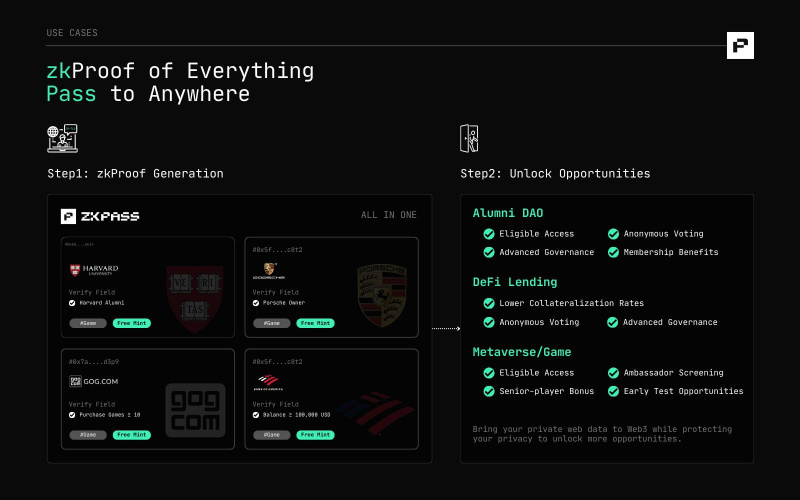
By redesigning the TLS protocol to Three-party TLS, zkPass makes it seamless for any HTTPS-based website to be used as a trusted data source for provenance of zero-knowledge metadata without having to authorize any APIs.
Open Invitation to Shape the Future
zkPass launched its Pre-alpha Testnet in July, receiving an overwhelming response with over 200,000 waitlist signups. Currently, tens of thousands of whitelisted users have already generated more than 100,000 zero-knowledge proofs, each representing their respective private data, identity, or ownership.
User feedback holds immense importance as it helps refine and enhance their solution. The public release of the Pre-alpha Testnet extends a warm invitation to technology enthusiasts, privacy advocates, and individuals who deeply value secure data practices. This invitation aims to shape the future landscape of data privacy alongside zkPass collectively.
Participating in the Pre-alpha Testnet not only grants users early access to an advanced solution but also empowers them to actively contribute towards its improvement. This collaborative effort is a key driver in tailoring zkPass into a privacy-focused protocol that empowers users in an increasingly data-centric world.
How to Get Involved
Getting involved in zkPass’s Pre-alpha Testnet is simple:
- Users can Install the TransGate Extension from Google Chrome Web Store.
- Interested users join pre.zkpass.org to be a part of the Pre-alpha Testnet and experience firsthand the power of private data validation.
More tutorial details can be found on the doc wiki and engage with the zkPass community. Users are invited share their insights, and become an integral part of shaping this groundbreaking technology.
About ZkPass
zkPass is an advanced privacy-preserving protocol for private data verification. It allows users to securely and selectively validate their data from any HTTPS website, making it highly versatile for various applications, including banking and DeFi lending protocols. zkPass is the ideal solution whenever trust and privacy are essential.
Contact
Mason Bennett
[email protected]
Binance Australia’s General Manager, Ben Rose, expressed his confidence in the eventual decisions of Australian regulators regarding digital asset laws in the country.
Speaking at the Intersekt Fintech conference in Melbourne on August 31, Rose emphasized the government’s commitment to crypto policy development and believed that the right outcomes would be achieved.
This optimism contrasted with recent challenges faced by the crypto industry, including Binance Australia.
Regulatory scrutiny and banking restrictions had impacted the exchange, with payments firm Cuscal severing ties due to perceived scam and fraud risks on May 18.
Consequently, Binance Australia suspended Australian dollar trading pairs and deposits, facing additional hurdles as major banks like Westpac and National Australia Bank restricted transfers to “high-risk exchanges.”
Ben Rose acknowledged these difficulties but stressed Binance’s dedication to restoring banking connections and fiat services for its one million Australian customers.
He engaged in constructive discussions with regulatory bodies like the Treasury and ASIC, indicating positive industry-regulator collaboration.
Rose remained confident that Australia’s pivotal decision-making process, particularly in framing licensing frameworks, would have a significant impact.
He had just participated in a round table with the Treasury and ASIC, witnessing productive engagement between stakeholders.
Similarly, Christian Westerlind Wigstrom, from Monoova, an Australian payments provider, shared insights on the ongoing discussions between crypto exchanges and policymakers.
READ MORE: What’s New in Crypto Staking This Year
Wigstrom acknowledged banks’ concerns about scams and urged nuanced conversations between regulators, banking entities, and crypto industry leaders.
Wigstrom emphasized the need to address scams proactively and collaboratively, rather than resorting to blanket bans on crypto-related fund transfers.
He believed that such an approach would lead to a more effective solution to the persisting issue of scams within and beyond the crypto sector.
In terms of regulatory progress, Australian Treasury Assistant Secretary Trevor Power projected the introduction of crypto-specific legislation for Australian crypto firms in 2024.
This timeline indicates the government’s ongoing commitment to establishing comprehensive regulations for the crypto industry within the country.
Overall, Binance Australia’s Ben Rose and other industry stakeholders expressed confidence in Australia’s regulatory journey, hoping for timely decisions that would both safeguard the industry and foster innovation.
The ongoing dialogue between regulators, financial institutions, and crypto leaders was seen as a positive step toward achieving these goals.
Other Stories:
BlockFi Advances Fund Recovery Efforts with Court Application
South Korean Parliamentary Subcommittee Rejects Expulsion Motion Over Cryptocurrency Controversy
Bitcoin Holds Strong Above $27,000 as Traders Maintain Bullish Outlook
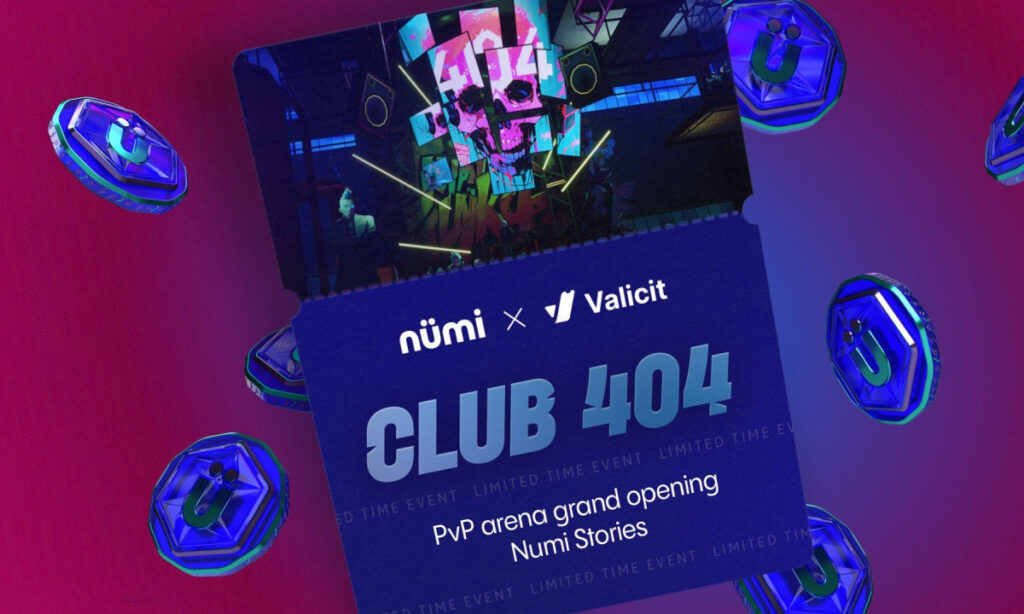
Abu Dhabi, UAE, 30 August, 2023 – Valicit Marketplace, the first decentralized ticketing platform built on the Venom blockchain, is thrilled to announce that more than 230,000 tickets were sold to the Numi Stories Club 404 Grand Opening on Venom testnet. The tickets give players early access to multiplayer functionality in the Numi metaverse’s Numi Stories game.
Despite the massive demand, the Valicit Marketplace enabled users to buy or resell tickets with confidence. Using the power of Venom blockchain, Valicit guarantees that every ticket sold is valid and authentic. Through its blockchain-based API solutions,Valicit ensures the authenticity and security of ticket transactions, preventing frauds, scams, and scalping that’s rampant on traditional online ticketing platforms. Additionally, it provides comprehensive control over the secondary market, facilitating both buying and selling of tickets.
Available on Android and iOS, Numi Stories is the ultimate rhythm action mobile game that lets players chart their own narrative, engage with VTubers, embark on dance battles, and tailor their characters using NFTs from the Numi Club. Numi Stories is reminiscent of popular rhythm games like Dance-Dance-Revolution but with a unique RPG twist.
Numi is the first worldwide metaverse platform built on the Venom blockchain for thought leaders, followers, and innovators. Venom emphasizes scalability, security, and user experience, making it an ideal choice for powering Numi. By utilizing blockchain technology, Numi ensures transparency, traceability, and the ownership of digital assets within the metaverse.
Mohammad Binyamin Chaudhry, the Founder & President of Valicit, stated, “Launching on the Venom testnet has been an exhilarating journey for us at Valicit. The ticket sales we’ve witnessed so far have truly been mind blowing, reaffirming our belief in the power of blockchain. This is just the beginning of our journey and we will continue our efforts to shape the future alongside the Venom blockchain.”
Numi CEO Victor Tumasov said, “Numi was thrilled to be chosen as one of the first projects on Venom to be incorporated into the Valicit ticket platform. For us the ability to sell tickets to events in our metaverse is a very interesting possibility that gives us a lot of potential cool use cases. For the first event we have chosen our PvP mode where Venom users will be able to test their mettle against each other in an amazing dance off in our mobile game.”
To be part of this unique experience:
- Launch Valicit’s portal to purchase your ticket with Venom testnet tokens for the Numi Stories’ PvP battle
- After purchasing the ticket, a link will be provided to stories.numi.net. Choose your platform (iOS or Android) and download the game
- Register your Numi ID, connect Venom Wallet, and complete the in-game tutorial
- Enter PvP battle at Club 404, a prominent location on the in-game map, in Numi Stories
- While in-game leaderboards are under development, daily leaderboards will be posted on Twitter
The PvP battle will end on Tuesday, September 5th at 19:59 UTC. The Top 100 players will be awarded with the exclusive NFT premium RadLad set. All NFTs earned can be accessed both in-game and on club.numi.net.
About Valicit
Valicit is a decentralized application taking on the ticketing industry. Through its blockchain-based API solutions, Valicit ensures the authenticity and security of ticket transactions. The platform gives users and event organizers the ability to verify the legitimacy of tickets using blockchain authentication. Additionally, it provides comprehensive control over the secondary market, facilitating both buying and selling of tickets.
About Venom Foundation:
Venom Foundation, operating as a decentralized network licensed by the Abu Dhabi Global Market (ADGM), is at the forefront of driving the advancement of global Web3 projects. As the world’s first compliant blockchain, Venom provides a secure and reliable blockchain with regulatory oversight by the ADGM, Venom serves as a trusted platform for governments, institutions and enterprises, ensuring compliance with regulatory requirements.
To enhance its capabilities, Venom has developed a range of in-house decentralized applications (dApps) and protocols on its blockchain. With features such as dynamic sharding, low fees, high-speed transactions, and scalability, Venom has the potential to serve as the foundational infrastructure for a thriving global ecosystem of Web3 applications. Its exceptional transaction speeds and limitless scalability enable it to meet the evolving needs of a rapidly growing user base.
For media inquiries, please contact: Muhammad Junaid, Principal, [email protected]
Disclaimer: This release is for informational purposes only and should not be construed as financial promotion.
TinyTap, a subsidiary of Animoca Brands specializing in educational technology (ed-tech), has revealed its latest advancements on August 30th, featuring the integration of cutting-edge artificial intelligence (AI) and nonfungible token (NFT) tools tailored for educators and parents.
With the newly integrated AI, both educators and platform users can now effortlessly craft educational games through topical prompts.
These prompts trigger the AI to swiftly generate corresponding games in mere minutes.
This update also introduces a text-to-image feature, enabling the creation of dynamic educational visuals to enrich the gaming experience.
The AI technology draws from a wealth of data amassed over a decade within the TinyTap system.
This database comprises the “learning architecture” gleaned from more than 250,000 games, millions of activities, and over 170 million play sessions.
Yogev Shelly, CEO of TinyTap, emphasized that the AI-generated content is carefully curated, ensuring alignment with specific age ranges:
“We have incorporated governors within the output to ensure games exist within the desired age range.”
Shelly elaborated that topics evolve from explanations to comprehensive activities.
Although the current beta tools are restricted to single-topic prompts, the future vision is to expand AI integration for richer and more engaging game creation.
Shelly highlighted that these tools expedite content development and access, ultimately empowering educators and parents to offer tailor-made learning experiences for individual children.
READ MORE: Anticipation Grows as Bitcoin Halving Nears, Experts Predict Surge Beyond $100,000
The roadmap of TinyTap also includes an AI tool named “Practice Anywhere,” which transforms existing media like educational YouTube videos into interactive content and games.
Animoca Brands’ Co-founder and Executive Chairman, Yat Siu, lauded the potential of AI in the education technology sector, predicting that streamlined content production will lead to an extensive educational library accessible to educators and parents.
Beyond AI enhancements, in the upcoming Q4, TinyTap plans to collaborate with Open Campus.
This partnership will enable NFT holders and EDU token holders to mint the educational games they create as NFTs.
This innovation is anticipated to invigorate the educational ecosystem, injecting new vitality into the field. Shelly remarked that “Teachers are some of the world’s biggest content creators…
These teachers will be able to reach wider audiences and start earning from beyond their classrooms.”
Amid the burgeoning concept of a “smart education system,” integrating blockchain, decentralized autonomous organizations, NFTs, and AI components, industry leaders inside and outside the Web3 realm have been underlining the transformative potential of this paradigm shift.
TinyTap’s recent advancements stand as a testament to the ever-evolving landscape of educational technology.
Other Stories:
Argo Blockchain Shows Resilience with 50% Reduction in Half-Year Losses
Shibarium Surpasses 100,000 Wallets in 24 Hours Post-Relaunch
The recent enforcement action by the United States Securities and Exchange Commission (SEC) against an NFT project has ignited a debate within the community, raising concerns about potential repercussions for similar projects falling under the same description and becoming targets for future SEC actions.
On August 28, the SEC took legal action against entertainment company Impact Theory, alleging the sale of unregistered securities through their NFTs named “Founder’s Keys.”
The SEC claims these NFTs were marketed as investments in the company, resulting in a purported fundraising of approximately $30 million.
The SEC contends that the NFTs in question meet the criteria for investment contracts and should be classified as securities.
According to the commission, the company violated the Securities Act of 1933 by conducting NFT sales without proper registration.
However, not everyone concurs with the SEC’s stance.
On the same day, SEC commissioners Hester Peirce and Mark Uyeda expressed their dissent, arguing that the statements made by the company and purchasers cited in the order do not constitute the kind of promises that form an investment contract.
Peirce and Uyeda further highlighted the SEC’s inconsistency in not pursuing enforcement actions against sales of other collectible items like watches and paintings that also come with vague promises of brand-building and increased resale value.
The incident has elicited reactions from community members who believe that numerous NFT projects align with the SEC’s description.
READ MORE: Europe Welcomes First-Ever Bitcoin ETF
A representative from the well-known NFT collection Azuki noted the potential significance of the case, suggesting that multiple NFT projects could share similarities with the charged project.
Critics contend that many NFT project founders, akin to Impact Theory, promote their offerings by enticing potential buyers with promises of profits tied to the project’s success.
In a conversation with Cointelegraph, Oscar Franklin Tan, Chief Legal Officer of NFT platform Enjin, expressed concerns over labeling all NFTs as securities.
Tan emphasized the diverse nature of NFTs, which can range from visual art to health records and property titles.
He cautioned against stifling creators’ exploration of various Web3 models due to regulatory uncertainty.
Tan emphasized the need for clearer regulatory guidelines from the SEC to prevent creators from inadvertently producing investment products and hindering the potential benefits of Web3 models.
This situation is not the first instance where NFTs have been debated in the context of securities.
Earlier in the year, a U.S. judge indicated that NBA Top Shot NFTs might qualify as securities based on the legal relationship established between investors and promoters.
As the debate rages on, the outcome of this case could set a precedent for the classification of NFTs in terms of securities regulation, shaping the future landscape of NFT projects and their interactions with regulatory authorities.
Other Stories:
Argo Blockchain Shows Resilience with 50% Reduction in Half-Year Losses
Shibarium Surpasses 100,000 Wallets in 24 Hours Post-Relaunch
Anticipation Grows as Bitcoin Halving Nears, Experts Predict Surge Beyond $100,000

A federal judge has overturned the United States Securities and Exchange Commission’s (SEC) denial of Grayscale Investments’ exchange-traded fund (ETF) proposal for its Bitcoin Trust.
However, experts caution that this ruling does not guarantee the immediate approval of the first Bitcoin ETF in the country.
Judge Neomi Rao of the U.S. Court of Appeals for the District of Columbia Circuit ruled on August 29 that Grayscale’s Bitcoin ETF plan was “materially similar” to already approved Bitcoin futures exchange-traded products by the SEC.
Rao’s decision largely criticized the SEC’s reasoning for rejecting Grayscale’s ETF, which was based on the ETF not being “designed to prevent fraudulent and manipulative acts and practices.”
Consequently, the matter will be sent back to the SEC for further review.
The U.S. SEC has consistently rejected applications for spot cryptocurrency ETFs thus far. Various applications, including those from BlackRock, ARK Invest, Bitwise Asset Management, and others, are currently under review.
The commission retains the authority to delay decisions on these applications, potentially postponing approvals until March 2024.
The SEC has not yet publicly commented on the appeals court’s ruling, but reports suggest that the commission will assess the case to determine its subsequent steps.
READ MORE: Argo Blockchain Shows Resilience with 50% Reduction in Half-Year Losses
While the SEC may contest the ruling, experts speculate that Grayscale’s initial triumph might set a precedent for future approvals.
ETC Group’s CEO, Tim Bevan, expressed confidence that the victory would pave the way for U.S. spot Bitcoin ETFs despite an anticipated SEC appeal.
He predicted a likely mass approval of applications meeting requirements, possibly occurring in the first quarter of 2024.
Alex Adelman, CEO and co-founder of Lolli, contended that the appeals court’s decision would pressurize the SEC to reconsider its stance on spot Bitcoin ETFs.
Adelman perceived the surge in BTC price following the news as a “vote of confidence” in investment products linked to Bitcoin.
The Crypto Council for Innovation (CCI) spokesperson noted that the ruling broadens the scope for various investors to introduce spot Bitcoin vehicles in the U.S., bringing spot Bitcoin ETFs closer to potential launch.
The next steps for Grayscale or the SEC remain uncertain. Grayscale could rework its application to align more closely with a Bitcoin futures-linked ETF.
Alternatively, the SEC might opt for an “en banc” hearing involving all judges on the D.C. circuit, rather than the three who presided over the Grayscale case.
Other Stories:
Shibarium Surpasses 100,000 Wallets in 24 Hours Post-Relaunch
Europe Welcomes First-Ever Bitcoin ETF
Anticipation Grows as Bitcoin Halving Nears, Experts Predict Surge Beyond $100,000
Georgetown, Cayman Islands, August 30th, 2023, Chainwire
Multiple core contributors of Quickswap, celebrated for their success on Polygon, have launched their next venture: Kinetix Finance on Kava Chain. Kava Chain is a Layer-1 Cosmos-Ethereum interoperability blockchain. The Kinetix Finance perpetual exchange is tailored for users eager to leverage trade without the limitations of traditional centralized exchanges.
Kinetix’s innovative Perpetual Market allows users to leverage trade on the Kava Chain. The Perpetual Market meets the rising demand for decentralized trading solutions, offering users leveraged exposure to crypto assets like KAVA, axlETH, axlWBTC, ATOM, and USDt all while ensuring utmost transparency and security.
“The Perpetual Market is not just another trading platform — it is a reflection of Kinetix’s dedication to providing decentralized solutions that empower our users. With this platform, we’re offering a unique, secure, and efficient way to leverage trade on the Kava Chain,” said Kinetix team lead Alexi Atlas.
At the heart of Kinetix’s Perpetual Market is the distinctive liquidity pool system, KLP. LPs can offer any of the initial five supported assets: KAVA, axlETH (ETH), axlBTC (BTC), ATOM, and USDT. In return for contributing these tokens, participants receive KLP, a special liquidity token representing the entire basket. This decentralized structure, combined with the protocol’s AMM, facilitates leverage trading, allowing users to borrow based on the value of their collateral.
“Kinetix’s Perpetual Market boasts a suite of features tailored to cater to sophisticated DeFi users. Its decentralized nature guarantees that positions of any size can be taken with clarity and safety,” said Scott Stuart, Kava Chain Co-founder. “And the KLP token is a nod to traditional liquidity pool systems, ensuring familiarity and ease of use for traders.”
For more updates, follow Kava Chain and Kinetix Finance on X (fka Twitter).
About Kava
Kava Chain is a secure, lightning-fast Layer-1 blockchain that combines the developer power of Ethereum with the speed and interoperability of Cosmos in a single, scalable network. Committed to fostering innovation and growth, Kava Chain is a trusted choice for developers and users worldwide.
About Kinetix
Kinetix Finance is building a DeFi Hub featuring perpetual futures trading and the most sophisticated trading instruments on Kava, connecting the major building blocks of decentralized finance. Your best trade, every trade.
Contact
Media Manager
Guillermo Carandini
Kava
[email protected]

Shibarium, the innovative layer-2 blockchain designed for Shiba Inu, has celebrated a significant milestone, surpassing 100,000 wallets registered on its platform.
Impressively, within a mere 24 hours following its re-launch on August 28, an impressive 35,000 new wallets joined the platform.
Shytoshi Kusama, the co-founder and lead developer of Shiba Inu, officially announced Shibarium’s restoration in an August 28 blog post.
Initially, Shibarium boasted 65,000 wallets and had processed 350,000 transactions.
These figures, however, have experienced a remarkable ascent.
A striking 55.8% increase in wallet count and a 20.2% surge in transactions have been documented since, as reported by Shibariumscan.io.
Presently, the Shibarium block explorer reveals a staggering 101,277 wallets that have facilitated an impressive 420,897 transactions across 344,614 blocks.
The network’s efficiency is evident through its average block time of just 5 seconds.
Kusama emphasized that the relaunch demonstrated the security of funds on the platform, reinforcing that they had always been safe.
He also extended gratitude to Sandeep Nailwal, co-founder of Polygon Labs, for lending a helping hand during the platform’s reboot.
READ MORE: Casino Gender: Which Games Do Men and Women Prefer?
Kusama noted that Polygon’s support was instrumental in achieving a successful resolution and praised their strategic decision to pivot and integrate with Polygon.
In the aftermath of the re-launch, SHIB, the native token of Shiba Inu, experienced a positive price movement, climbing by 3.6% to reach $0.00000825, as per CoinGecko data.
However, it is pertinent to note that SHIB remains 14.3% below its pre-outage price of $0.00000963.
Kusama attributed the initial outage to an overwhelming influx of transactions and users that led the platform to enter fail-safe mode.
Subsequently, the Shibarium team took robust measures to enhance server infrastructure, scaling it by an astonishing 1500%.
These enhancements were strategically implemented to alleviate congestion on-chain and ensure smooth functionality.
Shibarium’s significance lies in its position as an Ethereum layer-2 network, leveraging SHIB for gas fees.
The platform’s primary focus is on fostering the development of gaming and metaverse applications, showcasing its commitment to innovation within the blockchain and cryptocurrency ecosystem.
Other Stories:
Former FTX CEO Sam Bankman-Fried’s Legal Team Deems Trial Preparations Inadequate
Three Former Team Members Accused of $16 Million Theft from Pepecoin (PEPE) Multisig Wallet
Hashdex Challenges Status Quo with Innovative Approach in Pursuit of Bitcoin ETF Approval