


Zug, Switzerland, August 22nd, 2023, Chainwire
The Camino Network Foundation announced that its Web3 travel ecosystem Camino Network has passed a security audit with outstanding results carried out by the prestigious cybersecurity firm, Hexens. The full report can be found here.
Launched earlier this year, Camino Network is a public and permissioned Web3 blockchain for the global travel industry that anyone can build on. It will transform the travel industry by enabling participants to build and deploy decentralized applications powered by smart contracts, ushering in a new era of travel-related products and services.
Camino Network is a consortium blockchain backed by dozens of major travel industry players, including established brands such as Lufthansa, EuroWings, Hahn Air and Sunnycars.
Because the security of Camino Network has always been a top priority, it set out to find a reliable and trustworthy partner to audit its extensive codebase and provide recommendations on fixing any vulnerabilities.
The Camino Network Foundation ultimately chose to partner with Hexens, which has extensive experience in auditing blockchain infrastructure and smart contract code, having previously served noted projects including Polygon Labs, Celo, Lido and others.
Hexens uses the established methodologies and workflows in the industry to identify vulnerabilities and offer recommendations, and is also recognized as a pioneer in the development of new bug-finding techniques.
Hexens’ audit of Camino Network’s L1 codebase identified nine minor issues, each of which were promptly addressed by the team to ensure the integrity of the network. The absence of any major vulnerabilities underscores the commitment to high-quality coding practices and prioritization of robust security.
Following the audit, the Foundation has contracted Hexens to actively contribute to its security on an ongoing basis. The partnership will help to reassure the travel community that ecosystem security will always remain one of Camino Network’s highest priorities.
To that end, Camino Network is inviting white-hat hackers to test the strength of its network through an official bug bounty program, offering up to $50,000 in rewards for the discovery of critical vulnerabilities. Full details of the program and the incentives on offer are available now at https://hackenproof.com/camino-network/camino-protocol.
Camino Network has further increased the security of its network with the introduction of a fully-compliant KYC/KYB process. It ensures that only verified organizations and individuals are able to deploy smart contracts on Camino Network, preventing malicious actors from participating. Moreover, the governing Camino Network Foundation and Consortium also possess the authority to suspend suspicious smart contracts and validators through a democratic voting process, providing a novel layer of oversight that further enhances network security.
Camino Network officially launched its mainnet in April with support from more than 150 Web3, travel and travel technology partners. Its initial group of validators has since expanded to 26 live consortium members across eight countries and three continents, with several groundbreaking use cases to go live in the next weeks such as the Web3 hotel booking platform Sleap.
About Camino Network Foundation
Camino Network Foundation is a non-profit organization based in Zug, Switzerland, driving the development of a blockchain-based ecosystem in the global travel industry. The Camino Network Foundation supports the development of Camino Network, the first Layer 1 blockchain built specifically for the travel industry by travel technology experts.
Contact
Avishay Litani
[email protected]

In a recent update on X (formerly Twitter), David Schwartz, Chief Technology Officer of Ripple Labs, shed light on a recent development concerning the United States Securities and Exchange Commission’s (SEC) appeal.
Schwartz indicated that the SEC’s appeal is predicated on their interpretation that the ongoing legal case has not yet reached its conclusion.
This perspective grants parties involved the opportunity to appeal subsequent to the finalization of the case.
This procedural approach aims to streamline legal proceedings and prevent ongoing disruptions to the core case due to multiple appeals on minor rulings.
After Judge Analisa Torres’ ruling on July 13, which declared that the sale of XRP on digital asset exchanges does not qualify it as a security, the SEC has taken the step to file an appeal.
While this move by the SEC was prompted by the favorable outcome for Ripple, its focus centers on an unexpected twist within the legal proceedings.
Schwartz affirmed that consolidating appeals is crucial to streamline the process, as separate appeals are likely to protract the legal proceedings further.
READ MORE: Bitcoin Hovers Near 2-Month Lows Amidst Extensive Liquidations and Market Uncertainty
However, he clarified a rule applicable to specific scenarios.
The SEC contends that the unique circumstances in this instance warrant a different approach.
The SEC proposes a suspension of the process until the appeal is resolved, a proposition that Ripple does not endorse.
Ripple maintains that, even if the SEC is entitled to appeal, the primary lawsuit should continue while the appeal process unfolds.
This approach aligns with the notion of allowing the trial to proceed and addressing appeals diligently once all other matters are settled.
Schwartz provided additional insight to counter rumors within the Bitcoin community concerning the SEC’s potential intent to appeal Torres’ decision to higher courts.
The ultimate resolution of the legal dispute between Ripple Labs and the SEC may be influenced by the court’s decision on whether to grant the appeal request.
Other Stories:
Tether Discontinues Bitcoin Omni Layer Version Due to Waning Interest
Former US President Donald Trump’s Ethereum Wallet Surges to $2.8 Million
Shiba Inu’s Shibarium Network Restarts Block Production After Temporary Pause

IBM Automation’s Chief Technology Officer, Jerry Cuomo, recently penned a blog post that delves into the potential risks tied to deploying ChatGPT for enterprise purposes.
Cuomo highlights crucial areas of concern that businesses ought to ponder before integrating ChatGPT into their operations.
Despite these concerns, Cuomo ultimately asserts that ChatGPT is suitable solely for non-sensitive data, emphasizing that once information is fed into ChatGPT, its usage becomes opaque and uncontrollable.
Cuomo underscores the inadvertent likelihood of data leakage, posing a legal predicament for companies if confidential customer, partner, or client data seeps into ChatGPT’s training dataset and subsequently becomes public.
Intellectual property concerns also loom large, and Cuomo warns against the inadvertent violation of open-source agreements due to such data leakage.
In line with the IBM blog post, Cuomo states that if proprietary third-party or internal organizational data is inputted into ChatGPT, it morphs into a part of the chatbot’s data framework and could potentially be shared with others seeking relevant insights.
Following the article’s publication, Cointelegraph sought input from OpenAI on the matter.
READ MORE: Silvergate Bank Undergoes Executive Shake-Up Amid Crypto Transition and Legal Challenges
A public relations representative responded via email, asserting that the data would not be shared with other users posing relevant queries.
The representative further directed attention to the existing documentation elucidating ChatGPT’s privacy safeguards, including an explanation of how web users can deactivate their chat history.
OpenAI’s ChatGPT API, as disclosed, has data sharing deactivated by default.
However, critics have voiced concerns that conversations on the web-based iteration are automatically archived.
Users must actively opt out of saving their conversations, despite the utility of the feature in picking up where discussions left off, and the utilization of their data for model training.
Presently, no alternative exists for conserving conversations without consenting to data sharing.
In summary, IBM Automation’s CTO, Jerry Cuomo, has highlighted numerous vulnerabilities inherent in deploying ChatGPT for enterprise applications.
These vulnerabilities encompass inadvertent data leakage, potential legal repercussions, and intellectual property risks.
OpenAI’s response underscores the commitment to data protection, but critics have pointed out discrepancies between the web version’s conversation saving feature and the ability to opt out of data sharing for training.
Other Stories:
Former US President Donald Trump’s Ethereum Wallet Surges to $2.8 Million
Stellar Development Foundation Invests in MoneyGram International
Coinbase’s ‘Stand with Crypto Alliance’ Gains Momentum Amidst Lawmaker Engagement Push

London, United Kingdom, August 21st, 2023, Chainwire
Shiba Memu, a dynamic new cryptocurrency meme coin supported by AI, is causing a stir as its presale surpasses the impressive $2 million fundraising milestone. This remarkable achievement was further spurred by the recent news it would list on BitMart, a renowned crypto exchange, all within the first month of the presale’s launch.
The inception of the Shiba Memu AI stems from the team’s previous experiences with exorbitant marketing agency fees. This motivated Shiba Memu to develop a self-promoting AI solution capable of adapting to various practical applications.
Presently at $0.021700 per token, Shiba Memu’s price experiences scheduled increments every 24 hours due to the team’s well-crafted smart contract. This mechanism is particularly appealing to presale supporters, as it ensures that the token purchase price remains lower than the eventual listing price on exchanges. For instance, if purchased today at $0.021700, the increase by the end of the 60-day presale would amount to 10%.
Those interested can acquire SHMU tokens via the official Shiba Memu website.
The Surge of Shiba Memu: Unleashing AI Potential
Shiba Memu’s remarkable success can be attributed to its untapped AI potential. In its nascent stages, the AI employs Natural Language Processing (NLP) and Sentiment Analysis to scour the web, primarily focusing on social platforms, for mentions of Shiba Memu. It tailors its promotions accordingly, transforming the brand from a simple cute dog meme to an amusing and engaging one, infused with a sharp sense of humor. The project’s forthcoming AI dashboards scheduled for Q4 further stimulate investor interest in meme coins with tangible utility.
The project’s tokenomics demonstrate a robust structure, with 85% of tokens allocated to the presale, 10% to exchange listing liquidity, and 5% to development. This allocation empowers SHMU holders to actively participate in the future development of the dApp.
Crypto Community Propels Shiba Memu’s Soaring Engagement
In the recent video shared by influencer, CryptoPRNR, Shiba Memu was featured among the top four cryptocurrencies predicted to perform well in the next bull run. Additionally, Shiba Memu was also showcased as the best meme coin to buy in 2023 on investing website Invezz. This recognition highlights the project’s strategic advancements and AI-driven capabilities, solidifying its position as a competitive player in the crypto market. The inclusion of Shiba Memu in this selection also reflects the growing interest and attention directed towards AI-powered crypto projects within the broader cryptocurrency community.
The Shiba Memu presale is approaching its closing date on the 1st of September. At this juncture, the price is set to reflect an increase of 119% from its launch price, moving from $0.011125 to $0.024400.
About Shiba Memu
Shiba Memu (SHMU) is a fresh dog-themed crypto meme coin that supports a platform utilizing AI to promote itself and generate buzz in online communities. This technology is poised to gain traction within the blockchain industry in the coming years, establishing Shiba Memu’s position as an industry innovator. The innovative AI technology behind the project demonstrates true innovation in the meme coin sector, offering small and medium-sized businesses access to effective marketing solutions that could significantly cut costs and provide a competitive advantage.
To learn more, or to buy SHMU, visit: Website | Whitepaper | Socials
Contact
Shiba Memu Team
Shiba Memu
[email protected]

Warsaw, Poland, August 21st, 2023, Chainwire
ETHWarsaw, a web3 conference and hackathon, organized by a passionate group of local Ethereum enthusiasts, returns for its second edition. The event is set to take place from August 31st to September 3rd, 2023 in Warsaw, Poland, bringing together a global community of builders, founders, and educators in web3.
Building upon the achievements of its debut, the second edition of ETHWarsaw promises enhanced experience as it will coincide with the first in the history Warsaw Blockchain Week.
“Despite the backdrop of crypto’s resurgence after a challenging year, we’re ready to deliver an even more comprehensive experience for the global community traveling across the world to Poland. This year we’re literally transforming Warsaw, a tech hub teeming with talent, into a hotbed of web3 action.” said Lukasz Stoczynski, ETHWarsaw’s Co-Founder, Business Development Lead.
This collaborative initiative, set against the charming blend of tradition and modernity that defines Warsaw, promises community-organized side events, including conferences, networking meetups, and parties.
The collective effort is poised to make this year’s ETHWarsaw, for the second year in a row, the biggest web3 conference in the CEE region and Warsaw Blockchain Week the largest blockchain event ever held in Poland.
ETHWarsaw is structured to cater to both seasoned professionals and curious newcomers including web2 developers and students. The conference spans two dynamic days of talks, panels and fireside chats divided into six key tracks: DeFi, Scalability, Security, Infrastructure, Governance, and Non-Tech.
This year’s speakers include Marius Van Der Wijden, Ethereum Foundation; Akram El Milligy, Ledger; Patrick McCorry, Arbitrum Foundation; Artis from Gitcoin, and Adam Gagol from Aleph Zero.
Similarly to last year, the overnight hackathon will start on Friday evening and it will be a 48 hours marathon of non-stop building. There will be opportunities for teams and individuals to get hands-on, practical experience working with applications and advanced tools with ~$50,000 in value to be won from various competitions.
ETHWarsaw’s reputation as a hub for breakthroughs in the blockchain realm continues to be reinforced by the awe-inspiring success stories of projects born from the event. Antoni Zolciak, Co-founder of Aleph Zero, Ocean Sponsor of ETHWarsaw, explains: “The brilliant team behind our recently launched ecosystem company, AZERO.ID, was formed after they emerged as victorious champions of the ETHWarsaw hackathon. This win led them to secure a grant, develop the platform’s first version, and successfully close an oversubscribed pre-seed funding round. Their mainnet launch on Aleph Zero is just weeks away, marking an exciting beginning for AZERO.ID. We’re excited for this year’s hackathon during ETHWarsaw and have no doubt that this year’s edition will not disappoint.”
Other ETHWarsaw returning sponsors include RedStone Oracles, Arweave, Octant, Scroll, IPOR. In addition, EthWarsaw secured support for the vol2 event from companies like Lukso, zkSync, Request Network, PROPERLY, Beamer Bridge, Mantle & Chronicle.
For more details about the event and to buy tickets for the conference and hackathon, visit: https://www.ethwarsaw.dev/
Stay connected with ETHWarsaw:
Twitter: @ETHWarsaw
Telegram: ETHWarsaw Official
Contact
Head of PR
Martyna Borys-Liszka
ETHWarsaw
[email protected]
New York, USA, August 21st, 2023, Chainwire
Zebec has launched Nautilus, a modular L3 network that supports its blockchain-based global payment infrastructure. Nautilus enables continuous payment streaming and real-time payroll services on a previously impossible scale.
As a first-of-its-kind L3, Nautilus enables more than just instant payments. It can also facilitate Zebec Protocol’s live-payment streaming service at scale, made possible by the fastest EVM environment in web3.
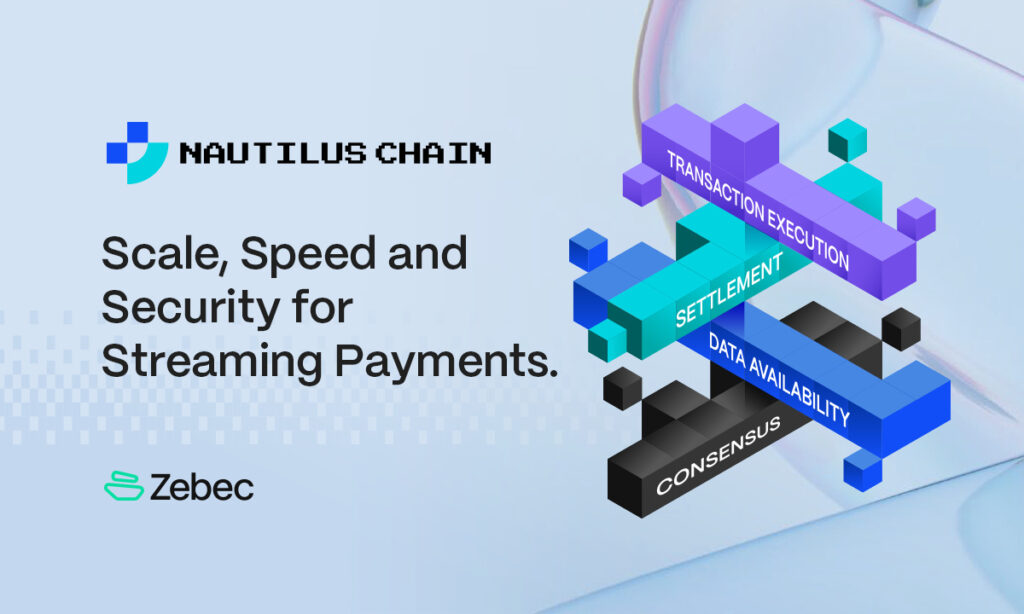
Capable of parallel transaction processing, Nautilus is built for scalability, interoperability, and security through interchangeable modules for consensus, settlement, data availability, and transaction execution. This modularity will have a significant impact on how web3 payment infrastructure is composed and adopted.
“Zebec is helping to create a future where money moves more freely, providing individuals, businesses, investors, and teams with quicker and easier access to funds and tokens,” said Zebec Founder Sam Thapaliya. “Launching the Nautilus Chain, and the new suite of products built on it, is a significant step towards our vision.”
With Nautilus now live, Zebec’s team is set to bring single-side staking and DeFi yields online in select jurisdictions and power ZebecPay – its live streaming web3 payroll services. Zebec is also in the process of launching a traditional payroll app, WageLink, with a planned integration with Circle. With the Nautilus chain functionality, Zebec is able to offer crypto off-ramps directly linked to US bank accounts (via a partnership with CoinFlow) and roll out Zebec Card programs in Asia and Europe. These products and services will augment Zebec’s existing services.
Zebec started as a continuous settlement protocol that enabled real-time payments, or payment streaming, allowing businesses to pay employees and partners in real-time in a tax-compliant way. However, the limitations of existing blockchain technology soon became apparent. Networks were either too slow or too unreliable to keep up with demand. To solve the issue, Zebec Labs created a next-generation blockchain: fast enough to facilitate payment streaming at scale, which could, critically, integrate with Ethereum-based chains.
Originally planned for Zebec’s core DeFi projects for internal payments and value/assets transfer, Nautilus testnet became one of the most prominent testnets in the crypto world. Having facilitated over 50 million transactions, with 400,000 wallets and 3,000 smart contracts deployed in its first 8 months, Nautilus chain has proven its utility and functionality beyond DeFi and opened to projects from other sectors, such as NFTs, Gamefi, etc., thus becoming a “general purpose” L3.
A huge upside to Nautilus’ modular system is that it gives developers the flexibility to configure the “chain stack” they use to build their dApps. A modular chain uses interchangeable modules for consensus, data availability, settlement, and execution. Each of these layers can be configured to developer needs or optimized based on the dApp being serviced. Especially at the execution layer, customized rollups can be deployed that optimize for privacy or scalability, or decentralization — whatever is required by the dApp.
Modular chains allow for infinite horizontal scaling and greater levels of interoperability. Since developers build from the same pool of modules, code is safer, more battle-tested, and easier to connect. More rollups and parallel chains can be deployed to increase block space and throughput effectively. Nautilus is a pioneer in this new type of blockchain, and its architecture will permanently change how blockchains are built and bring them into the real world.
At launch, Nautilus’ settlement layer is built using Solana’s VM, MOVE, and its execution layer on Neon EVM using Solidity smart contracts. Data availability is stored off-chain using Celestia. Nautilus’ initial default execution layer will use optimistic rollups, but the team plans to transition to zkRollups for faster settlements, privacy, and even higher levels of scalability.
Nautilus is built with Celestia and Eclipse empowering modular chains. Through Celesita, Nautilus allows projects to tailor their consensus and settlement layers. Eclipse allows builders on Nautilus to deploy customized rollups on their execution layer.
The result is a chain with Solana-like speeds but with the security and decentralization of Ethereum. According to its engineers, Nautilus has been tested up to 3,000 TPS, but the team expects the number to increase with the transition to zkRollups. By having such a high TPS, Nautilus chain provides a platform that can keep up with the demands of the real world, opening the door to decentralized markets for financial instruments and assets, such as stocks, bonds, real estate, and tokenized real-world assets.
Thanks to Nautilus, Zebec can now operate on a much larger scale. Businesses can pay employees and partners in real time through live payments or payment streaming. Zebec’s goal isn’t merely to provide more efficient payment services; it’s to onboard millions of new users through user-friendly, secure payment apps and new use cases.
Zebec’s innovation paves the way for pay-as-you-go payment plans for streaming services, car-sharing platforms, gyms, residential clubs, and more. It enables potential new business models and applications not yet created. As Zebec continues to innovate and grow its ecosystem, it invites developers and founders from around the world to join it in creating a more connected, efficient, and accessible financial future.
About Zebec
Zebec enables real-time and continuous streams of payments and financial transactions for payroll, investments, and more. It was founded in 2021, with investments from Circle, Coinbase, Solana Ventures, Breyer Capital, Republic, and Lightspeed Venture Partners, among others. Zebec already services hundreds of companies, running thousands of continuous payment streams and bringing the blockchain to our day-to-day lives.
Website | Twitter | Discord | Telegram
About Nautilus
Nautilus is a high-performance real-world payment modular chain. Using celestia and eigenlayer, It delivers high-speed and low-cost transaction processing with a secure and stable decentralized foundation.
Website | Twitter | Telegram | Medium
Contact
Elena Solovyov
Zebec
[email protected]

Amidst the ongoing bear market dampening venture capital investments in the cryptocurrency sector, innovative financing avenues like grants have gained prominence as they foster community support and nurture established projects’ growth.
Presently, approximately 40 crypto initiatives, as stated by Blockchain Grants, are extending grants to developers focused on Web3 solutions.
Contrarily, data from Cointelegraph Research underscores that the crypto venture capital space has suffered due to the market downturn, causing a substantial 30% decrease in capital infusion into Web3 projects over the past year.
Grants and venture capital diverge in purpose and prerequisites.
While grants align with particular goals and values, venture capital centers on startups with exponential growth potential and financial profitability.
However, the efficacy of grants rests on reinvesting funds into the project, according to Naveen Agnihotri, CEO of Cumberland Labs.
Agnihotri emphasizes that grants can be a boon for burgeoning crypto projects if funds are channeled back into project development.
Alternatively, venture capital, he notes, can enable founders to bootstrap their projects, given the mutually incentivized engagement between parties.
To sustain accountability and innovation, the SingularityNET team has revamped its Deep Funding grant initiative.
This updated program, now in its third round, will evaluate teams based on milestones, deliverables, and peer revisions.
Proposals are open until September 3 across five funding pools, with over $1.5 million earmarked for AI-related projects.
READ MORE: Former US President Donald Trump’s Ethereum Wallet Surges to $2.8 Million
According to Rafael Presa, operations manager of Deep Funding, grant programs are pivotal in shaping the next phase of crypto industry evolution by supporting innovative ideas, research, and solutions.
Since its inception in 2022, the Deep Funding program has nurtured 28 artificial intelligence (AI) projects through decentralized voting within the SingularityNET ecosystem.
Furthering this trend, the Interledger Foundation employs its grant program to bolster initiatives targeting payment networks for unbanked communities worldwide.
Briana Marbury, CEO of the Interledger Foundation, highlights that grants can alleviate financial constraints faced by entrepreneurs and innovators, enabling ideas that might otherwise remain unrealized.
The program is currently accepting applications, with grants exceeding $100,000 in this round and a deadline of November 21.
Applying for grants necessitates a deep understanding of grantor objectives and priorities, demonstrating a sincere commitment to the program’s essence.
Engaging with the community, soliciting feedback, and refining proposals showcase dedication to collaboration and improvement, according to Presa.
In these challenging market conditions, Naveen Agnihotri advises projects to focus on addressing genuine issues when presenting grant proposals.
He encourages taking advantage of the bear market’s contemplative environment to devise significant ideas and craft comprehensive grant proposals, highlighting that even in lean times, quality ideas attract funding.
In summation, while the bear market impacts venture capital, the rise of grant programs offers a lifeline for crypto projects, nurturing innovation, collaboration, and impactful solutions.
Other Stories:
Coinbase’s ‘Stand with Crypto Alliance’ Gains Momentum Amidst Lawmaker Engagement Push
Silvergate Bank Undergoes Executive Shake-Up Amid Crypto Transition and Legal Challenges
Stellar Development Foundation Invests in MoneyGram International

Former US President Donald Trump’s Ethereum wallet has been revealed to contain more than $2.8 million, according to a newly disclosed financial statement.
Released on August 14 by the nonprofit watchdog group Citizens for Responsibility and Ethics in Washington, the statement exposes that Trump accrued over $4.8 million through licensing fees linked to nonfungible token (NFT) collections that utilized his image.
His crypto-related endeavors, in total, brought in approximately $7.6 million.
This sum stowed in Trump’s Ethereum wallet significantly surpasses the previously stated figure of $250,000 to $500,000, which was disclosed in an April 14 filing.
The disclosure comes as Trump, after his defeat by President Joe Biden in 2020, is aiming for a White House comeback in the 2024 election.
However, this financial revelation is accompanied by a shadow cast by Trump’s indictment in Georgia on August 14. The charges revolve around allegations of Trump and his supporters plotting to disrupt the 2020 presidential election.
READ MORE: Voyager Digital’s Massive Token Transfers Spark Speculation of Impending Sell-Off
Despite his financial successes in the crypto sphere, Trump’s historical skepticism towards digital currencies lingers.
He has questioned the legitimacy of cryptocurrencies, labeling them as potentially “fake” and foreseeing a “disaster waiting to happen.”
Notably, he has expressed distaste for Bitcoin, deeming it a “scam” and expressing his concern about its competition with the US dollar.
In essence, Trump’s Ethereum wallet now holds over $2.8 million, a sum that dwarfs previous estimates.
This disclosure coincides with his aspiration to reclaim the presidency in 2024, despite the backdrop of legal challenges.
Amid his financial accomplishments within the cryptocurrency realm, his enduring skepticism towards digital currencies remains palpable, particularly in his criticisms of Bitcoin’s viability and potential impact on traditional fiat currencies.
Other Stories:
Pro-Bitcoin Politician Surges Ahead in Argentine Presidential Primaries
Former FTX CEO Sam Bankman-Fried Detained in Notorious Brooklyn Jail
Zunami Protocol Issues Warning Amidst Attack on Stablecoin Pools on Curve Finance

Uzbekistan’s financial landscape is undergoing a digital transformation as two prominent private banks, Kapital Bank and Ravnaq Bank, secure the green light from the National Agency for Perspective Projects (NAPP) to participate in the realm of cryptocurrency regulation through the digital sandbox initiative.
A significant development unveiled on August 14th, NAPP’s approval was extended to Ravnaq Bank, thus welcoming them to partake in the pilot program.
This followed the Agency’s announcement in May 2023 confirming Kapital Bank’s involvement in issuing its own crypto card.
Branded as “UzNEX,” the forthcoming Uzbeki crypto card is set to revolutionize the financial sector by synergizing traditional banking services with access to a crypto exchange and an automated exchange mechanism.
Bolstering this innovative venture is a partnership with Mastercard, a global frontrunner in payment systems.
Both Kapital Bank and Ravnaq Bank are diligently working towards a shared goal, aiming to roll out their crypto card offerings to the general public by the close of December 2023.
Notably, they stand as two of the esteemed trio of registered participants within the nation’s digital sandbox experiment.
In a pivotal move commencing from 2023, Uzbekistan’s administration has mandated that only licensed cryptocurrency entities are permitted to offer crypto-related services.
READ MORE: Voyager Digital’s Massive Token Transfers Spark Speculation of Impending Sell-Off
This regulatory pivot comes on the heels of the issuance of the inaugural licenses to local crypto enterprises in November 2022.
Preceding this, the country had barred access to several international crypto exchanges of repute, including Binance, FTX, and Huobi, citing allegations of unauthorized activities.
The nation’s meticulous approach to cryptocurrency oversight was instigated by a presidential decree in 2022 that heralded the inception of NAPP, entrusted with the responsibility of supervising the burgeoning digital assets sector.
Furthermore, the decree not only set the wheels in motion for regulatory clarity but also intricately delineated the legal framework encompassing cryptocurrency mining endeavors within the confines of Uzbekistan.
As these private banks join hands with cutting-edge technology and renowned financial giants, they are poised to shape a pioneering era in Uzbekistan’s financial landscape.
With their sights set on the imminent launch of the UzNEX crypto card and the overarching vision of advancing secure and regulated cryptocurrency services, these institutions are indelibly etching their mark in the digital evolution of finance.
Other Stories:
Zunami Protocol Issues Warning Amidst Attack on Stablecoin Pools on Curve Finance
Former FTX CEO Sam Bankman-Fried Detained in Notorious Brooklyn Jail
Pro-Bitcoin Politician Surges Ahead in Argentine Presidential Primaries
The launch of the Digital Energy Council on August 15 marks a significant development in the United States’ crypto mining sector, aiming to debunk misunderstandings about its environmental impact among policymakers.
The council’s primary objective is to champion policies that foster the expansion of digital asset mining and energy innovation.
Thomas Mapes, the founder and president of the council, emphasized the pressing need for a united voice for digital asset miners in the corridors of power in Washington.
Drawing from his past role as the director of energy at the Chamber of Digital Commerce and his experience as the chief of staff at the U.S. Department of Energy’s Office of International Affairs, Mapes underlined the crucial role of crypto mining companies in the energy ecosystem.
He highlighted how these entities contribute by either supplying energy to the grid during peak demand periods or purchasing excess energy that would otherwise go to waste.
Mapes envisions a future where crypto mining firms evolve into energy companies, alongside established players like utility companies and major power providers.
However, he acknowledged that many lawmakers have yet to share this perspective. Over the past year, legislative measures have been introduced that cast a shadow on the industry’s reputation.
READ MORE: Pro-Bitcoin Politician Surges Ahead in Argentine Presidential Primaries
For instance, in March, the chair of the Senate Environment and Public Works Subcommittee reintroduced legislation alleging that crypto miners strain public grids and release substantial greenhouse gas emissions solely for personal profit.
Mapes further referenced President Biden’s proposal for a 30% excise tax on digital asset mining and the White House’s report on the environmental impact of crypto mining as additional instances that have generated concerns.
Mapes disclosed that the association already boasts a roster of founding members, encompassing both crypto mining and energy companies, some of which are publicly traded entities.
While the association’s initial focus will be on the U.S., Mapes emphasized that both membership and lobbying efforts are concentrated within the country.
In summary, the inauguration of the Digital Energy Council on August 15 signifies a pivotal step in the U.S. crypto mining realm, as it endeavors to correct misconceptions surrounding the sector’s sustainability while advocating for policies conducive to its growth and technological innovation.
Other Stories:
Voyager Digital’s Massive Token Transfers Spark Speculation of Impending Sell-Off
Zunami Protocol Issues Warning Amidst Attack on Stablecoin Pools on Curve Finance
Former FTX CEO Sam Bankman-Fried Detained in Notorious Brooklyn Jail