



Grayscale’s Bitcoin Trust (GBTC) has displayed a ray of optimism as its outflows have recently slowed for the second consecutive day, hinting that the massive Bitcoin selloff might be nearing its conclusion.
Data from BitMEX Research indicates that on January 24th, GBTC outflows amounted to $429 million, marking the smallest daily outflow since the inception of Grayscale’s spot Bitcoin ETF on January 11th.
This also signifies a 33% reduction compared to the outflows observed at the beginning of the week on January 22nd.
Eric Balchunas, an ETF analyst at Bloomberg, observed on January 25th that GBTC outflows appear to be on a downward trend, though he acknowledged that the figure is still considerable.
He pointed out that there remain several uncertainties regarding when the “mass exodus” from GBTC will come to an end.
Over the course of nine trading days, GBTC has seen a significant outflow of 106,092 BTC, equivalent to around $4.4 billion.
However, it is crucial to note that a slowdown in daily outflows does not necessarily indicate that GBTC’s “bleeding” has ceased or significantly slowed down.
Balchunas had previously estimated that GBTC would need to lose approximately 25% of its outstanding shares before the outflows come to a halt.
READ MORE: Avalanche Foundation Sets Criteria for Memecoins Seeking Share of $100 Million Fund
Adding to the complexity, Arkham Intelligence, a blockchain tracking firm, has cautioned against misinterpreting the GBTC transaction data displayed on its platform.
In a January 24th post, Arkham clarified that the outflow data for GBTC exhibited on its platform is divided between Coinbase Prime and new GBTC custody addresses.
Consequently, not all of the BTC being transferred from Grayscale’s Bitcoin Trust is necessarily being redeemed. This is due to the inherent structure of Bitcoin transactions, which often split outputs among multiple addresses.
Arkham further explained that “GBTC custody wallets frequently send to multiple addresses,” meaning that a portion of the BTC sent in a transaction might be directed to an address different from the main recipient indicated in the transaction panel.
In summary, while the recent slowdown in GBTC outflows provides a glimmer of hope for investors, it’s essential to approach the data with caution and consider the complexities of Bitcoin transactions, as highlighted by Arkham Intelligence.
The future trajectory of GBTC and its outflows remains uncertain, and investors will likely continue to monitor the situation closely.
Polygon Labs, a developer of Ethereum-scaling solutions, has unveiled a groundbreaking protocol called AggLayer that seeks to revolutionize the blockchain ecosystem.
In a blog post released on January 24th, the company announced its plan to launch AggLayer in February, with the primary objective of bridging the divide within the blockchain landscape, ultimately creating a seamless network that resembles a single chain.
AggLayer’s core innovation lies in its ability to aggregate zero-knowledge proofs (ZK-proofs) from various blockchains.
This novel approach enables developers to seamlessly connect both layer 1 and layer 2 blockchains, effectively merging them into a unified network.
For everyday users, this promises a transformative experience akin to the simplicity of using the internet.
No longer will users be burdened with the complexities and inconveniences of frequent bridging between different chains.
Polygon Labs illustrated the potential of AggLayer through a practical use case.
They described a scenario where a user on Ethereum’s layer-2 chain X1 holds the cryptocurrency Dai and wishes to purchase a nonfungible token on Polygon’s zero-knowledge Ethereum Virtual Machine.
From the end-user perspective, this process would feel like interacting with a single chain, eliminating the need to comprehend the intricacies of accessing multiple chains.
READ MORE: Avalanche Foundation Sets Criteria for Memecoins Seeking Share of $100 Million Fund
The driving force behind Polygon Labs’ development of AggLayer is their conviction that blockchain networks should evolve into a unified, highly scalable ecosystem akin to the internet.
Currently, these networks are characterized by fragmentation and a lack of interoperability, resulting in subpar user experiences and scalability limitations.
AggLayer, as Polygon Labs contends, will address these issues and bring about substantial improvements over the existing monolithic and modular blockchain architectures.
Monolithic blockchains, typified by Bitcoin, consolidate critical functions like transactions, settlements, and data availability within a single layer.
On the other hand, modular chains, exemplified by post-Merge Ethereum, distribute these functions across multiple layers to enhance efficiency.
AggLayer, through its innovative use of ZK technology, aims to amalgamate the advantages of both integrated (monolithic) and modular architectures.
The initial release of AggLayer is scheduled for February, with a subsequent version slated for later in the year.
Polygon Labs has revealed that the second version will introduce support for asynchronous cross-chain transactions, further expanding the protocol’s capabilities and potential impact on the blockchain landscape.
As the crypto community eagerly anticipates the launch, AggLayer appears poised to bring about a new era of cohesion and scalability within the blockchain world.

The Federal Court of Canada has delivered a significant ruling, deeming an emergency law utilized by the Canadian government to halt the flow of funds and cryptocurrency to protesting truckers as unreasonable and unconstitutional.
On January 23rd, Justice Richard Mosley unequivocally asserted, “There was no national emergency justifying the invocation of the Emergencies Act, and the decision to do so was therefore unreasonable.”
In February 2022, Prime Minister Justin Trudeau’s administration deployed the law for the first time to freeze funds, including cryptocurrencies, donated to truckers who were protesting COVID-19 restrictions. The court found this action to be in violation of the constitution.
These protesters, part of the “Freedom Convoy,” had used their trucks to block streets in Ottawa, Canada’s capital, in opposition to a mandate requiring truck drivers crossing the Canada-United States border to be fully vaccinated against COVID-19.
The government had argued that invoking the Emergencies Act was essential due to the protests being deemed an illegal occupation.
Various organizations, including the Canadian Civil Liberties Association (CCLA) and the Canadian Constitution Foundation, challenged the government’s use of this emergency law to freeze funds, contending that it was unnecessary and unconstitutional.
The CCLA hailed the decision as a “clear and critical precedent for every future government.”
Justice Mosley emphasized that the Emergencies Act should only be invoked as a last resort, stating, “The government cannot invoke the Emergencies Act because it is convenient, or because it may work better than other tools at their disposal or available to the provinces.”
Finance Minister Chrystia Freeland announced the government’s intention to appeal the ruling.
Cryptocurrency played a pivotal role in financing the 2022 trucker protests, with protesters believed to have received millions of dollars.
However, the exact amount raised remained unclear due to the challenges associated with tracking decentralized digital assets.
In response to the freezing of funds, organizers moved their efforts to platforms like Tallycoin, a crowdfunding platform built on the Bitcoin blockchain, and the Christian crowdfunding site GiveSendGo.
These platforms collectively raised substantial sums, including unspecified amounts in cryptocurrency. Nevertheless, Canadian authorities also took measures to freeze bank accounts associated with GiveSendGo donations.
At the time, leaders in the cryptocurrency industry, including Jesse Powell, the founder of Kraken, voiced their condemnation of Canada’s freeze on digital assets.
The dominance of the Ethereum execution client Geth has experienced a significant decline recently, raising concerns within the Ethereum community about network diversity and the potential for a “black swan event.”
On January 23rd, Geth’s market share on the Ethereum network execution clients dropped by 5.2%, falling from 84% to 78.8%.
Geth plays a crucial role in processing transactions and executing smart contracts on the Ethereum blockchain.
However, its overwhelming popularity among Ethereum validators has led to a lack of diversity among execution clients, which has sparked concerns about centralization.
Ethereum decentralization advocates, including a prominent member of the ETHStaker community known as “Superphiz,” emphasized the risk of a bug in Geth leading to a catastrophic event that could wipe out more than 80% of the Ether staked on the network.
Superphiz urged the use of less popular but potentially more robust execution clients to mitigate such risks.
Lachlan Feeney, the founder and CEO of Ethereum infrastructure firm Labrys, pointed out that Ethereum validators could face significant losses, as staked ETH is not risk-free.
He questioned whether investors would commit a minimum of $75,000 USD to an instrument with a maximum potential gain of 3.5% per annum but a potential loss of 100%.
READ MORE: Dencun Upgrade Boosts Ethereum’s Scalability and Reduces Gas Fees on Testnets
Feeney also highlighted that if Geth’s market share remains above 66%, a critical bug could halt the chain from finalizing, leading to an “inactivity leak” that burns staked Ether until execution client diversity is restored to 33.3% of the network.
In this scenario, approximately 90% of a validator’s staked Ether could be lost in about 40 days.
Feeney noted that validators would have only a small window to exit and limit their losses, given the rate-limited queue for validator exits.
Meanwhile, the second-largest execution client, Nethermind, saw its market share increase from around 8% to 14% on January 23rd, despite recently addressing a critical bug that affected users’ ability to process Ethereum blocks.
Coinbase, a major Ethereum validator that relies on Geth, announced plans to transition to a multi-client infrastructure in the coming months.
While Geth was the only execution client that met Coinbase’s technical requirements when it started Ethereum staking in 2020, Coinbase acknowledged the changing landscape and the need for greater client diversity in the ecosystem.
As concerns about Geth’s concentration continue to mount, Ethereum’s path toward greater decentralization and reduced risks remains a topic of ongoing discussion within the community.
Avalanche-based memecoins aiming to tap into a $100 million fund now face specific criteria, according to the Avalanche Foundation.
The Foundation, in a recent blog post dated January 23, introduced a set of guidelines for its memecoin selections within its “Culture Catalyst” fund.
Originally designed to support nonfungible token artists, the fund’s expanded scope now includes “community coins.”
To be considered eligible, meme tokens must meet various criteria.
These include having renounced contracts, limited ownership concentration among large holders (whales), and substantial liquidity levels.
While many criteria are flexible, the Foundation has established certain non-negotiable requirements.
These include a minimum of 2,000 unique holders, at least $200,000 in liquidity from 50 different providers, and a project existence of at least one month.
READ MORE: US House Committee Pressures Meta for Transparency on Crypto and Blockchain Plans
Memecoins are known for their lack of intrinsic value, often created as a joke or for entertainment, which appeals to memecoin enthusiasts.
When the Avalanche Foundation initially announced its decision to include memecoins in its fund expansion in late December 2023, it faced skepticism from market observers, with some criticizing the move as “desperate and unbecoming.”
Despite the initial backlash, the Avalanche Foundation has revealed that it has already begun deploying capital into “community coins” through its Culture Catalyst program.
One notable memecoin that has gained prominence within the Avalanche ecosystem is Coq Inu (COQ), a token with a rooster theme.
Coq Inu boasts a market capitalization of $75 million and ranks as the most traded memecoin on the Avalanche network, according to DexScreener data.
In summary, the Avalanche Foundation has established a set of criteria for memecoins seeking a portion of its $100 million Culture Catalyst fund.
While memecoins are often considered whimsical and valueless, the Foundation has laid out specific requirements to ensure eligibility.
Despite initial criticism, the Foundation has already started investing in these “community coins,” with Coq Inu emerging as a notable player within the Avalanche network, commanding a substantial market capitalization.

With the rise of online gaming platforms, ensuring robust security measures is essential, particularly for Hugewin, a shining star in the crypto casino world. For gambling businesses and their clients, acquiring a gaming license is of utmost importance. It’s not merely a formal requirement; it’s a transformative element for the industry. This is crucial in an era where digital security is paramount, especially for platforms dealing with cryptocurrencies. A gaming license guarantees legitimacy and trust, providing peace of mind for users and operators alike. It’s a significant step towards responsible and safe online gambling.
Prioritizing player safety is the main goal of gaming licenses. Platforms holding these licenses are required to establish strong security measures to safeguard players’ personal and financial information. They also dedicate themselves to promoting responsible gambling by providing various tools and resources. This helps players keep a balanced perspective on gaming, ensuring a safer and more responsible gaming environment. These measures demonstrate the platforms’ commitment to player protection and responsible gaming practices.
Obtaining a gaming license demands strict adherence to fairness and integrity. Gaming companies undergo comprehensive evaluations of their operational systems and methodologies. This includes verifying game fairness by employing random number generators to ensure unbiased outcomes. To consistently align with industry norms, routine audits and inspections are mandatory. Such rigorous processes are crucial for gaming operators to showcase their dedication to fair play and establish a reliable gaming atmosphere.
Complying with regulatory standards is essential for legal and reputable operations. Authorities grant gaming licenses, ensuring operators adhere to specific laws and rules. This adherence is vital for maintaining a trustworthy business. Obtaining a license shows a commitment to these norms, boosting the industry’s overall reputation. It’s a critical step for any gaming company to gain trust and operate successfully.
This time, we will find out the security strategies that Hugewin has implemented. Let’s find it out.
Licensed and Regulated for Trust
The digital era demands stringent security measures, especially in sectors involving financial transactions like online casinos. Hugewin, a top-notch casino and betting platform with more than 1000 games accessible there, recognizes this need and implements several strategies to ensure the safety of its users.
First and foremost, Hugewin holds a Curaçao eGaming license (CEG), a mark of legitimacy in the online gaming world. The government gaming authority of Curaçao, a well-known regulator in the industry, issues this license. This certification means that Hugewin undergoes regular regulatory audits to adhere to high standards of fairness and security. The CEG license is a testament to its commitment to operating within a legal and ethical framework, offering players peace of mind.
Transparent and Secure Transactions
In an environment where transactions are non-stop, the transparency of payments becomes crucial. Hugewin ensures that all payments, regardless of the amount, are processed transparently. This openness in financial dealings helps build trust among players, reassuring them that their winnings and deposits are handled with integrity.
Hugewin is committed to promoting responsible gambling and protecting users’ interests. The casino employs a forward-thinking approach by offering daily cashback to players on their losses.
These measures are designed to promote a healthy gaming environment and prevent the potential negative impacts of gambling. It demonstrates its commitment to the well-being of its community, which is a vital aspect of any gaming platform’s security strategy.
24/7 Support: Strengthening Security with Constant Care
At Hugewin, the live support team is available at any moment, providing essential assistance for any queries or concerns, which is crucial for a secure gaming environment. 24/7 availability has become a standard in the competitive online casino industry, essential for addressing urgent customer needs and preventing small issues from escalating.
Furthermore, customer service reflects the overall quality of the platform and, has legal significance, and has a great influence on customer satisfaction and business growth.
Hugewin: Pioneering Secure and Responsible Gaming
As you see, the platform stands out as a prominent player in the dynamic world of crypto casino gaming. By harmonizing innovative security measures with a player-centric approach, it elevates the gaming experience to new heights. Hugewin is not just about playing games; it is about doing so in an environment where every aspect, from data protection to transaction transparency, is meticulously crafted for player satisfaction and safety.
The platform’s commitment to responsible gambling further highlights its dedication to caring for its community. This focus on player welfare goes beyond mere compliance, setting a new standard in the industry. The synergy of cutting-edge technology and round-the-clock support ensures that users are playing games and engaging in a secure, fair, and supportive environment.
Hugewin, thus, redefines what it means to be a leader in the online gaming sector. It is a place where players can indulge in their favorite games with the assurance that they are in safe, reliable hands. So, don’t take a word for it. See for yourself, and enjoy everything it has to offer.

The cryptocurrency community has brushed off the recent remarks made by JPMorgan CEO Jamie Dimon during an interview on CNBC.
Dimon’s repeated criticisms of Bitcoin, which included debunked claims about its creator, Satoshi Nakamoto, returning to “erase” the cryptocurrency, as well as allegations that Bitcoin “does nothing” and has criminal use cases, have raised suspicions within the crypto community.
Some members of the community speculate that Dimon’s constant negative statements about Bitcoin may be an attempt to manipulate its price.
On Reddit, one user suggested that Dimon’s influence over older investors could be leveraged to drive down the price of Bitcoin, allowing him to accumulate more cryptocurrency at a lower cost.
However, opinions within the community vary. Some believe that Dimon is simply uninformed about Bitcoin, while others think he may be strategically acquiring Bitcoin in anticipation of the upcoming halving event, which many believe will drive up the cryptocurrency’s price.
Dimon’s suggestion that Satoshi Nakamoto could return to “erase” Bitcoin is widely regarded as flawed due to the decentralized nature of the cryptocurrency.
READ MORE: Mt. Gox Trustee Advances Towards Bitcoin Repayments with Identity Verification Confirmation
Nonetheless, a community member proposed the alternative theory that Nakamoto might choose to sell their Bitcoin holdings, which some consider to be a more plausible scenario than Dimon’s idea.
Interestingly, while Dimon continues to criticize cryptocurrencies, it’s worth noting that JPMorgan, the company he leads, is actively involved in the cryptocurrency space.
JPMorgan Securities was named as one of the authorized participants for BlackRock’s recently approved spot Bitcoin exchange-traded funds (ETFs) in the United States.
This move drew criticism, as it appeared contradictory for Dimon to make anti-crypto comments while his company was embracing cryptocurrency-related ventures.
In conclusion, Dimon’s negative remarks about Bitcoin have sparked speculation within the crypto community regarding his motivations.
While some believe he is attempting to manipulate the market, others think he may be positioning himself for potential gains from the upcoming halving event.
Regardless of his statements, the involvement of JPMorgan in cryptocurrency-related initiatives adds an intriguing dimension to the situation.
Roadtown, British Virgin Islands, January 25th, 2024, Chainwire
Followed by LIF3’s Token Migration to Ethereum Network for Enhanced Market Accessibility
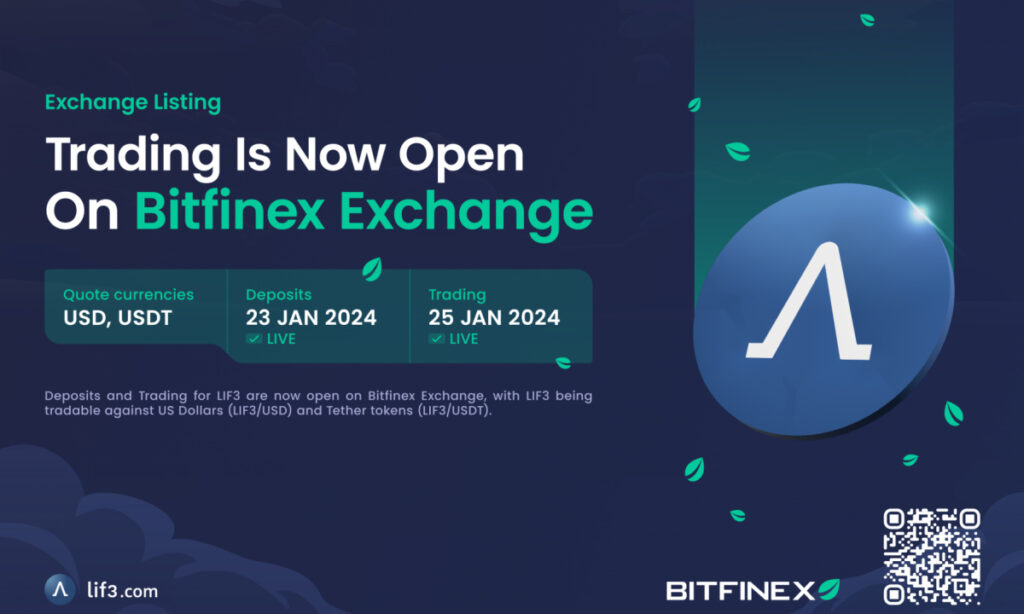
Today, $LIF3 (pronounced Life), a ground-breaking and complete omni-chain DeFi Layer-1 Curated Blockchain ecosystem, announces its recent listing on Bitfinex (https://trading.bitfinex.com/t/LIF3:USD), a premier digital asset trading platform, after recently migrating to the Ethereum Network from Fantom.
This announcement coincides with Lif3’s vision and commitment to breaking down barriers to cryptocurrency, enabling easier adoption for consumers entering DeFi, through the Lif3 Mobile App. Lif3 provides a platform for exclusive event access, on-ramping, investing, trading, earning, gaming, and off-ramping.
This announcement coincides with Lif3’s vision and commitment to breaking down barriers to cryptocurrency, enabling easier adoption for consumers entering DeFi, through the Lif3 Mobile App. Lif3 provides a platform for exclusive event access, on-ramping, investing, trading, earning, gaming, and off-ramping.
Bitfinex Listing
The Bitfinex listing allows for professional traders to trade $LIF3 through a top tier exchange.
Deposits for LIF3 will commence on January 23, 2024, at approximately 1:30 PM UTC. Trading is scheduled to start on January 25, 2024, at approximately 3:30 PM UTC, with LIF3 being tradable against US Dollars (LIF3/USD) and Tether tokens (LIF3/USDt).
“The addition of LIF3 to our offerings is a significant step in our commitment to embracing innovative financial solutions. LIF3’s features include crypto swapping, yield farming, and a secure mobile wallet”, said Henry Child, Head of Tokens.. “This listing underscores our commitment to advancing the DeFi space with cutting-edge solutions,” he added.
To obtain access to $LIF3 on Bitfinex, customers can visit: https://trading.bitfinex.com/t/LIF3:USD
Ethereum Migration
The Lif3 protocol has recently migrated to Ethereum from Fantom Network. This move is not just a change of platform but a leap towards broader market accessibility and ease of trading of the $LIF3 token. According to the team behind Lif3, the transition simplifies the purchasing process for users, enabling easier acquisition of LIF3, and paves the way for Lif3’s further expansion.
The migration to Ethereum also marks a new chapter in Lif3’s journey. It represents a move towards a platform with a more extensive user base, offering increased exposure and potentially higher transaction volumes. This shift is about harnessing the strengths of Ethereum’s ecosystem, providing Lif3 users with easier methods of acquiring $LIF3 and improved reliability, crucial for DeFi transactions.
“This Bitfinex listing in addition to the migration to Ethereum will expand Lif3.com and its market accessibility while enhancing efficiency in cryptocurrency transactions through consumer DeFi, unlocking more opportunities within the dynamic world of decentralised finance and beyond. We are not only excited for the recent migration to Ethereum, in addition to being available on Fantom, BNB Chain and Polygon – but also opening up a larger market and simplifying the purchase process for users, particularly in acquiring mainstream tokens like USDT and ETH”, says Kean Laurens, Head of Product.
“The early stage of DeFi adoption presents unique challenges, including the complexity of swapping, staking, and bridging various chains. Recognizing Ethereum’s widespread recognition and trust factor, Lif3 aims to reduce entry barriers and foster a smoother transition into its ecosystem. Lif3 was conceived with a clear mission to make DeFi interactions and investments seamless and safe, especially for newcomers. Our visionaries in the crypto realm identified a need to simplify the on-ramping process and offer a unified platform for various DeFi activities,” emphasises Kean.
Lif3 Ecosystem
Lif3.com is a complete, omni-chain DeFi ecosystem, Curated Layer-1 blockchain, and a self-custody wallet available on the App Store and Google Play – unlocking the potential of Web3 through consumer DeFi, iGaming and the Entertainment Sectors.
Now available on multiple blockchains: Ethereum, Polygon, BNB Chain, and Fantom – Lif3 offers a comprehensive suite of DeFi products that transcends beyond a mere platform and an entire curated ecosystem.
The ease of use for consumer DeFi, broader market accessibility and adoption are some of the key missions for Lif3. Through the use of a consumer focused and easy to use DeFi wallet, this results in a heightened efficiency in cryptocurrency transactions, signifying a quantum leap for both Lif3 and the future of digital finance in the Web3 space.
“As an investor and Lif3 enthusiast, I am thrilled Lif3 is officially listed on Bitfinex, a renowned platform that shares Lif3’s commitment to innovation and excellence in addition to the Layer Zero partnership, in supporting the migration to the Ethereum Network. This listing signifies a crucial quantum leap in providing increased visibility and accessibility to a broader audience of investors and other Web3 enthusiasts alike, for a more seamless experience in using blockchain. As the Lif3 ecosystem continues to advance its mission in reshaping the future of finance, this announcement is poised to catalyse further growth and innovation,” says Harry Yeh, Managing Director of Quantum Fintech Group.
Esports Tournament Supercup.gg
Lif3.com is also pleased to announce that Lif3 has teamed up with MetaNews and acquired an official licence by Krafton for the PUBG mobile tournament Super Cup, this falls in line with its vision to expand its reach and adoption with the esports user base. The competition will kick off on January 26 and is set to run until January 29, 2024.
The Lif3 ecosystem includes an architecture for esports which will bridge the gap from antiquated payment processors which cannot satisfy the need for micro-payments required for esports to operate in Web3 between amateur gamers, fans and their favourite esports organisations.
To learn more, visit https://supercup.gg/
About LIF3.com
Lif3.com is a complete, omni-chain DeFi ecosystem, Curated Layer-1 blockchain, and a self-custody wallet available on the App Store and Google Play – unlocking the potential of Web3 through consumer DeFi, iGaming and the Entertainment Sectors. To learn more, visit https://lif3.com
Twitter:
https://twitter.com/Official_LIF3
Lif3 News and Updates:
How to Buy LIF3 with ETH or USDT on Ethereum:
For official LIF3 logos and branding please visit:
https://docs.lif3.com/brand-assets
Media Contact
About Bitfinex
Founded in 2012, Bitfinex is a digital token trading platform offering state-of-the-art services for traders and global liquidity providers. In addition to a suite of advanced trading features and charting tools, Bitfinex provides access to peer-to-peer financing, an OTC market and margin trading for a wide selection of digital tokens. Bitfinex’s strategy focuses on providing unparalleled support, tools, and innovation for experienced traders and liquidity providers around the world. Visit www.bitfinex.com to learn more.
https://blog.bitfinex.com/media-releases/bitfinex-to-list-lif3/
For official Bitfinex logos and branding:
https://www.bitfinex.com/press/#press-downloads
About LayerZero Labs
LayerZero Labs is the team that launched the leading blockchain messaging protocol LayerZero. LayerZero’s advanced messaging infrastructure seamlessly connects over 30 blockchains and facilitates transparent and secure cross-chain messaging from one easy-to-use interface. Since going live in March 2022, the LayerZero protocol has processed more than 20 million messages with thousands of mainnet contracts being deployed by thousands of developer teams. Backed by leading venture capital firms including a16z, Sequoia, Binance Labs, Christie’s, Lightspeed, Opensea, Bond, Samsung Next, and GBV, LayerZero was recently valued at $3 billion. Developers building on LayerZero can create interoperable, omnichain dApps, which will lead to the establishment of a unified digital asset ecosystem. Visit LayerZero to learn more.
Contact
Media Relations
Chantel Elloway
Lif3 Labs Limited
[email protected]
Grand Cayman, Cayman islands, January 25th, 2024, Chainwire
Gaming, Ecommerce and DeFi applications are leveraging Sui’s singular social authentication to eliminate the biggest hurdle blocking mainstream audiences from web3.
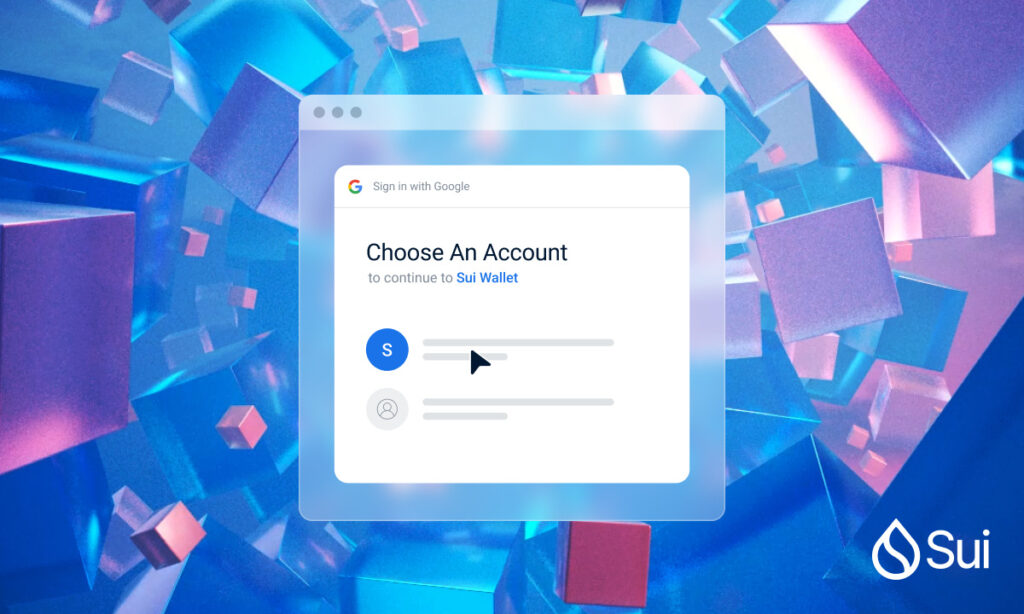
Sui, the rapidly ascending Layer-1 blockchain created by the leaders of Facebook’s Diem project, today announced that over 10 decentralized applications (dApps) in the Sui ecosystem have integrated zkLogin, the first-of-its-kind primitive that makes Web3 login as simple as signing in with familiar web credentials such as Google or Twitch.
Sui continues to advance zkLogin, adding new providers and additional features such as multi-sig capability and more. Thanks to these recent additions, it’s estimated that thousands of users will now be able to use zkLogin and experience one of the world’s first one-click onboarding into crypto.
“zkLogin is a native utility unique to Sui that empowers developers to offer users the ability to use the same social logins they use everywhere else to authenticate with web3 applications,” said Kostas Chalkias, Co-Founder & Chief Cryptographer of Mysten Labs, the a16z and Circle-backed company that created the Sui Network. “As we enter the next phase of adoption, the existence of tools like zkLogin will become a prerequisite to onboard mainstream users into the decentralized web.”
Among the wallets that now support zkLogin are Chrome-based wallets such as Ethos Wallet and Sui Wallet. zkLogin is now also integrated into mobile applications (both on Play Store and AppStore) by using Suiet and Surf Wallet.
Similarly, web3 gaming experiences such as Suilette and Quantum Temple are using zkLogin, to give their users an easier, more intuitive onboarding experience.
Lastly, DeFi applications on Sui are also taking advantage of this unique strength of Sui. Well-known protocols like DegenHive, Blockbolt, Aftermath, Navi, and BlueFin have integrated the technology, allowing users to manage their digital assets and participate in financial activities without the hassle of managing private keys.
“zkLogin is a game-changer in Web3 and particularly in DeFi,” said Zabi Mohebzada, Co-Founder at Bluefin. “With zkLogin, users only need a Google account to sign up and trade. No wallets are required. This enables us to unlock the security benefits of decentralized trading for a much broader universe of investors.”
Launched in 2023 as one of the first industry solutions for Web2-based authentication for Web3, zkLogin makes it possible for users to join the Sui ecosystem without having to install separate wallets or memorize and manage seed phrases.
Contact
Sui Foundation
[email protected]

A court in California has handed down a significant ruling in a case that has been ongoing for over two years, involving Crowd Machine and Metavine, the creators of Crowd Machine Compute Tokens (CMCT).
The court has ordered them to pay over $20 million in disgorgement, interest, and penalties, and also found the companies’ founder, Craig Sproule, liable for his role in the case.
The legal troubles for Craig Sproule began in January 2022 when the United States Securities and Exchange Commission (SEC) filed a lawsuit against him, alleging that the 2018 initial coin offering (ICO) for CMCT constituted a “fraudulent and unregistered” securities sale.
Alongside this accusation of unregistered securities sales, it was also claimed that Sproule had misused and lost $5.8 million of the $33 million he had raised during the ICO.
CMCT was initially designed with the aim of reimbursing computer owners for lending their computing power and compensating programmers for their coding efforts. Unfortunately, the tokens never became operational.
As part of the initial legal action, Sproule was fined $195,047 and instructed to cease operations of CMCT, including removing it from the one cryptocurrency exchange where it had been listed. Importantly, the defendants did not admit or deny any wrongdoing.
READ MORE: Mt. Gox Trustee Advances Towards Bitcoin Repayments with Identity Verification Confirmation
On January 17, the District Court of Northern California issued an amended final judgment that ordered the defendants to disgorge a total of $19,676,401.27, along with an additional $3.4 million in prejudgment interest.
Furthermore, Metavine was found liable for disgorgement of $5 million of the total amount, and both defendants were directed to pay civil penalties of $600,000 each.
In its statement dated January 24, the SEC highlighted that the previous consent judgments had already resolved the SEC’s action against Mr. Sproule, leaving the court to determine the monetary relief for the remaining defendants.
It is noteworthy that initial coin offerings (ICOs) were once a common method for launching cryptocurrencies until the SEC classified them as securities sales in July 2017.
Subsequently, the SEC has pursued numerous legal cases against ICO issuers.
Craig Sproule founded Metavine in 2013, which is described as a “no-code software development platform.”
However, Metavine reportedly filed for bankruptcy on January 3. On the other hand, Crowd Machine is described as a “unified cloud platform.”