


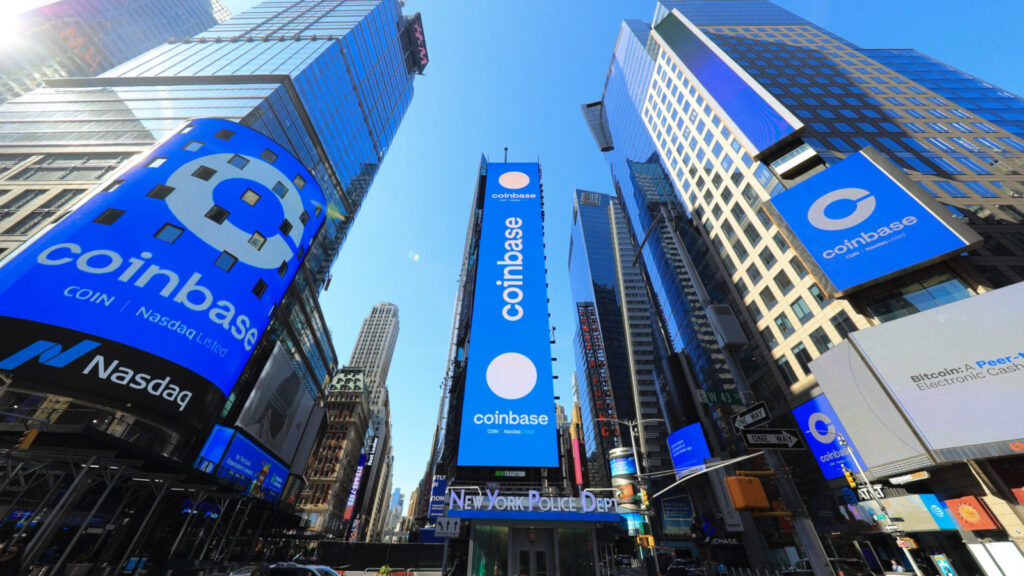
Coinbase, a prominent cryptocurrency exchange, has officially embraced the Lightning Network (LN), a layer-2 payment protocol.
This integration is in response to user demands for swifter and more cost-effective Bitcoin transactions.
The Lightning Network was conceived as a solution to Bitcoin’s scalability issues and to compete with newer cryptocurrencies that promised quicker and cheaper transactions.
For a considerable period, major crypto exchanges like Coinbase and Binance had hesitated to adopt this layer-2 solution.
Many community members argued that integrating the Lightning Network would offer fewer financial incentives for exchanges.
Contrary to the prevailing sentiment, Brian Armstrong, the CEO of Coinbase, confirmed the exchange’s decision to integrate the Lightning Network.
In his statement, he emphasized the importance of Bitcoin in the crypto world and expressed excitement about enabling faster and cheaper Bitcoin transactions.
Armstrong also acknowledged that the integration process would take some time and requested patience from users.
READ MORE: Federal Reserve Vice Chairman Highlights CBDC Research and Stablecoin Oversight in Fintech Speech
This decision followed a month of exploration by Viktor Bunin, a protocol specialist at Coinbase, into the feasibility of integrating the Lightning Network.
During this period, influential figures in the crypto industry, such as Michael Saylor of MicroStrategy and Jack Dorsey of Square, publicly questioned Armstrong’s stance on the Lightning Network.
The crypto community welcomed Coinbase’s announcement, as the integration of the Lightning Network will make affordable and efficient Bitcoin microtransactions accessible to a broader audience.
In a related development, on July 17th, Binance, another major cryptocurrency exchange, revealed that it had successfully integrated the Lightning Network for Bitcoin withdrawals and deposits.
Binance users now have the option to choose “LIGHTNING” when withdrawing or depositing Bitcoin.
This additional option enhances the flexibility of users and contributes to the growing adoption of layer-2 solutions in the cryptocurrency ecosystem.
Other available options for withdrawals and deposits on Binance include BNB Smart Chain (BEP-20), Bitcoin, BNB Beacon Chain (BEP2), BTC (SegWit), and Ethereum ERC-20.
Overall, these integrations mark a significant step forward in addressing Bitcoin’s scalability issues and making cryptocurrency transactions more efficient and cost-effective for users on these platforms.
Other Stories:

Bitcoin faced a notable resurgence, surging by 5% after a critical test of the $25,000 support level on September 11th.
Nonetheless, this upward swing should not be hailed as an unequivocal triumph for bullish investors.
To provide context for this recent price action, it’s crucial to acknowledge that Bitcoin has weathered a harsh 15% decline since July, a performance contrasted by the stability observed in the S&P 500 index and gold during the same period.
This underperformance exposes Bitcoin’s struggle to gain momentum, despite substantial catalysts like MicroStrategy’s intent to acquire an additional $750 million worth of BTC and the persistent requests for Bitcoin spot exchange-traded funds (ETFs) from trillion-dollar asset management firms.
Yet, in the realm of Bitcoin derivatives, the bullish camp appears confident, viewing the $25,000 level as a significant bottom and a gateway to further price hikes.
Some proponents argue that Bitcoin’s primary drivers for 2024 remain in force, particularly the anticipation of a spot ETF and the reduction in new supply after the April 2024 halving.
Furthermore, immediate risks in the cryptocurrency markets have diminished, partly due to the United States Securities and Exchange Commission experiencing partial losses in cases involving Grayscale, Ripple, and decentralized exchange Uniswap.
Conversely, bears have their own advantages, including ongoing legal disputes involving prominent exchanges like Binance and Coinbase.
Additionally, Digital Currency Group’s precarious financial position after a subsidiary’s January 2023 bankruptcy declaration, bearing debts exceeding $3.5 billion, could potentially lead to the sale of Grayscale-managed funds, including the Grayscale Bitcoin Trust.
A closer examination of derivatives metrics sheds light on the stance of professional traders in the current market conditions.
Bitcoin monthly futures typically maintain a slight premium over spot markets, signaling that sellers demand more money to postpone settlement.
READ MORE: CFTC Commissioner Calls for Tech-Driven Investor Protection Reforms
Consequently, BTC futures contracts usually exhibit a 5 to 10% annualized premium, known as contango, a phenomenon not unique to crypto markets.
While the demand for leveraged BTC long and short positions through futures contracts had minimal impact on the drop below $25,000 on September 11th, the BTC futures premium remains below the 5% neutral threshold, signaling a lack of enthusiasm for leveraged long positions.
To delve further into market sentiment, observing the options markets, particularly the 25% delta skew, provides insight into investor optimism.
Previously, a 9% premium on protective put options implied an anticipation of correction.
However, this metric has now stabilized at zero, indicating balanced pricing between call and put options, suggesting equal odds for both bullish and bearish price movements.
In light of macroeconomic uncertainty, including the impending release of the Consumer Price Index report on September 13th and retail sales data on September 14th, crypto traders are likely to proceed cautiously, aiming for a “return to the mean” within the trading range of $25,500 to $26,200 observed over the past weeks.
Ultimately, both bullish and bearish forces possess influential triggers that could sway Bitcoin’s price.
However, the timing of events such as court decisions and ETF rulings remains elusive.
This dual uncertainty likely explains the resilience of derivatives metrics, with both sides exercising caution to mitigate excessive exposure.
Other Stories:
SEC Pursues Appeal in Ripple Labs Lawsuit Over XRP’s Security Classification
Bitcoin Rebounds from Three-Month Lows Amid Traders’ Doubts
Federal Reserve Vice Chairman Highlights CBDC Research and Stablecoin Oversight in Fintech Speech

The United States and Vietnam have entered into groundbreaking business agreements worth billions of dollars, aimed at fostering collaboration in cutting-edge technologies, most notably artificial intelligence (AI).
The announcement was made during a joint press conference on September 11, underscoring the significance of this move.
U.S. President Joe Biden described this as a formal “upgrading” of the bilateral relationship between the two nations, highlighting key sectors like cloud computing, semiconductors, and AI.
He emphasized the deepening cooperation in critical and emerging technologies, particularly in building a resilient semiconductor supply chain.
President Biden also expressed optimism that this economic partnership would catalyze increased trade and investment between the two countries.
Importantly, he clarified that this initiative is not aimed at containing China but rather at establishing a stable foundation in the region.
Dignitaries from major tech companies, including Google, Intel, Boeing, Amkor, Microsoft, and Nvidia, were present at the conference.
Boeing and Amkor, in particular, announced additional deals, with Amkor planning to establish a new factory near Hanoi, Vietnam’s capital, starting in October of this year.
READ MORE: Coinbase CEO Foresees Crypto’s Major Role in 2024 Elections, Urges Clearer Regulations
This facility will be dedicated to assembling, packaging, and testing AI chips.
Vietnam has emerged as one of the world’s fastest-growing economies, ranking 34th globally with a GDP of $450 billion, as per data from Acclime, a regional corporate services provider in Asia.
Vietnam’s transition from centralized economic control to a more open approach has enabled the United States to become one of its largest export markets.
This AI-centric agreement has reportedly elevated the United States by two levels in Vietnam’s bilateral hierarchy, a position traditionally held by China, Russia, India, and South Korea.
Historically, the U.S.-Vietnam relationship had been restrained due to concerns about upsetting China and the remnants of a tumultuous past stemming from the Vietnam War.
These developments come at a time when governments worldwide are actively competing to develop and deploy advanced AI systems, particularly in the ongoing rivalry between the U.S. and China.
In October 2022, the Biden administration imposed an export ban on the latest and most potent semiconductor chips to China, a policy that is under consideration for further tightening.
China, on the other hand, introduced new AI regulations in August, resulting in the release of more than 70 AI models with over a billion parameters.
The AI landscape is rapidly evolving, and partnerships like the one between the U.S. and Vietnam are pivotal in shaping the global AI landscape.
Other Stories:
Vitalik Buterin’s X Account Breached: Over $691K Lost to Malicious NFT Link
Rise of Senior Executives Leading Digital Asset Strategies Signals Investment Firm Transformation
Terra Classic Community Proposes Minimum Deposit Hike to Combat Spam
Binance.US has firmly responded to the United States Securities and Exchange Commission’s (SEC) recent motion to compel and reply, characterizing most of the SEC’s demands as “unreasonable” and “unduly burdensome.”
In a legal move made on September 12, attorneys representing BAM Trading Services, the entity operating the Binance.US cryptocurrency exchange, submitted confidential documents contesting the SEC’s request for additional information from Binance.US.
The defendants contended that the SEC’s requests for production and interrogatories were excessively broad, imposing an undue burden and extending beyond the scope defined in the consent order.
They further criticized the SEC’s pursuit of certainty and their requests for depositions of BAM CEO Brian Shroder and CFO Jasmine Lee, deeming them “unreasonable.”
BAM’s legal representatives emphasized that the SEC’s motion failed to identify any evidence implicating Shroder and Lee in the day-to-day management details related to the custody and transfer of customer assets at Binance.US.
The attorneys argued, “BAM’s CEO and CFO have no unique knowledge regarding facts relevant to the limited topics identified in the consent order’s expedited discovery provision.”
They also highlighted that BAM had presented alternative witnesses, like BAM’s Chief Information Security Officer, Erik Kellogg, who possessed more pertinent insights into BAM’s operations.
READ MORE: Vitalik Buterin’s X Account Breached: Over $691K Lost to Malicious NFT Link
The lawyers contended that the burden imposed by the requested depositions far outweighed any potential benefits and that the discovery sought was disproportionate to the needs outlined in the consent order.
Moreover, BAM’s legal team contended that the SEC had failed to provide any substantive evidence to support its allegations of asset diversion, characterizing these allegations as “misleading and mistaken.”
The attorneys pointed out a “complete disconnect” between the SEC’s “overbroad and abusive approach” and the limited expedited discovery framework to which the SEC had previously agreed in the consent order.
BAM’s response came shortly after both the SEC and Binance reached an agreement on a protective motion.
This motion mandated the filing of confidential information under seal, with restricted access only to specific parties including the judge, attorneys, plaintiffs, and defendants.
This joint motion was submitted on September 11, ensuring the confidentiality of protected materials in the ongoing legal proceedings.
Other Stories:
Coinbase CEO Foresees Crypto’s Major Role in 2024 Elections, Urges Clearer Regulations
Terra Classic Community Proposes Minimum Deposit Hike to Combat Spam
Rise of Senior Executives Leading Digital Asset Strategies Signals Investment Firm Transformation

SINGAPORE, SINGAPORE, September 14th, 2023, Chainwire
McLaren Racing and OKX, a leading Web3 technology company and Official Primary Partner of the McLaren Formula 1 Team, today revealed a limited-edition Stealth Mode livery design to be carried on the McLaren MCL60 F1 cars at the 2023 Singapore Grand Prix (15-17 September) and the 2023 Japanese Grand Prix (22-24 September).
The Stealth Mode livery was co-designed by OKX and McLaren, and will switch McLaren’s livery colourway, augmenting black against the team’s classic papaya trim. The sleek and understated design represents the two brands’ belief in putting in hard work behind the scenes to strive for excellence, while embracing change and innovation.
The MCL60 was revealed in Stealth Mode on Wednesday 13 September at an exclusive media event in Singapore at Lantern, Fullerton Bay Hotel. The event was attended by OKX Chief Marketing Officer Haider Rafique, McLaren F1 Team drivers Lando Norris and Oscar Piastri, and McLaren Racing Executive Director, Partnerships & Accelerator, Matt Dennington.
A limited-edition t-shirt will be made available through the McLaren Store, and at a limited giveaway for attendees of Token2049, the Web3 conference taking place in Singapore prior to the race.
To bring fans closer to Stealth Mode, OKX will host a McLaren-themed fan zone, OKX Race Club, at Chijmes, Singapore. The OKX Race Club will run from Thursday 14 September to Sunday 17 September, featuring a Stealth Mode show car, racing simulators, giveaways and surprise guests over the race weekend. This will be officially opened at 14:00 SGT on Thursday 14 September, and free tickets are available here.
Zak Brown, CEO, McLaren Racing, said: “Our partnership with OKX goes from strength to strength, and it’s fantastic to celebrate it with this incredible livery. Stealth Mode flips our race car’s colours, bringing something exciting and different to these two great races in Singapore and Japan. We hope fans will love it as much as we do and get a chance to enjoy the fan zone to connect with our team. OKX are a dedicated supporter of McLaren’s journey, and in turn we’re proud to bring our partnership to life on track through the global platform of Formula 1.”
Haider Rafique, Chief Marketing Officer, OKX, said: “Success on the track, and in the Web3 world, is only possible through teamwork, creativity and innovation. Stealth Mode is inspired by these common principles. It’s also a way for us to celebrate the return of F1 to the Asia Pacific region, which is the epicentre of Web3 in many ways. As Stealth Mode hits the track this weekend we wish the best of luck to Lando and Oscar in what we hope will be a strong performing MCL60.”
For further information, please contact:
- Steve Atkins, Chief Communications Officer, McLaren Racing
[email protected] / +44 (0) 7590 771 849
- Saskia Wirth, Director, Corporate Communications, McLaren Racing
[email protected] / +44 (0) 7442 934 149
- Curtis Nice, Communications Manager, McLaren Racing
[email protected] / +44 (0) 7765 742 300
- Fran Campbell, Communications Executive, McLaren Racing
[email protected] / +44 (0) 7442 692 253
About McLaren Racing
McLaren Racing was founded by racing driver Bruce McLaren 60 years ago in 1963. The team entered its first Formula 1 race in 1966. McLaren has since won 20 Formula 1 world championships, 183 Formula 1 grands prix, the Indianapolis 500 three times, and the Le Mans 24 Hours at its first attempt.
McLaren Racing competes across five racing series. In 2023, the team will compete in the FIA Formula 1 World Championship with McLaren F1 drivers Lando Norris and Oscar Piastri, the NTT INDYCAR SERIES with Arrow McLaren drivers Pato O’Ward, Felix Rosenqvist and Alexander Rossi, the ABB FIA Formula E World Championship with NEOM McLaren Formula E Team drivers René Rast and Jake Hughes, and the Extreme E Championship with NEOM McLaren Extreme E Team drivers Emma Gilmour and Tanner Foust. The team also competes in the F1 Esports Pro Championship as McLaren Shadow, having won the 2022 Constructors’ and Drivers’ Championships.
McLaren is a champion for sustainability in the sport and a signatory to the UN Sports for Climate Action Commitment. It is committed to achieving net zero by 2040 and fostering a diverse and inclusive culture in the motorsport industry.
McLaren Racing – Official Website
About OKX
OKX is a leading Web3 ecosystem.
As a top partner of English Premier League champions Manchester City FC, McLaren Formula 1, Olympian Scotty James, and F1 driver Daniel Ricciardo, OKX aims to supercharge the fan experience with new engagement opportunities. OKX is also the top partner of the Tribeca Festival as part of an initiative to bring more creators into Web3.
The OKX Wallet is the platform’s latest offering for people looking to explore the world of NFTs and the metaverse while trading GameFi and DeFi tokens.
OKX is committed to transparency and security and publishes its Proof of Reserves on a monthly basis. To learn more about OKX, download our app or visit: okx.com
Disclaimer
This announcement is provided for informational purposes only. It is not intended to provide any investment, tax, or legal advice, nor should it be considered an offer to purchase, sell, hold or offer any services relating to digital assets. Digital assets, including stablecoins, involve a high degree of risk, can fluctuate greatly, and can even become worthless. You should carefully consider whether trading or holding digital assets is suitable for you in light of your financial condition and risk tolerance. OKX does not provide investment or asset recommendations. You are solely responsible for your investment decisions, and OKX is not responsible for any potential losses. Past performance is not indicative of future results. Please consult your legal/tax/investment professional for questions about your specific circumstances.
Contact
Monaco, Monaco, September 14th, 2023, Chainwire
Emerging project Bitcoin BSC (BTCBSC) is proud to announce that it has raised over $1,700,000 surpassing 50% of the presale stage, leading up to its soft cap goal.
The project has gained traction for combining Bitcoin’s branding with staking rewards and the speed of the Binance Smart Chain.
Bitcoin BSC Promises New Era of Crypto with High-Yield Staking
Bitcoin BSC has become one of the most talked-about new crypto projects in recent weeks, aiming to blend the nostalgia of Bitcoin with passive income opportunities.
As noted in Bitcoin BSC’s whitepaper, the token includes a high-yield staking setup, with staking rewards of up to 320% per year.
At the time of writing, over 821,000 BTCBSC tokens have been staked, a noteworthy figure considering the project is still in its presale phase.
Early investors can purchase BTCBSC tokens for $0.99 during the presale stage, which is divided into two phases, with the initial phase already exceeding 50% of its $3.96 million soft cap.
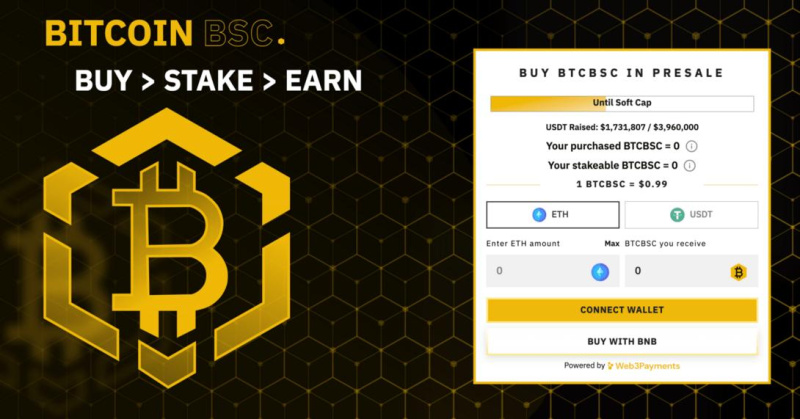 The project is backed by a stringent audit from Coinsult, and recently got featured by YouTube influencer Jacob Bury, who described it as a “new 10x potential crypto presale”, since then the Bitcoin BSC’s official Telegram channel has been growing steadily.
Bitcoin Clones & BTCBSC’s Unique Path to Success
In the past few months, so-called “Bitcoin clones” that draw inspiration from Bitcoin’s name and ethos have started to appear in he market.
With two notable ones being BTC20 (BTC20), a stake-to-earn cryptocurrency hosted on the Ethereum blockchain, and memecoin HarryPotterObamaSonic10Inu (BITCOIN), currently ranked eighth in CoinMarketCap’s list of the biggest meme coins in the world (as measured by market cap).
The Bitcoin BSC team believes a combination of strong branding with their proprietary staking rewards coupled with a comprehensive roadmap will help the project grow and achieve traction from the crypto community.
There’s no guarantee that Bitcoin BSC will follow in the footsteps of these projects. The Bitcoin BSC’s future will depend on whether the development team can execute the roadmap and capture community momentum and interest.
About Bitcoin BSC
Bitcoin BSC is a Proof of Staked based, greener version of Bitcoin which was created on the BNB chain infrastructure.
To learn more, visit the Bitcoin BSC Presale
Contact
Bitcoin BSC
[email protected]

Road Town, British Virgin Islands, September 13th, 2023, Chainwire
Premia Blue, the first-of-its-kind DeFi options exchange, is now live on Arbitrum.
Designed for traders and liquidity providers across all experience levels, Premia Blue offers unparalleled capital efficiency, user functionality, and composability in the DeFi space. Traders are now open to fully customizable European-style crypto options with market-driven pricing and dual trading modes—AMM and Orderbook. The only options platform in DeFi where products are composable no matter the preferred trading method.
Premia Blue opens the world to traders and liquidity providers of any knowledge, skill, or experience level thanks to its unique features, smooth UX, and easy onboarding. Liquidity providers can open pools on any ERC-20 token permissionlessly, while fully customizing their risk profile. Premia Blue’s unique Smart Range Orders and Concentrated Liquidity, allow liquidity providers to maximize their capital, while one-click Strategy Vaults offer potential passive yields.
Whether one is a trader, market-maker, or liquidity provider, Premia Blue’s robust feature set, including the upcoming margin, spreads, and lending products, empowers them to optimize their strategies and earn potential yield seamlessly.
As part of Premia Blue’s special promotion, for a limited period, users can receive 50% of protocol commissions back on referrals during the initial month.
The Hybrid nature of Premia Blue is the best of both worlds. To compete with the big boys we knew we needed to match costs at the granular level, while offering novel primitives and transparency that the big boys cannot match. Centralized Fees, Decentralized Attitudes. – DK, Vibe Broker at Premia
Setting a New Standard in Options Protocols
Previous iterations of DeFi options protocols (including Premia V2) have followed a vault-style design.
In protocols such as these, users can provide liquidity or buy options. However, LPs have to assume risk across all strikes and expiration dates, while traders have to combat low or fragmented liquidity and inefficient pricing models.
In contrast, Premia Blue is the first crypto options exchange to merge an order book, algorithmic strategies, and an AMM, composable and fully onchain. The onchain order book is available at no cost to users published on Arbitrum Nova, so users can ensure their orders are not being censored, or front ran.
While keeping the best of the pool-to-peer protocol design with Strategy Vaults, Blue also introduces multiple new sources for liquidity: an RFQ-network, Concentrated Liquidity Pools, and the ability to expand passive management strategies via Vaults.
These sources are combined in a deCentral limit-order book fashion. As a bonus, pricing converges to become fully market-driven, and traders receive competing price quotes from multiple inventory sources.
Introducing Premia Blue’s Exclusive Referral Initiative
Premia Blue invites users to embark on their DeFi journey and benefit from an exclusive offer: 50% of protocol commissions returned on referrals for the initial month. Catering to everyone from individual advocates to platform developers, this initiative is meticulously crafted to ensure rewarding experiences. Users are encouraged to register on their profile page or explore the detailed offers to discover more.
About Premia Blue
Premia Blue, previously known as Premia Finance, represents more than just a DeFi options platform. It embodies a shift towards a democratized financial landscape. Anchored in the principles of Public Redux of Economic Market and Investment Access, the platform’s mission is to provide universal access to investment opportunities and foster economic empowerment.
Premia Blue’s platform offers a comprehensive suite of services through the Premia Blue dApp and educational resources via Premia Academy. Whether one is a trader, a liquidity provider, or new to the space.
Initially launching exclusively on Arbitrum, Premia Blue has ambitious plans for omni-chain functionality. Users are welcome to be a part of Premia Blue’s journey in reshaping the financial horizon.
For more information visit:
Website | Premia Blue | v2 dApp | Docs | Twitter | Discord | Blog | YouTube | GitHub |
Please note that Premia does not provide investment advice, and nothing herein should be construed as such. Anyone considering trading or holding derivatives or crypto assets should be aware that the risk of loss can be very high, and it is upon each individual to seek advice from an appropriate professional advisor.
Contact
Marketing
Kseniia Baziian
Premia
[email protected]
United States Commodity Futures Trading Commission (CFTC) Commissioner Christy Goldsmith Romero has called for a modernization of protection measures using advanced technology to safeguard American investors.
Speaking at the annual meeting of the North American Securities Administrators Association in San Diego, Romero emphasized the need for government regulators to keep up with technological advancements to protect vulnerable investors.
Romero stressed the importance of regulators having a strong understanding of emerging technologies and their implications for the financial and legal sectors as they make policy decisions regarding next-generation financial technology.
In a significant move, Romero appointed technology experts in fintech, responsible artificial intelligence (AI), cryptocurrency, blockchain, and cybersecurity to the CFTC’s Technology Advisory Committee (TAC).
These experts are tasked with identifying ways to incorporate Know Your Customer (KYC) and Anti-Money Laundering (AML) processes into decentralized finance and cryptocurrency investment channels.
Furthermore, the TAC will play a crucial role in promoting responsible AI development within the financial industry, focusing on governance for decision-making that impacts investors and markets.
Romero highlighted a shift in federal crypto investigations from trade activities to monitoring social media platforms such as X (formerly Twitter), Reddit, and Facebook.
She recommended the use of tools like blockchain analysis, link analysis, and data analytics to aid these investigations.
Romero emphasized that statements made on social media platforms can serve as strong evidence of intent, and regulators can use these platforms to issue warnings about scams to protect investors.
READ MORE: Vitalik Buterin’s X Account Breached: Over $691K Lost to Malicious NFT Link
To combat financial fraud effectively, Romero proposed the establishment of a National Financial Fraud Registry.
This centralized database would maintain records of all crimes and fines related to financial fraud, allowing investors to conduct background checks on companies and ongoing investigations or fines related to fraud.
Romero initially proposed the registry in December 2019 to enhance investor protection.
Romero believes that this one-stop-shop platform can deter financial fraud and improve overall investor safety.
In conclusion, she emphasized that federal and state officials must work together to enhance investor protection and safety.
In April, Romero urged crypto companies to verify the digital identity of users to mitigate risks associated with anonymity.
She encouraged both exchanges and decentralized finance (DeFi) platforms to adopt digital identity verification while still providing financial privacy for customers.
This approach aligns with her commitment to enhancing investor safeguards in the rapidly evolving cryptocurrency and blockchain space.
Other Stories:
Coinbase CEO Foresees Crypto’s Major Role in 2024 Elections, Urges Clearer Regulations
Terra Classic Community Proposes Minimum Deposit Hike to Combat Spam
Rise of Senior Executives Leading Digital Asset Strategies Signals Investment Firm Transformation

Bitcoin experienced a notable recovery from its recent three-month lows on September 12, sparking skepticism among traders regarding the cryptocurrency’s price behavior.
Market data from Cointelegraph Markets Pro and TradingView reflected a rapid return to levels seen immediately after the weekly close of BTC/USD.
The preceding day had witnessed a sudden decline in Bitcoin’s value upon Wall Street’s opening, briefly pushing it below the $25,000 mark.
This performance marked its most significant decline since mid-June.
However, Bitcoin embarked on a subsequent comeback, surging by $1,000. Nevertheless, as of the time of writing, it was encountering resistance at the $26,000 level.
In anticipation of future price movements, on-chain monitoring resource Material Indicators had already issued a warning about an imminent “support test.” This was due to a decrease in bid liquidity in the order book’s lower levels.
Further analysis, both from Material Indicators and others, pointed out that previous occurrences of “rug pulls” in support levels had paradoxically led to positive outcomes in the Bitcoin market.
Large-volume traders were effectively clearing liquidity from the immediate vicinity of the spot price.
Co-founder Keith Alan even predicted that $24,750 would hold as support during a potential downturn, a prediction that remained accurate at the time of writing.
In a separate development, the DeFi Education Fund (DEF), an advocacy group for decentralized finance (DeFi), submitted a petition to the United States Patent and Trademark Office (USPTO) on September 7.
READ MORE: Coinbase CEO Foresees Crypto’s Major Role in 2024 Elections, Urges Clearer Regulations
This petition aimed to prompt a review of a patent owned by True Return Systems, a company accused by DEF of being a “patent troll.” Such entities seek to profit from patent-related lawsuits.
The patent, granted in 2018, claimed ownership of a process for “linking off-chain data to a blockchain.” DEF’s legal chief, Amanda Tuminelli, revealed that True Return had attempted to sell the patent as a nonfungible token (NFT) before subsequently filing lawsuits against DeFi protocols MakerDAO and Compound Finance in October.
Tuminelli asserted that True Return’s intention was to name defendants who couldn’t respond to the complaint, obtaining a default judgment.
The company would then seek to enforce the court’s ruling against token holders and repeat the process with other protocols that lacked the resources or means to challenge them in court.
DEF argued that the technology described in the patent was not innovative at the time of its granting and cited existing tech such as the InterPlanetary File System (IPFS) and decentralized storage platforms like Sia, Storj, and Swarm.
True Return Systems acknowledged a request for comment from Cointelegraph but had not provided an immediate response.
DEF’s petition to the USPTO aimed to protect the use and development of open-source software, prevent potential legal actions by True Return against crypto projects, and aid in the legal defense of MakerDAO and Compound.
True Return has a three-month window to optionally respond to the petition, after which the USPTO must decide whether to review the patent within six months and, ultimately, whether to cancel it within 12 months.
Other Stories:
Vitalik Buterin’s X Account Breached: Over $691K Lost to Malicious NFT Link
Rise of Senior Executives Leading Digital Asset Strategies Signals Investment Firm Transformation
Terra Classic Community Proposes Minimum Deposit Hike to Combat Spam
The Federal Reserve Bank vice chairman delivered a speech at the Philad elphia Fed’s fintech event on September 8, focusing on the central bank’s role in financial innovation, which primarily encompasses research and supervision, with a notable mention of the FedNow Service.
Michael Barr, the vice chair for supervision at the Federal Reserve, emphasized their commitment to central bank digital currency (CBDC) research, framing it as fundamental research that could potentially support a CBDC payments infrastructure or enhance the existing payments system.
Barr specifically highlighted the importance of system architecture for recording transactions and ownership in ledgers and explored tokenization models, in line with a FEDS Notes publication that underlined the compatibility of tokenized platforms with central bank money functioning as a settlement asset.
In an unusual punctuation choice for Federal Reserve communications, Barr underscored the significance of the Fed’s novel activities supervision program, introduced the previous month.
READ MORE: Block Earner Forges Ahead with Crypto-Backed Loans Despite Legal Battle with Regulator
This program entails a dedicated team of supervisors providing feedback to federally supervised banks, enabling them to obtain “written supervisory non-objection” for novel activities involving stablecoins and related endeavors, aligning with Office of the Comptroller of the Currency (OCC) policies outlined in interpretative letters 1174 and 1179.
Barr stressed the importance of strong federal oversight of stablecoins, in line with the OCC’s guidance, asserting that dollar-pegged stablecoins rely on the trust of the central bank and indicating support for ongoing legislative efforts.
He voiced concerns, stating, “If non-federally regulated stablecoins were to become a widespread means of payment and store of value, they could pose significant risks to financial stability, monetary policy, and the U.S. payments system.”
Barr also highlighted the Federal Reserve’s role in facilitating 24-hour instant payments through the FedNow Service, which was introduced in July. While current usage volumes of the service remain modest, he emphasized that it falls on depository institutions to make this service widely accessible, encompassing large banks, regional banks, community banks, and credit unions.
Other Stories:
Ant Group Unveils ZAN Sub-Brand for Web3 Blockchain Development Services
Crypto Exchange CEO and Siblings Sentenced to Over 11,000 Years in Prison
Singapore’s MAS Maintains Strict Stance on Crypto Participation in Regulatory Sandbox