



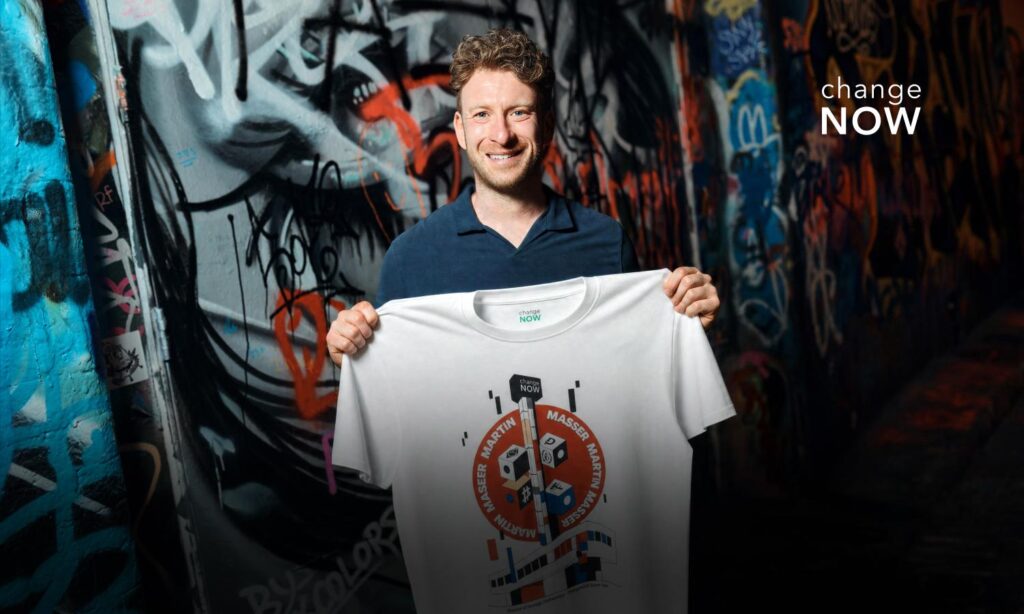
Kingstown, Saint Vincent and the Grenadines, August 5th, 2026, Chainwire
The former TON executive joins as Director of Strategic Partnerships to form the connections behind ChangeNOW’s next phase.
Former TON executive Martin Masser joins ChangeNOW to build strategic partnerships, ecosystem relationships, and media momentum behind its next phase.
Masser comes with experience across traditional banking, Web2 and Web3, including senior growth and business development roles within the TON space. At ChangeNOW, he will lead strategic relationships with blockchain networks, wallets, fintech companies, payment providers and other infrastructure partners.
His appointment comes as ChangeNOW grows beyond standalone crypto services, transitioning to one connected product where users can buy, store, swap, trade, send, receive and grow digital assets. The industry has already built most of the individual components. What it hasn’t solved is the experience of using them together; clients are still expected to switch between platforms, understand different networks and connect the pieces on their own. ChangeNOW’s super app strategy is designed to move that complexity beneath the product.
“Martin brings a rare mix of commercial relationships, product and media understanding,” said Pauline Shangett, Chief Strategy Officer at ChangeNOW. “He knows what the technology can do, what the business needs and how to make the market pay attention. That is exactly the perspective we need as we build the ChangeNOW super app.”
Masser’s role will focus not on accumulating partnership announcements, but on identifying relationships that can make ChangeNOW’s infrastructure more complete and remove unnecessary steps from the сlient experience.
“The best partnerships create access, adoption and attention. My focus is to build relationships that make the product stronger, simpler and more useful, and then help the market understand why they matter. If you are building wallets, networks, payments, stablecoins, fintech infrastructure, consumer crypto or Web3 products, I want to hear from you,” said Masser.
For consumers, ChangeNOW is combining the core activities of managing crypto within one environment. For businesses, it is developing an integrated set of tools for crypto payments, exchange, stablecoin settlement, digital asset management and Web3 integrations.
As ChangeNOW expands into a crypto super app, its next phase is connecting the right networks, wallets and partners. Masser’s role will be central to building those relationships and turning them into product value, adoption and market momentum.
About ChangeNOW
ChangeNOW.io is a crypto super app built for every crypto move, giving newcomers, professionals, and businesses the tools they need to access Web3 finance in a simple and secure way.
Since 2017, ChangeNOW has grown from a fast, secure, and limitless instant exchange into a trusted platform where storage, swaps, trading, staking, and asset management are covered in one simple experience for millions of clients worldwide.
About Martin Masser
Martin Masser is Director of Strategic Partnerships at ChangeNOW, where he is building partnerships around the company’s expansion into a crypto super app. His career covers traditional banking and capital markets in London and Web3, including his previous role as Head of Growth at TON Foundation. Martin works at the intersection of growth, infrastructure, and partnerships, connecting products and industry players to make crypto services work as one seamless user experience.
Contact
PR Team
CHN Group LLC
[email protected]
New York, United States, July 28th, 2026, Chainwire
BitSafe has released infrastructure for builders launching decentralized financial applications on Canton Network.
Backed by a Canton Foundation Development Fund grant of over $1 million (8,500,000 $CC), BitSafe today opened the public beta of Decentralization Manager, an open-sourced framework allowing apps and institutions to build resilient products that distribute control across multiple independent operators.
Canton Network has become critical infrastructure for institutions bringing real capital and operations on-chain. Meeting institutional application standards requires audit trails and distributed trust, but until now every team building on Canton has had to build threshold custody, governance, and audit infrastructure from scratch. Decentralization Manager makes those reusable, so teams build the application, not the infrastructure.
Independently audited by Quantstamp, Decentralization Manager marks an exciting expansion of on-chain use cases and allows institutions to continue leveraging the network’s privacy-native architecture while mitigating risk by distributing their operations.
Decentralization Manager ships with pre-built frameworks for token issuance and custody and enables additional products such as:
- Token issuance: Issuers can launch and govern Canton-native tokens, ranging from wrapped cryptoassets to stablecoins and RWAs.
- Custody and multi-signature wallets: Teams can hold and transfer assets under shared, multi-party control, removing reliance on any single custodian.
- Tokenized real-world assets and securities: Builders can bring real-world assets on-chain and govern them under distributed control.
- DEXs, lending, and structured products: Institutions can launch institutional-grade financial applications with Decentralization Manager.
Contact us to start launching decentralized applications and assets.
CBTC, the first non-native asset on Canton, is the first live use case of Decentralization Manager. With over 10 million transactions to date, node operators powering CBTC already earn a share of Canton fees from on-chain transactions. Decentralization Manager now extends that opportunity across the network. Application builders get an easier path to high quality node operators who can support their products, and those operators earn the same share of Canton fees in return.
“The future of institutional blockchain depends on making sophisticated infrastructure easier to build and adopt,” said Viv Diwakar, Head of the Canton Foundation. “By open-sourcing Decentralization Manager, BitSafe is giving developers the tools to create resilient, privacy-preserving applications that distribute trust across independent operators without compromising the governance and control institutions require. Contributions like this strengthen the Canton ecosystem and help accelerate the growth of institutional digital assets and tokenized financial markets. We’re pleased to see BitSafe making this capability available to the wider community and look forward to seeing the next generation of institutional applications built on Canton.”
As of today, Palladium Labs is the first builder announced using Decentralization Manager to enable multi-party authorization for protocol operations. “Distributed trust and full auditability are table stakes for institutional-grade credit infrastructure like Alpend,” said Akshay Sinha, Cofounder & CTO of Palladium Labs. “Decentralization Manager makes that a framework the entire Canton ecosystem can build on. Adopting it was one of the easier decisions we’ve made.”
In addition to Palladium, CBTC Attestors Nethermind, DSRV, and Finoa Consensus Services have already implemented Decentralization Manager. Their institutional participation affirms a collective effort across Canton to embrace decentralized technology that prioritizes data privacy, operational control, and resilience.
The public beta is open now on the Canton Foundation’s GitHub, with an additional grant application underway. Builders who need operators to complete their Decentralized Party can reach out to BitSafe to be matched with vetted, institutional-grade node operators. Institutions looking to issue and govern Canton-native tokens can engage BitSafe’s Decentralization Services for custom tokenization engagements.
Additional quotes from ecosystem partners:
“The CBTC Decentralized Party has shown how far Canton has come, and the public beta opening of Decentralization Manager is a big step for the whole ecosystem. Onboarding was remarkably smooth for our team – contract deployment was essentially one click. For any app still running on a single validator, this is the easiest path we’ve seen to move beyond a single point of failure.” – Joonkyo Kim, CTO, DSRV
”As one of the attestors securing CBTC, we’ve operated inside BitSafe’s decentralized signing architecture from an early stage, so we’ve seen firsthand what it takes to distribute trust across independent operators in production. Onboarding into Decentralization Manager was refreshingly straightforward, the admin tooling is intuitive and whenever we hit an issue the BitSafe team resolved it quickly and communicated the whole way through.
Institutions bringing real assets onto Canton increasingly expect exactly this: no single point of control with the audit trails and operational resilience their risk teams demand. Making that kind of infrastructure open and repeatable is a meaningful step for the ecosystem.” – Mateusz Jędrzejewski, CIO, Nethermind
“BitSafe’s Decentralization Manager turns the infrastructure we already run into a setup with no single point of failure, the kind institutions expect from Canton. We’re glad to extend our partnership with BitSafe and look forward to building more together as new applications join the network.” – Daniel Schrader, Managing Director, Finoa Consensus Services
About BitSafe
BitSafe builds decentralized, privacy-enabled digital asset infrastructure on the Canton Network. As the team that brought Bitcoin to Canton ($CBTC), BitSafe’s threshold-governed multi-sig infrastructure distributes custody and governance, eliminates single points of failure, and enables institutions and developers to launch trading venues and build compliant financial products and assets across the ecosystem.
Contact
Kadeem Clarke
BitSafe
[email protected]
Singapore, Singapore, July 24th, 2026, Chainwire
Backed by Galaxy Ventures and Vitalik Buterin, the ultra-high-performance perp DEX has officially launched its public rewards program.
RISEx, the fully on-chain perpetuals exchange built on the high-throughput RISE Chain, has officially launched Ignite: Season 1, its core loyalty and ecosystem points program. Following an invite-only beta phase that generated over $3 billion in cumulative trading volume, the program marks the next major step in RISEx’s broader ecosystem rollout as the protocol builds toward long-term community ownership and future token distribution.
Launch week concluded today with the distribution of the Season 0 retroactive points, recognizing the users who traded on a merit-based, invite-only venue with no guarantee of reward.
The program also carries a claim no competing venue can make: 100% of RISE points are allocated to RISEx users, including traders, LPs, and builder code integrators. RISE is an exchange chain, and RISEx is its product. Rather than splitting rewards across a diffuse ecosystem, the entire network’s incentive weight routes through the venue where activity actually happens.
The launch arrives amidst a massive structural shift in crypto derivatives, with decentralized perpetuals rapidly devouring centralized venue market share. Following the successful live deployment of its core exchange infrastructure, including cross-asset netted-margining and native Real-World Asset (RWA) trading, the public opening of RISEx’s rewards system marks the platform’s formal transition into global scale and growth mode.
Ecosystem Traction: By the Numbers
Prior to opening public rewards, the RISEx closed beta cultivated organic, institutional-grade liquidity and deep user engagement over three months:
- $3 Billion+ in cumulative trading volume processed since genesis.
- $26 Million+ in Open Interest (OI).
- $15 Million+ in Total Value Locked (TVL).
- 15,000+ Registered users accumulated entirely through a merit-based referral network.
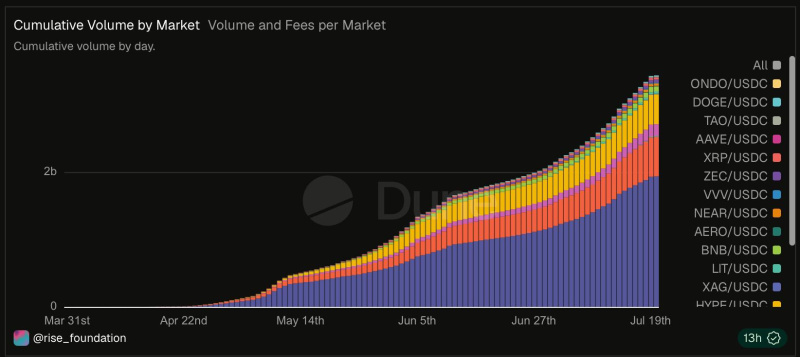 Source: DUNE
Product First, Incentives Second “Much to the frustration of our growth team, I was adamant that we would not launch an incentives program until our core exchange engine reached absolute stability,” said Sam Battenally, CEO and co-founder of RISE Labs. “Too often, points programs are deployed prematurely to mask unfinished infrastructure or buy empty, temporary volume. We spent the last few months doing the hard engineering work instead by stabilizing core features like reduce-only GTC and bootstrapping deep, quality liquidity. If you are fueling the engine, it has to perform. Now that our core architecture is fully live, optimized, and performing at a world-class level, we are ready to scale.”
Ignite Season 1 Structure & Timeline
Ignite runs according to a product roadmap, and that is RISEx’s commitment to the RISE mission. As the exchange ships and reaches milestones, the season moves with it. AutoYield, Permissionless Portfolio Margin, and equity listings are all part of a larger vision to bring full-scale composable finance on-chain.
This is a deliberate design choice. Rewards should track real product progress rather than a marketing calendar that forces a program to overspend early or thin rewards later, penalizing the early contributors and active traders who showed up first.
- Live Since: Week 1 of Ignite began on Monday, July 20, 2026, at 00:00 UTC.
- Public Distribution: RISEx will distribute 200,000 points per week, settled every Tuesday, with the first weekly distribution on July 28, 2026, at 14:00 UTC.
- Season Length: Ignite is expected to end no later than Q2 2027.
- Allocation: 100% of RISE points are allocated to RISEx users, including traders, LPs, and builder code integrators.
Inside the Ignite Mechanics
Engineered to reward genuine, long-term ecosystem participation over predatory Sybil farming and artificial wash trading, Ignite evaluates user contribution across multiple health metrics rather than volume alone.
- Multi-Layered Earning: Qualifying activity spans higher-order activity, total costs including fees, slippage and negative markouts, trading volume, and open interest and hold time.
- Referral Rewards: Referrers earn an additional 10% of their referee’s points.
- Undisclosed Weightings: The exact methodology and weightings are not published. This protects the program from being gamed.
- Affiliate Program: For those who qualify, the affiliate program offers additional incentives such as fee rebates, point boosts, and more.
Institutional-Grade Architecture
RISEx achieves centralized-exchange execution speeds with full self-custody by utilizing RISE Chain, an EVM-compatible Layer 2 network delivering unprecedented 5 Ggas/s throughput and 1-millisecond latency. Because the exchange and the underlying blockchain share the same state, users benefit from a fully on-chain orderbook where collateral and interconnected DeFi positions exist within a single, atomic execution environment.
With the core perpetual exchange engine stabilized, the platform’s mid-term product roadmap is shifting toward the launch of native EVM Spot trading, AutoYield, and Permissionless Portfolio Margin.
Traders can clear the gate, check their retroactive allocations, and begin earning Season 1 points by visiting rise.trade.
About RISEx
RISEx is a fully on-chain perpetuals exchange built on RISE Chain. Delivering centralized-exchange execution speeds with full self-custody, RISEx features an on-chain orderbook that shares state and liquidity with the entire RISE DeFi ecosystem in a single transaction. RISEx offers institutional-grade crypto perpetuals with flexible collateral, with plans to expand into equities, forex, and commodities.
About RISE Chain
RISE Chain is a next-generation Ethereum Layer 2 purpose-built for high-performance DeFi, delivering 5 Ggas/s throughput and Web2-like latency via its proprietary Shreds architecture. Developed by RISE Labs, the network is backed by Galaxy Ventures, Vitalik Buterin, Finality Capital Partners, EtherFi, OrangeDAO, DACM, P2 Ventures, Stani Kulechov, and other leading digital asset investors.
Contact
Grigory Prelovskiy
[email protected]
Toronto, Canada, July 23rd, 2026, Chainwire
CoinRabbit and GoMining have published a report on Bitcoin mining profitability, showing why managing mined Bitcoin is becoming as important as producing it.
The report highlights how the post-halving environment is redefining success in mining, with operators relying on stronger treasury management, capital discipline, and long-term asset strategies to navigate tighter margins. With the block reward reduced to 3.125 BTC and network difficulty near record levels, operational efficiency alone is no longer enough. The next phase of mining will be shaped by smarter capital allocation and long-term conviction in Bitcoin.
The Four Pillars of the Bitcoin Mining Efficiency Mindset
The report presents a clear framework built around four key pillars:
1) Operational Cost Efficiency
Low-cost power procurement, high uptime, efficient cooling, and disciplined maintenance remain the foundation of any viable mining operation. These factors determine the baseline production cost and are essential for competitiveness.
2) Collateralization Over Liquidation
Instead of selling freshly mined Bitcoin to cover expenses, effective operators are using it as collateral. This approach allows them to meet short-term cash needs while retaining full ownership and long-term exposure to the asset’s value.
3) Operational Liquidity and Tax Optimization
Bitcoin-backed lending provides flexibility to cover recurring operating costs, including power, hosting, and payroll, while avoiding taxable sales. At the same time, it preserves the deductibility of operational expenses.
4) Long-Term Vision and Capital Discipline
Sustainable operators treat mining as a disciplined, capital-intensive business. They maintain the flexibility to hold Bitcoin through market cycles and reinvest in hardware upgrades when opportunities arise, avoiding forced sales during downturns.
The full report can be downloaded here.
Walter Barrett, Chief Strategy & Growth Officer at CoinRabbit, commented: “Long-term success is built on conviction in the assets you hold and the discipline to manage them through different market cycles. At CoinRabbit, we are proud to work with clients who share this long-term vision and recognize the value of staying focused through periods of uncertainty. We appreciate the collaboration with GoMining experts and their contribution to sharing deeper industry insights with the mining community.”
Jeremy Dreier, Chief Business Development Officer at GoMining and Managing Director of GoMining Institutional, added: “In the post-halving environment, discipline is critical. The miners that are winning are those with efficient operations and cash put aside for this exact time. This is the best possible moment to deploy capital into expanding your fleet, because it’s cheap to add hash rate when Bitcoin’s price is down. There’s a lot of opportunity in the market. At GoMining, this is our third bear market, and we’ve seen that the operators who are prepared look at these conditions as an opportunity. Those who aren’t prepared are the ones who panic.”
About CoinRabbit
CoinRabbit is a crypto asset management platform built for long-term capital preservation. It enables users to manage liquidity seamlessly across instant payments, lending, trading products, and the Private Program — all within a single ecosystem. Since 2020, CoinRabbit ensures 100% capital reserve, keeping clients’ funds safe and never reused.
For more information, users can visit coinrabbit.io
About GoMining
GoMining is an all-in-one Bitcoin ecosystem that makes it simple and secure to mine, earn, and use Bitcoin every day. GoMining serves 5 million users and ranks among the top-10 Bitcoin miners by hashrate globally, with data centers in the U.S. and internationally. The company makes Bitcoin accessible through tokenized hashrate, daily BTC rewards, and an expanding suite of payment and earning products.
For more information, users can visit gomining.com
Contact
CMO
Irene Afanaseva
CoinRabbit
[email protected]

Miami, United States, July 22nd, 2026, Chainwire
Unserious today announced the acquisition of Creepz, one of the most recognizable NFT collections of the 2021-22 cycle. Backed by entrepreneur and investor Adam Weitsman, and with the support of the original founders, the deal places the lizard cult brand under a powerhouse new team.
Most importantly, the acquisition marks a homecoming for Psychrome – the original mastermind and creative genius behind the Creepz lore. Returning to lead IP development, he also brings a resume as a globally exhibited artist whose commercial collaborations span Nike, Salomon, Sneaker Con, Staple, Disney, Warner Bros., and Rovio.
Beyond this foundational creative leadership, the Unserious team brings deep operating experience with a track record spanning consumer brands, entertainment, and enterprise tech, alongside crypto’s largest token launches – including the historic ApeCoin.
Unserious also took the opportunity to formally deny the existence of lizard people, their alleged evil activities, and any plans for $CREEPZ world domination.
About Unserious
Unserious is reimagining the future of decentralized brands.
Contact
Acquirer
Unserious
Unserious
[email protected]

ENCINITAS, CALIFORNIA, July 20th, 2026, Chainwire
The California Institute for Human Science (CIHS) today announced the launch of its Master of Science in Artificial General Intelligence, the first accredited graduate program dedicated specifically to AGI. The program is taught live, online, by researchers who helped found the field, including Dr. Ben Goertzel, who introduced the term “artificial general intelligence” and founded SingularityNET, the ASI Alliance and the Hyperon AGI project.
Where most AI graduate programs train students on today’s tools and applications, the M.S. in AGI is built around the scientific, engineering, ethical, and civilizational questions of general intelligence itself, the discipline’s founders teaching the discipline they founded.
“CIHS was built for frontier questions — the kind that require scientific rigor, philosophical depth, and a serious commitment to human flourishing,” said Timothy Laporte, Interim President of California Institute for Human Science. “Artificial general intelligence may be one of the most consequential developments of our time. As AGI moves from theory toward reality, the questions at the heart of CIHS — what intelligence is, how consciousness relates to mind and technology, and how transformative knowledge can serve humanity — have never been more urgent. This program brings the field’s founding researchers together with the students who will help shape what comes next,” says Dr. Timothy Laporte, Interim President of the California Institute for Human Science.
Institutionally accredited by the WSCUC Senior College and University Commission, the same accreditor as Stanford and Caltech.
Dr. Ben Goerzel shared, “During these unprecedented times in which AGI is rapidly transitioning from theory into practical and deployment, the need has never been greater for a new breed of AGI professional – conversant in a variety of technical AI paradigms and their underlying scientific foundations, and also in the intersections of AGI with broader issues of consciousness, ethics and society. It has been an absolute pleasure to collaborate with Gabriel Axel and the folks at CIHS on creating the world’s first AGI degree programme, oriented toward fostering the careers of this new generation of AGI scientists. We need to work toward a beneficial future together with our diverse AGI creations.”
Most graduate AI programs train students to apply today’s models and tools. The M.S. in AGI treats artificial general intelligence as a field of study in its own right, with open technical questions and a long-running research history, rather than as a specialization inside a broader computer science degree.
That distinction matters because prospective students weighing graduate study in an AI-saturated moment are increasingly looking past today’s specific tools toward the questions that will outlast them. CIHS’s answer is that the durable thing to study is intelligence itself: the fundamental questions and intellectual and practical methodologies that don’t change as any one tool generation comes and goes, taught by researchers who have spent their careers on those questions directly.
The program is also a departure in format: live, faculty-led video classes rather than a self-paced, pre-recorded course library, with a small inaugural cohort that works directly with Goertzel, Iklé, and Montes rather than watching them.
Program details
- Format: 100% online, live video classes (Pacific Time), quarter system
- Faculty: Ben Goertzel (launched the term and concept of “AGI”; founder, SingularityNET, the ASI Alliance, and OpenCog), Matthew Iklé, and Gabriel Axel Montes (Chair and Program Director), with additional guest lectures from the SingularityNET AI research team. More faculty to be announced.
- Admissions: No GRE required. Applications include transcripts, two letters of recommendation, an essay, and a writing sample, reviewed on a rolling basis as they arrive.
- First cohort: Application priority deadline July 31, 2026; final deadline August 31, 2026. Course registration September 7–18, 2026; Quarter begins September 28, 2026.
- Eligibility: Open to students in 31 approved U.S. states and worldwide internationally; the program is not available in all U.S. states. Prospective students can contact CIHS to confirm eligibility in their state.
- Tuition: https://cihs.edu/tuition-fees/
A small inaugural cohort will work directly, live, with the researchers who have spent their careers defining AGI’s foundational questions.
Two info sessions will be held with Ben Goertzel and Gabriel Axel Montes on Friday, July 24, at 10:30am PT and on Thursday, August 13, at 5pm PT. Prospective students can learn more and register for a live virtual info session at https://cihs.edu/degrees-and-programs/artificial-general-intelligence/info-sessions/.
About CIHS
California Institute for Human Science (CIHS) is an accredited nonprofit graduate university and research center in Encinitas, California, dedicated to serious inquiry at the frontiers of science, consciousness, health, technology, psychology, and human transformation. Founded in 1992, CIHS has long focused on fundamental questions about human potential, consciousness, and the nature of reality. Its new M.S. in Artificial General Intelligence extends that mission into one of the defining fields of the 21st century, bringing together technical AI study with questions of intelligence, consciousness, ethics, safety, and the future of civilization. CIHS is accredited by the WASC Senior College and University Commission (WSCUC). Learn more at CIHS.edu.
Contact
Stacy Gomes
[email protected]
San Francisco, CA, July 17th, 2026, Chainwire
Crowdsourced Hedge Fund Completes Third Open-Market Purchase as Contributor Network and Assets Continue to Grow
Numerai, the decentralized hedge fund powered by crowdsourced machine learning, today announced the completion of a third strategic purchase of Numeraire (NMR), acquiring an additional $1.2 million of the token from the open market. The purchase brings Numerai’s total NMR buybacks to $3.2 million within one year.
The buyback reflects Numerai’s continued investment in the staking system that aligns thousands of independent data scientists toward improving the firm’s Stake-Weighted Meta Model, the machine learning model that powers Numerai’s hedge fund. Contributors stake NMR on their models, earning additional NMR when their predictions perform well on future market data and losing it when they do not. The resulting Stake-Weighted Meta Model continues to outperform Numerai’s internal benchmark models, demonstrating the value of aligning incentives with predictive performance.
Since announcing its first strategic buyback in July 2025, Numerai’s network has expanded significantly. Active accounts have more than doubled over the past year, submissions continue to increase, and the platform has introduced new infrastructure including Numerai Skills, Numerai Model Context Protocol (MCP), and Atomic Blockchain Staking, enabling increasingly autonomous participation by AI systems.
The underlying hedge fund has also continued to grow. According to the company, Numerai now manages approximately $700 million in assets, up from approximately $560 million at the end of 2025.
Numeraire is a fixed-supply Ethereum token capped at 11 million NMR. Because tournament rewards and staking incentives are distributed from Numerai’s treasury, the company is replenishing its holdings through open-market purchases. Before this buyback, approximately 3.1 million NMR remained in Numerai’s treasury.
Unlike the previous two announcements, this buyback had already been completed before today’s announcement. As with prior purchases, the transaction was executed on the open market through Coinbase Institutional at or near the bid price over several weeks to minimize market impact.
Past performance is not indicative of future results. This content does not represent an offer to purchase or sell any security or the interests of any account managed by Numerai GP, LLC or its affiliates. Such an offer may only be made to persons who qualify to invest and in jurisdictions in which such an offer is legal.
About Numerai
Numerai is a San Francisco-based hedge fund and data science platform founded in 2015. Through a global competition and open API, thousands of data scientists submit stock market signals that are aggregated into a single Meta Model used to trade global equities. Numeraire (NMR) is used to stake and reward models that improve the fund. Numerai’s mission is to build the world’s last hedge fund through open, competitive machine intelligence.
Contact
Contact Numerai
[email protected]
London, United Kingdom, July 17th, 2026, Chainwire
ether.fi, the leading onchain neobank for digital asset management, has selected Nexus Mutual to provide crypto’s largest-ever ETH Slashing Cover. The cover protects ether.fi‘s validators against up to 15,000 ETH worth of slashing penalties.
As ether.fi continues to see rapid adoption from both retail and institutional audiences, securing industry-leading protection against slashing risk for ether.fi users is critical. Over the last year, ether.fi has been systematically strengthening their stack across infrastructure, risk management, operational security and real-time defense systems.
Since ether.fi operates one of the largest validator sets on Ethereum, slashing is a real tail risk for them. By working with Nexus Mutual, ether.fi has mitigated this with protection that kicks in to secure against validator losses. This cover was calculated to protect ether.fi in even the most extreme scenarios and represents more than all historical losses from ETH slashing combined.
“We’ve always believed the safest protocols will ultimately win. That’s why we’ve invested heavily in audits, operational security, staking architecture, and now the largest insurance program in the industry. We are excited to partner with Nexus Mutual to make this a reality,” said Mike Silagadze, Founder & CEO of ether.fi.
“We’ve known the ether.fi team since before it was ether.fi, and they’ve been focused on risk from day one. Covering their users for up to 15,000 ETH in slashing penalties is a historic step, and we’re proud they chose Nexus Mutual to take it with them,” said Hugh Karp, Founder of Nexus Mutual.
About ether.fi
ether.fi is the leading onchain neobank for digital asset management. With $6B+ in AUM across Cash (crypto card), Stake (restaking), and Liquid (liquid restaking derivatives), ether.fi has established category dominance in crypto neobanking. It’s the rare institutional-grade product built for consumer adoption.
About Nexus Mutual
Nexus Mutual is the first crypto insurance alternative. Since 2019, they have covered more than $7 billion against smart contract hacks, slashing, and other digital asset risks. As the industry leader, they have become a trusted partner for everyone from individuals to institutions to help manage onchain risk.
Contact
Head of Marketing
Phil Johnston
Nexus Mutual
[email protected]
Kingstown, St. Vincent and the Grenadines, July 16th, 2026, Chainwire
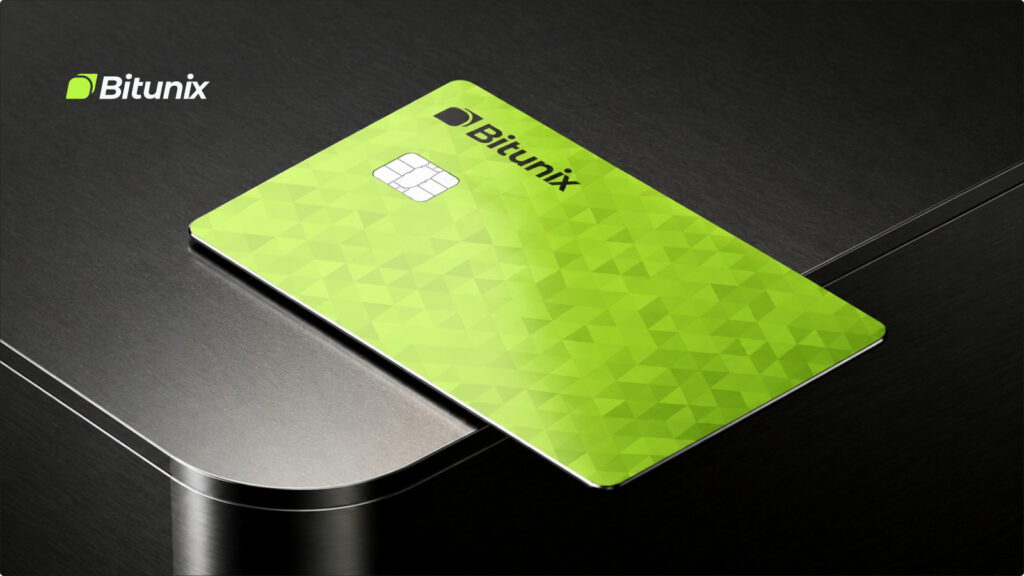
Cryptocurrency exchange Bitunix has launched the Bitunix Card, a Visa-powered payment solution that allows users to spend their funds on everyday purchases, and earn yield on idle balances.
The launch reflects a growing demand for practical crypto products that connect digital assets with everyday spending. Instead of moving funds between multiple platforms, Bitunix users can now manage payments, and earnings from one place.
The Bitunix Card can be used at more than 130 million merchants worldwide that accept Visa payments. Users can pay for everyday services and subscriptions such as Uber, ChatGPT, Amazon, Spotify, and Netflix, while also using the card when traveling internationally. Payments are completed instantly, allowing users to spend their crypto as easily as they would with any traditional payment card. The card offers up to 8% cashback on eligible spending, with rewards capped at 1,000 USDT monthly.
To support everyday payments across different regions, the Bitunix Card is compatible with major digital wallets such as Apple Pay, Google Pay and Paypal, as well as selected regional payment platforms and local payment networks.
Available through the Bitunix web platform as well as its iOS and Android applications, the card is designed to give users more utility for their USDT beyond trading. Through a unified dashboard, users can manage card balances, transfer funds between accounts, track transactions, monitor cashback rewards, and control card settings in one place.
The card applies standard regional network processing fees, while eligible users may offset these costs through cashback rewards, depending on their VIP tier.
In addition, eligible balances held on the card can automatically earn yield, reaching up to 11.6% annually, depending on the asset and applicable conditions.
“The Bitunix Card goes far beyond payments. It unlocks a seamless, high-yield financial ecosystem built for everyday global commerce,” said Bitunix’s Chief Strategy Officer, Steven Gu.
The card comes with no issuance fee and no monthly maintenance fee. To activate the card, users are required to transfer a minimum balance of 100 USDT to their card account. The funds remain fully available for spending and do not represent an activation fee.
Users can apply for the Bitunix Card directly through the Bitunix platform. The card is offered to eligible Bitunix users who have completed the platform’s identity verification process and reside in supported regions.
The launch is part of Bitunix’s broader effort to make cryptocurrency more practical for everyday use. By combining spending and earning features in a single product, Bitunix gives users more ways to put their digital assets to use in everyday life.
For more information about the Bitunix Card and application details, users can visit the official Bitunix Card page.
About Bitunix
Bitunix is a global cryptocurrency derivatives exchange trusted by over 5 million users across more than 150 countries. Guided by its core principle of better liquidity, better trading, the platform is built for traders who expect more, committed to providing Ultra Trust, Ultra Products, and Ultra Experience. Bitunix offers a fast registration process and a user-friendly verification system to ensure safety and compliance. With global standards of protection through Proof of Reserves (POR) and the Bitunix Care Fund, the exchange prioritizes user trust and fund security. Industry-first innovations like Fixed Risk, TradingView-powered chart suite, along with indicator alerts, cloud-synced templates, provide both beginners and advanced traders with a seamless experience. Making Bitunix one of the most dynamic platforms on the market.
Bitunix Global Accounts
X | Telegram Announcements | Telegram Global | CoinMarketCap | Instagram | Facebook | LinkedIn | Reddit | Medium
Contact
COO
Kx Wu
Bitunix
[email protected]

London, United Kingdom, July 15th, 2026, Chainwire
CT3 today announced the transition of its decentralized storage infrastructure to a dedicated Storage Contracts model designed to support continued platform growth, improve infrastructure scalability, and expand storage capacity as demand increases.
The transition follows rapid growth across the CT3 ecosystem, with more than 180,000 unique users having used the platform and more than 500,000 uploads completed. Each upload is linked to an NFT access key, allowing platform activity and network usage to be independently verified on-chain.
Continued growth in demand for ct-3.cloud services has increased pressure on the existing infrastructure. Processing all new uploads through a single main collection and one smart contract may reduce scaling flexibility and make storage capacity more difficult to manage as network activity expands.
Under the new architecture, new uploads will be distributed across dedicated Storage Contracts rather than a single main contract. Each Storage Contract is linked to a fixed amount of storage capacity and operates as an independent infrastructure segment with its own capacity, utilization level, and on-chain statistics.
The new model is intended to distribute workloads across multiple smart contracts, improve the transparency and measurement of resource utilization, and support the deployment of additional storage capacity as demand grows. Participants may finance the deployment of new Storage Contracts and the addition of storage capacity. The allocated capacity is used to store files uploaded through ct-3.cloud, while the resulting profit is shared between CT3 and the participant who financed the infrastructure expansion.
Infrastructure Segmentation
Previously, CT3 keys were issued primarily through the main collection and a single contract flow. As the platform expanded, this model became less flexible for handling different categories of data.
Storage Contracts divide the infrastructure into separate segments. Each segment:
- operates through its own smart contract;
- is linked to a specific amount of storage capacity;
- can serve a particular category of files;
- allows capacity utilization and workload to be measured independently;
- reduces pressure on the main NFT key issuance process.
This separation makes the infrastructure more resilient and allows individual areas of the platform to scale without rebuilding the entire system.
How the Allocated Storage Capacity is Used
Each Storage Contract is linked to a defined amount of capacity within the CT3 network. Once activated, the corresponding storage space is supplied by network nodes and used to store data uploaded through ct-3.cloud.
The allocated capacity may be used for:
- standard user files;
- corporate archives;
- automatic backups;
- long-term datasets;
- future CT3 products and applications.
Larger contracts can accommodate heavier files and more substantial flows of corporate or backup data. This allows the network to direct workloads to infrastructure segments with sufficient available capacity.
Storage Contract Economics
The commercial model behind Storage Contracts is based on the real use of CT3 infrastructure. The platform acquires storage capacity from node operators and provides it to ct-3.cloud customers at the market price of the storage service.
A participant finances the deployment of a new Storage Contract and the expansion of the network’s available capacity. Once launched, this capacity is used to store personal and corporate data, while the generated profit is distributed between the investor and CT3.
The financial performance of each contract depends on two main factors:
- the actual utilization of the allocated capacity;
- the margin between the cost of acquiring storage capacity and the price charged to end users.
Storage Contracts therefore allow participants to take part in the growth of CT3 infrastructure and potentially earn income linked to real demand for storage services. The more actively the allocated capacity is used, the greater the contract’s potential result.
On-chain transparency
The operation of each Storage Contract can be verified through the blockchain. Files stored within the allocated capacity are represented by NFT keys containing storage-related metadata.
The combined size of the files associated with these keys can be compared with the utilization figure displayed for the contract. Through the smart contract address, an investor can verify issued NFTs, collection activity, and the actual use of the capacity they helped finance.
This model makes it possible to independently verify:
- the number of keys created;
- the volume of stored data;
- utilization of the allocated capacity;
- activity within a specific Storage Contract;
- the relationship between infrastructure usage and profit generation.
For ct-3.cloud users, the experience remains unchanged: both existing and new NFT keys continue to be supported, and the transition to the new architecture requires no additional action.
About CT3
CT3 is developing a decentralized data storage infrastructure that combines independent nodes, the ct-3.cloud interface, NFT access keys, and blockchain verification.
Users upload files through ct-3.cloud, after which the data is distributed across network nodes. An NFT key is created for every stored object, confirming access rights and containing the relevant storage metadata.
Within this model, nodes provide physical storage capacity, CT3 manages data distribution and access, while individual and corporate users generate demand for storage services.
As the number of users and uploads increases, the network must continuously expand its available capacity. At certain times, demand growth may outpace the addition of new capacity from node operators. Storage Contracts allow CT3 to add new resources in a structured way and allocate them to specific areas of use.
Contact
CMO
Rodrigo Pereira
CT3
[email protected]