


Ukrainian lawmakers have submitted a draft bill that would allow the National Bank of Ukraine (NBU) to include cryptocurrencies like Bitcoin in its official reserves.
The proposal was introduced as bill number 13356 in the Verkhovna Rada this Tuesday.
It seeks to amend the law “On the National Bank of Ukraine” by authorizing the central bank to hold crypto assets alongside gold and foreign currencies.
Discretionary Power for the Central Bank
Unlike mandatory reserve requirements, this draft bill gives the NBU full discretion over crypto holdings.
According to MP Yaroslav Zhelezniak, the bill neither compels nor directs the bank to invest in Bitcoin or other crypto assets.
“How, when and how much should be the decision of the regulator itself,” Zhelezniak said on his Telegram channel.
A Move to Strengthen Economic Stability
Lawmakers behind the bill argue that managing crypto reserves could bolster Ukraine’s macroeconomic stability.
It would also support the development of the nation’s digital economy.
“Proper management of crypto reserves will help strengthen macroeconomic stability and create new opportunities for the development of the digital economy,” Zhelezniak posted on Telegram.
Industry Involvement in Drafting
The draft bill received input from notable stakeholders.
Early in the week, Zhelezniak appeared in a video with Kyrylo Khomiakov, Binance’s regional head for Central & Eastern European and Central Asian countries.
Khomiakov was one of the bill’s contributors, following reports that Binance advises several governments on establishing crypto reserves.
Legal experts were also involved.
Co‑author Petr Bilyk, head of AI practice at Juscutum Legal Engineering and a member of Ukraine’s AI expert committee, helped draft the legislation.
A Thoughtful, not Rushed, Initiative
Zhelezniak emphasized this isn’t an aggressive push by Kyiv to adopt crypto.
Rather, it is a strategic move to avoid being left behind as global interest in digital asset reserves grows.
“This story has the right to life, and, as we see, many countries are implementing it,” he said, citing experiments by the U.S., El Salvador, and others.
The draft follows earlier reports that Ukraine is nearing final stages of crafting a bill on state crypto reserves.
This development comes amid ongoing discussions about peace with Russia, suggesting Ukraine is preparing financially for post-war stability.
What Comes Next
Broad parliamentary review and debate are expected before the bill advances.
If approved, Ukraine would join a small but growing group of nations exploring digital assets as part of sovereign reserves.
Observers will be watching how the NBU responds, and whether reserve allocations will remain symbolic or evolve into meaningful financial strategies.
Ukraine’s willingness to explore this frontier reflects an appetite for financial innovation, while also recognizing the need for careful oversight.

June 10, 2025 – To mark this summer’s Club World Cup, Sportsbet.io is launching one of its biggest promos to date, with more than 10 million USDT up for grabs.
Throughout the tournament, which is hosted in the US and brings together 32 of the best club teams in the world, Sportsbet.io will give away a series of 1 million and 2 million USDT jackpots.
There will also be a 50,000 USDT prize pool raffle in the lead up to the tournament, and a 100,000 USDT knockout challenge throughout. 350,000 tickets for the competition have already been generated.
Shane Anderson, Chief Brand Officer for Sportsbet.io (Yolo Entertainment) said: “The Club World Cup is a truly global celebration of football, and we wanted to match that energy with something extraordinary. With more than 10 million USDT in prizes, this is one of our biggest giveaways ever and shows that Sportsbet.io is the place to play for the chance to win life-changing sums.”
Sportsbet.io players will have a chance to win big across three different campaigns before and during the FIFA World Club Cup.
To find out more, please visit:
Jackpot (live from 31st of May) https://sportsbet.io/promotions/2025-06-club-world-cup-jackpots:
Giveaway (live from 2nd of June) – https://sportsbet.io/promotions/2025-06-club-world-cup-giveaway:
Activity Challenge (live from 2nd of June) – https://sportsbet.io/promotions/2025-06-club-world-cup-battle-royale:
Some of Sportsbet.io’s legendary ambassadors will be watching along as the Club World Cup kicks off on June 14, including NBA superstar Tristan Thompson.
About Sportsbet.io
Founded in 2016 as part of Yolo Group, Sportsbet.io is the leading crypto sportsbook. Sportsbet.io has redefined the online betting space by combining cutting-edge technology, with cryptocurrency expertise and a passion for offering its players with the ultimate fun, fast and fair gaming experience.
Official Regional Partner of LALIGA, Official Betting Partner of English football team, Hull City and a Club Partner of Premier League team Newcastle United, Sportsbet.io provides an expansive range of betting action across all major sports and eSports, offering players more than 1M pre-match events per year and comprehensive in-play content.
As the first crypto sportsbook to introduce a cash out function, Sportsbet.io is recognised as a leader in both online sports betting and within the crypto community.
In December 2023, a lucky Sportsbet.io won the biggest ever online slots jackpot while playing on the site, turning a $50 spin into a prize of more than $42 million.
Sportsbet.io prides itself on its secure and trustworthy betting service, with withdrawal times of less than 90 seconds, among the fastest in the industry.
For more information about Sportsbet.io, please visit https://sportsbet.io.
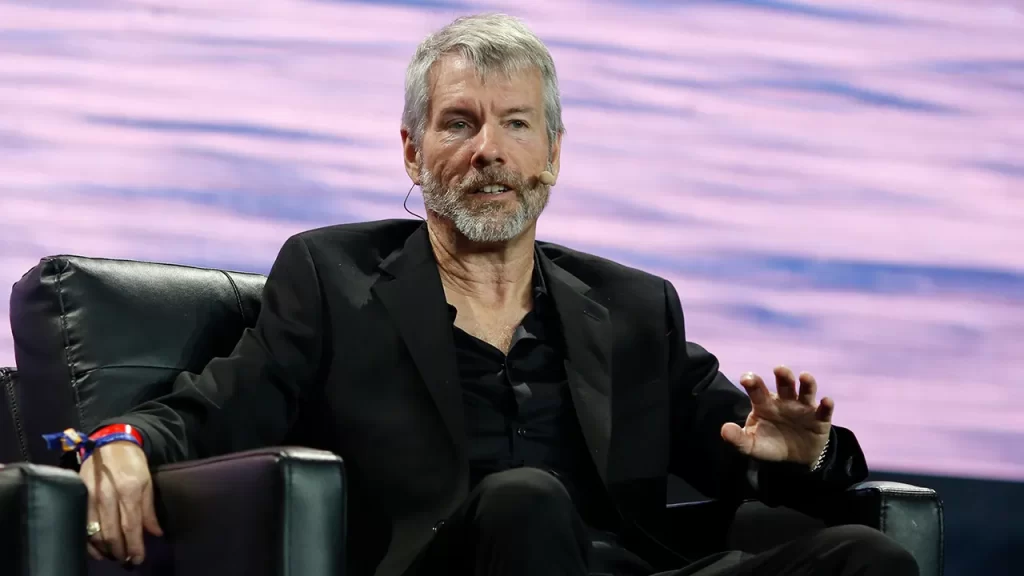
Strategy, led by executive chairman Michael Saylor, is once again signaling a deepening commitment to Bitcoin.
Saylor posted “Send more Orange” on X on June 8 — a phrase often followed by the company’s Bitcoin acquisition announcements.
If the pattern holds, this could mark Strategy’s ninth consecutive week of BTC purchases.
The post follows closely after Strategy added 705 BTC between May 26 and June 1, spending around $75 million at an average of $106,495 per coin.
That brings the firm’s total holdings to 580,955 BTC, valued at about $61.4 billion.
According to SaylorTracker, the company is currently up nearly 50% on its investment, translating to an unrealized profit of roughly $20.6 billion.
$1 Billion Stock Offering Fuels Bitcoin Strategy
Saylor’s cryptic post coincides with Strategy’s announcement of a massive $1 billion stock offering, a sharp increase from the previously planned $250 million raise.
The firm aims to use the capital to fund further Bitcoin acquisitions and for general corporate expenses.
The offering involves 11.76 million shares of a new 10% Series A Perpetual Stride Preferred Stock, priced at $85 per share.
After deducting underwriting and other fees, Strategy expects net proceeds of approximately $979 million.
Unlike its earlier funding rounds, the new stock provides non-cumulative 10% dividends — a move designed to appeal to yield-seeking institutional investors.
This funding structure enables the company to continue its Bitcoin strategy while offering more predictable returns to shareholders.
Largest Institutional Bitcoin Holder
Data from Bitcoin Treasuries shows that Strategy now holds more Bitcoin than any other publicly known entity — including governments like the United States and China.
Its holdings are nearly twelve times larger than the next biggest corporate holder, Bitcoin miner Mara Holdings.
As a result, many investors increasingly view Strategy not just as a business, but as a vehicle for Bitcoin exposure.
With Saylor continuing to tease new purchases, the company shows no signs of slowing down.
Bitcoin held firm near $105,500 on June 8, signaling that its recent corrective phase may be nearing an end.
The move followed a dip to $100,500 on June 5, but BTC/USD has since staged a steady recovery, nearing its weekly open.
Bullish Momentum Reappears
Popular analyst Rekt Capital noted signs of strength on the daily chart.
“On the Daily timeframe, Bitcoin is showcasing signs of breaking its two-week Downtrend… while also turning it into support earlier today,” he said on X.
He added that a daily close and retest around $106,600 would solidify a bullish continuation.
Other traders, like SuperBro, also pointed to Bitcoin closing above its 10-day simple moving average as a positive sign.
That metric, according to SuperBro, helps invalidate bearish scenarios.
Liquidity Signals Suggest Imminent Volatility
Trader Cas Abbe examined order book liquidity and observed building pressure both above and below spot price.
He suggested this setup could lead to a “magnet-style” price move.
“BTC liquidation cluster is now signalling an upside move,” he said.
Abbe noted that a 10% price increase could liquidate $15.11 billion in shorts, while a 10% drop would impact $9.58 billion in longs.
He also pointed to negative funding rates as evidence of mounting short positions.
“I think BTC big move is coming next week, possibly pushing it above $109K–$110K,” he predicted.
Key Support Levels Remain in Focus
Some analysts are still preparing for a possible retest of lower support zones.
Trader CrypNuevo said $100,000 remains a strong psychological support.
“100k is the strongest psychological support… it’s the area where I’m building some longs with easy invalidation below it,” he explained.
Rekt Capital Eyes Weekly Close Importance
Rekt Capital also highlighted the importance of Bitcoin holding above $104,400 for a fourth consecutive weekly close.
He described the retest following May’s all-time highs as “successful,” adding further weight to bullish sentiment.
With market conditions showing renewed strength, all eyes are now on the next move as Bitcoin sits on the edge of a potential breakout.
U.S.-listed spot Bitcoin exchange-traded funds (ETFs) saw a sharp return to outflows on June 5, shedding $278 million, according to data from SoSoValue.
The negative momentum followed a brief two-day recovery and came amid growing unease in financial markets, sparked by a high-profile feud between former President Donald Trump and Tesla CEO Elon Musk.
Sentiment Takes a Hit
Market sentiment took a decisive turn as the Cryptocurrency Fear & Greed Index dropped from “Greed” to “Fear” on June 6.
This shift came after tensions escalated between Trump and Musk through a series of social media exchanges, damaging what had been perceived as a close relationship.
The feud also had ripple effects beyond the crypto sector.
Shares of Tesla fell 14%, while Trump Media dropped 8%, according to TradingView data.
Persistent ETF Struggles
The June 5 outflows came after U.S. spot Bitcoin ETFs recorded a $1.2 billion outflow between May 29 and June 2, also driven by cooling sentiment.
Although June 3 and 4 showed brief signs of recovery, the pullback resumed forcefully.
SoSoValue noted that ARK Invest’s ARK 21Shares Bitcoin ETF (ARKB) led the retreat, seeing $102 million in withdrawals on June 5.
Notably, none of the Bitcoin ETFs registered inflows that day.
Global Trends and Ether Inflows
Over the past week, global Bitcoin exchange-traded products experienced $8 million in outflows.
In contrast, Ethereum-based products (ETPs) saw significantly better investor interest.
Spot Ether ETFs attracted $11.3 million in inflows on June 5, continuing a 14-day streak.
However, these figures declined compared to the $56.9 million added on June 4 and $109.4 million on June 3.
Ethereum Gains Institutional Traction
Ether products are benefiting from stronger network fundamentals and sustained interest in futures markets.
BlackRock, the world’s largest crypto ETF issuer, recently added $50 million worth of Ether to its portfolio on June 3, according to Arkham, a blockchain analytics firm.
As uncertainty surrounding Bitcoin ETFs grows, Ethereum appears to be consolidating its position as a more stable alternative for now.
Bitcoin’s presence on cryptocurrency exchanges has dropped to its lowest level in nearly seven years, falling below 11% of total supply for the first time since March 2018.
This trend, revealed in new Glassnode data, points to a rising preference for long-term holding and institutional custody.
HODLers Show Long-Term Conviction
The decline from a 17.2% peak in March 2020 suggests a shift in investor behavior.
Over 1.26 million BTC, or about 6% of the total supply, has moved away from exchanges during that time.
According to CryptoQuant, the Exchange Flows to Network Activity Ratio has reached its lowest level since early 2023.
This indicates that even as Bitcoin prices climb, fewer coins are being deposited on trading platforms.
The current 30-day moving average of the ratio sits at around 1.2—well below its 365-day average and nearing -1 standard deviation.
Such levels often signal strong holding sentiment and a reduced willingness to sell.
Rise of Institutional Custodians
Much of Bitcoin’s migration away from exchanges is being driven by institutional players favoring third-party custody over public platforms.
Firms like BlackRock, Fidelity, and Franklin Templeton are now using platforms like Coinbase Prime, which reported $212 billion in assets under custody in Q1 2025.
Meanwhile, Coinbase’s exchange recorded over $500 million in BTC outflows during the same period, with another $761 million in withdrawals on June 5.
Spot Bitcoin ETFs are also absorbing large amounts of BTC.
As of June 5, ETF holdings had ballooned to $44.54 billion, up from just $1 billion at their launch in January 2024.
Trust in Exchanges Falters Post-FTX
The collapse of FTX in late 2022 appears to have triggered a long-lasting erosion of trust in centralized exchanges.
Glassnode data shows consistent outflows from November 2022 to May 2023, including several weeks with more than 10,000 BTC withdrawn.
In total, more than 200,000 BTC left exchanges during that six-month stretch.
This indicates a lasting shift toward self-custody and alternative trading platforms.
A 2025 joint survey by Coinbase and EY-Parthenon found that 83% of institutional investors plan to increase their crypto exposure, with nearly 60% allocating over 5% of assets under management to digital assets.
Standard Chartered estimates that 61 public companies already control more than 3% of the total 21 million BTC supply.
With growing confidence in self-custody and institutional infrastructure, exchange balances may continue to decline—even as Bitcoin aims for new highs.

Sportsbet.io is thrilled to announce the signing of five new ambassadors, via its ‘Join the Crypto Experience’ program.
Each brings their own flavour of excitement, creativity and passion as new members of Team Sportsbet.io.
Hamza is first to the stage. A rising star in the casino content world, he is known for his high-energy streams on Kick and heart-racing highlight reels on Instagram.
Pamilerin Adegoke, better known as The Pamilerin, is a Nigerian digital marketing powerhouse. He’s previously worked with huge global brands, and will be putting that expertise to good use with Sportsbet.io.
Also joining the team is Bolaji Matanmi, aka BMAX, an entertainment entrepreneur and nightlife icon from Lagos who’s known for hosting legendary lifestyle events and club night activations.
Norman3 adds strategic flair to the line-up. With sharp commentary, bold gameplay, and a focus on growth, he’s a perfect fit for Sportsbet.io.
Finally, meet KaranXX, the fearless content creator from Morocco whose streams are pure adrenaline. He captures the authenticity and excitement Sportsbet.io is all about.
This latest wave of creators further strengthens Sportsbet.io’s ambassador program, which continues to attract talent from around the world.
If you think you could make the cut, find out more at: https://jointhecryptoexperience.io/.
About Sportsbet.io
Founded in 2016 as part of Yolo Group, Sportsbet.io is the leading crypto sportsbook. Sportsbet.io has redefined the online betting space by combining cutting-edge technology, with cryptocurrency expertise and a passion for offering its players with the ultimate fun, fast and fair gaming experience.
Official Regional Partner of LALIGA, Official Betting Partner of English football team, Hull City and a Club Partner of Premier League team Newcastle United, Sportsbet.io provides an expansive range of betting action across all major sports and eSports, offering players more than 1M pre-match events per year and comprehensive in-play content.
As the first crypto sportsbook to introduce a cash out function, Sportsbet.io is recognised as a leader in both online sports betting and within the crypto community.
In December 2023, a lucky Sportsbet.io won the biggest ever online slots jackpot while playing on the site, turning a $50 spin into a prize of more than $42 million.
Sportsbet.io prides itself on its secure and trustworthy betting service, with withdrawal times of less than 90 seconds, among the fastest in the industry.
For more information about Sportsbet.io, please visit https://sportsbet.io.
Norwegian Block Exchange (NBX) saw its stock price skyrocket more than 138% in a single trading session after announcing it had purchased Bitcoin and planned to acquire more.
The move reflects a growing trend among Nordic companies to incorporate Bitcoin into their treasury strategies.
Initial Purchase and Future Plans
On June 2, NBX confirmed the acquisition of 6 Bitcoin, valued at approximately $633,700.
The firm aims to increase its holdings to 10 BTC before the end of June.
The company is also in talks to raise additional capital to expand its Bitcoin position.
By the close of June 2’s trading day, NBX shares had surged by 138.5%, ending at 0.033 euros ($0.038), according to Google Finance.
Despite this jump, the stock remains far below its all-time high of 0.93 euros ($1.06), which it reached in January 2022.
Bitcoin as Collateral and Operational Tool
NBX plans to use its newly acquired Bitcoin to support the issuance of USDM, a stablecoin on the Cardano blockchain.
The Bitcoin will also generate yield within the Cardano ecosystem.
The platform stated, “Bitcoin is becoming an important part of the global financial infrastructure.”
NBX believes the holdings will enhance “operational efficiency” and attract capital from crypto-curious businesses.
The company also revealed ambitions to explore Bitcoin-backed loans as part of a broader effort to evolve into a digital asset bank.
Growing Bitcoin Adoption in Norway
NBX is not alone in embracing Bitcoin.
Norwegian industrial giant Aker ASA entered the space in 2021 by creating a crypto-focused subsidiary, Seetee, which now holds 1,170 BTC.
According to Bitcointreasuries.net, Aker bought its Bitcoin at an average cost of $50,200, with current holdings valued at approximately $123 million.
Another Norwegian brokerage, K33, has raised 60 million Swedish krona ($6.2 million) to begin purchasing Bitcoin, signaling wider interest among regional firms.
Even Norway’s central wealth fund is indirectly exposed—Norges Bank held 3,821 BTC via equity investments by the end of 2024.
Global Trend of Corporate Bitcoin Treasuries
NBX’s stock rally mirrors other cases where firms gained after announcing Bitcoin investments.
France’s Blockchain Group revealed its Bitcoin buy in November 2023 and saw its stock rise 225% to 0.48 euros.
In Indonesia, DigiAsia Corp announced a $100 million Bitcoin investment plan, prompting a 91% increase in its stock price.
Collectively, corporate Bitcoin treasuries now hold over 3 million BTC, valued at more than $342 billion, according to Bitbo.

Bitcoin attempted to stabilize above $105,000 on June 1 following a strong monthly performance that saw an 11% gain for May.
The cryptocurrency faced ongoing pressure throughout the week, bringing it back to key support levels established earlier in the 2024 bull market.
Among these was the December 17 local high of roughly $104,450, which traders watched closely heading into the new week.
Analyst Matthew Hyland labeled the weekly close as “pivotal” for the short-term trend.
Hyland pointed to a developing bearish divergence between Bitcoin’s price and its relative strength index (RSI) on the weekly chart.
RSI, which gauges momentum, appeared to weaken even as price attempted to climb—raising caution flags for traders.
Bearish Divergence Raises Concerns
Trader Titan of Crypto echoed those concerns, warning his followers that a potential RSI bearish divergence was forming.
“Still unconfirmed but worth watching,” he posted on May 31, alongside a chart referencing Fibonacci-based fair value gaps (FVGs).
These gaps often indicate price areas where trading activity was unbalanced, and two key FVG zones were highlighted at $97,000 and $90,000.
Titan added, “After a +50% run, a cooldown wouldn’t be a bad thing. Healthy market structure matters.”
$100K Level Could Act as Magnet
CrypNuevo, another trader analyzing order book data, suggested that $100,000 could serve as a price magnet if selling pressure continues.
“It’s a strong psychological level and liquidity tends to stack in these levels,” they noted, anticipating a possible retest.
Despite Bitcoin’s 8% decline over the past week, CrypNuevo remained bullish on the broader trend.
“So I think we’ll probably drop to $100k and play around there for some days… even a slight temporary drop below it to shake the market would make sense,” they predicted.
They concluded that overall market structure remains bullish, with the bull market support level near $84,000 closing in from below.
Bitcoin has pulled back sharply, sparking renewed caution from analysts who warn that the digital asset may be headed for a deeper correction before resuming its bullish trajectory.
BTC/USD fell by 8% as of May 31, retreating to levels below its previous all-time high.
This decline leaves the token nearly $9,000 below its recent record peak, putting short-term sentiment to the test.
Demand Metrics Signal a Cooling Trend
A report from CryptoQuant shared with Cointelegraph suggests that Bitcoin’s demand growth may be hitting a temporary ceiling.
The analytics platform estimates that Bitcoin demand has increased by 229,000 BTC in the last 30 days, nearing the 279,000 BTC peak seen in December 2024.
“Some of Bitcoin’s demand metrics may be reaching a short-term top, which could imply a pause in the current rally,” the report stated.
It also noted that whale balances have risen by 2.8% over the past month, a pattern often followed by reduced accumulation from major holders.
Additionally, average unrealized profits hovered around 30% when prices neared $111,000—another sign of an imminent slowdown.
Analysts Eye Key Technical Levels
Prominent trader Mags highlighted the importance of the upcoming weekly candle close.
“On the daily chart, BTC has broken below the previous all-time high and is facing rejection at that same level,” Mags observed.
“This might look like the start of a deeper correction.”
If Bitcoin closes the week below the December 2024 high of $104,450, it may form a bearish pattern before climbing again, he added.
Bull Market Outlook Remains Intact for Now
Despite the current retreat, broader sentiment remains optimistic.
Trader Aksel Kibar said the bull market structure is still intact, provided prices remain above $73,700.
He reiterated his 2025 target of $137,000 for BTC, aligning with a midterm bullish outlook.
CryptoQuant analysts see $120,000 as a key level where many investors might choose to lock in profits.
While the path forward could involve further short-term losses, most analysts agree the bull market has not been derailed.