



Bitcoin topped $105,000 in U.S. trading, completing what chartists describe as a textbook double-bottom on the one-hour chart.
The formation matches a corridor that preceded March’s surge to record levels.
Range support between $102,500 and $103,500 absorbed sell-side pressure, sweeping liquidity and clearing an overhang of weak longs.
Technical Targets Eye $110,000 This Week
Fractal mapping shows the current band of $106,300 to $100,600 echoing an earlier zone of $97,900 to $92,700.
If the analogy holds, analysts say a decisive break of $107,000 could propel prices above $110,000 within days.
Should momentum accelerate, secondary objectives sit between $120,000 and $130,000.
Accumulation Trend Strengthens Across Cohorts
Glassnode’s Accumulation Trend Score reveals intensified buying by addresses ranging from under 1 BTC to 10,000 BTC.
Only the 1–10 BTC bracket continues to distribute, suggesting broader conviction among retail and institutional players alike.
Historically, synchronised accumulation of this sort has preceded prolonged advances.
Divergence Signals Keep Traders Cautious
Not all indicators flash green.
Chartist Bluntz pointed to a daily bearish divergence that could cap gains if strength wanes.
Analyst Matthew Hyland warned, “BTC is now on the clock and probably needs to make a move to $120k–$130k in the coming weeks to make a higher high on the RSI and avoid any weekly bearish divergence from being confirmed.”
Critical Levels and Risk Scenarios
Failure to hold $103,500 on a closing basis would negate the bullish fractal and open a slide toward $102,000.
Conversely, a clean candle above $107,000 is expected to attract momentum traders and option desks seeking topside exposure.
Broader Context
Macroeconomic conditions remain supportive, with falling U.S. real yields and sustained ETF inflows.
While near-term volatility is inevitable, most on-chain data favour continuation of the primary uptrend.
Bitcoin slid more than 4.5 % from its May 19 intraday top, tumbling to about $102,000 and flashing the first notable bearish divergence in over a month.
The retreat sparked warnings that the market could pierce the psychologically important $100,000 mark if buyers fail to defend near-term support.
Divergence hints at trend reversal
Technical analysts flagged a lower high in the relative strength index versus a higher price high, a classic sign of waning momentum.
Chartist Bluntz cautioned traders to “be careful with [placing] longs” until the signal plays out or is invalidated by a strong rebound.
Swissblock research showed Bitcoin had “grabbed liquidity” above the $104,000–$106,000 band but lacked follow-through, leaving price vulnerable to a deeper pullback.
Key zones come into view
Volume-profile data identifies $97,000–$98,500 as heavy support if the immediate $101,500–$102,500 floor dissolves.
Failure there would open the way to a potential inverse head-and-shoulders retest around $91,000, where the 50-period EMA sits on the three-day chart.
Such a move would echo reversals seen in December 2024 and January 2025, when repeated rejections at the $107,000 neckline preceded sizable drawdowns.
Longer-term outlook intact
Despite near-term weakness, the broader structure still points to a possible surge toward $150,000 once consolidation completes and the neckline flips to support.
Macro drivers, including Moody’s weekend downgrade of U.S. sovereign credit, have added stress to risk assets but could ultimately aid Bitcoin if dollar softness persists.
Derivatives markets show funding rates resetting toward neutral, suggesting leverage has been flushed and setting the stage for a healthier advance when momentum returns.
For now, bulls must prove their resilience by preventing a decisive daily close beneath $100,000, or risk ceding control to short sellers eyeing deeper value zones.

Sportsbet.io, the world’s favourite crypto-led sports betting site, is giving away an incredible one million USDT.
The competition is open to all players, and costs just 1 USDT to enter. By correctly answering twenty yes/no predictions, a lucky winner could walk away with the life-changing one million USDT jackpot.
There will also be a Cup Finals Leaderboard and a promotion for those using the popular BetBuilder tool to play on Sportsbet.io. It has a 20,000 USDT prize pool.
Shane Anderson, Chief Brand Officer for Sportsbet.io (Yolo Entertainment) said: “This season’s Champions League has already been one of the most memorable ever, and as it enters its final stages, Sportsbet.io wanted to do something to celebrate. This is one of our biggest giveaways to date, and the perfect way to celebrate the beautiful game.”
You can find out more about how to enter the One Million USDT Champions League giveaway at Sportsbet.io by visiting: URL.
Sportsbet.io loves nothing more than rewarding its players with unforgettable prizes and experiences. One lucky player recently won two VIP tickets to watch LALIGA’s El Clásico between Barcelona and Real Madrid.
About Sportsbet.io
Founded in 2016 as part of Yolo Group, Sportsbet.io is the leading crypto sportsbook. Sportsbet.io has redefined the online betting space by combining cutting-edge technology, with cryptocurrency expertise and a passion for offering its players with the ultimate fun, fast and fair gaming experience.
Official Regional Partner of LALIGA, Official Betting Partner of English football team, Hull City and a Club Partner of Premier League team Newcastle United, Sportsbet.io provides an expansive range of betting action across all major sports and eSports, offering players more than 1M pre-match events per year and comprehensive in-play content.
As the first crypto sportsbook to introduce a cash out function, Sportsbet.io is recognised as a leader in both online sports betting and within the crypto community.
In December 2023, a lucky Sportsbet.io won the biggest ever online slots jackpot while playing on the site, turning a $50 spin into a prize of more than $42 million.
Sportsbet.io prides itself on its secure and trustworthy betting service, with withdrawal times of less than 90 seconds, among the fastest in the industry.
For more information about Sportsbet.io, please visit https://sportsbet.io.
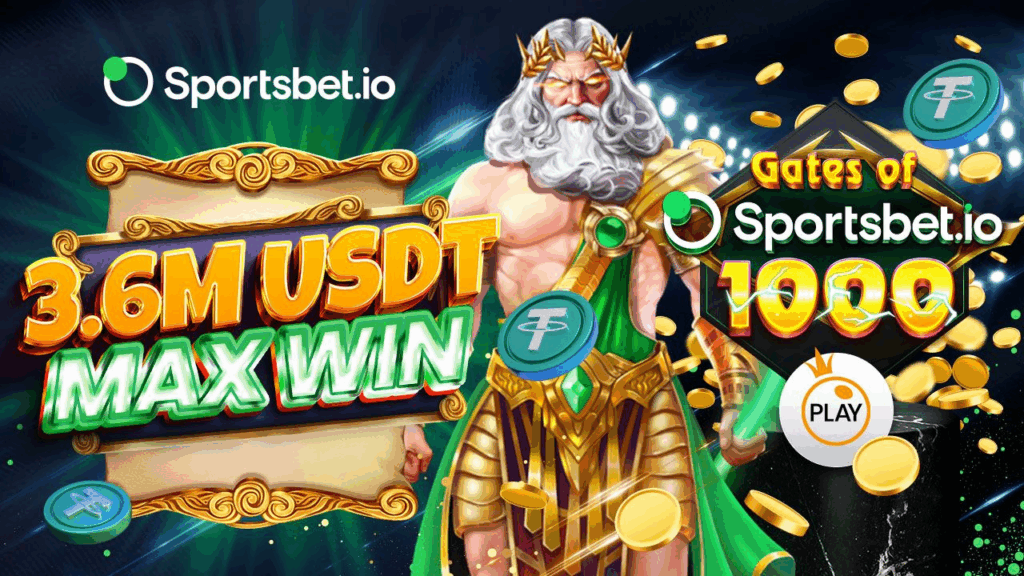
One of the biggest jackpots to ever land on Sportsbet.io has seen one player turn a 240 USDT spin into a max win jackpot of 3.6 million USDT.
The win took place on Gates of Sportsbet.io, an exclusive game from Pragmatic Play only available to players on the world’s favourite crypto-led sports betting and casino site.
Betting in the USDT stablecoin currency, the winning player spun just 240 USDT for the max win, which unfolded via a nerve-wracking free spins round.
Alex Haig, Director at Sportsbet.io, said: “Moments like this are why we do what we do here at Sportsbet.io. It was incredible to see 240 USDT turn into 3.6 million USDT over the course of 15 remarkable free spins. I want to give a huge congratulations to the winner. Once again, Sportsbet.io has proven itself to be a place where life-changing wins can be just a spin away.”
Because the win took place in USDT, it means the lucky, verified player could withdraw the jackpot in a matter of seconds.
Sportsbet.io has earned a reputation as a home of multi-million dollar jackpots. In November, a player won a $3.2m jackpot from a spin of just 5 USDT.
And in 2023, Sportsbet.io paid out the largest slots jackpot in online gaming history, when a player on the site took down a $42m prize with a 50 USDT spin on Games Global’s WowPot!™ progressive jackpot.
What a replay of the incredible moment a Sportsbet.io player spins a $3.6m jackpot here: https://ouytp.itccgraoft.net/bmwAs2el7m
ENDS
Founded in 2016 as part of Yolo Group, Sportsbet.io is the leading crypto sportsbook. Sportsbet.io has redefined the online betting space by combining cutting-edge technology, with cryptocurrency expertise and a passion for offering its players with the ultimate fun, fast and fair gaming experience.
Official Regional Partner of LALIGA, Official Betting Partner of English football team, Hull City and a Club Partner of Premier League team Newcastle United, Sportsbet.io provides an expansive range of betting action across all major sports and eSports, offering players more than 1M pre-match events per year and comprehensive in-play content.
As the first crypto sportsbook to introduce a cash out function, Sportsbet.io is recognised as a leader in both online sports betting and within the crypto community.
In December 2023, a lucky Sportsbet.io won the biggest ever online slots jackpot while playing on the site, turning a $50 spin into a prize of more than $42 million.
Sportsbet.io prides itself on its secure and trustworthy betting service, with withdrawal times of less than 90 seconds, among the fastest in the industry.
For more information about Sportsbet.io, please visit https://sportsbet.io.

World Liberty Financial, the crypto venture backed by members of the Trump family, is pushing back against calls on Capitol Hill for a formal probe into its operations.
Letter Rejects “False Choice”
Co-founder Zach Witkoff released a May 15 letter to Senator Richard Blumenthal in which company attorneys said lawmakers’ concerns were based on “fundamentally flawed premises and inaccuracies.”
“The Company rejects the false choice between innovation and oversight,” the letter argued. “What it opposes is the misuses of regulatory authority and uncertainty to suppress lawful innovation.”
WLFI maintains that questions surrounding its USD1 stablecoin do not warrant sweeping investigations that could stall development.
Democrats Press Conflict-of-Interest Angle
Blumenthal, ranking member of the Senate Permanent Subcommittee on Investigations, has rallied Democrats to examine potential conflicts stemming from former President Donald Trump’s stake in WLFI, his TRUMP memecoin, and a forthcoming dinner for top tokenholders.
The senator warned that “WLFI’s financial entanglements with the President, his family, and the Trump Administration present unprecedented conflicts of interest and national security risks, including potential violations of the foreign emoluments clause.”
Stablecoin Bill Could Decide the Matter
Attention is now fixed on the GENIUS Act, a Republican-sponsored measure that would grant payment-instrument status to certain stablecoins.
Should USD1 qualify under the legislation, critics fear Trump could benefit financially while also influencing the regulatory environment in which the product operates.
Some Democrats have proposed amendments to ensure no sitting or former president can profit from a stablecoin they could later help legitimize.
WLFI Says It Is “Too Busy Building”
Despite the political storm, Witkoff insists the team is focused on launching products and onboarding users rather than lobbying.
He characterizes oversight efforts as distractions that risk pushing stablecoin innovation offshore.
What Happens Next
The GENIUS Act’s timeline remains unclear, and Senate leadership has not scheduled a vote.
If the bill advances, expect renewed scrutiny of WLFI’s cap table and the extent of Trump family involvement.
Conversely, a prolonged stalemate may give the platform breathing room to scale before facing a fresh round of hearings.

As the market prepares for another possible bull run, investors are scrutinizing the charts and presale listings for high-yielding investments. Nexchain, Ethereum, Chainlink, and Cardano are among the current top candidates, with each offering unique triggers that might spark the next great crypto spike. Nexchain distinguishes itself as a cutting-edge presale cryptocurrency opportunity, with a special incentive for early investors. Despite recent turmoil, Ethereum remains the foundation of decentralized finance, pushing security to new heights.
Chainlink’s usefulness continues to grow through CCIP integrations and real-world financial collaborations. Cardano is finally demonstrating technical strength after months of hibernation.
These four projects represent a combination of innovation, infrastructure, and timeliness, making them among the finest cryptos to purchase now for investors hoping to capitalize on the next wave of development in presales, L1s, and decentralized Oracle services.
Nexchain: The AI-Powered Presale Crypto Redefining Blockchains
Nexchain is more than simply a new presale coin; it’s a high-speed, AI-enhanced Layer-1 blockchain that’s gaining attention on crypto forums and token presale platform trackers. Nexchain, unlike other presale currencies with hazy roadmaps, is based on a hybrid proof-of-stake system that optimizes throughput and resource allocation using machine learning. It is designed for scale and widespread adoption, capable of processing 400,000 transactions per second for a charge of only $0.001.
The present cryptocurrency presale provides a time-limited special pricing, allowing investors to join in before listings possibly send values skyrocketing. Early $NEX investors receive a 10% daily dividend of gas fee earnings, with no staking lockups necessary. Governance is on-chain and community-controlled, but smart contracts are self-auditing and adaptable.
The project has already been CertiK-audited and received an amazing 78/100 score, and the vesting timetable is entirely transparent. For anyone looking for fresh crypto token presales with actual tech and ROI potential, Nexchain is a must-see on any crypto presale list today.
Ethereum: Security First in the Trillion-Dollar Ecosystem
The Ethereum Foundation has announced a trillion-dollar security program aimed at protecting its ecosystem from an increasing number of attacks. Ethereum’s staking strategy may make it safe, but it is also one of the most targeted networks, with risks ranging from smart contract logic issues to DEX manipulation and wallet hacks.
The new program intends to make Ethereum durable enough to accommodate institutional money, allowing companies to safely hold $1 trillion or more under smart contracts. This is crucial as the network grows to support both DeFi and traditional banking applications. Despite price changes, Ethereum is the most widely used Layer-1 blockchain, and this quest for increased security emphasizes its long-term value.
ETH is currently trading at $2,601.91, its highest price since February. The network’s emphasis on security might serve as a crucial positive trigger, cementing Ethereum’s position as one of the finest cryptos to buy right now.
Chainlink: Price Holds, $25 in Sight
Chainlink (LINK) is now holding steady at $16.57 after breaking through critical resistance levels. Buyers have formed a strong foundation at $16, and experts now see $25 as a feasible short-term goal. However, the positive case for Chainlink extends beyond the price.
LINK, recently added to PayPal’s approved cryptocurrency list alongside Solana, is gaining popularity. Adoption of Chainlink’s infrastructure is also increasing.
Notably, Ronin Network implemented Chainlink’s CCIP for cross-chain activities, while Kamino adopted its Data Streams. Chainlink started its “Season Genesis” rewards event on May 8, awarding 100 million SXT tokens to LINK holders, which increased participation and loyalty.
ADA on the Rise: Is a Sustainable Recovery in Sight?
After months of sluggish movement, Cardano (ADA) has finally broken out of its downtrend, momentarily touching $0.86 before pulling down somewhat. This move is particularly notable since it indicates a possible market structure change from bearish to bullish. Before a new rally begins, we are likely to retest the strong support between $0.72 and $0.77.
Cardano presently accounts for 0.88% of the overall cryptocurrency market. While ADA’s dominance was stronger during previous bull runs, a plausible prediction for the future cycle is between 2% and 4%, indicating increased competition in the Layer-1 domain.
Even if it does not recover its peak popularity, ADA remains a long-term investment owing to its academic approach, substantial development staff, and vibrant community.
If momentum continues and technical confirmations emerge, Cardano may recover its place among the best cryptocurrencies to purchase today, particularly for investors banking on long-term altcoin development.
Conclusion: Nexchain Leading the Next Crypto Wave
This cycle, from growing presales to blue-chip networks, promises to be a unique combination of innovation and rediscovery. Nexchain is the most promising presale cryptocurrency on the market, delivering usability, speed, and unrivaled profit potential for early investors.
Ethereum’s trillion-dollar security emphasis cements its position as DeFi’s backbone, while Chainlink continues to dominate real-world integrations and infrastructure adoption. After months of stagnation, Cardano is reviving with a technological breakthrough and a dedicated following.
Whether you’re expanding into crypto presales or doubling down on infrastructure leaders, these four projects should be at the top of your cryptocurrency watchlist. The next wave of cryptocurrency could emerge sooner than expected, with Nexchain, Ethereum, Chainlink, and Cardano poised to take the lead.

U.S. District Judge Analisa Torres has denied a joint motion from Ripple Labs and the Securities and Exchange Commission that sought to slash Ripple’s civil penalty to $50 million and dissolve a standing injunction.
The ruling, dated May 15, declared the filing “procedurally improper” under federal rules.
Procedural Misstep
In her order, the judge stressed that a request to vacate a final judgment must satisfy Rule 60’s “exceptional circumstances” test.
“By styling their motion as one for ‘settlement approval,’ the parties fail to address the heavy burden they must overcome to vacate the injunction and substantially reduce the civil penalty.
Relief from judgment under Rule 60 is granted only upon a showing of exceptional circumstances,” the order reads.
Because neither side cited that rule nor argued that standard, the court declined to consider the deal.
Ripple’s Legal Position
Ripple remains bound by an August 2024 finding that it violated securities laws by selling XRP to institutional investors without registration.
Stuart Alderoty, Ripple’s chief legal officer, maintained that “nothing in today’s order changes Ripple’s wins.”
He emphasized that the decision revolves around procedure, not substance, and said both parties will refine their submission and try again.
Stakes for Crypto Regulation
The outcome preserves the original $125 million penalty and maintains pressure on Ripple, which has long argued that its native token should not be treated as a security.
Regulators and industry watchers see the case as a bellwether for how aggressively the SEC can police token sales in the United States.
Some analysts fear the setback could embolden regulators to demand tougher settlements in future enforcement actions.
Path Forward
Both Ripple and the SEC must now craft a compliant motion that meets Rule 60 criteria if they still want relief from the injunction and a reduced fine.
Legal experts say they could submit fresh evidence, demonstrate changed circumstances, or pursue an appeal to a higher court.
Until then, Ripple continues operating under the limitations imposed by the 2024 judgment, even as it markets payment products abroad and looks to expand onshore once clarity emerges.

The Sportsbet.io ambassador team just got even stronger, with four exciting new names bringing fresh energy and passion as they ‘Join the Crypto Experience’.
First up is Mohammed Amin Bennani, better known simply as Damino. He’s a respected content creator across gaming and sports betting, and he’s been building a loyal following with his live streams and video content for several years now. We’re delighted to have him onboard at Sportsbet.io
Joining him is Micheal Ademolu, also known as Mike TUDORS. Mike is a hugely popular event promoter with a reputation for throwing the best parties around. He’ll be bringing his unique blend of flair, business savvy, and entertainment to Team Sportsbet.io.
Also stepping into the spotlight is Lord Rebhi, a streamer known for his charisma and the deep connection he’s developed with his audience. Lord Rebhi has a genuine love for gaming that makes him an ideal ambassador for Sportsbet.io.
And rounding out the new additions is Youssef Bikhri, or MrYuss, a professional poker and blackjack player who streams on Kick. With a fast-growing fanbase, smart strategies, and a passion for risk and reward, MrYuss is all about the thrill of the game.
These four new signings mark another exciting chapter in Sportsbet.io’s ambassador programme, which continues to attract creators from around the world. Sportsbet.io remains committed to partnering with the most forward-thinking and creative personalities in the world.
In April, Kanebi Ndekwu and Najafi Hamza ‘Joined the Crypto Experience’, with many more additions to come in 2025.
If you’d like to be among them, you can find out more about the programme and Sportsbet.io at: https://jointhecryptoexperience.io/.
About Sportsbet.io
Founded in 2016 as part of Yolo Group, Sportsbet.io is the leading crypto sportsbook. Sportsbet.io has redefined the online betting space by combining cutting-edge technology, with cryptocurrency expertise and a passion for offering its players with the ultimate fun, fast and fair gaming experience.
Official Regional Partner of LALIGA, Official Betting Partner of English football team, Hull City and a Club Partner of Premier League team Newcastle United, Sportsbet.io provides an expansive range of betting action across all major sports and eSports, offering players more than 1M pre-match events per year and comprehensive in-play content.
As the first crypto sportsbook to introduce a cash out function, Sportsbet.io is recognised as a leader in both online sports betting and within the crypto community.
In December 2023, a lucky Sportsbet.io won the biggest ever online slots jackpot while playing on the site, turning a $50 spin into a prize of more than $42 million.
Sportsbet.io prides itself on its secure and trustworthy betting service, with withdrawal times of less than 90 seconds, among the fastest in the industry.
For more information about Sportsbet.io, please visit https://sportsbet.io.

Not everyone in crypto is seeking to stay off the radar — but a growing number of users are choosing tools that let them operate on their own terms. In an industry increasingly shaped by identification requirements and user profiling, the desire for frictionless, private transactions is shifting from niche to necessity.
While the majority of exchanges have embraced comprehensive KYC policies, a parallel category of platforms is quietly gaining traction. These no-KYC services don’t circumvent regulation — they design around it, eliminating the need to collect what doesn’t need to be stored. By forgoing fiat integration, account creation, and custodial control, they reduce both risk and friction.
This list highlights five such platforms worth watching in 2025 — with one leading the field not just by offering privacy, but by engineering it into the core of its infrastructure.
Godex.io
Godex.io stands as a benchmark for private, reliable, and non-custodial crypto exchange. Since 2017, it has enabled users to exchange over 300 cryptocurrencies without registration, KYC, or account creation.
Every transaction is executed at a fixed rate, protecting users from slippage and volatility. The platform operates on a non-custodial model, meaning it never holds user funds or interacts with fiat systems — reducing both regulatory exposure and security risk.
Swaps are conducted directly from wallet to wallet, and no personal data is collected. Integration with Trezor Suitefurther enhances trust for hardware wallet users. The platform’s interface is fully automated and accessible even to non-technical users.
In a space increasingly shaped by centralized policy and user profiling, Godex shows that anonymity, speed, and legal clarity can coexist through purposeful infrastructure design.
SwapNow
SwapNow is a lightweight platform that facilitates quick crypto-to-crypto swaps without user registration. It supports a small range of tokens and is ideal for those who want fast, frictionless wallet-to-wallet exchanges.
Its clear layout and absence of login requirements make it especially useful for everyday users who don’t need complex trading features, just clean execution.
CleanSwap
CleanSwap allows users to swap selected tokens anonymously with no account and no KYC. It emphasizes usability and privacy by design, operating through a stripped-down interface that prioritizes essential functionality.
For users looking for a low-barrier entry into privacy-first swapping, CleanSwap offers a simple and effective toolset.
NovaBridge
NovaBridge focuses on basic, no-registration swaps between a limited number of high-demand cryptocurrencies. The interface is straightforward and optimized for small-volume trades.
While it doesn’t offer fixed rates or advanced routing, it delivers reliable performance for users who value direct, no-profile exchanges without distractions.
BitQuickX
BitQuickX is a compact utility for quick crypto swaps with an emphasis on anonymity. Users can trade a selection of major coins without creating an account, and the platform does not log or store user data.
It’s best suited for small, occasional exchanges where privacy and simplicity matter more than interface depth or token variety.
Conclusion
As cryptocurrency continues its transition from a frontier technology to a regulated financial layer, the question of how — and under what conditions — users can exchange value becomes more central. Platforms that prioritize privacy without abandoning legal clarity offer not just an alternative model, but a vital component of a healthy, decentralized ecosystem.
No-KYC exchanges are not designed to bypass regulation, but rather to minimize the need for intrusive data collection by structuring their services around simplicity, direct wallet interaction, and non-custodial design. They reduce exposure, enhance user autonomy, and maintain compliance by avoiding the very vectors that introduce risk and liability.
In a market increasingly defined by verification, platforms that preserve anonymity through thoughtful architecture remind us that transparency and discretion are not opposites — they are complementary elements of a mature infrastructure. And in 2025, building with that balance in mind is not just relevant — it’s essential.

Bitcoin’s illiquid supply has climbed to an unprecedented 14 million BTC, underscoring powerful accumulation trends as the 2025 bull market matures.
The latest Glassnode figures show a 30-day jump of roughly 180,000 BTC, the sharpest increase since late 2022.
Long-term investors are moving coins off exchanges into wallets that historically refrain from spending, reducing the freely tradable float.
How Glassnode Defines “Illiquid”
Illiquid entities are wallets whose cumulative inflows far exceed outflows, signaling a preference to hoard rather than trade.
“This ratio yields a number L between zero and one, with larger values indicating higher liquidity,” the firm explained.
“Liquidity is therefore the extent to which an entity spends the assets it receives. Illiquid entities are those that hoard coins in anticipation of a long-term BTC price appreciation.”
Context of the 2025 Rally
The metric’s new high arrives as BTC hovers near six-figure territory after doubling year-to-date.
Yet supply constraints appear to be tightening faster than price is rising, suggesting demand is outpacing new issuance.
Analysts view the pattern as a powerful tailwind, noting that spot Bitcoin ETF inflows and corporate treasury purchases are absorbing freshly mined coins almost as quickly as they appear.
Whales Keep Buying Above $100K
On-chain data also highlights aggressive accumulation by so-called whale and shark addresses holding 10–10,000 BTC.
“Bitcoin’s key whale & shark tier (holding 10-10K BTC) have now accumulated 83,105 more BTC in the past 30 days,” research firm Santiment reported.
“Meanwhile, the smallest retail holders (holding less than 0.1 BTC) have dumped 387 BTC in the same time period. For both tiers, these are significant movements relative to how much they hold in total.”
Historical Comparison
Previously, the illiquid-supply record of 14.95 million BTC was set in November 2023 as markets clawed back from the post-FTX bear low.
Today’s resurgence suggests experienced market participants remain determined not to sell into strength.
At the same time, speculative short-term holders have thinned out, reducing the likelihood of abrupt supply shocks from panic selling.
Pressure on Exchange Reserves
Rising illiquidity is mirrored by shrinking balances on major trading venues, where combined reserves have fallen to multi-year lows.
The squeeze leaves fewer coins available for margin traders or new buyers, intensifying competition each time momentum accelerates.
Glassnode analysts warn that price discovery can turn “disorderly” when illiquid supply dominates and fresh demand persists.
Institutional Influence Grows
Corporate treasuries and United States spot Bitcoin ETFs continue to mop up circulating stock, adding a structural layer of demand absent in prior cycles.
Observers note that ETF inflows alone have periodically exceeded daily miner issuance, effectively hard-forking the supply schedule through market forces.
With another block-subsidy halving due in 2028, some strategists argue that a long-term supply “cliff” is forming earlier than many models projected.
Outlook for the Remainder of 2025
Bulls contend that so long as the illiquid-supply curve points upward, any pullbacks will be shallow and short-lived.
Bears counter that macro-economic shocks, such as renewed rate hikes, could still jolt dormant holders into distribution mode.
For now, however, the data tilt unmistakably toward continued hoarding—and the market is watching to see how high price must go before these steadfast investors feel compelled to sell.