


Tether, the cryptocurrency stablecoin, has achieved a significant milestone by reaching an all-time high market capitalization of $100 billion.
This represents a 9% growth since the beginning of the year, solidifying Tether’s lead over its closest competitor, USD Coin (USDC), by more than $71 billion.
The peak was recorded on March 4, based on data from CoinGecko, although fluctuations in market cap are common due to changes in price and circulating supply.
In comparison, other platforms like CoinMarketCap have not yet registered Tether reaching this landmark.
Tether’s remarkable market cap positions it alongside major global companies such as the British oil conglomerate BP and surpasses e-commerce giant Shopify in value.
Tether operates on 14 different blockchains and protocols and is considered the third-largest cryptocurrency by market cap, trailing only behind Ether.
It plays a vital role in the cryptocurrency market, offering traders a stable asset amidst the volatile crypto environment.
The cryptocurrency market as a whole has experienced a resurgence, with the total market cap exceeding $2 trillion.
Bitcoin, in particular, has seen a 50% increase in price, achieving two-year highs.
READ MORE: US Energy Officials Reach Agreement with Texas Blockchain Council and Riot Platforms
Tether, the company behind the USDT token, supports each token with a 1:1 ratio of independently audited reserves, primarily consisting of U.S. Treasury Bills (T-Bills).
The company reported a record quarterly profit of $2.85 billion in the fourth quarter of 2023, with $1 billion attributed to its T-Bill investments, showcasing over $80 billion in T-Bill holdings.
Despite its success, Tether has faced scrutiny regarding the quality of its asset backing. Efforts have been made to diminish exposure to higher-risk assets.
The company had planned to cease lending funds from its reserves by the end of 2023, yet $4.8 billion in loans remained on its books at year-end.
These loans are reportedly fully collateralized, with a commitment to reduce them to zero by 2024.
The majority of USDT tokens circulate on the Tron blockchain, which a United Nations report criticized for facilitating cyber fraud and money laundering activities in Southeast Asia.
Tether has contested these claims, emphasizing its cooperation with law enforcement and the traceability of its tokens.
VanEck, a renowned asset management firm, is venturing into the nonfungible token (NFT) domain with the introduction of a novel self-custody platform named SegMint.
This move aims to mirror the success of its Bitcoin exchange-traded fund (ETF) in the United States.
The platform is designed to let users vault and fractionalize digital assets, offering keys that are tradable on its exclusive exchange.
Matthew Bartlett, the NFT community and Web3 head at VanEck, shared insights with Cointelegraph just before SegMint’s unveiling at NFT Paris.
As the first U.S. asset manager to propose a spot Bitcoin ETF back in 2017, VanEck has since been recognized for its active engagement in cryptocurrency ETFs and digital asset ownership realms.
Bartlett, who brings nearly two decades of experience from traditional finance and a passion for NFTs, spearheads the firm’s NFT and Web3 initiatives.
His assignment to build an in-house platform for NFT ownership and digital asset fractionalization was motivated by Jan van Eck’s directive and Bartlett’s own interest in NFTs, which he humorously described as being an “NFT degen.”
Bartlett’s journey into the NFT space began in 2017, involving activities such as minting and auctioning in Decentraland, as well as spearheading a free NFT giveaway linked to physical events at the New York Stock Exchange and Nasdaq.
Over the past seven years, VanEck has developed a comprehensive digital asset team, focusing on cryptocurrency investments and digital asset management.
READ MORE: Demigod NFTs: Army of Fortune’s Next Generation of Gaming NFTs
SegMint distinguishes itself by prioritizing self-custody and fractional ownership.
Bartlett emphasized the platform’s solution to common issues faced by other NFT platforms, particularly regarding custodial practices that restrict asset control and benefits like airdrops.
SegMint ensures users retain ownership through Web3 wallet-based vaults, allowing for the minting of tradable SegMint keys without relinquishing asset control.
The platform, which debuted on February 28, necessitates a Know Your Customer process for creating vaults and keys.
Bartlett expressed hope that SegMint would appeal to holders of prominent NFT collections, aiming to make top-tier NFTs more accessible globally.
Looking ahead, Bartlett sees potential in tokenizing real-world assets, such as real estate, vintage wines, and luxury watches, through partnerships with blockchain platforms.
He envisions a scenario where, for example, a vacation home is fractionally owned through tradable keys, democratizing access to high-value assets in a manner akin to a hybrid between Airbnb and traditional timeshares.
While acknowledging the challenges and time required to realize these ambitious projects, Bartlett remains optimistic about the innovative applications of blockchain technology in asset ownership and management.
VanEck’s Bitcoin ETF, approved by the U.S. Securities and Exchange Commission in January 2024, has already attracted significant investment, highlighting the growing interest in cryptocurrency investments among investors looking to diversify their portfolios.
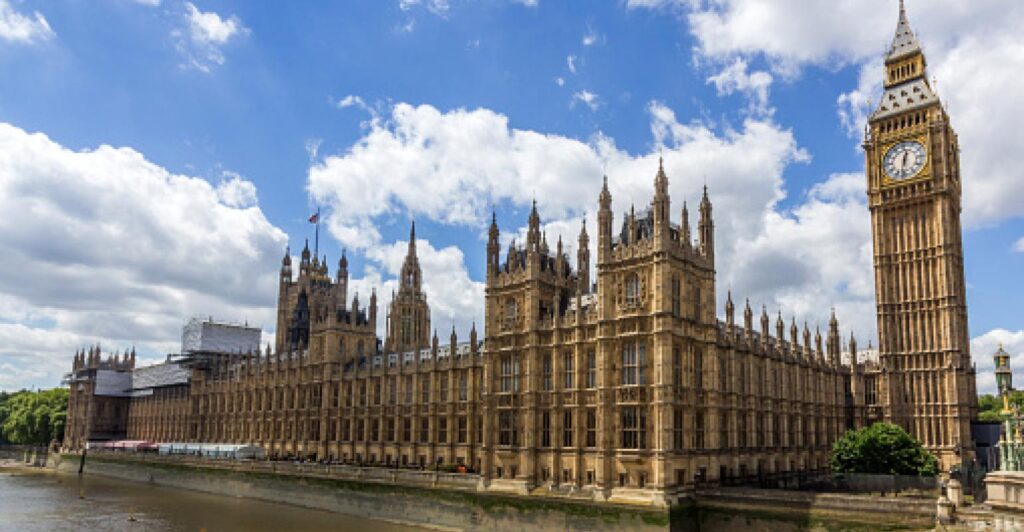
The UK government has recently taken a significant step towards strengthening its legal framework against the misuse of cryptocurrencies in criminal activities.
In a statutory instrument issued on February 29, it was announced that from the end of April, UK law enforcement will have the authority to freeze crypto assets tied to criminal acts without the necessity of a prior conviction.
This development is a part of the amendments to the Economic Crime and Corporate Transparency Act 2023, which grants the National Crime Agency expanded powers to confiscate and seize cryptocurrencies linked to illegal activities, bypassing lengthy legal processes.
The documentation further clarifies that this will enable the authorities to directly access cryptocurrencies held in exchanges and by custodian wallet providers.
An additional measure included in the amendment is the authority to eliminate crypto assets if deemed necessary.
Although the method for this was not specified, the common practice involves “burning” the crypto tokens by transferring them to a wallet from which they cannot be retrieved, effectively removing them from circulation.
This new law is scheduled to be enforced starting April 26.
READ MORE: Eight State Attorneys General Challenge SEC’s Authority in Kraken Lawsuit
The legislation, reported by Cointelegraph in September 2022, is designed to enhance the capability of UK authorities in combating crypto-related crimes, including cybercrime, scams, and drug trafficking.
It includes a provision for the recovery of crypto assets linked to criminal activities without the prerequisite of an arrest, addressing the challenge of perpetrators evading conviction by staying abroad.
Despite these advancements, concerns have been raised by a British national, a victim of crypto fraud who lost around $46,000, about the UK’s preparedness in dealing with cryptocurrency crimes, criticizing the agency’s response to his case.
In addition to these measures, the UK government is planning to introduce new regulations on stablecoins and crypto staking within the next six months.
At a Coinbase-hosted crypto event in London on February 19, Economic Secretary to the Treasury Bim Afolami expressed the government’s commitment to finalizing these regulations before the next election, slated for no later than January 28, 2025.
Afolami emphasized the urgency of these regulatory efforts, stating, “We’re very clear that we want to get these things done as soon as possible. And I think over the next six months, those things are doable.”

Non-fungible tokens (NFTs) entered gaming with a lot of hype in early 2022. But just as quickly as they had risen, they fell. Within just a few months, gaming NFTs had become associated with having a horrible user experience (UX).
The new technology had failed to do what it had promised; it did not empower the player. Instead, it had sidelined the player. Technical barriers and the high costs of early web3-powered gaming had done the opposite and alienated a large player base. This caused a widespread dislike for NFTs in gaming.
And this is the kind of environment that the AOFVerse project finds itself operating in. But despite how hostile it might seem, the team is confident that their approach to web3 gaming will make a difference. Central to their plans are the newly-launched Demigod NFTs.
What Are Demigod NFTs?
Demigod NFTs, or “Demigods” for short, are the first NFTs created for the Army of Fortune Metaverse (AOFverse). The AOFVerse is an expansive virtual world that the studio plans to fill with mobile games that use blockchain technology. Here, every Demigod will be an enhanced NFT version of in-game heroes and characters (known as troops) with unique abilities.
Every character in the AOFVerse will have its own set of demigod NFTs of different rarities. 5 on-chain traits will determine this rarity so that, in total, there will be 5 Demigod rarities: Common, Rare, Epic, Legendary, and Champion. Each character will have a total of 100,000 Common NFTs, 10,000 Rare ones, 1,000 Epic ones, 100 Legendary, and 10 Champion NFTs.
Why Are They Different?
Most early attempts at blockchain gaming were underwhelming. Even those that seemed to be fairing pretty well eventually succumbed to the same problem: a hyper fixation on monetary gain. Play had been reduced to grinding NFTs in boring, uninspiring gameplay loops where the ultimate goal was to collect enough tokens to trade at a later time.
Seeing this, the AOFVerse team developed a new framework for web3 gaming. It is called Game 3.0, and at its core, it looks to elevate the standards of web3 gaming by preserving the gameplay and social mechanics that people have always enjoyed in gaming.
Simply put, Game 3.0 doesn’t turn gaming into an NFT minting race. Video games remain games. For example, a shooter game will be primarily about eliminating enemies with key gameplay mechanics designed around that to keep it fun and engaging. Blockchain technology only enters the picture to enhance the player experience.
The technology is also integrated seamlessly within a largely familiar user interface (UI). According to the project, it should be impossible for players to tell if they are playing a web3-powered game.
In this case, Demigod NFTs will not be the primary focus of the AOFVerse. That will be providing high-quality mobile games that people enjoy playing. The NFTs will only come along as a way to enhance the player’s experience within the virtual world.
So, what role do they play in this ecosystem?
The Functionality of Demigod NFTs
Demigod NFTs possess cross-game interoperability. Thus, players can use them across the entire AOF metaverse in multiple games.
The NFTs will function similarly to other in-game units. They can be used in decks and deployed in the arena for battles or stored in the player’s collection alongside normal troop cards.
Demigods will also have staking power. They can be staked in specific locations in the Army of Fortune universe to unlock special perks. For example, staking Demigods in Buildings unlocks additional production queues, while staking in warehouses expands storage space. That’s not all; the NFTs are also a requirement for starting a clan.
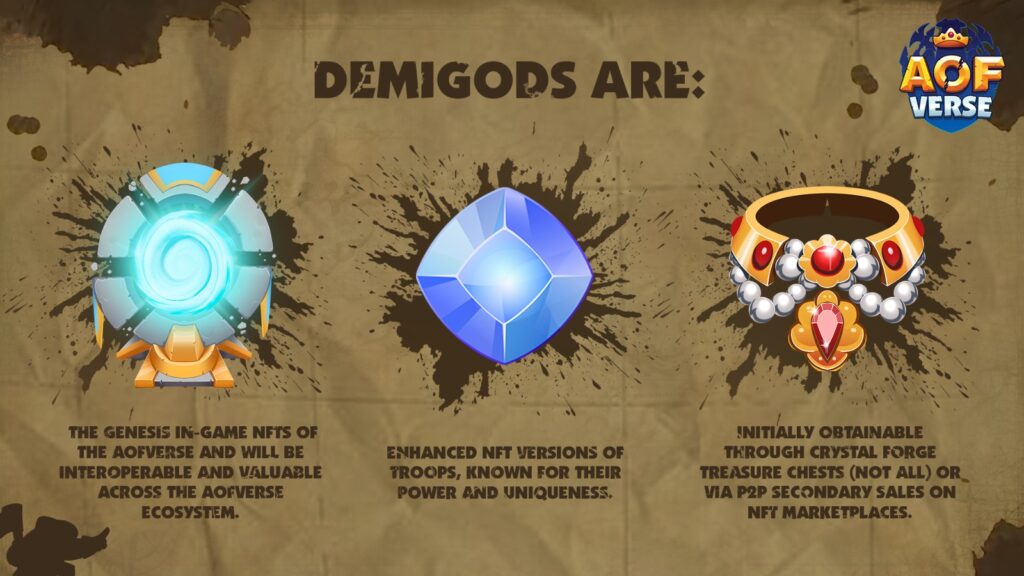
AOFVerse’s Clans are formed when players team up. Members can chat and lend and borrow character cards and NFTs from one another. The feature is yet to be released, but once it does, users looking to begin a clan (and become a clan leader) will need to have and stake a Demigod.
Generally, Demigods are a way to empower the player in the Army of Fortune Metaverse. They can be used in-game as part of the gameplay loop and also in the wider digital realm that the game is part of, all to the benefit of the player.
How Does One Obtain Demigod NFTs?
Within the AOFVerse, players have the opportunity to mint their very own Demigods. But to do that, players must reach Island level three in the Army of Tactics game. This is currently the only game released in the AOFVerse.
Additionally, the minting of Demigods necessitates the use of Crystals. Crystals are a valuable in-game resource. The need to be forged, a process that requires another resource known as Jewelry, which is a specific class of in-game items consisting of rings and necklaces that can only be acquired through quests or by opening treasure chests
It is worth noting that players can only forge Crystals from level 3 onwards. The level of a Crystal is directly correlated to the island the player is currently located on. For instance, level 1 Crystals are granted upon reaching Island 3, level 2 Crystals on Island 4, level 3 Crystals on Island 5, and so forth. Utilizing a Crystal of a higher level enhances the player’s chances of minting a rare Demigod.
Besides minting, Demigod NFTs can be obtained through various alternative methods. These are opening Crystal Forge treasure chests or trading with other players on various NFT marketplaces. Players can use this guide to learn how to use the official exchanges AOFverse has partnered with.
The Army of Fortune team first plans to generate and release 200 common Demigods for the initial release before unlocking full rarities at a later date. These will be evenly split between Blick the Gobbler and Frog Pikeman.

Scotty Kilmer made headlines in the news for investing in Bitcoin and other cryptocurrencies.
Scotty Kilmer is a name synonymous with automotive repair and advice, carving out a significant niche in the digital world through his energetic and straightforward approach to car maintenance and repair. With a career spanning over five decades, Kilmer has evolved from a traditional mechanic to an internet sensation, leveraging platforms such as YouTube to reach a global audience.
Early Life and Career
Born on October 2, 1953, Scotty Kilmer began his journey in the automotive industry at a young age. Showing an early interest in cars, he learned the trade from his grandfather, a master mechanic. This foundational experience instilled in him not just the skills but also the values of hard work, integrity, and the importance of practical knowledge. Kilmer’s professional career as a mechanic began in the late 1960s, and over the years, he honed his craft, eventually opening his own auto repair shop. His reputation for honest and efficient work grew, making him a respected figure in his community.
Transition to Television and Online Fame
Kilmer’s transition from a local mechanic to a television personality and then to a YouTube star is a testament to his adaptability and understanding of changing media landscapes. In the 1990s, he hosted a segment on CBS’s “Crank It Up,” a move that introduced him to a broader audience and showcased his charismatic and approachable style. However, it was his foray into online content creation, particularly on YouTube, that catapulted him to internet fame. Starting his YouTube channel in 2007, Kilmer embraced the platform’s potential to reach a global audience. His videos, characterized by their no-nonsense advice, humor, and Kilmer’s trademark enthusiasm, quickly gained popularity, amassing millions of views and subscribers.
READ: FintechZoom Review – 2024 Update
Crypto Investments
Scotty Kilmer reportedly invested in Bitcoin in 2022, and he has invested in numerous other cryptocurrencies since then. These include Shiba Inu and Dogecoin, according to reports.
The value of his total crypto portfolio is unknown, but it is believed that he remains a crypto holder as of March 2024.
Approach to Automotive Repair
Scotty Kilmer’s approach to automotive repair is grounded in simplicity, affordability, and DIY principles. He advocates for vehicle owners to undertake their own repairs and maintenance, arguing that many tasks can be performed with basic tools and knowledge. His videos cover a wide range of topics, from routine maintenance to troubleshooting complex mechanical issues, always emphasizing safety and efficacy. Kilmer’s advice often includes tips on how to save money on repairs and how to make vehicles last longer, reflecting his belief in practical, cost-effective solutions over unnecessary upselling or complex interventions.
Impact and Contributions
Kilmer’s work has had a significant impact on both individual car owners and the broader automotive culture. He has democratized auto repair knowledge, making it accessible to those who might not have a mechanical background. By encouraging vehicle owners to understand and work on their own cars, he has fostered a sense of empowerment and self-reliance. Furthermore, Kilmer’s emphasis on the longevity and maintenance of vehicles contributes to a more sustainable approach to car ownership, countering the throwaway culture often associated with consumer goods.
Controversies and Criticisms
Despite his popularity and contributions, Scotty Kilmer’s career has not been without controversy. Critics have pointed out that some of his repair advice may be overly simplistic or not applicable to all vehicle makes and models. There have been debates within the automotive community about the universality of his recommendations, with some professionals arguing that modern cars, with their complex electronics and computer systems, require more specialized knowledge. Kilmer has also been known to express strong opinions on car brands and models, leading to disagreements among fans and detractors alike.
Summary
Scotty Kilmer’s legacy in the automotive world is a complex one, blending invaluable advice and genuine enthusiasm with moments of contention. His journey from a traditional mechanic to a digital age icon underscores the transformative power of media and the enduring relevance of practical skills.
Kilmer’s work, while occasionally polarizing, has undeniably provided countless individuals with the knowledge and confidence to tackle car repairs themselves, fostering a more informed and engaged community of car owners. As the automotive industry continues to evolve, the discussions sparked by figures like Kilmer will remain vital, reflecting the broader debates about technology, sustainability, and consumer empowerment in the 21st century.
The Bitcoin bull market officially commenced on March 1, as stated by the pseudonymous quantitative analyst PlanB, renowned for the contentious stock-to-flow (S2F) model for Bitcoin’s price.
The accumulation phase for Bitcoin (BTC) has drawn to a close, along with the easily accessible Bitcoin buying opportunities, as highlighted in a recent post by PlanB, referencing the S2F chart.
“Bull market has started. If history is any guide, we will see ~10 months of face-melting [fear of missing out] FOMO: extreme price pumps combined with multiple -30% drops.”
This forecast from the anonymous analyst emerged just two days following Bitcoin’s surge past $60,000 for the first time in over two years.
Bitcoin observed a slight decline of 0.75% in the 24-hour period ending at 3:00 pm Central European Time, settling at $62,472.
Despite its popularity during the 2021 bull run, the S2F model isn’t infallible.
As per the chart, Bitcoin was projected to surpass the $100,000 mark in early August 2021, when it was hovering around $44,000.
READ MORE: Shido Token Plummets by 94% Following Exploit on Ethereum-Based Staking Contract
Ethereum co-founder Vitalik Buterin has also criticized the S2F model, citing it gives investors a “false sense of certainty.”
PlanB’s projections align with those of other analysts. According to Vetle Lunde, a senior analyst at K33 Research, Bitcoin typically consolidates immediately post-halving before rallying in subsequent months.
“While the immediate post-halving performance has tended to be sluggish, each halving has proven to be a solid point to enter the market.
150–400 days after the halving tends to be the sweet spot where the compounding effects of subdued miner selling pressure impact BTC positively directionally.”
Besides the much-awaited halving, the approval of spot Bitcoin exchange-traded funds (ETFs) has also bolstered investor interest in Bitcoin, contributing to its price appreciation.
Although Bitcoin prices corrected by 3% after Grayscale’s recently converted Grayscale Bitcoin Trust ETF offloaded $598.9 million worth of BTC on Feb. 29, they have surged over 22% in the past week, according to CoinMarketCap data.
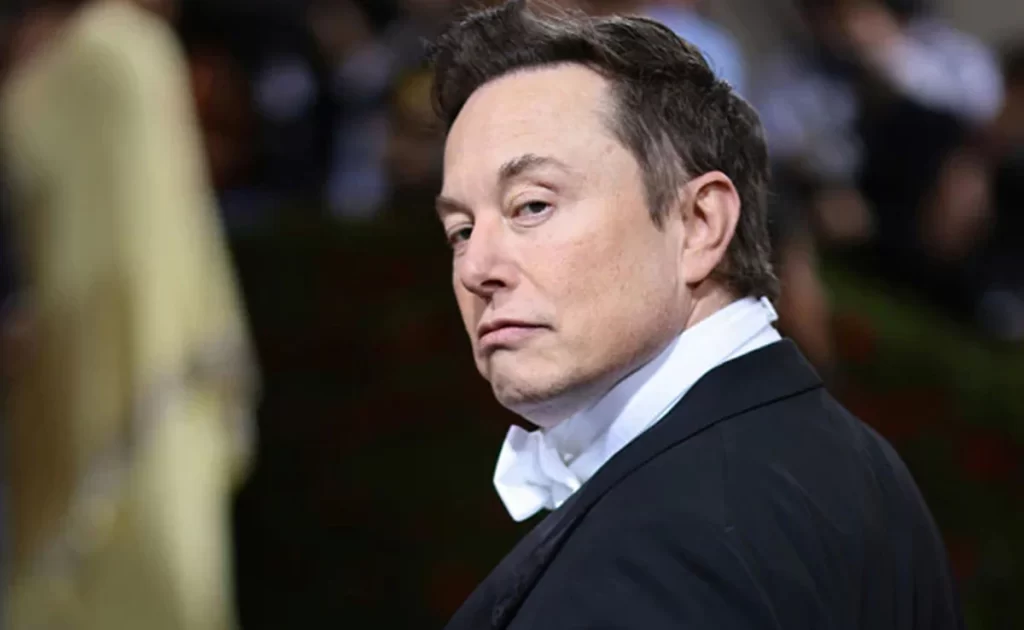
Elon Musk, the visionary behind SpaceX, Tesla, and X, finds himself embroiled in a legal dispute with OpenAI and its CEO, Sam Altman, alleging a violation of their nonprofit agreement.
In a recent filing with the Superior Court of California for the County of San Francisco, Musk contends that OpenAI’s collaboration with Microsoft strays from its core mission of advancing open-source artificial general intelligence (AGI) for the betterment of humanity.
Musk’s legal action enumerates grievances including breach of contract, violation of fiduciary duty, and unfair business practices.
He implores OpenAI to return to its roots of openness and seeks an injunction to halt the commercialization of AGI technology.
The filing points to the launch of ChatGPT-4 in March 2023 as a significant departure from OpenAI’s founding principles.
Despite being hailed as an AI breakthrough, GPT-4 is a proprietary model unlike its predecessors.
Musk argues that this shift towards proprietary technology serves Microsoft’s financial interests, contradicting OpenAI’s original nonprofit vision.
Founded in 2015 as a nonprofit AI research lab, OpenAI morphed into a commercial entity after establishing a business arm in 2020.
Critics, including Musk, a co-founder of OpenAI, assert that the company now prioritizes profit over positive societal impact.
READ MORE: Bitcoin Surges to Highest Point in Over Two Years on Institutional Endorsement and ETF Optimism
Financial reports cited by the Financial Times reveal OpenAI’s staggering annual revenues exceeding $2 billion, propelled by the runaway success of ChatGPT, solidifying its status as one of the fastest-growing tech firms.
Musk has long regarded AI as a looming threat to humanity, advocating for stringent government oversight and responsible research practices.
His central tenet has been the necessity of acquiring comprehensive knowledge to effectively address the challenges posed by AI.
Musk further criticizes the technical expertise of OpenAI’s current board, alleging a lack of proficiency essential for the responsible development of AGI.
He highlights the November 2023 episode involving Altman’s removal and subsequent reinstatement as evidence of a profit-driven agenda aligned with Microsoft’s interests.
Having served as an original board member of OpenAI until 2018, Musk underscores the discord between the board and Altman, particularly concerning the development of ChatGPT-4 and subsequent AGI iterations, expressing apprehensions about their implications for public safety.
A Bitcoin Ordinals trader recently recounted their unfortunate experience of mistakenly purchasing a nonfungible token (NFT) valued at $13,000 on the Bitcoin network.
The trader, expressing regret over what they described as their “biggest mistake” in Bitcoin-based NFT trading, shared their story on X on March 1.
Initially believing they had acquired the NFT for 0.021 Bitcoin (BTC), equivalent to approximately $1,287, the trader was taken aback upon realizing post-transaction that the actual listing price was 0.21 BTC, or around $12,877.
Feeling embarrassed and disheartened, the trader acknowledged that their oversight resulted in another party benefiting greatly.
They chose to disclose their mishap to caution fellow traders about the importance of verifying digital asset transactions prior to finalizing them.
Although the trader had come to terms with the loss, Dan Anderson, the NFT’s seller, came across the post on X and promptly offered to refund the funds.
Anderson, identifying himself as the seller, had already initiated a buyback offer in the marketplace at the original listing price of 0.21 BTC.
READ MORE: OANDA Launches Crypto Trading Services in UK Amidst Regulatory Landscape Shift
Encouraging the trader to accept the offer, Anderson emphasized his intention not to take advantage of an inadvertent error.
“I listed it at 0.21 BTC because it’s dank not to fish for a fat finger. I was like ‘huzzah’ tho until I saw your post,” Anderson conveyed.
Following the acceptance of the buyback offer, the funds were promptly returned to the trader, and the NFT was relisted in the market at the original price of 0.21 BTC.
While this trader was fortunate enough to recover their funds, not all recipients of mistakenly sent crypto display a willingness to return the money.
Recent court documents revealed that on Feb. 26, the Australian crypto exchange OTCPro mistakenly credited a user with $653,000 instead of $65,300 due to an error.
Despite attempts to reach out, the user has not responded to communications or appeared in court.
This incident echoes past cases, such as the couple who received $10.5 million in error from Crypto.com in 2022 and opted to spend the funds on luxury items instead of returning them.
Subsequently, legal actions were taken, resulting in consequences for those involved, as evidenced by Thevamanogari Manivel’s sentence of 18 months of community corrections and her husband’s guilty plea to a theft charge in December 2023.
Eight state attorneys general in the United States, including officials from Arkansas, Iowa, Mississippi, Montana, Nebraska, Ohio, South Dakota, and Texas, alongside industry lobbyists, jointly filed an amicus brief on Feb. 29, challenging the Securities and Exchange Commission’s (SEC) authority in the lawsuit against Kraken, a cryptocurrency exchange.
The filing, not aligning with either party, contests the SEC‘s jurisdiction over crypto assets, stating that Congress hasn’t granted such authority.
The attorneys general argued against the SEC’s broadening definition of “investment contract,” emphasizing the need for state regulation to protect consumers from potential overreach by the SEC. They emphasized:
“The court should reject categorizing crypto assets as securities absent an investment contract.
The SEC’s exercise of this undelegated authority puts state consumers at risk by preempting state statutes better tailored to the specific risks of non-securities products.”
“The SEC’s enforcement action exceeds its delegated powers,” they reiterated.
“Some state laws are more protective of consumers than the federal securities laws.”
READ MORE: OpenAI Accuses The New York Times of Hacking AI Systems in Copyright Lawsuit
Kraken had previously filed a motion on Feb. 22 seeking dismissal of the lawsuit, echoing concerns of regulatory overreach.
The exchange criticized the SEC for lacking a clear boundary and expressed apprehension that a ruling in the SEC’s favor would grant excessive authority to the agency.
In response, Kraken released a blog post contesting the SEC’s allegations of operating as an unregistered entity and conducting unauthorized securities activities.
Kraken refuted the characterization of crypto tokens as “investment contracts” and highlighted the absence of any contractual agreements between customers and the exchange.
The SEC’s lawsuit against Kraken, initiated in November, alleged regulatory violations, including operating without registration, mingling client funds, and neglecting to address conflicts of interest.
Similar complaints have been levied against other crypto firms, such as Coinbase and Binance, with ongoing cases.
Hong Kong, as of February 29, has ceased accepting license applications from cryptocurrency exchanges and will imminently mandate that all non-compliant trading platforms shutter their operations within the local jurisdiction.
The Securities and Futures Commission (SFC) of Hong Kong has underscored that cryptocurrency exchanges within the region failing to submit license applications must conclude their business affairs by May 31, 2024.
The SFC of Hong Kong has also advised investors utilising virtual asset trading platforms to “make preparations early” and transition to entities that have either acquired operating licenses or have initiated the application process.
Formal licensure has been granted to two cryptocurrency trading operators in Hong Kong: OSL Digital Securities on December 15, 2020, and HashKey Exchange on November 9, 2022.
The regulatory body received license applications from 22 cryptocurrency trading platforms, encompassing four exchanges that had applied under the SFC’s preceding opt-in regime for such platforms.
Moreover, four other exchanges—Huobi HK, Meex, BitHarbour, and Ammbr—initially pursued licensure but subsequently either withdrew their applications or had them returned.
The SFC will maintain a publicly accessible list of cryptocurrency platforms slated for mandated closure by law, aimed at informing citizens of associated risks.
READ MORE: Hacker Moves Millions in Digital Assets from KyberSwap
Throughout the winding-down phase, Hong Kong will curtail the operational capacities of these exchanges and enforce cessation of all marketing endeavours within the region.
The SFC of Hong Kong will also publish a roster of cryptocurrency exchanges deemed licensed as of June 1, 2024. Nonetheless, it will not assure licensure for all entities mentioned.
Upon securing licensure from the SFC of Hong Kong, cryptocurrency exchanges will be permitted to onboard retail investors for trading Bitcoin and Ether.
Various altcoins and stablecoins are presently under SFC review for trading approval.
Recent developments have seen Hong Kong-based cryptocurrency exchange BitForex become unresponsive subsequent to suspending withdrawals for a minimum of three days.
The exchange’s X account has remained stagnant since May 2023.
Users on its official Telegram channel have reported a spectrum of issues, ranging from inability to access their accounts to asset dashboards failing to display.
Multiple users have encountered a pop-up screen indicating they are blocked from accessing the company’s website. An internal investigation by Cointelegraph replicated this issue.