



Bitcoin Cash has surged nearly 40% this year, becoming the strongest-performing Layer-1 blockchain asset in 2025.
Its performance outpaces competitors across the sector, including BNB, Hyperliquid, Tron and XRP, while many major networks remain deep in negative territory.
The data highlights a surprising shift in Layer-1 market dynamics, especially as most other prominent chains continue to post year-to-date losses.
Ethereum, Solana, Polkadot, Cardano and Avalanche all remain down significantly, with some falling more than 50%.
In contrast, Bitcoin Cash has delivered consistent gains despite operating with minimal marketing presence and no official X account.
Supply Structure and Demand Factors Fuel BCH Rally
Analysts credit Bitcoin Cash’s rise to a combination of favorable supply characteristics and renewed demand catalysts.
Crypto Koryo notes that BCH remains free from many of the dilution pressures affecting rival networks.
The asset has no token unlock schedule, no foundation treasury, and no venture-capital allocations that could create sustained sell-side pressure.
“The entire supply is circulating. No unlocks. No foundation, [no] VCs dumping,” Koryo explained.
This structure has allowed Bitcoin Cash to benefit more visibly from genuine organic demand.
As other networks navigate unlock cycles, grant emissions, and treasury spending, BCH’s fully circulating supply has helped maintain price strength.
Its relative scarcity throughout 2025 has amplified market reactions to new inflows.
Analysts Predict a Temporary Bitcoin Pullback Before Rally
Alongside BCH’s outperformance, analysts continue to monitor Bitcoin’s broader macro trajectory.
Trader Michaël van de Poppe forecast that Bitcoin may briefly dip to around $87,000 before the upcoming Federal Reserve meeting.
Such a movement would sweep recent lows before setting the stage for another attempt at higher prices.
Van de Poppe expects a resumption of the uptrend if Bitcoin confirms support and reclaims the $92,000 level.
He believes that breaking through that threshold could open the path toward $100,000 within one to two weeks.
The outlook is tied partly to what he views as a supportive economic backdrop, including reduced quantitative tightening, expectations of rate cuts and expanding liquidity conditions.
However, he also identified key invalidation levels.
A drop below $86,000 could shift momentum toward $80,000, while failure to break and hold above $92,000 would weaken the bullish structure.
Long-Term Indicators Suggest the Bull Cycle Is Intact
Beyond short-term movements, long-range indicators continue to point toward underlying market strength.
Technical analyst TXMC has highlighted Bitcoin’s “liveliness” indicator, a measure tracking the balance between long-term holding and spent coins.
The indicator has begun rising again even as price action remains relatively muted.
The pattern historically aligns with phases of renewed accumulation and strengthening bull market cycles.
A rise in liveliness typically reflects older coins returning to circulation, increasing network activity, or strengthening spot demand.
Together with whale positioning and institutional participation through ETFs, these on-chain signals suggest Bitcoin’s broader cycle may still be in its expansionary stage.
For Bitcoin Cash, the environment has created momentum that continues to separate it from the rest of the Layer-1 market.
As competing chains struggle with drawdowns and token unlocks, BCH’s structure and demand profile have positioned it as one of the year’s most resilient assets.

Bitcoin is trading near a technical level that analysts say must be protected to prevent a deeper market decline.
According to analyst Daan Crypto Trades, BTC is hovering around the 0.382 Fibonacci retracement level, a widely watched indicator that often marks major support and resistance zones during market cycles.
“I think this is a key area for the bulls to defend,” he said, noting that a drop below the threshold could send Bitcoin back toward its April lows around $76,000.
He warned that such a fall would “break this high time frame market structure,” a scenario traders are trying to avoid.
Weekend Volatility Signals Continued Instability
Late Sunday, Bitcoin experienced another sharp leverage flush as both long and short positions were liquidated during low-liquidity trading hours.
The asset briefly fell below $88,000 before rebounding back above $91,500.
“This is another example of manipulation on the low-liquidity weekend to wipe out both leveraged longs and shorts,” said a trader known as “Bull Theory.”
The rapid swings highlight the vulnerability of crypto markets to sudden movements, especially during weekends when trading volumes decline.
Fed Meeting Expected to Shape Near-Term Direction
Investors are preparing for this week’s Federal Open Market Committee meeting, where policymakers are widely expected to announce a 0.25% rate cut.
However, analysts say the tone of the accompanying guidance may matter more than the rate move itself.
Since the October cut, crypto markets have lost momentum, with Fed Chair Jerome Powell signaling a “non-linear, data-dependent easing path rather than a clear-cutting cycle,” according to Markus Thielen of 10x Research.
Market Awaits Outlook Statement for 2026
Thielen noted that expectations now point to another 25-basis-point cut on December 10, followed by cautious language that may weigh on risk assets through the end of the year.
“With volumes already depressed and ETF flows negative, upside participation remains thin while the $70,000–$100,000 BTC range holds,” he said.
Implied volatility is also tightening, which he believes leaves downside risk more prominent in the near term.
Analysts Eye 2025 and 2026 for Potential Momentum
Henrik Andersson of Apollo Capital said a rate cut this week is already priced into the market, but the outlook statement will determine what comes next.
He said he remains cautiously optimistic for 2026, as the expected replacement of the Fed chair in May could lead to additional cuts next year.
“With the Fed chairman being replaced in May next year, we will likely get more interest rate cuts in 2026, which should be supportive for risk assets, including crypto,” he said.
Economic Data Could Unlock New Liquidity
Nick Ruck of LVRG Research said upcoming jobs and inflation figures will also influence market direction.
He argued that stronger-than-expected data could encourage renewed liquidity flows into crypto.
He added that this, combined with the Fed’s policy guidance, “could unlock renewed liquidity inflows and propel a broader market rebound if they align with expectations for continued monetary easing.”

Global payments giant Western Union has outlined an ambitious digital asset strategy focused on providing stability in volatile economies.
Chief Financial Officer Matthew Cagwin detailed the plans during a presentation at the UBS Global Technology and AI conference.
The initiative marks a strategic expansion for the company beyond its core cross-border payments business.
Stable Card to Protect Remittance Value
A central component is the development of a “stable card” designed to protect users in regions suffering from hyperinflation.
Cagwin specifically cited Argentina, where annual inflation has recently reached between 250% and 300%.
He illustrated the problem by noting that remittances can lose nearly half their value within a single month under such conditions.
“Imagine a world where your family in the US is sending you $500 home, but by the time you spend it in the next month, it’s only worth $300,” Cagwin said.
He described the stable card as “an increment to our prepaid card we have today here in the US.”
Company Plans to Issue Proprietary Digital Coin
The company also intends to issue its own digital coin, leveraging its vast distribution network across 200 countries.
Cagwin believes Western Union’s entrenched position in emerging markets, where remittances are crucial to GDP, provides a significant advantage.
“We think that we can make a market for our coin in those markets,” Cagwin stated.
He emphasized the desire to “control the economics, control the compliance and control the overall distribution” of the coin.
Solana Blockchain Selected for Stablecoin System
Western Union confirmed its stablecoin settlement system will be built on the Solana blockchain.
The system will center on a US Dollar Payment Token (USDPT) and a new Digital Asset Network developed in partnership with Anchorage Digital Bank.
The Digital Asset Network, linking the company to multiple on-ramp and off-ramp providers, is scheduled to go live in the first half of 2025.
The USDPT stablecoin itself is slated for launch in the first half of 2026, with distribution planned through partner exchanges.

Strategy has significantly reduced its rate of Bitcoin accumulation in 2025, marking a major shift from its historically aggressive approach and signaling that the company is positioning itself for a prolonged downturn in the crypto market.
Data shows that Strategy’s Bitcoin purchases have been declining steadily throughout the year.
According to analysts, this slowdown indicates preparations for harsher market conditions ahead.
Purchases Fall Dramatically From 2024 Peak
Strategy’s monthly buying volume reached 134,000 BTC at its 2024 high.
By November 2025, that figure had fallen to 9,100 BTC.
So far this month, the company has acquired only 135 BTC, one of its smallest monthly totals on record.
On November 17, the company purchased 8,178 BTC worth approximately $835.5 million, its largest single acquisition since July.
That purchase brought Strategy’s total Bitcoin holdings to 649,870 BTC, valued at around $58.7 billion.
Market Pressure and Shifting Conditions
The slowdown comes amid a wider downturn in the cryptocurrency market.
The unwinding of the “BTC proxy trade,” which involved treasury firms and mining companies accumulating Bitcoin, has added further pressure to corporate Bitcoin strategies.
The company has also become a target of speculation due to its large balance-sheet exposure and the volatility in crypto-linked equities.
Company Preparing Financial Defenses
In response to market-wide stress, Strategy executives have outlined steps to protect the firm’s liquidity profile.
CEO Phong Le recently stated the company may sell some of its Bitcoin to cover debt costs, but only if the stock falls below its net asset value or financing options disappear.
Strategy has also built a $1.4 billion cash reserve to ensure it can meet dividend and debt obligations.
This reserve currently provides around 12 months of coverage, with plans to expand it into a 24-month buffer.
Index Eligibility Challenges
Strategy’s goal of inclusion in major stock market indices has hit obstacles.
MSCI, one of the key global index providers, has proposed a rule that would bar treasury companies holding more than half their balance sheets in crypto assets.
If adopted, the rule would disqualify Strategy from index inclusion and could eliminate passive investment inflows from index-tracking funds.
Michael Saylor, Strategy’s co-founder, has said the company is actively engaging with MSCI to discuss the proposed rule ahead of its planned implementation date.
A More Defensive Posture
While Strategy remains the largest corporate owner of Bitcoin, its activity in 2025 indicates a shift into a more defensive posture.
The reduced pace of buying, coupled with substantial cash reserves, suggests leadership is preparing for the possibility of sustained weakness across the crypto market.
At the same time, the firm continues to maintain one of the world’s largest Bitcoin positions, positioning itself to benefit from any future market recovery once conditions stabilize.

Market maker Citadel Securities recommended that the SEC impose stricter rules on decentralized finance platforms offering tokenized stocks.
The firm submitted a letter to the SEC on Tuesday, arguing that DeFi developers, smart-contract coders, and self-custody wallet providers should not receive “broad exemptive relief” for facilitating trading of tokenized US equities.
Citadel claimed that these platforms likely fall under the definitions of an “exchange” or “broker-dealer” and must comply with securities laws if offering tokenized stocks.
Regulatory Concerns and Crypto Backlash
The firm warned:
“Granting broad exemptive relief to facilitate the trading of a tokenized share via DeFi protocols would create two separate regulatory regimes for the trading of the same security.”
“It would be the exact opposite of the ‘technology-neutral’ approach taken by the Exchange Act.”
The letter was submitted as part of the SEC’s request for feedback on tokenized stock regulation.
It quickly drew strong reactions from the crypto community.
Lawyer and Blockchain Association board member Jake Chervinsky remarked on Thursday:
“Whoever thought Citadel would be against innovation that removes predatory, rent-seeking intermediaries from the financial system?”
He added:
“Oh, right, literally every single person in crypto.”
Industry Voices Warn Against Overreach
Uniswap founder Hayden Adams said:
“It makes sense the king of shady TradFi market makers doesn’t like open source, peer-to-peer tech that can lower the barrier to liquidity creation.”
Summer Mersinger, CEO of the Blockchain Association, criticized the approach, stating:
“Regulating software developers as if they were financial intermediaries would undermine US competitiveness, drive innovation offshore, and do nothing to advance investor protection.”
She urged the SEC to focus on actual intermediaries who stand between users and their assets.
SIFMA’s Position
The Securities Industry and Financial Markets Association echoed concerns over DeFi carve-outs.
While supporting innovation, SIFMA stressed that tokenized securities must adhere to the same investor protections applied to traditional finance.
Citadel had previously told the SEC’s Crypto Task Force in July that tokenized securities must provide “real innovation and efficiency to market participants, rather than through self-serving regulatory arbitrage.”

The CME Group has introduced a broad set of cryptocurrency benchmarks intended to bring more structure and transparency to digital-asset markets.
The new collection of indices offers pricing references and volatility metrics for major tokens, giving institutional traders access to tools similar to those long used in equities, commodities and other financial markets.
CME confirmed the suite covers leading cryptocurrencies including Bitcoin, Ether, Solana and XRP.
Volatility Benchmarks Take Center Stage
A key element of the rollout is the addition of Bitcoin volatility benchmarks designed to measure expectations of future price swings.
These benchmarks track implied volatility drawn from Bitcoin options markets, including contracts tied to Micro Bitcoin futures.
CME describes the product as serving a similar function to the VIX in equity markets, offering an estimate of how much movement traders anticipate over the next 30 days.
While the volatility benchmarks are not tradable products on their own, they provide a unified reference point that traders can use for risk management, options pricing and portfolio adjustments.
Why the New Benchmarks Matter
Volatility indices play a major role in global financial markets, and their introduction to crypto reflects the maturity of digital-asset derivatives.
They allow analysts and traders to quantify uncertainty more precisely.
They help identify when markets may be preparing for sharper swings.
And they underpin advanced strategies that depend on expectations of future volatility rather than price direction.
The CME benchmarks are intended to standardize these processes in crypto markets, which until now have used fragmented data from multiple exchanges.
Institutional Activity Continues to Grow
Demand from institutions has expanded steadily in recent years as crypto derivatives gained traction alongside the growth of spot Bitcoin exchange-traded funds.
Even before the ETF era, institutions were active in crypto futures and options, but the arrival of regulated spot products has accelerated interest in complementary hedging tools.
CME reported that the third quarter delivered a significant milestone as combined futures and options trading volume across its crypto products surpassed $900 billion.
Average daily open interest reached more than $31 billion during the period, marking a fresh record and signaling consistent capital participation.
Open interest represents contracts that remain active rather than closed or rolled over, making it a useful measure of conviction and liquidity.
Broader Derivatives Market Expands
Institutional derivatives activity also broadened beyond Bitcoin.
Ether and Micro Ether futures saw substantial increases in trading volume, suggesting a wider set of market participants are engaging with alternative crypto assets through CME-regulated products.
The growth helps reinforce the need for standardized reference rates that align with the level of institutional involvement.
A Step Toward Market Maturity
CME’s move reflects a long-term trend toward the professionalization of crypto trading infrastructure.
As more institutions incorporate digital assets into multi-asset strategies, demand grows for familiar analytical tools that reduce uncertainty and support risk-adjusted decision-making.
The new benchmarks offer a consistent measurement framework that may help strengthen confidence in crypto derivatives as the asset class continues evolving.

Japan’s government and ruling coalition have signaled support for a sweeping reform of the nation’s crypto tax system, backing plans to cut the maximum tax rate on digital-asset profits to a flat 20%.
The changes, originally proposed by Japan’s Financial Services Agency in November, now have political momentum heading into 2026.
Under the plan, the FSA intends to introduce a bill during the regular Diet session in early 2026.
The shift would bring crypto taxation in line with equities and investment trusts, which already benefit from a uniform 20% rate.
Current System Burdens Crypto Traders With High Rates
Under existing rules, profits from crypto trading are categorized as “miscellaneous income,” meaning individuals and businesses face income-based taxation.
The rate can range from as low as 5% to as high as 45%, depending on annual earnings.
High-income earners may also be subject to an additional 10% inhabitant tax, pushing the total burden even higher.
This system has long been criticized for discouraging both investment and innovation in Japan’s digital-asset sector.
By contrast, gains from equities and investment funds are treated separately from income tax and taxed at a consistent 20%.
Proposed Changes Aim to Boost Domestic Crypto Activity
Nikkei Asia reported that the proposed reduction is part of a broader plan to place crypto assets within a “solid investor-protection framework” while aligning them more closely with other financial products.
The reforms are expected to increase domestic participation by removing one of the biggest deterrents facing retail and institutional investors.
If passed, the new structure could make Japan one of the more competitive major markets for digital-asset investing.
FSA Bill Targets Oversight, Transparency and Market Integrity
Alongside the tax reduction, the FSA’s upcoming legislation will include new rules aimed at tightening market oversight.
These measures will reportedly address the handling of non-public information, enhance disclosure requirements and introduce safeguards to reduce risks in crypto trading.
The goal is to strengthen regulatory protections while allowing the industry to grow under clearer, more favorable conditions.
Lobbying Efforts Show Signs of Paying Off
For nearly three years, the Japan Blockchain Association has pushed for a flat-rate tax structure for crypto assets.
In 2023, the group published a formal letter urging the government to adopt a 20% rate similar to those used for other investments.
“This letter requests a review of tax on crypto assets, which is the biggest hurdle for companies operating Web3 businesses in Japan and a disincentive for the public to actively own and use crypto assets,” the letter reads.
While the FSA has not confirmed whether the association’s lobbying directly influenced its decision, the agency began publicly considering reforms in late 2024.
Industry Prepares for a New Phase of Growth
If the legislation passes in 2026, Japan’s crypto market may experience a substantial increase in trading activity.
Lower taxes, combined with stronger investor protections, could attract both domestic users and international companies seeking regulatory stability.
The reform would represent one of Japan’s most significant steps toward modernizing its financial landscape and reaffirming its position as a major hub for blockchain innovation.

Bitcoin is showing an unusually strong resemblance to its 2022 bear-market behavior, with analysts noting that the price pattern in 2025 is aligning almost perfectly with previous cycle lows.
With the year nearing its end, the cryptocurrency remains down around 36% from its all-time high despite earlier expectations that bullish momentum would accelerate into December.
Network economist Timothy Peterson has been among the most vocal in highlighting how closely the current trajectory matches that of 2022.
“2H2025 Bitcoin is the same as 2H2022 Bitcoin,” he wrote in a recent post on X.
Correlation Metrics Reach Unprecedented Levels
Peterson’s analysis shows that the daily correlation between 2025 and 2022 market action sits at roughly 80%.
The monthly correlation has climbed even higher, hitting an extraordinary 98%.
Charts accompanying his research indicate that if the trend remains intact, Bitcoin may not see a significant rebound until sometime in the first quarter of 2026.
These findings have unsettled investors who hoped the market would rebound heading into the holiday period.
Peterson recently summarized November’s performance with blunt clarity.
“It feels bad because it is bad,” he wrote, adding that “this month ranks in the bottom 10% of daily price paths since 2015.”
Historical Patterns Suggest December May Bring More Losses
Bitcoin’s negative performance in November has historical implications.
Data shows that when the cryptocurrency posts a “red” November, December often follows with further declines, though usually with reduced severity.
With only weeks remaining in the year, traders are now weighing whether macro-driven optimism could deliver an end-of-year “Santa rally” or whether the market will continue mimicking 2022’s prolonged slump.
Shift in Macro Environment Boosts Equities
While crypto endured a challenging month, broader financial markets have shown signs of recovery.
Figures reported by The Kobeissi Letter indicate that US equity funds have witnessed $900 billion in inflows since November 2024, with $450 billion arriving within the last five months alone.
The publication noted: “Put differently, equities have attracted more inflows than all other asset classes COMBINED.
Equity inflows remain remarkably strong.”
This surge contrasts with the relatively muted performance of other asset classes, creating a divergence between stock-market sentiment and crypto-market behavior.
ETF Inflows Signal Potential Crypto Stabilization
Despite the recent sell-off, new data suggests that institutional crypto participation may be recovering.
Spot Bitcoin ETFs recorded $220 billion in inflows during Thanksgiving week, a noteworthy improvement after weeks of consistent redemptions.
Spot Ether ETFs saw a similar turnaround, adding $312 million over the same period.
These inflows may indicate that institutional investors are positioning ahead of a possible early-2026 recovery.
Bitcoin may have significant upside from its current levels, according to crypto researcher André Dragosch, as the asset appears out of step with the forward macroeconomic outlook.
“The last time I saw such an asymmetric risk-reward was during COVID,” Dragosch, head of research at Bitwise Europe, said in a post on X on Friday.
He was referring to March 2020, when global pandemic fears caused Bitcoin’s price to tumble from around $8,000 to below $5,000.
Current Setup Mirrors Extreme Past Conditions
Dragosch highlighted that Bitcoin’s current conditions mirror the extreme risk-reward scenario seen during the early COVID period.
He noted that the cryptocurrency is “pricing in the most bearish global growth outlook since 2022,” pointing to aggressive quantitative tightening from the US Federal Reserve and the collapse of crypto exchange FTX.
“Bitcoin is essentially pricing in a recessionary growth environment,” Dragosch said, adding that the asset has already accounted for “a lot of the bad news.”
US Treasury Secretary Scott Bessent reassured citizens on Sunday that the United States is not at risk of entering a recession in 2026.
Bitcoin Struggles Despite Market Hopes
Bitcoin’s price has underperformed relative to market expectations over the past month.
After hitting all-time highs of $125,100 on October 5, the cryptocurrency entered a downtrend following a $19 billion liquidation event on October 10.
This sell-off occurred shortly after US President Donald Trump announced 100% tariffs on Chinese goods, further impacting market sentiment.
Bitcoin fell below the psychological $100,000 level on November 13 and has yet to reclaim it.
The price briefly dipped under $90,000 on November 20, though it quickly rebounded above this level a few days later.
According to CoinMarketCap, Bitcoin has declined 17.33% over the past 30 days.
Continued Adoption
Despite the pullback, Bitcoin and other cryptocurrencies are continuing to be adopted in the real world. For example, cryptocurrencies are continuing to be used for secure withdrawals in crypto casinos – and this adoption is unlikely to slow down even in the face of a bear market.
Even countries such as the UAE, where gambling has long been banned, are starting embrace online casinos and blockchain-based gambling platforms. For instance, the GCGRA recently authorized Play 971 as the first online casino in the UAE.
Optimism from Macro Drivers
Dragosch believes global growth is likely to recover, supported by the effects of preceding monetary stimulus.
He compared the current environment to the post-COVID period, suggesting similar macro forces could support growth well into 2026.
“I genuinely think we’re staring at a similar macro setup right now,” Dragosch said.
Market Participants Eye a Rebound
Not all crypto investors are convinced that a prolonged bear market has begun.
Crypto trader Alessio Rastani told Cointelegraph that the recent price drop may not indicate the start of a long-term downturn.
Instead, Rastani argued that historical data points to recurring setups that have preceded strong rallies roughly 75% of the time.
Meanwhile, BitMine chair Tom Lee expressed confidence that Bitcoin could reclaim the $100,000 mark by the end of the year.
He added that the cryptocurrency might even reach new all-time highs, reflecting ongoing optimism among certain market participants.
Crypto-linked stocks saw strong upward movement on Friday as traders reacted to a sharp rise in prediction-market forecasts pointing to a December interest-rate cut.
The odds listed on Polymarket rose to 87% — the highest level recorded this month — and that shift in expectations drove renewed appetite for crypto-exposed equities.
Several U.S.-listed Bitcoin miners led the day’s advance.
Cleanspark, Riot Platforms and Cipher Mining each recorded gains during Friday’s session, adding to a streak of double-digit increases over the previous five days.
Circle, the issuer of USDC, also made notable progress with nearly a 10% jump in early trading.
Strategy, backed by Michael Saylor, alongside Coinbase, logged more modest increases but still participated in the broader market move.
Bitcoin itself added around 7% over the past week after briefly dipping to roughly $82,000 on Nov. 21.
Interest-Rate Commentary Drives Market Volatility
The rapid swings in prediction-market pricing throughout November have largely been tied to comments from Federal Reserve officials.
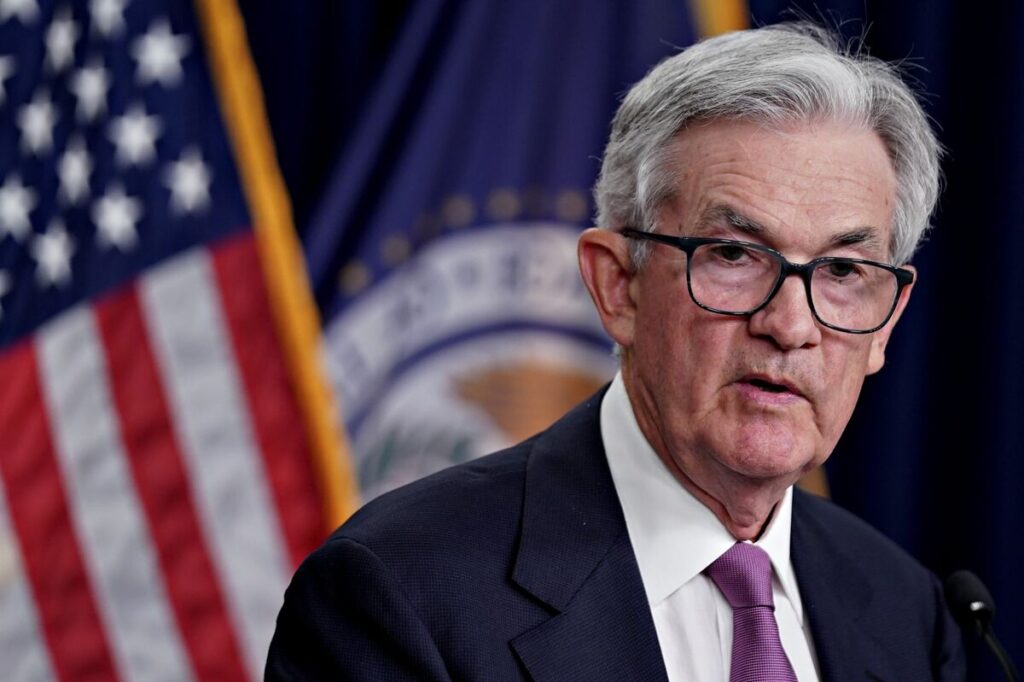
On Oct. 29, Fed Chair Jerome Powell stated that a December rate cut was “not a foregone conclusion,” which investors interpreted as a hawkish signal.
That single remark led to prediction-market odds collapsing from 89% the previous day to around 22% by Nov. 20.
The sentiment reversal began on Nov. 17 after Fed Governor Christopher Waller indicated the central bank should actively consider a rate cut next month.
He argued that “the labor market is still weak and near stall speed” and that inflation appeared “relatively close” to the Fed’s 2% target.
The remarks immediately reshaped expectations and helped drive the latest price rally in crypto-linked assets.
Prediction Markets Gain Influence Across Industries
Prediction markets have expanded significantly this year as more companies and investors embrace the model.
Platforms such as Polymarket and Kalshi have attracted users by allowing wagers on political developments, financial outcomes and major global events.
Polymarket recently secured a multi-year partnership to act as the official prediction-market platform for both the UFC and Zuffa Boxing.
The company has also grown through other strategic partnerships that broaden the use of prediction contracts across entertainment and sports.
Meanwhile, Kalshi has continued its own expansion after attracting major investment rounds that substantially increased its valuation.
Both platforms have reported surging user activity as traders increasingly use prediction markets to anticipate economic decisions, including those from the Federal Reserve.
Trading Apps Join the Prediction-Market Trend
The rapid rise of prediction markets has also caught the attention of larger trading platforms.
Robinhood recently confirmed that prediction markets have become one of its fastest-growing revenue categories.
The platform said that more than one million users have already traded billions of contracts since the feature launched earlier this year.
Rumors have also circulated that Coinbase is developing a prediction-market platform of its own, following the appearance of early interface images.
The acceleration of these platforms underscores a broader trend: traders across traditional and crypto markets are relying more heavily on probabilistic pricing tools to interpret and react to policy shifts.
As expectations for a December rate cut climb, crypto-linked stocks appear positioned to remain sensitive to any new signals from the Federal Reserve.