


Since the launch of spot Bitcoin exchange-traded funds (ETFs) in the United States on January 11, these new investment vehicles have rapidly gained traction, with trading volumes soaring past $10 billion within just three days, as reported by Bloomberg Intelligence analyst James Seyffart.
This meteoric rise in trading activity has sparked debate, with some questioning whether the frenzied trading has had any substantial impact on Bitcoin’s price.
However, Eric Balchunas, another Bloomberg analyst, emphasizes the sheer magnitude of this achievement.
He points out that the $10 billion volume in the first three days dwarfs the performance of 500 ETFs launched throughout 2023, which collectively managed only $450 million in volume during the same period.
The most successful ETF from that batch achieved a mere $45 million in trading volume.
In contrast, BlackRock’s iShares Bitcoin Trust (IBIT) alone recorded more activity than the entire class of ETFs launched in 2023.
Regarding net inflows and outflows, the data shows a trend of investors moving away from the Grayscale Bitcoin Trust (GBTC), which recently transitioned into an ETF format.
Over three days, BlackRock’s IBIT accumulated an impressive $700 million in net gains.
Meanwhile, GBTC experienced net outflows of over $1.1 billion, likely due to investors switching to ETF products with lower fees.
READ MORE: Vanguard’s Indirect Crypto Exposure: Owning a Significant Stake in MicroStrategy
James Van Straten, a research and data analyst at CryptoSlate, expressed optimism about the ongoing trends:
“GBTC total outflows are now at $1.18 billion vs. spot Bitcoin ETF inflows of $2 billion. It would be extremely encouraging if we continued this pace for the first month of trading.”
CEO Samson Mow anticipates a return to ETF equilibrium in the near future, expecting Grayscale to adjust its fees and alleviate the selling pressure.
While these developments are exciting, the Bitcoin price remains within its well-established trading range since December 2023, hovering around $43,000.
Although some remain confident in the market’s strength at this level, concerns persist regarding Bitcoin’s ability to avoid another significant price decline.
Popular social media trader JT believes that there is still room for further decline, especially when considering the long-standing trading range.
The price has found support around $41,500 in January, repeatedly testing this level since the beginning of 2024, according to data from Cointelegraph Markets Pro and TradingView.
The cryptocurrency community remains watchful, hoping for stability and potential price growth as the ETF market continues to evolve.
Toronto, Ontario, January 18th, 2024, Chainwire
.box is bridging Web3 and Web2
Breaking new ground in the domain name industry, My.box Inc. announces the upcoming launch of its Public Beta on January 18th, 2024 at 12:00 PM ET. This kicks off public availability of the first ever domain name system supported natively by browsers, email, and wallets.
The future of digital identity
.box domains offer secure and seamless identity on Web3 and Web2. The holder of ‘example.box’ is empowered with decentralized ownership and access to DNS record management, ENS integration, payments, Web3 authentication, Web3 messaging, websites, and email. Founder of .box, Josh Brandley states, “There are many great things happening at the intersection of Web3, decentralized identity, and domain names – we are the first to tie it all together with a powerful, easy to use product”.
.box solves the major problem with blockchain domains
.box sets a new standard in the world of blockchain-based top-level domains. While other new blockchain domain systems generate excitement, they ultimately fall short because they do not work with traditional browsers and email services. In contrast, .box is ICANN-accredited, recognized by the global Domain Name System (DNS), and supported by the Ethereum Name Service (ENS). Both DNS and ENS have established substantial network effects, solidifying their positions as core infrastructure. .box is pioneering an approach that natively integrates the features of both systems, thus delivering a better experience for users.
The team behind .box
The .box TLD is owned and operated by Intercap Registry, an ICANN Accredited Registry Operator. Intercap has dedicated over a decade to the development of .box. Core partners include 3DNS and ENS Labs, whose leaders share the vision of bringing the benefits of Web3 to the domain industry. Nick Johnson, Founder of ENS, states: “We have always had a deep respect for the DNS and are very excited to witness this unique .box implementation that supports seamless interoperability between the two systems”. Paul Gauvreau, CEO of 3DNS adds, “Bringing real world domain assets onchain improves almost every use case there is – we anticipate that this product will be widely adopted by Web3 enthusiasts and newcomers alike.”
Launch pricing
During launch, .box domains will run through a premium pricing phase, ensuring fair access for everyone. Prices start at $7,680 USDC and then decay exponentially for 6 days until stopping at a fixed rate of $120 USDC. All domains will renew at $120 USDC per year. Domains are minted and managed using the dApp hosted at my.box. Payment is made with ETH or USDC.
Join the .box community
- Secure your .box domain now at https://my.box
- Follow .box at https://x.com/boxdomains
- Join the .box Discord server to:
- Learn how to buy a .box and take control of your decentralized identity.
- Qualify for your referral link to earn $18 for each successful referral.
- Receive support, updates, and connect with the team.
For More Information:
Visit our website at www.my.box or contact Omar Hamed, [email protected]

Contact
Community Manager
Omar
My.box
[email protected]
Crypto lender Celsius has recently moved over $125 million worth of Ether to various crypto exchanges as part of its strategy to start repaying its creditors.
According to data from Arkham Intelligence, between January 8 and January 12, Celsius transferred $95.5 million to Coinbase, while $29.7 million was moved to FalconX.
Despite these transfers, Celsius still holds a substantial amount of Ethereum, with over 550,000 ETH valued at a staggering $1.36 billion as of the latest data available.
On January 5, Celsius initiated the unstaking of a massive 206,300 ETH, worth $407 million at the time.
The lender explained that this newly-liberated Ether would be used to cover costs related to its ongoing restructuring process and to prepare for the repayment of creditors.
While Celsius has expressed its intention to distribute Bitcoin and ETH to creditors in its recovery plan, it has not provided a specific timeline for when creditors can expect to receive their funds.
Celsius creditors have endured a long wait of more than 18 months to access their funds, as the platform declared bankruptcy in July 2022.
READ MORE: Vanguard’s Exclusion of Spot Bitcoin ETFs Spurs Investor Exodus to Alternative Platforms
In a similar move, FTX, a bankrupt crypto exchange, and its defunct trading arm, Alameda Research, transferred $28 million in crypto assets to exchanges on January 14, as per data from blockchain analytics platform Spot On Chain.
This transfer included $18.7 million in Wrapped Bitcoin, $8 million in Ether, and $1 million in Pendle (PENDLE) to Coinbase and Binance.
Following their bankruptcy declaration in November 2022, FTX and Alameda Research have been actively working to raise funds for creditor repayment.
Administrators of FTX have successfully reclaimed approximately $7 billion in assets, including a substantial $3.4 billion in cryptocurrency.
Market sentiment has been favorable towards FTX creditor claims, with some assets trading as high as $0.50 on the dollar as of October 2023.
While there is no precise date for when FTX customers can expect to be reimbursed, the current plan outlines that repayments are likely to commence at some point in 2024.
This suggests that creditors may have a reasonable chance of recovering their investments.

More than a year has passed since the notable Terra, FTX, and Celsius collapses in 2022, and the cryptocurrency industry has faced numerous challenges since then.
Industry leaders are now discussing the crucial role of crypto rating agencies in managing risks within the crypto sphere.
In 2022, Ben Goertzel, the CEO of SingularityNET, a decentralized artificial intelligence (AI) firm, argued that rating agencies could play a more significant role in rebuilding trust in crypto than regulators.
As we enter 2024, Goertzel remains skeptical of regulatory efforts aimed at bolstering confidence in the crypto space.
He expressed his lack of faith in regulatory agencies, stating, “Nothing that the world’s regulatory agencies have done since 2022 has increased my faith that they are going to be able in practice to do more good than harm for customers or service providers in the crypto space.”
However, Goertzel believes that transparent, crowdsourced, and intelligently aggregated rating mechanisms could significantly benefit the crypto landscape.
He highlighted the advancements in AI technology, which now make it easier to generate customized summaries of the reputations of various entities in crypto using raw data and reports from diverse sources.
Goertzel also pointed out the United States regulator’s handling of the FTX case as evidence that special laws for crypto fraud may not be necessary.
He argued that existing laws against fraud can effectively be applied to arrest “crypto fraudsters,” similar to individuals involved in other fraudulent activities.
While he doesn’t believe that rating agencies could have prevented the FTX collapse, he suggests that they could have “alerted customers to the numerous red flags observable in advance.”
READ MORE: Ether Surges Over 20% Against Bitcoin in 72 Hours, Traders Bullish on Further Upside
Anastasia Ulianova, co-founder of the crypto ratings platform Aria, acknowledges the limitations of rating agencies in preventing collapses like FTX.
Ulianova emphasized that rating agencies can “raise red flags” when the risk associated with a particular crypto exceeds its performance, but they cannot predict collapses.
She stated, “A rating can only tell you how much risk you are taking. It is not a certain prediction of an upcoming collapse.”
Despite these limitations, Ulianova believes that rating agencies can still play a crucial role in helping investors assess the risk-to-reward ratio of tokens.
This information can aid investors in determining whether the expected returns justify the associated risks.
She also emphasized that Aria’s goal as a rating agency is to “legitimize the place of crypto assets in a traditional investment portfolio.”
In summary, crypto rating agencies are being viewed as a valuable tool in the cryptocurrency industry to assess risks and provide investors with information needed to make informed decisions.
While they may not prevent collapses, they can help individuals navigate the complex crypto landscape and make more educated investment choices.
Bybit, the world’s third-largest cryptocurrency exchange by trading volume, has taken a significant stride in the DeFi (Decentralized Finance) revolution by introducing Bybit Web3 Swap. This upgraded platform not only meets the evolving demand for token swapping but also pushes the industry forward by providing users with a secure and user-friendly environment for swapping tokens across various blockchain networks.
Ben Zhou, the co-founder and CEO of Bybit, stated, “Our mission at Bybit has always been to bridge the gap between traditional finance and the power of DeFi. With Bybit Web3 Swap, we’re fulfilling that promise by creating a simpler, user-friendly experience that caters to both experienced DEX (Decentralized Exchange) users and newcomers to the Web3 space.”
Bybit Web3 Swap, a crucial component of the #BybitWeb3 initiative, empowers users to perform decentralized token exchanges across multiple blockchain networks. This opens up opportunities for users to access a wide range of tokens, liquidity pools, and engage in activities such as yield farming and staking.
Key Features of Bybit Web3 Swap:
- Expanded Token Support: Bybit Web3 now supports over 2,000 tokens, providing users with a diverse selection for seamless and diversified token swapping.
- Intuitive Token Discovery: Users looking for tokens not listed on Bybit will be seamlessly redirected to Bybit Web3 Swap, where they can easily acquire the desired tokens.
- Cross-Chain Asset Bridge: Bybit Web3 Swap facilitates the transfer of assets between Ethereum (ETH), Binance Smart Chain (BSC), Polygon, Arbitrum, and other mainstream Ethereum Virtual Machine (EVM) public chains, enhancing platform versatility and user convenience.
- Streamlined One-Step Swap Process: Bybit Web3 Swap simplifies the user experience by combining approval and swap steps into a single seamless operation, making token swaps effortless.
Additional Benefits:
- No KYC Required: Bybit Web3 Swap stands out by eliminating the need for Know Your Customer (KYC) procedures, prioritizing user privacy and convenience.
- High Liquidity Access: Users can access the highest liquidity available in the market, ensuring optimal token swap rates across various decentralized exchanges (DEXs).
- On-Chain Transparency: All transactions on Bybit Web3 Swap are executed on-chain, providing full visibility into fund flows and trading mechanisms, instilling user confidence.
Bybit remains committed to staying at the forefront of innovation by continuously expanding the compatibility of Bybit Web3 Swap.
Upcoming integrations include Polygon zkEVM, zkSync, StarkNet, and Mantle Network, ensuring that users have access to the latest and most advanced blockchain technologies.

The South Korean government is contemplating the imposition of sanctions on the use of cryptocurrency mixing services, following in the footsteps of the United States.
As reported by a local publication, South Korea’s financial regulator, the Financial Intelligence Unit (FIU), is in the early stages of crafting legislation to regulate digital asset mixing services.
This move comes as the use of mixers for illegal money laundering operations has been on the rise.
Cryptocurrency mixing services are designed to mix potentially identifiable or “tainted” cryptocurrency funds with others, making it difficult to trace the original source of the funds.
While initially intended to enhance privacy and allow senders to conceal their transaction details, these services have become a preferred method for scammers and hackers to launder stolen funds.
The discussions within the FIU began after the United States imposed sanctions against cryptocurrency mixers.
The South Korean regulator is now considering similar measures to curb money laundering and illicit financial activities in the crypto space.
READ MORE: Vanguard’s Exclusion of Spot Bitcoin ETFs Spurs Investor Exodus to Alternative Platforms
However, it is important to note that these discussions are in their early stages, and it may take some time before any new regulations are implemented.
Mixers and online gambling platforms are particularly notorious for facilitating money laundering, processing a significant portion of illicit funds.
In response, the U.S. government has already taken action by imposing sanctions on prominent crypto-mixing service providers.
The first set of sanctions was imposed in August 2022 when the U.S. Treasury Department targeted Tornado Cash, a well-known crypto mixing service.
Subsequently, in November 2023, the U.S. government expanded its sanctions by alleging North Korean ties to another crypto mixer, Sinbad.
South Korea’s consideration of similar measures reflects the global concern over the misuse of cryptocurrency mixing services for illegal activities.
While the regulatory framework is still under development, it is evident that authorities are taking steps to address these issues and ensure the integrity of the cryptocurrency ecosystem.
On January 14, an eye-catching report surfaced regarding a substantial $15 billion XRP transaction from an undisclosed wallet to Bitfinex.
However, it soon became apparent that this transaction had never actually transpired. Bitfinex’s Chief Technology Officer, Paolo Ardoino, shed light on the situation, revealing that it was, in fact, an unsuccessful attempt at a “partial payments exploit.”
The initial revelation of the supposed transfer came from Whale Alert, a prominent blockchain tracking account that formerly operated on Twitter.
Whale Alert claimed to have spotted a transaction involving a staggering 25.6 billion XRP – nearly half of the total XRP supply – moving from an unidentified wallet to Bitfinex.
However, Whale Alert later deleted the post and attributed the error to “an issue with properly reading the Ripple node response, resulting in a few wrong posts.”
Paolo Ardoino, in a subsequent explanation on the platform X, clarified that the incident was an attempted attack on Bitfinex through a “Partial Payments Exploit.”
READ MORE: US Financial Services Committee Establishes Bipartisan AI Working Group
The attacker seemed to have believed that Bitfinex had improperly configured its software to process partial payments.
The mechanics of a partial payments exploit involve assuming that a company’s system only reads the amount field of an XRP transaction, which is intentionally set to a high value.
The exploiter then sends a significantly smaller amount, specified in another transaction field, in an attempt to receive credit for the difference.
However, Ardoino affirmed that Bitfinex thwarted this attack because it correctly manages the ‘delivered_amount’ data field.
Notably, the attacker didn’t limit their efforts to Bitfinex alone. Blockchain data revealed that they also targeted Binance with a 58.9 billion XRP transfer, mirroring the unsuccessful outcome of the attack on Bitfinex.
In conclusion, what initially appeared as a colossal XRP transaction turned out to be a failed exploit attempt.
Bitfinex’s robust security measures successfully prevented any unauthorized manipulation of their systems, and the attacker’s ambitions to exploit vulnerabilities were thwarted.
BlackRock’s conservative approach to advertising its iShares Bitcoin Trust ETF (IBIT) may prove to be a winning strategy in attracting the affluent baby boomer demographic.
On January 11, BlackRock, a financial juggernaut, unveiled its first video advertisement for IBIT, introducing investors to the concept of Bitcoin and how they can gain exposure to it through the new ETF.
The ad, running for nearly two minutes, features a BlackRock executive calmly explaining Bitcoin’s value proposition and the ease of investing in the ETF.
Jay Jacobs, BlackRock’s US head of thematics and alternative ETFs, highlights IBIT’s accessibility, operational simplicity, and the reputation and expertise BlackRock brings to the ETF space.
Notably, the advertisement steers clear of flashy graphics and complex crypto jargon, setting it apart from other Bitcoin ETF commercials.
Industry commentators have lauded BlackRock’s approach as tailor-made for the well-off baby boomer audience.
READ MORE: Ether Surges Over 20% Against Bitcoin in 72 Hours, Traders Bullish on Further Upside
Eric Balchunas, an ETF analyst at Bloomberg, noted that the ad’s calm demeanor, straightforward message, soothing music, and the absence of a tie on the executive convey a reassuring message: “it’s okay now, the adults are here.”
Chris Dark, founder and managing partner of Fourth Turning Investments, dubbed the ad “so boring it’s brilliant” for its effectiveness in capturing the attention of baby boomers.
Digital asset investor Fred Krueger concurred, asserting that wealthy boomers prefer traditional finance firms like BlackRock and Fidelity over tattoo-covered Gen-Xers advocating for a financial system overhaul.
He indicated that they are now eagerly adding IBIT and FBTC to their portfolios, perceiving it as a Wall Street takeover of the Bitcoin narrative.
The battle for marketing supremacy among Bitcoin ETFs began with Bitwise’s ad release on December 18, 2023.
Shortly after, ETF issuers such as Hashdex and VanEck also unveiled their advertisements. In January, ARK Invest and Grayscale launched new advertising campaigns.
The Valkyrie Bitcoin Fund (BRRR) even advertised on the Nasdaq billboard in Times Square on January 13.
While BlackRock, Fidelity Investments, and others have reportedly showcased their Bitcoin ETFs on their homepages, the deliberate simplicity of BlackRock’s ad campaign appears to have struck a chord with the affluent baby boomer demographic, potentially setting the tone for success in this competitive market.

The United States Government Accountability Office (GAO) recently offered crucial recommendations to the Securities and Exchange Commission (SEC) in anticipation of its approval of a spot Bitcoin exchange-traded fund (ETF) on January 10.
These recommendations primarily revolved around workforce management for the digital asset market and the regulatory approach towards the burgeoning industry in the upcoming years.
The GAO presented these recommendations to the SEC on December 15, and they were made public on January 16.
The GAO’s report advised the SEC to develop a new workforce plan, establish clear policies and procedures for its Strategic Hub for Innovation and Financial Technology (FinHub) internal controls, and formulate performance objectives for the hub.
The GAO, known for its independent and nonpartisan role within the U.S. federal government’s legislative branch, provides auditing, evaluation, and investigative services for the U.S. Congress.
Upon assessing the SEC’s readiness to handle the growing crypto market, the GAO identified that the agency currently employs 116 individuals primarily focused on crypto asset matters.
However, the SEC has yet to create an updated workforce planning strategy, despite the need to align with its fiscal years 2019–2022 strategy.
The GAO suggested that such a strategy would better equip the SEC to address future workforce requirements and effectively fulfill its responsibilities in overseeing and formulating policies related to crypto assets.
READ MORE: Rosario Witnesses Historic First as Tenant Pays Monthly Rent in Bitcoin
Additionally, the GAO observed that while the SEC’s FinHub coordinates oversight of emerging technology, it lacks documented policies, procedures, and performance goals, even though it has established operational processes like meetings with market participants.
In response to their assessment, the GAO issued three recommendations:
- The SEC’s chief should ensure that the chief human capital officer devises a new workforce planning strategy in line with the agency’s 2022–2026 strategic and performance plans.
- The SEC’s chief should ensure that the FinHub director documents policies and procedures that underpin its internal controls.
- The chair of the SEC should ensure that the FinHub director establishes performance goals and metrics that are clear, quantifiable, and targeted.
For each of these recommendations, the GAO included a live status section to monitor whether the SEC takes appropriate actions on them.
In a landmark decision, the SEC granted approval for 11 spot Bitcoin ETF applications on January 10. The internal document shared by the SEC revealed that the proposal received three votes in favor and two against. SEC chief Gary Gensler’s decisive vote marked the approval of the first spot BTC ETFs in the U.S., ending nearly a decade of rejections.
Notably, gold enthusiast and prominent Bitcoin critic Peter Schiff suggested that Gensler was pressured into approving the spot Bitcoin ETFs.
However, Schiff cautioned that Gensler might introduce stringent crypto regulations in the near future, potentially increasing the cost of Bitcoin transactions and undermining its utility, which could lead to a significant price drop.
All the approved spot BTC ETFs commenced public trading the following day, quickly amassing over $2 billion in trading volume on their debut.
Los Angeles, California, January 17th, 2024, Chainwire
Key Takeaways
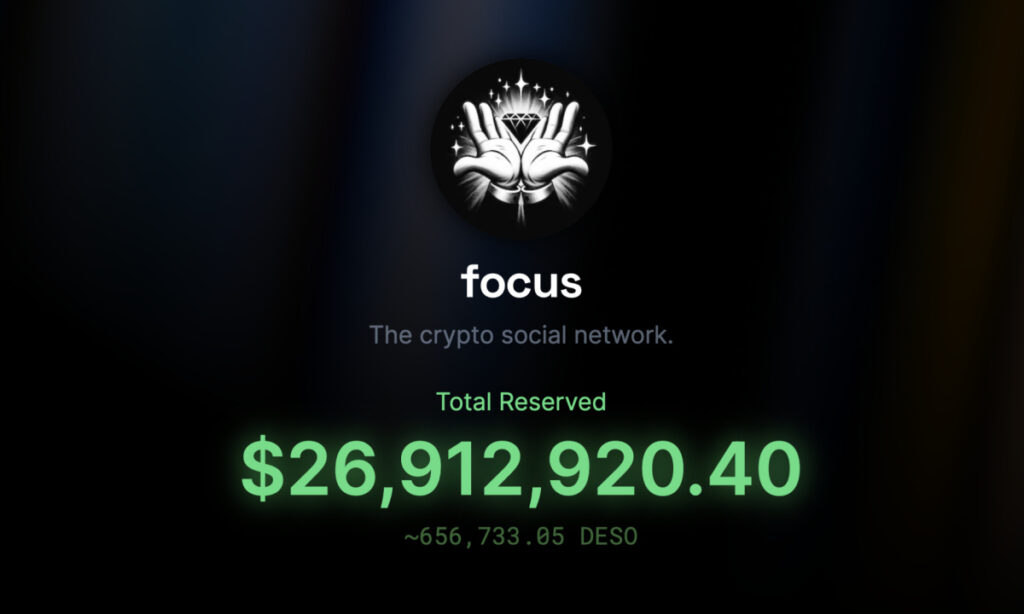
- Focus, the revolutionary new decentralized SocialFi app, raised $20 million in less than 24 hours
- Focus rivals subscription platforms like OnlyFans and Patreon, a multi-billion-dollar industry
- The Social Airdrop offers users the chance to earn upwards of $100,000 in $FOCUS tokens
Focus is a brand new SocialFi app from DeSo, the team that raised $200M from Coinbase, Sequoia, a16z, Social Capital, and other top funds. It aims to disrupt the trillion-dollar social media market and creator economy by introducing groundbreaking features rivaling X, Onlyfans, and Patreon.
The TAM for this market is significant, with OnlyFans processing roughly $8 Billion in 2023 and charging 20% per transaction. These high fees significantly reduce creator profits, highlighting the need for a more equitable solution.
Focus combines the best of Onlyfans, Patreon, X, and other billion-dollar social platforms into one app. It’s built on the DeSo blockchain and powered by permissionless crypto-native monetization features that are not possible in web2.
Under the leadership of crypto-veteran Nader Al-Naji, Focus is fully decentralized, with no corporate entity behind it. Just coins and code:
“Decentralized social media is facing the same skepticism Bitcoin did at its inception. Critics believe it can’t challenge major players, won’t scale, and faces a ban if it does. Ask yourself: do you want to be on the side that’s short-sighted and left behind or embrace optimism and innovation? This is your chance to be part of a monumental technological shift.” – Nader Al-Naji, Founder of DeSo
Focus allows new ways for users to make money with anonymous crypto-enabled monetization mechanics that include paid reposts (decentralized ads), paid messages, unlockable content, subscriptions, and Creator Coins, allowing users to invest directly in other creators’ revenue streams.
Thanks to the DeSo blockchain and its Revolution Proof of Stake system, Focus users can transact in a variety of cryptocurrencies, including USDC, Bitcoin, Ethereum, Solana, DeSo, and Focus tokens, all for under 1/10,000th of a cent per transaction, including for cross-chain assets.
DeSo also supports the storage of content directly on-chain for 1/10,000th of a cent per post, which is much less than Solana at ~$1 per post or Ethereum at ~$100+ per post.
This means that Focus can pioneer innovative monetization and content mechanics that are not possible with older high-fee blockchains or slower and heavily censored fiat payment rails.
DeSo Founder Nader Al-Naji continues: “From the beginning, our strategy was clear: lay down a scalable, decentralized groundwork, then roll out applications that truly showcase the unparalleled advantages and power of DeSo.”
Focus allows users to reserve tokens akin to staking, with the flexibility to choose any supported currency via HeroSwap, including BTC, ETH, SOL, USDC, and DESO. Early adopters who reserve tokens during the first week (January 11th to January 18th) will receive a 100% bonus in $FOCUS tokens.
Unlike traditional social networks, Focus democratizes distribution by distributing 100% of all fees directly to the holders of $FOCUS tokens. This contradicts the business model users see with social platforms today, where a small group of venture capitalists and shareholders capture all the value.
To further incentivize user participation, Focus is introducing a viral airdrop model, The Social Airdrop, which rewards users based on their influence on external social networks, distributing $FOCUS tokens commensurate with their reach.
This new airdrop model means someone with a thousand views per post would get a joining bonus of about $100 in $FOCUS tokens. In contrast, someone with millions of views per post, like Elon Musk, would get a bonus of upwards of $100,000 in $FOCUS tokens.
The Social Airdrop also includes a referral program allowing users to refer others to the platform and in return receive 10% of the referee’s joining bonus and 5% of all revenues the referee generates on the platform.
FOCUS plans to support X, Instagram, YouTube, TikTok, Twitch, select email domains, DeSo, and OnlyFans at launch.
To reserve tokens and earn a 100% bonus in $FOCUS, prospective users should visit Focus.xyz and reserve their funds before 11:11 am EST on January 18th. The bonus will drop every week until the app goes live.
About Deso
DeSo is the first and only censorship-resistant Layer-1 blockchain purpose-built to power storage-heavy apps and scale decentralized social networks for mass adoption. Their mission is to decentralize social media like Bitcoin and Ethereum are decentralizing finance. DeSo has gained significant adoption and boasts 2.6M users (wallets) and 93M transactions. With Focus, DeSo aims to usher in a new age in crypto led by cutting-edge consumer apps that scale to billions of users.
Contact
Ed Moss
[email protected]