


Blockchain data highlighted by Coinbase director, Conor Grogan, shows that in 2021, Alameda Research redeemed over $38 billion in Tether USDT tokens, even though their assets under management didn’t match this value. At the 2021 crypto market’s peak, the USDT creation by Alameda exceeded its recorded assets.
Grogan also pointed out probable USDT redemptions ordered by FTX were from Alameda’s stash, approximately 3.9 billion USDT. Most of these redemptions coincided with Terra’s algorithmic stablecoin downturn.
In January 2021, Alameda’s former co-CEO, Sam Trabucco, addressed reports about major USDT mints by Tether.
He detailed how Alameda capitalized on arbitrage opportunities due to USDT’s value fluctuations on different exchanges.
He explained that the value at which USDT trades compared to $1 tends to be volatile.
When juxtaposed with BTC/USD trades, Bitcoin-to-USDT trades often show a minor deficit in basis points.
Trabucco emphasized that the BTC/USDT and BTC/USD markets are better indicators of USDT’s trading position than any individual exchange’s USDT/USD market.
READ MORE:Prosecutors Challenge Defense Over FTX Funds in Bankman-Fried’s High-Profile Trial
Unlike USDT, other stablecoins like the USD Coin (USDC) have a steadier premium.
This is attributed to the USDT creation and redemption process.
As only certain firms can directly create and redeem USDT, most traders obtain and trade USDT via the markets, bypassing Tether’s treasury.
Highlighting Alameda’s trading strategies, Trabucco mentioned that when USDT’s value exceeds $1, a well-equipped firm like Alameda would be inclined to sell, and they did so extensively.
With their ability to initiate USDT creations and redemptions, they could place significant bets.
This was a strategic move for Alameda, ensuring both profit for the company and stability for USDT’s value, keeping it close to the $1 mark.
Alameda leveraged these arbitrage chances by creating USDT tokens and cashing in on the premium.
In 2021, Sam Bankman-Fried also mentioned Alameda’s active redemptions of USDT for U.S. dollars.
Cointelegraph is awaiting Tether’s response regarding the exact number of USDT tokens minted upon Alameda’s request.
Other Stories:
Binance and OKX Adjust Operations in Response to U.K.’s New FinProm Regulations
EU Mulls Tighter Regulations on Major AI Systems, Mirroring Digital Services Act Approach
Why Developers Should Seriously Consider Building on EOS EVM with v0.6.0 Release
Binance’s ambitious Industry Recovery Initiative (IRI) intended to boost the crypto industry following the FTX collapse may have fallen short of its objectives, as a recent report indicates.
The IRI was launched in November 2022, with Binance committing $1 billion in its BUSD stablecoins.
However, by October 10, only $15 million had been spent, with the remaining $985 million being moved back to Binance’s corporate treasury.
Later, in March, Binance converted these funds into cryptocurrencies such as Bitcoin, attributing the decision to increasing regulatory concerns over stablecoins.
Besides Binance’s commitment, 18 other organizations, including Animoca Brands, Aptos Labs, Jump Crypto, and Polygon Ventures, added to the IRI, raising a collective $100 million by February 2023.
Although Binance stated that the IRI funded 14 projects within three months of its establishment, the details of these projects remain undisclosed.
The only publicized investment from Binance’s commitment was its purchase of the South Korean crypto exchange, Gopax.
READ MORE:Why Developers Should Seriously Consider Building on EOS EVM with v0.6.0 Release
However, based on Bloomberg’s research on wallet data, the total investment by the IRI since its inception is less than $30 million.
Notably, of the nine identifiable participants, only DWF Labs and Binance-backed Aptos utilized a portion of the funds they committed.
The current operational status of the IRI remains ambiguous, despite its online application form still being active on Google Docs. Binance has not provided a comment on the matter.
This discrepancy between the IRI’s proposed investments and actual contributions comes at a critical time.
The crypto sector is experiencing a significant decline in venture funding, dropping by as much as 70% from Q3 2022, as noted by the blockchain analytics firm, Messari.
In Q3 2023, funding volumes were a mere $2 billion, a drastic decrease from the $17 billion peak in Q1 2021.
Other Stories:
Prosecutors Challenge Defense Over FTX Funds in Bankman-Fried’s High-Profile Trial
Binance and OKX Adjust Operations in Response to U.K.’s New FinProm Regulations
EU Mulls Tighter Regulations on Major AI Systems, Mirroring Digital Services Act Approach

The hacker, dubbed “FTX Drainer”, who previously stole over $400 million from FTX and FTX.US in November, might be exploiting the media frenzy surrounding Sam Bankman-Fried’s fraud trial to further conceal the stolen assets, as per Hugh Brooks, CertiK’s director of security operations.
As Bankman-Fried’s trial commenced, the “FTX Drainer” initiated a series of transactions, moving millions in Ether obtained from the theft.
Recently, the hacker shifted about 15,000 ETH (equivalent to approximately $24 million) to three fresh wallet addresses.
Brooks suggests that the trial’s widespread media coverage might be serving as a distraction, allowing the hacker to stealthily move the assets.
He theorized that the perpetrator might have assumed the trial would consume so much of the Web3 sector’s attention that tracking the stolen funds would become more challenging.
READ MORE:Binance and OKX Adjust Operations in Response to U.K.’s New FinProm Regulations
FTX’s valuation once stood at $32 billion.
However, following the hack, it filed for bankruptcy on November 11. On the same day, FTX staff noticed significant fund withdrawals from their wallets.
A Wired report dated Oct. 9 unveiled that on realizing the hacker had access to several wallets, FTX’s team shifted a significant portion of the remaining assets, between $400 million to $500 million, to a private Ledger cold wallet.
This strategic move probably thwarted the hacker from pilfering close to $1 billion.
Brooks has also shed light on the hacker’s evolving tactics. Initially, on November 21, the hacker tried laundering the stolen money using the “peel chain” method, which involves dispersing decreasing amounts to fresh wallets.
However, the hacker now adopts a more intricate technique, splitting the funds across numerous wallets. This makes tracing more time-consuming.
As of now, the identities of individuals or groups responsible for the hack remain elusive, and investigations persist.
Other Stories:
Prosecutors Challenge Defense Over FTX Funds in Bankman-Fried’s High-Profile Trial
Why Developers Should Seriously Consider Building on EOS EVM with v0.6.0 Release
EU Mulls Tighter Regulations on Major AI Systems, Mirroring Digital Services Act Approach
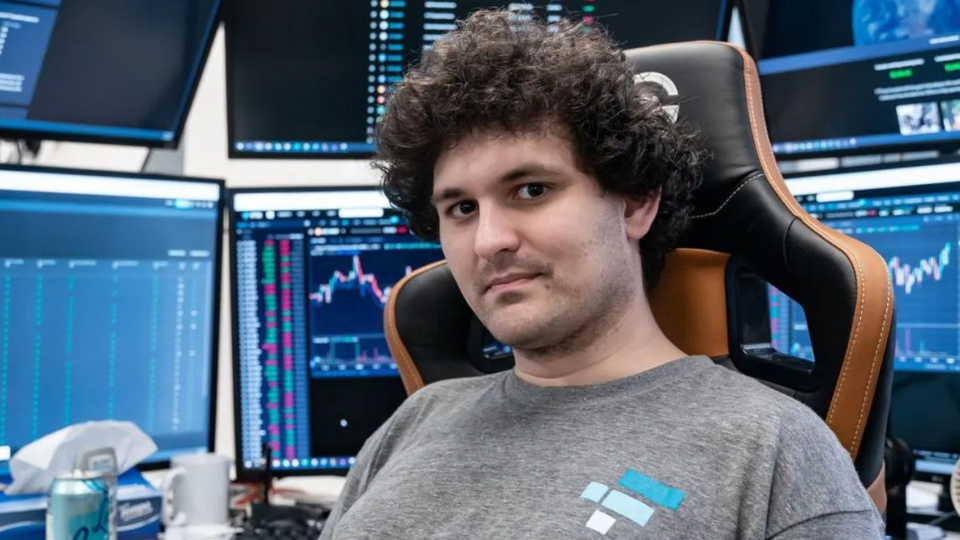
U.S. prosecutors have urged the court overseeing Sam Bankman-Fried’s trial to prevent his defense from raising arguments about the possible recovery of FTX customer funds invested in Anthropic.
Bankman-Fried directed $500 million into the AI startup, Anthropic, in April 2022. The U.S. government, however, intends to demonstrate that these funds were siphoned from FTX customer deposits.
Anthropic has recently been in the spotlight, aiming to secure new investment, with major companies like Amazon and Google showing interest.
This could boost the firm’s valuation to between $20-$30 billion.
Prosecutors stress that this surge in valuation could also amplify the worth of Bankman-Fried’s stake, which might facilitate the recovery of assets for those impacted by FTX’s bankruptcy.
A letter presented to Judge Lewis Kaplan reveals that the U.S. government and Bankman-Fried’s attorneys have debated issues likely to emerge during witness cross-examination.
The defense is prepping to introduce evidence about the present value of Bankman-Fried’s 2022 investment in Anthropic.
READ MORE: Crypto Exchange HTX Recovers Stolen Funds; Rising Cyberattacks Concern Industry in 2023
Prosecutors argue that such evidence could be utilized to claim that FTX customers and other affected parties might be fully compensated.
This notion has been previously termed by the court as an “impermissible purpose”.
They further state, “Such evidence would… be wholly irrelevant, and present a substantial danger of unfair prejudice.”
The crux of the case against Bankman-Fried lies in accusations of wire fraud, involving the use of FTX customer deposits for various investments.
The prosecution holds that any successful investments Bankman-Fried made are ultimately inconsequential to the charges being examined.
While the government aims to present evidence of Bankman-Fried’s alleged misuse of customer funds leading to significant deficits for FTX, they do not plan to provide details on the final losses post the FTX bankruptcy completion.
The Bankman-Fried trial, reported by Cointelegraph’s Ana Paula Pereira from New York, commenced by exploring the disappearance of around $8 billion of FTX customer assets from the defunct crypto exchange.
Other Stories:
ESMA Releases Second Consultative Paper on MiCA Mandates, Focuses on Sustainability and Transparency
FTX Co-Founder Testifies: Former CEO’s Alleged Misuse of User Funds
Senior Republicans Push Biden Administration to Enhance Semiconductor Export Rules to China
The EOS EVM v0.6.0 is almost live, bringing a number of interesting goodies to the platform’s new EVM environment, most notably natively bridged USDT.
Since its launch in April, the EOS EVM has seen a flurry of upgrades that make it a surprisingly unique EVM environment, which uses EOS’s underlying stack to create one of the fastest blockchain environments for EVM transactions.
The latest update is now bringing EOS USDT as a native token that can be bridged to the EOS EVM, as previously only EOS could be transferred trustlessly. The release also brings important technical updates to enhance interoperability with the native EOS environment.
Now, smart contracts on EOS can execute functions on the EVM, while smart contracts on the EVM can send messages to the native VM, which helps integrate the two deployments. EOS currently has $71M in TVL according to DefiLlama, a sizable figure providing a solid base to launch the next killer dApp on the EVM.
The EOS EVM’s unique properties
EOS is technologically highly advanced, providing an ultra low-latency smart contract platform built with C++. It was originally considered as the main “Ethereum killer” blockchain, but mismanagement by the original creators of EOS, Block.One, meant that the chain failed to take advantage of the later bull run.
Now, under the leadership of the community-established EOS Network Foundation, the ecosystem is finding new vigor — and its current focus is on bringing it up to speed with what happened in the land of smart contracts.
The EOS EVM is, unlike many other alternative L1 chains, not a fork of the Geth client, meaning that it doesn’t carry over much of its legacy code (which significantly reduces its performance). Instead, it is a smart contract on EOS that recreates an Ethereum client based on Erigon, a newer and much more efficient software.
EOS has a 1 second block time, making it easily one of the fastest blockchains supporting the EVM, and the one with the highest throughput for DEX swaps. With an efficient node implementation and low block times, the EOS EVM enables Solidity developers to build the kinds of things that were only possible on Solana, including order book DEXs and advanced derivatives.
How to build on EOS EVM
Like on any other EVM chain, developers can deploy contracts by simply connecting their favorite developer tools to the EOS EVM chainId, 17777. The documentation includes the full list of data such as RPC endpoints, network settings and block explorers.
For testnet tokens, a faucet is also readily available directly from the docs.
The EOS EVM is fully compatible with existing smart contracts, including some key cryptography precompiles that exist on Ethereum. Unlike complex rollups like zkSync, there is nearly no additional headache from switching to EOS.
The rest of the way is pretty much like building anywhere else, and deep dives into building Solidity contracts are easy to find.
The EOS Foundation heavily incentivizes developers
As a recently launched initiative, the EOS Network Foundation is keen to offer incentives to the right teams who build on EOS. With venture funding across the board hitting multi-year lows according to Messari, this can be a boon to ambitious teams who are struggling with funding elsewhere.
For example, the ENF is giving up to $50,000 for anyone deploying on the EOS EVM (pending some checks). Additional options include the EOS Network Ventures and Grant program, completing the circle of funding avenues.
Another cool feature from the last v0.5.0 update is the Yield+ program, a semi-automated network-wide liquidity mining program. Apps can receive extra yield to give to their users to incentivize activity, divided in multiple tiers based on EOS and USDT TVL.
Combined with a number of quality of life improvements, the EOS EVM is gearing up to become the dark horse this season as it continues to make critical updates to its technology stack. And as far as developer experiences go, its program seems very competitive at a time when most other networks are slowing down their spending.

The European Union (EU) is in advanced discussions to enact further regulations on major artificial intelligence (AI) systems.
These talks involve the European Commission, European Parliament, and the member states of the EU.
Their primary focus is the potential impacts of extensive language models like Meta’s Llama 2 and OpenAI’s ChatGPT-4. The objective is to include additional constraints on these models within the forthcoming AI Act.
Bloomberg’s sources suggest that the EU’s aim is to ensure that startups are not excessively restricted while maintaining adequate control over larger AI systems. The agreements made thus far remain preliminary.
The approach being considered for the AI systems mirrors the strategy used for the EU’s Digital Services Act (DSA).
The DSA was recently executed by the EU to ensure that platforms and websites maintain specific standards, particularly around the protection of user data and monitoring for unlawful activities.
Moreover, massive web platforms face even more stringent regulations under the DSA.
READ MORE: Bitcoin Hovers Near $28,000 Amid Geopolitical Tensions and Trader Speculations.
For instance, major companies like Alphabet and Meta were given a deadline of August 28 to align their service practices with these newly introduced EU standards.
The AI Act by the EU is set to become among the initial mandatory AI-specific regulations established by a Western government.
By contrast, China had already put into effect its own AI regulations by August 2023.
Within the stipulations of the EU’s proposed AI Act, companies involved in the development and rollout of AI systems would be required to conduct risk evaluations.
Furthermore, AI-produced content would need clear labeling, and the use of biometric surveillance would be entirely prohibited, among other provisions.
It’s important to note, however, that the legislation is still in its proposal stage, granting member states the discretion to challenge any of the suggestions made by the parliament.
Since China introduced its AI regulations, over 70 new AI models have been launched, indicating a vibrant AI landscape despite the regulatory environment.
Other Stories:
Crypto Exchange HTX Recovers Stolen Funds; Rising Cyberattacks Concern Industry in 2023
ESMA Releases Second Consultative Paper on MiCA Mandates, Focuses on Sustainability and Transparency
Senior Republicans Push Biden Administration to Enhance Semiconductor Export Rules to China
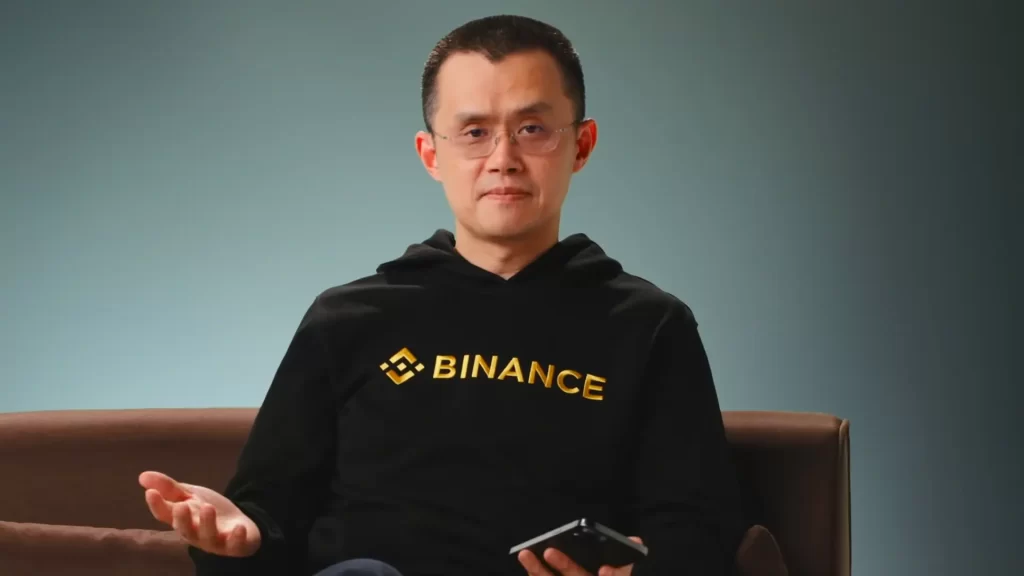
Major global cryptocurrency exchanges, Binance and OKX, are adjusting their operations to adhere to the U.K.’s new Financial Promotions (FinProm) Regime.
Introduced by the U.K. Financial Conduct Authority (FCA) on October 8, the regime aims to ensure transparency in crypto promotions.
In anticipation of these regulations, Binance, on October 6, introduced a new domain exclusively for U.K. retail users and joined hands with the local peer-to-peer lending platform, Rebuildingsociety.
Starting October 8, U.K. retail users will be directed to this domain which will only display Binance offerings in line with U.K. regulations.
This means services like spot and margin trading, Binance Pay, the NFT marketplace, loans, etc., will be accessible.
However, offerings like gift cards, referral bonuses, and research will no longer be available to U.K. retail users due to the FinProm compliance.
Notably, this will not affect users exempted under FinProm, like specific institutional and professional investors.
Similarly, OKX made its own compliance announcements on October 6.
The platform has limited its token offerings to about 40 assets and now sports striking risk warnings on its platform.
READ MORE: Senior Republicans Push Biden Administration to Enhance Semiconductor Export Rules to China
One such cautionary message on the OKX homepage advises investors about the volatile nature of crypto investments, underlining the importance of investing only what they’re prepared to lose.
Furthermore, OKX has initiated a dedicated U.K. social media account (on a platform formerly known as Twitter) to keep users updated about compliant services and products.
Another entity, the crypto payment service MoonPay, is working to accommodate the FinProm rules.
MoonPay’s deputy general counsel, Matt Sullivan, highlighted the global challenge of meeting these U.K.-specific standards.
Sullivan emphasized that adhering to the FinProm rules means tailoring products, incorporating new processes, and initiating company-wide education.
He hinted at a possible adjustment phase as interpretations of certain rules might evolve.
However, some crypto firms seem to be grappling with these new promotional regulations.
As per an FCA announcement on October 8, significant crypto exchanges, KuCoin and HTX, possibly marketed their services without requisite permissions.
These firms were among 143 “non-authorized firms” cautioned against by the FCA, advising the public to avoid interactions with them.
Other Stories:
Bitcoin Hovers Near $28,000 Amid Geopolitical Tensions and Trader Speculations.
ESMA Releases Second Consultative Paper on MiCA Mandates, Focuses on Sustainability and Transparency
Crypto Exchange HTX Recovers Stolen Funds; Rising Cyberattacks Concern Industry in 2023
Amsterdam, The Netherlands, October 9th, 2023, Chainwire
The token presale for upcoming crypto casino TG.Casino has now raced past $500,000 and is approaching the $1 million soft cap mark.
TG.Casino Token ($TGC) is currently available to purchase for $0.125 – holding the token allows users to generate staking rewards and earn a share of casino profits through a token buyback once it is launched.
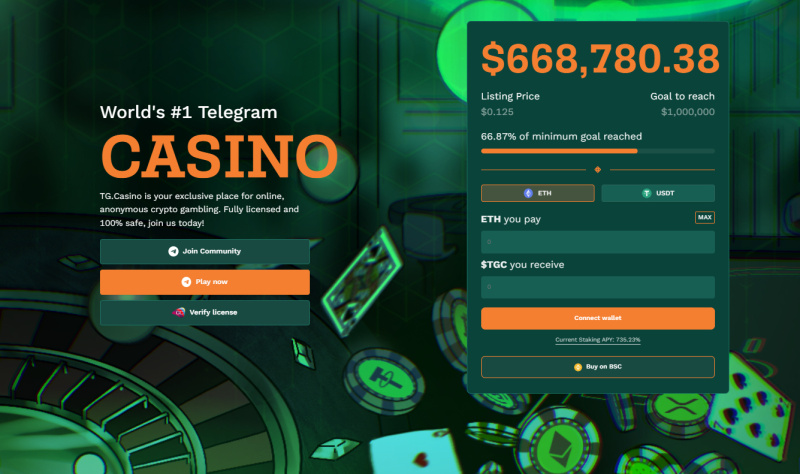
At the time of writing the presale has raised almost $700,000 with the staking annual percentage yield (APY) set at 737%.
Stake $TGC to Earn Rewards and Share Casino Profits
TG.Casino is a fully decentralized and licensed crypto casino – powered by Telegram – that will offer instant and anonymous play, anonymous crypto transfers, thousands of slots, classic casino games, and a competitive sportsbook.
However, unlike many other casinos in the crypto space TG.Casino, which has not yet launched, is offering native token $TGC for holders to earn further rewards beyond gambling and wagering.
Staking
The first is through its staking mechanism, with presale buyers able to add purchased $TGC tokens immediately to the staking pool and generate an APY.
As outlined above, the current APY is over 737% meaning those who have purchased early will continue to accrue tokens as the presale continues. The APY will reduce as more tokens are locked into the pool meaning.
Profit Sharing/Token Buyback/Burn Mechanism
Staking will also play an integral role in the profit-sharing system.
Users who have tokens staked once the casino is up and running will earn a share of daily profits through a planned token buyback system.
$RLB, the native token of Rollbit, surged 60% and reached a peak market cap of $700 million after it announced a buyback scheme in August.
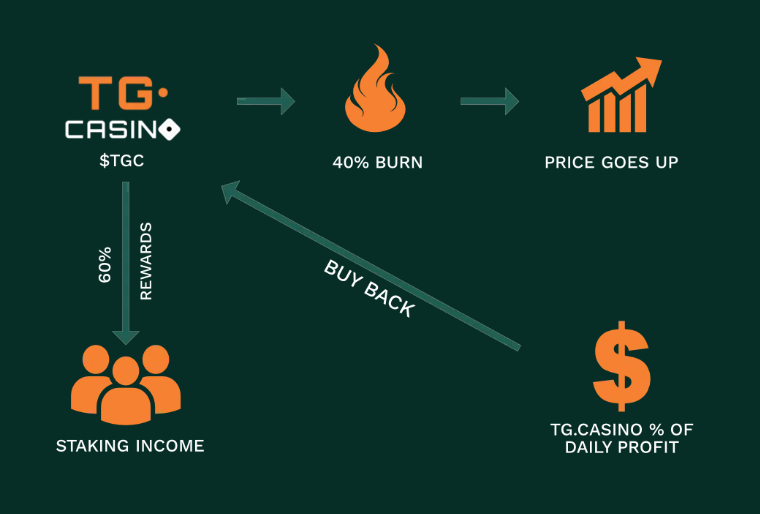
The TG.Casino buyback will see the casino use a share of daily profits, once live, to purchase $TGC tokens and distribute them to those who are staking.
This will allow token buyers to earn more tokens. However, the buyback goes a step further by also adding a burn mechanism as a feature.
From the buyback, 60% of purchased tokens will be distributed to stakers as rewards, with 40% sent to a burn address meaning they are permanently taken out of supply.
As has been shown with the likes of Maker ($MKR) and Verasity ($VRA), token burns can have a positive effect on price, as the supply is reduced and the value of an individual token increases.
Presale Info and Tokenomics
The presale launched in late September and is offering tokens at a fixed price of $0.125 through one round.
There is a max supply of 100 million tokens with 40 million allocated to the presale (40%) with a soft cap of $1 million – which is now 67% sold out – and a hard cap of $5 million.
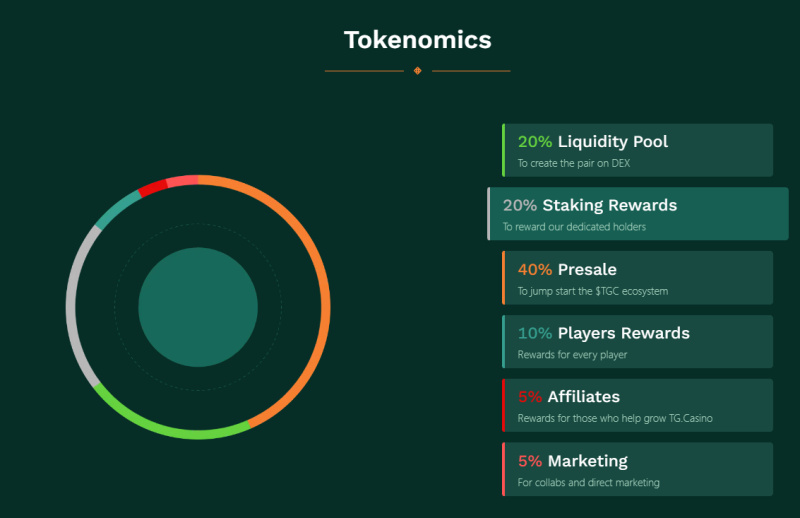 There is a minimum purchase of 100 tokens ($12.50), with $TGC an Ethereum-based ERC-20 token that can be purchased with ETH, BNB or USDT.
The remaining supply will be allocated to decentralized exchange liquidity (20%), the staking pool (20%), the rewards system (10%), marketing (5%), and affiliates (5%).
Its token smart contract has been audited by Coinsult with no major security issues found.
Telegram-Powered Casino
TG.Casino will utilize powerful Telegram bots to offer users an enhanced customer experience, with players able to enjoy anonymous and instant crypto gambling.
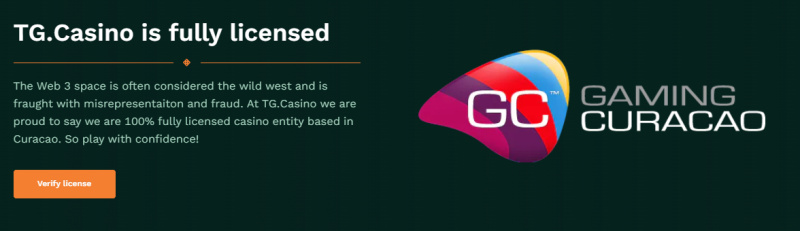
The crypto casino is fully licensed by the government of Curacao, and follows anti-money-laundering and responsible gambling policies. Some players will only be able to access the site via a VPN, however.
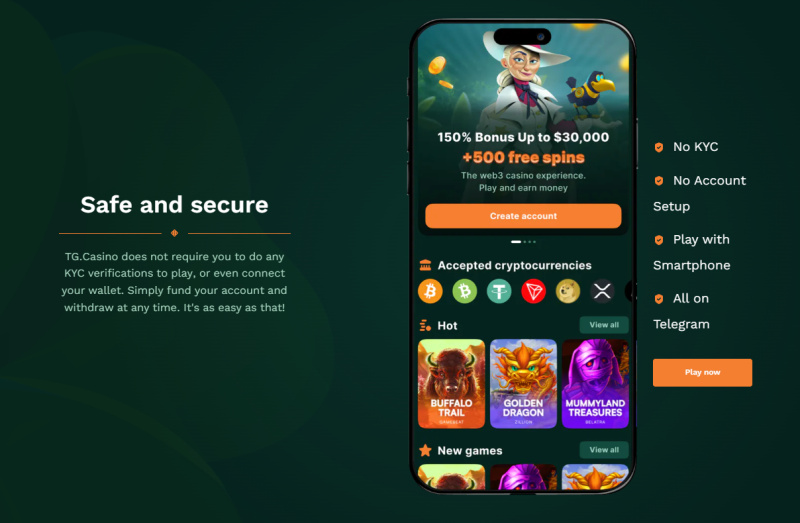 Players use the messaging app, which has almost 800 million active global users, to access the casino via command-based prompts.
That means that sign-up is instantaneous and anonymous, with no KYC verification steps to complete, and the casino and Telegram recognizing a phone number as a unique reference for individual players.
Telegram also allows players to deposit and withdraw crypto instantly and anonymously, via trusted crypto wallets such as MetaMask, Coinbase and Trust Wallet.
Players can transfer around a dozen cryptocurrencies, including BTC, ETH and USDT, without fees and with a minimum amount of just $1 (or equivalent).
Once live, the casino will offer thousands of leading and provably fair slots games – such as Aviator and Plinko – from leading and trusted developers like Spribe, Hacksaw, and Evolution.
 TG.Casino will have casino classics such as Poker, Blackjack, and Roulette, with both live and virtual dealers and dozens of different tables that are suitable for both novice players and high rollers.
There will also be a sportsbook with competitive odds from leading providers, such as BetRadar, with pre-game and in-play markets on competitions such as the Premier League, NFL, NBA, and many more, including eSports.
New players at TG.casino can earn a 150% matched first deposit bonus, up to $30,000, and get 300 free spins – there is a 40x wagering requirement to receive the full bonus.
For more information on the casino – as well as the presale, staking and buyback mechanism – users can read through the TG.Casino whitepaper or join the Telegram community group
Disclaimer:
TG.Casino is the source of this content. This Press Release is for informational purposes only. The information does not constitute investment advice or an offer to invest.
Contact
TGCASINO
TG Casino
[email protected]
Bitcoin maintained its position around $28,000 as of the Oct. 8 weekly close, with geopolitical tensions capturing the attention of traders.
Recent data from Cointelegraph Markets Pro and TradingView highlighted Bitcoin’s resilience against potential drops over the past weekend.
After briefly dipping to $27,000 on Oct. 6, positive US employment figures—contrasting with Federal Reserve policy changes—aided its recovery.
The main focus for traders in the coming week is the $28,000 resistance.
Skew, a notable trader, emphasized in his analysis on the low timeframe (LTF) of exchange order books that significant buying power is essential to transition the $28,000 from resistance to support.
“The market still perceives $28K as resistance. Breaking it would need substantial buying,” he mentioned to his X (formerly Twitter) followers.
Additionally, he observed perpetual contracts (perps) shorting each LTF bounce at $28,000.
Skew also pointed out Bitcoin’s response to the $28,000 level and the current 200-day moving average (MA) of $28,040 as less than ideal.
Another trader, Daan Crypto Trades, warned against betting on Bitcoin’s price drop, especially if a surge takes place.
READ MORE:Senior Republicans Push Biden Administration to Enhance Semiconductor Export Rules to China
He noted the significance of the $28,000 mark with the Daily/Weekly 200MA at the same position and expressed his hesitancy in shorting any upward deviations.
He further shared, “Historically, weekend breakouts at these points have been resilient against retractions.”
A provided chart showcased the final price for the past week’s CME Bitcoin futures, which could act as a pricing guide for the forthcoming week. Daan added, “The CME price is most effective in a fluctuating environment.
We’re in that scenario, but a strong upward move might change it, making me reluctant to short during a potential weekend surge.”
Additionally, recent events in Israel have raised discussions about geopolitical uncertainties possibly influencing Bitcoin’s pricing in the future.
Among the commentators is Michaël van de Poppe, CEO of MN Trading.
He anticipated a volatile week, suggesting that Bitcoin might approach $30K due to growing global uncertainty.
Van de Poppe had previously predicted Bitcoin surpassing $30,000 in October, a month traditionally favorable for Bitcoin.
Currently, Bitcoin is priced slightly below $28,000, marking a 3.5% increase month-to-date, based on CoinGlass data.
Other Stories:
FTX Co-Founder Testifies: Former CEO’s Alleged Misuse of User Funds
Why Do Over 1,6 Billion People Trust BetFury and BFG?
Elon Musk Faces Scrutiny Over Suspension of XRP Account Amidst SEC Investigation

On October 5, the European Securities and Markets Authority (ESMA), the EU’s primary markets regulator, unveiled its second consultative paper focused on the Markets in Crypto-Assets (MiCA) mandates.
This comprehensive 307-page report is an invitation for stakeholders to share their perspectives on five specific MiCA areas.
At the core of the discussion is the proposal for sustainability indicators for distributed ledgers.
These indicators emphasize both quantitative metrics, such as energy consumption, greenhouse gas emissions, and waste production, and qualitative insights on the environmental consequences of using equipment by blockchain nodes.
Another pivotal aspect revolves around the disclosure of inside information, ensuring that relevant data stays transparent and accessible.
The ESMA has also pinpointed the necessity for technical prerequisites for white papers, which would guide the foundational design of crypto projects and their respective public presentations.
READ MORE:FTX Co-Founder Testifies: Former CEO’s Alleged Misuse of User Funds
Further, in a move to bolster trading transparency, the ESMA has recommended that Crypto-Asset Service Providers (CASPs) disclose crucial trading details.
This encompasses data like trading date and time, the specific crypto-asset involved, pricing details, transaction volume, execution location, and the unique transaction ID.
Notably, while CASPs would have flexibility in how they store transactional data, the ESMA mandates that they must be capable of converting this data into a predetermined format upon request by authorities.
As the ESMA continues to refine its approach towards regulating the burgeoning crypto market, stakeholders can anticipate another consultative paper in Q1 2024.
The culmination of these consultations will be a final report, which will serve as a foundation for the draft technical standards expected to be presented to the European Commission by June 30, 2024.
It’s worth noting that the ESMA had previously issued a consultation paper in July, where they highlighted the need for crypto companies registering under MiCA to furnish additional details to the national authorities of their registration country.
Other Stories:
Senior Republicans Push Biden Administration to Enhance Semiconductor Export Rules to China
FTX Co-Founder Testifies: Former CEO’s Alleged Misuse of User Funds