

Spot Bitcoin exchange-traded funds (ETFs) saw net inflows of $332.7 million on Tuesday, reversing recent trends and outpacing Ethereum ETFs, which recorded $135.3 million in net outflows, according to SoSoValue data.
The latest movement underscores shifting investor sentiment between the two largest cryptocurrencies.
Bitcoin Gains Institutional Support
Fidelity’s FBTC led the inflows, securing $132.7 million.
BlackRock’s IBIT followed with $72.8 million, while other firms, including Grayscale, Ark 21Shares, Bitwise, VanEck, and Invesco, also registered inflows.
The rebound comes at a time when Bitcoin’s reputation as “digital gold” is gaining renewed traction among institutional investors.
“Bitcoin is once again attracting institutional flows as its digital gold narrative regains traction,” said Vincent Liu, chief investment officer at Kronos Research.
Ethereum Takes a Hit
By contrast, Ether ETFs faced significant withdrawals.
Fidelity’s FETH lost $99.2 million, while Bitwise’s ETHW shed $24.2 million.
This marked a sharp reversal from August, when Ethereum funds attracted $3.87 billion, compared to $751 million in outflows from Bitcoin ETFs.
Ether products also recorded $164 million in outflows on Friday, further adding to recent losses.
Market Sentiment Shifts
Analysts say the divergence reflects broader macroeconomic uncertainty.
“With gold at all-time highs, appetite for hard assets is clearly strengthening,” Liu explained.
“In this environment of macro uncertainty, BTC is standing out against ETH, which appears to be entering a period of profit-taking,” he said.
Liu suggested that if volatility persists across global markets, Bitcoin could continue to outperform Ethereum thanks to its perceived safe-haven qualities.
Crypto Funds Recover
The shift in flows comes as crypto investment products overall rebounded strongly.
Last week, funds posted $2.48 billion in net inflows, recovering from $1.4 billion in outflows the previous week.
August ended with $4.37 billion in inflows, lifting year-to-date figures to $35.5 billion, a 58% increase compared to 2024.
Despite the rebound, assets under management dropped 7% week-over-week to $219 billion, showing that volatility remains a key factor in the sector.

Ether could be preparing to surprise bearish traders in the coming weeks, with September setting up for what some analysts believe might be a significant market trap.
“It might look bearish at first, but if it plays out, it could be the biggest bear trap I’ve ever seen,” full-time crypto trader and analyst Johnny Woo said on Monday.
Woo suggested that charts could form a head-and-shoulders pattern in September, designed to alarm traders into selling, only for the setup to be invalidated in October.
“This would trap paper-handed traders, forcing them to buy higher,” he explained, adding that this type of pattern has appeared before.
Historical Precedent Offers Clues
According to Woo’s projection, Ether (ETH), currently valued at $4,392, may dip toward support levels near $3,350 during September.
The downside could reverse in October, with momentum building toward a fresh all-time high in November.
A similar sequence unfolded in 2021, when ETH declined by 30% from $3,950 to $2,750 in September, only to recover and post record highs in November.
That historical context is feeding optimism among those who see September’s weakness as a setup rather than a breakdown.
Traders Anticipate Range Movements
Fellow trader “Daan Crypto Trades” expressed a similar perspective, noting that Ether has been consolidating within a tight range.
He wrote on X that ETH has been “chopping everyone up” in the $4,300 to $4,500 zone.
A retest of the lower range, near $4,160 and aligned with the four-hour 200 moving average, could present “an interesting spot” for traders watching key technical signals.
Fundamentals Over Technicals
However, some market professionals are less convinced that short-term chart patterns are worth following.
Henrik Andersson, chief investment officer at Apollo Capital, argued that traders should be cautious about overreliance on historical setups.
“My view is that it’s generally more prudent to focus on fundamental analysis rather than relying on what can often be spurious historical patterns,” Andersson said.
He added that past trends may provide some insight but are not a reliable foundation for predictions in a fast-changing crypto environment.
OKX Singapore CEO Gracie Lin echoed that sentiment, highlighting macroeconomic and structural forces as more relevant drivers of Ether’s future.
“Macro events like US jobs data (out this Friday) and the Fed’s upcoming rate decision will likely bring short-term volatility, but the real story is structural,” Lin said.
She emphasized that Ethereum’s role in powering stablecoin flows and benefiting from regulatory clarity will underpin long-term growth regardless of short-lived pullbacks.
Ether’s Current Price Action
Despite the broader debate, Ether continues to show weakness.
The asset fell to $4,238 during intraday trading before recovering to $4,374 at press time.
That leaves it 11.7% below its all-time high, but analysts point out this retreat is far less severe than earlier September corrections.
Some see that as evidence the market may be preparing for another rebound as October approaches.

Bitcoin continues to struggle around the $108,000 level, with traders facing renewed uncertainty amid signs of large-scale selling and muted market activity during the U.S. Labor Day holiday.
The cryptocurrency traded at $108,711 on Sunday, showing little momentum for a rebound as broader market sentiment weighed heavily on the asset.
Whale Selling and ETF Weakness
Investor confidence has been shaken by reports of long-dormant Bitcoin wallets transferring coins into the market, with some proceeds converted into Ether.
At the same time, inflows to spot Bitcoin ETFs have slowed, removing another source of support for prices.
This negative environment has been compounded by a weak performance in U.S. stock markets, with the Dow, S&P 500, and Nasdaq all closing the week lower.
President Trump’s shifting stance on tariffs and his attempts to exert influence over the Federal Reserve board have also added to the uncertainty.
Market Dynamics and Technical Signals
Some investors remain hopeful that the Fed could begin cutting interest rates as soon as late September or October. However, these expectations have done little to boost short-term sentiment.
From a technical perspective, activity in the perpetual futures market continues to dominate price action.
Data shows significant selling pressure from larger cohorts of traders on platforms like Binance, outweighing buying activity in both spot and futures markets.
Retail investors, however, appear more willing to buy dips, particularly in the $112,000–$111,000 range and again at $107,200. This buying activity marks the first significant upside order book signal since late June, when Bitcoin briefly fell below $98,000.
Key Support Levels
Charts suggest notable downside liquidity remains at $104,000, with shorter-term bids emerging at $105,000, $102,600, and $100,000.
Deeper bids in the $99,000 to $92,000 zone indicate some traders are preparing for further declines.
Despite the dip-buying enthusiasm, overall liquidity conditions favor sellers, making it harder for Bitcoin to establish sustained upward momentum.
With U.S. markets closed for the holiday and large Bitcoin holders continuing to offload positions, analysts believe downside risks will remain in play for the near term.

The crypto market has turned its attention to a massive Solana whale accumulation worth $100M.
More than 530,000 SOL was pulled from exchanges into private wallets, hinting at long-term confidence rather than short-term trading.
This comes as analysts anticipate a crypto market catalyst Q4 2025, potentially setting the stage for a wider altcoin season 2025.
But the story isn’t just about Solana. New players like MAGACOIN FINANCE, fully audited by HashEx, are entering the conversation.

Solana Whales and the 2025 Outlook
Large-scale Solana whale accumulation signals that institutional and high-net-worth investors are confident about long-term growth.
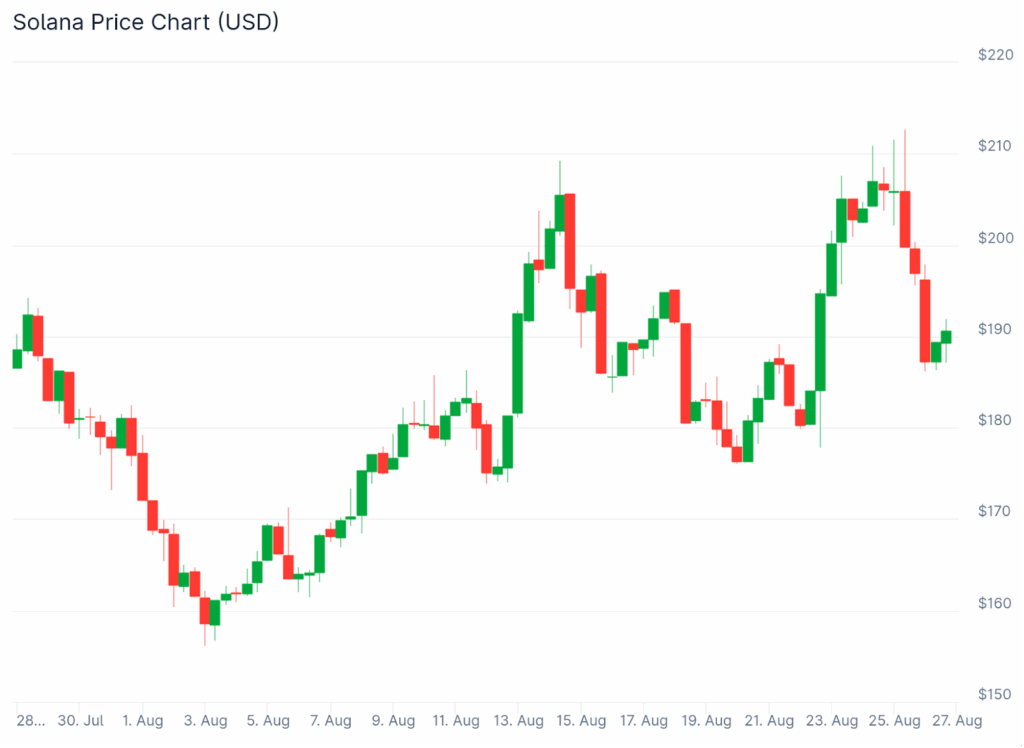
In August, around 530,000 SOL tokens, worth $100 million, were moved off exchanges into private holdings. Such moves often reduce selling pressure and set the stage for price appreciation.
ETF talk adds fuel to the story. The SEC’s 2025 Global ETF Outlook highlighted expansion beyond Bitcoin and Ethereum, putting Solana in line for potential spot ETF listings.
Grayscale has also signaled intent to push for a SOL ETF by 2026. These developments could attract mainstream investment, making Solana a contender for the top crypto to invest in 2025.
From a technical perspective, analysts place the Solana price prediction 2025 around $280, provided it clears the $230 resistance zone. With treasury initiatives like Pantera’s $1.25 billion Solana-focused fund, institutional demand could continue to build.
When compared in the Ethereum vs Solana debate, Solana’s speed and efficiency make it attractive, particularly for retail users chasing lower fees during altcoin season 2025.
MAGACOIN FINANCE: The Rising Catalyst for Altcoin Season
Alongside Solana, MAGACOIN FINANCE is drawing increasing attention. Insiders report that whales are not only stacking SOL but also allocating into MAGACOIN.
What’s catching eyes is the project’s projected 11,200% ROI and the fact it has already passed a full audit by HashEx, one of the top blockchain security firms.
This independent verification strengthens trust for retail buyers who see MAGACOIN as a secure, growth-driven alternative.
To sweeten early participation, the project offers a PATRIOT50X bonus code, giving buyers a 50% bonus on entry.
Such mechanics make it appealing to investors looking for the best altcoin to buy now ahead of what could be a strong crypto market catalyst Q4 2025.
For many traders, MAGACOIN FINANCE is being positioned as more than a speculative play—it’s viewed as one of the top crypto to invest in 2025, thanks to its security credentials and ambitious growth forecasts.

Can Q4 2025 Spark the Next Altcoin Season?
With institutions backing Solana and retail investors eyeing projects like MAGACOIN, conditions are aligning for a powerful altcoin season 2025.
Whale movements, ETF expansion, and treasury investments are all bullish signs, but retail-driven growth in audited projects could be just as impactful.
The Ethereum vs Solana rivalry will continue, but the bigger story is how the broader altcoin market responds to new demand drivers.
For anyone hunting for the best altcoin to buy now, the message is clear: watch the whales, track ETF signals, and don’t overlook rising stars like MAGACOIN FINANCE.
To learn more about MAGACOIN FINANCE, visit:
Website: https://magacoinfinance.com
Twitter/X: https://x.com/magacoinfinance
Telegram: https://t.me/magacoinfinance

Bitcoin has suffered a sharp pullback after hitting its all-time high earlier this year.
The cryptocurrency has fallen more than 13.75% from its record peak of $124,500, now trading at around $108,791.
This drop broke below its multiyear uptrend support, raising concerns of a deeper market correction.
Historical Patterns Raise Red Flags
Bitcoin’s bull markets have traditionally relied on parabolic support curves as a foundation for sustained rallies.
Temporary dips below this curve have not always been fatal, so long as the relative strength index (RSI) maintained its momentum.
Trouble has historically emerged when both parabola and RSI support failed.
In 2013, that scenario triggered an 85% crash from $1,150 to $150.
A similar breakdown in 2017 led to an 84% plunge from nearly $20,000 to $3,100.
Again in 2021, Bitcoin lost both supports and tumbled 77% from $69,000 to roughly $15,500.
The Current Outlook
By late August 2025, Bitcoin slipped under its long-term trendline support.
However, RSI remains above its critical uptrend, leaving some room for optimism.
The key test will come if RSI weakens.
A breakdown there could send Bitcoin toward its 50-week exponential moving average, around $80,000, by year’s end.
Such a move would mirror previous cycle corrections that reset investor sentiment before renewed rallies.
Analysts Suggest Pullback Could Be Temporary
Some analysts argue that the current correction may not signal the end of the bull cycle.
BitBull, a popular crypto market commentator, described the recent breakdown as a possible “fakeout.”
Even a move briefly under $100,000 could fit Bitcoin’s historical pattern of forcing out weaker hands before rebounding, he argued.
That would put the $80,000–$100,000 range as both a bearish target and a potential launchpad for the next upward move.
Cycle Indicators Suggest Room to Grow
Market analyst SuperBro pointed to the Pi Cycle Top model, a long-trusted tool for identifying Bitcoin’s cycle peaks.
The model tracks two moving averages: the 111-day simple moving average and twice the 350-day simple moving average.
When the 111-day line rises to cross above the 350-day x2 line, it has historically marked major cycle tops.
These crossovers were evident in 2013, 2017, and 2021 — each followed by sharp corrections.
At present, however, the crossover has not occurred.
SuperBro believes this indicates Bitcoin has not yet reached its peak and forecasts a possible top at $280,000.
Investor Sentiment at a Crossroads
Despite the pullback, Bitcoin’s long-term cycle signals remain intact.
For now, the correction resembles past volatility episodes that preceded stronger rallies.
If RSI holds and cycle indicators stay supportive, analysts suggest that the latest decline could ultimately prove to be a consolidation phase rather than the start of a long downturn.

Bitcoin tumbled below $108,000, marking its lowest level in 50 days.
The drop triggered $137 million in liquidations of leveraged long positions, catching traders off guard.
The decline followed weakness in the Nasdaq 100, which fell 1.2% amid doubts over the long-term strength of the artificial intelligence sector.
Trade Deficit Adds to Investor Concerns
Market sentiment worsened after the U.S. reported a 22% jump in its July trade deficit.
The gap between imports and exports widened to $103.6 billion, exceeding forecasts.
Economists warned this could drag on economic growth in the third quarter, adding to uncertainty.
Insider Sales Signal Caution
Investor unease deepened after data revealed an unusual trend in insider trading activity.
X user Malone_Wealth noted that the top 200 trades by executives and large shareholders last week were all sales.
Major moves included Walmart’s Jim C. Walton with $961 million, Snowflake’s Frank Slootman at $164 million, and Amer Sports’ Dennis J. Wilson with $160 million.
Other significant sales included Dutch Bros’ Travis Boersma at $81.5 million and Klaviyo’s Andrew Bialecki at $73.7 million.
Chinese Banking Stress Adds Pressure
China added another layer of concern.
Its five largest banks reported record-low margins and rising delinquencies, with retail banks writing off $5.2 billion in bad loans in the first quarter—an eightfold jump year-on-year.
The figures highlighted mounting risks in the Chinese financial system.
AI Sector Weakness Intensifies
Meanwhile, the artificial intelligence sector is showing signs of strain.
Nvidia revealed that nearly half of its data center revenue comes from just two customers, raising questions about reliance.
Despite delivering solid quarterly results, Nvidia shares fell 4.7% over two sessions.
Super Micro Computer, a major Nvidia partner, added to concerns by warning of potential issues in its financial reporting.
Its shares dropped more than 5% as a result.
Bonds Reflect Risk Aversion
In the bond market, investors sought safety in U.S. Treasurys.
The two-year yield fell to 3.62%, its lowest level in four months and down from 3.80% the week before.
This decline suggests growing risk aversion, as investors preferred lower yields in exchange for security.
Outlook for Bitcoin
Alongside these global risks, Bitcoin faces its own pressures.
Long-dormant whales have been selling, while miners continue steady outflows.
Despite these factors, analysts suggest the broader macroeconomic picture remains the primary driver of Bitcoin’s latest decline.
With traders cautious ahead of the U.S. national holiday, volatility could remain elevated in the coming sessions.
Crypto asset manager 21Shares has filed an application with the U.S. Securities and Exchange Commission to launch an exchange-traded fund tied to the price of SEI.
The proposal, submitted through an S-1 registration statement, would use price data from CF Benchmarks, which aggregates information across multiple crypto exchanges.
If approved, the fund would mark the first SEI-linked ETF available to U.S. investors.
What is SEI?
SEI is the native token of the Sei blockchain, a layer-1 network launched in August 2023.
The platform focuses on decentralized exchange trading infrastructure and marketplace activity.
The token itself can be used to pay transaction fees and participate in governance decisions.
As of now, SEI trades around $0.30, placing it in the mid-70s by market capitalization rankings.
Custody and Staking Options
Under the plan, Coinbase Custody Trust Company would serve as the custodian for SEI held by the ETF.
In its filing, 21Shares also raised the possibility of staking SEI to generate extra income for the fund.
However, the firm emphasized it is still assessing whether staking could expose investors to legal or tax complications.
Competing Applications
The move comes just months after Canary Capital filed for its own SEI ETF in April.
That proposal would give both institutional and retail investors exposure to staked SEI, with returns boosted by staking rewards.
Justin Barlow, executive director of the Sei Development Foundation, welcomed the idea of ETFs tied to the project.
He said they act as “a gateway for broader adoption, providing a vital bridge between crypto and mainstream markets.”
Broader ETF Landscape
Currently, the only spot crypto ETFs approved in the U.S. track Bitcoin and Ethereum.
However, there is a growing wave of applications for products tied to other blockchains.
21Shares itself already operates the ARK 21Shares Bitcoin ETF and has applied for funds covering assets such as SUI, XRP, and Ondo Finance.
Other major issuers including VanEck, Grayscale, and Bitwise are pursuing ETFs linked to Solana, Cardano, and even memecoins like Dogecoin.
Regulatory Developments
In an effort to streamline the process, the SEC is reportedly considering a system that would automatically approve certain ETFs after 75 days unless the agency raises formal objections.
This would reduce the lengthy back-and-forth that has often slowed crypto ETF approvals in the past.
21Shares, for its part, described its SEI filing as a “key milestone in our vision to expand exchange-traded access to the SEI Network.”
Outlook
With two filings now on the table, the race is on to see which firm, if any, will bring the first SEI ETF to U.S. markets.
While regulatory hurdles remain, the growing number of applications suggests rising demand for diversified crypto investment products that go beyond Bitcoin and Ethereum.
For SEI, approval of such a fund could mark a major step in its journey from a newly launched blockchain to a mainstream investment asset.
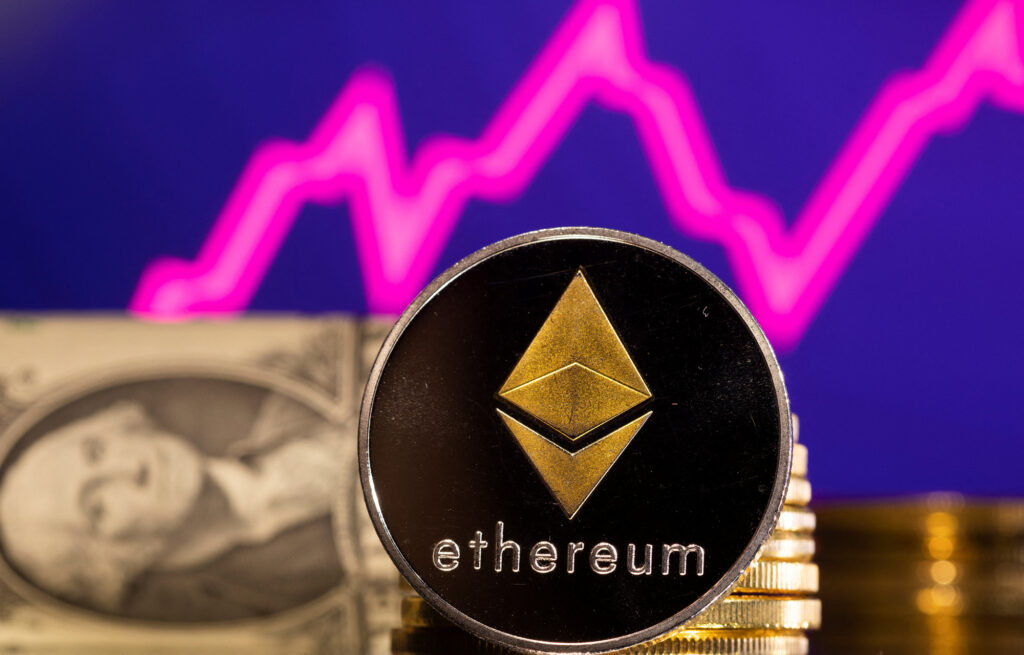
Jan van Eck, the CEO of investment management firm VanEck, has suggested that Ethereum will emerge as the dominant blockchain as banks prepare for a wave of stablecoin adoption.
In an interview with Fox News Business on Wednesday, van Eck explained that financial institutions will inevitably need to integrate blockchain infrastructure to handle stablecoin transactions.
“It’s very much what I call the Wall Street token,” van Eck said.
“And what I mean by that is, if you think that because of stablecoins, now every bank and every financial services company has to have a way of taking in stablecoins.”
He added that the eventual “winner” will likely be Ethereum or a network built on similar technology, known as ECM.
U.S. Law and Stablecoin Growth
The timing of van Eck’s remarks comes shortly after the passage of the Genius Act, a landmark U.S. law signed by President Donald Trump in July.
The legislation is the first federal law focused exclusively on payment stablecoins, marking a turning point in how regulators approach digital assets.
At the same time, the stablecoin market has swelled, with the total supply surpassing $280 billion in recent weeks.
A report published on May 14 by Fireblocks revealed that 90% of institutional investors surveyed are actively exploring stablecoin use within their operations.
Financial Institutions Facing Pressure
Van Eck argued that financial institutions will have no choice but to adapt to the shift toward stablecoins or risk being left behind.
“Companies have to employ technology to enable stablecoin usage over the next 12 months,” he said.
“It will take a while, but no financial services company wants to say, ‘no, don’t send me that digital dollar.’”
He stressed that if banks fail to accommodate stablecoin transfers, customers will inevitably turn to alternative institutions.
This sentiment was echoed earlier this year by Eric Trump, executive vice president of the Trump Organization, who warned that banks unwilling to embrace crypto could be extinct within a decade.
VanEck’s Ethereum ETF and Market Performance
Van Eck’s perspective is partly influenced by his firm’s direct involvement with Ethereum.
In July 2024, the U.S. Securities and Exchange Commission approved VanEck’s launch of an Ethereum-based exchange-traded fund (ETF).
The product tracks the price of Ether (ETH) but does not directly hold the asset.
As of Wednesday, the ETF held more than $284 million in assets under management.
Meanwhile, Ethereum itself continues to demonstrate strong market momentum.
On Sunday, Ether reached a new all-time high of $4,946, though it has since retraced slightly and was trading at $4,566, down 1% over the last 24 hours.
Corporate Adoption Bolsters Ethereum Narrative
Beyond speculation, Ethereum’s real-world adoption has gained traction as corporations add Ether to their treasuries.
Matt Hougan, chief investment officer at Bitwise, argued earlier this year that Ethereum’s treasury adoption has addressed its “narrative problem.”
By presenting ETH as a corporate treasury asset, the platform has become more accessible to traditional investors, drawing significant new inflows.
In the past month alone, corporate treasuries have purchased more than $6 billion worth of Ether, with firms such as BitMine and SharpLink among the most active buyers.
This wave of adoption reinforces van Eck’s belief that Ethereum will remain central as stablecoins reshape global finance.

Around 27% of British adults would consider including cryptocurrency in their retirement plans, according to a new survey by Aviva.
The findings suggest that crypto could eventually capture a portion of the UK’s multitrillion-pound pension market.
Of those open to crypto in retirement funds, just over 40% said they were motivated by the potential for higher returns.
The survey, conducted by Censuswide between June 4 and 6, polled 2,000 UK adults.
Pension Withdrawals Already Taking Place
The study also revealed that 23% of respondents would consider withdrawing part, or all, of their existing pension savings to invest in crypto.
With over 80% of UK adults holding pensions worth a combined £3.8 trillion, widespread adoption could direct significant capital into the sector.
The survey follows developments in the United States, where President Donald Trump recently signed an executive order permitting 401(k) retirement plans to include Bitcoin and other cryptocurrencies.
The U.S. order potentially opens crypto access to more than $9 trillion in retirement assets.
Young Investors Lead the Way
One in five UK adults surveyed — equivalent to around 11.6 million people — reported holding or having previously held crypto.
Two-thirds of that group still own some form of digital assets.
Among younger investors, particularly those aged 25 to 34, nearly 20% said they had already withdrawn pension funds to invest in crypto.
That group formed a large portion of the 8% of all respondents who admitted to doing the same.
Risks Remain a Major Concern
Despite growing interest, respondents flagged security and regulatory issues as leading concerns.
Hacking and phishing were cited as the biggest risks by 41% of participants, while 37% pointed to a lack of oversight and consumer protection.
Price volatility was identified as the third biggest worry at 30%.
Aviva’s managing director of wealth and advice, Michele Golunska, acknowledged crypto’s appeal but urged caution.
“We mustn’t forget the value of the good old pension,” she said.
“It comes with some powerful benefits, like employer contributions and tax relief, that can make a real difference to your long-term financial wellbeing.”
Regulation Moves Slowly
The UK has been taking gradual steps toward stronger crypto oversight.
In May, regulators unveiled a draft framework to treat exchanges and service providers more like traditional financial firms, focusing on compliance, transparency, and consumer protection.
Banks have been slower to embrace crypto.
According to another survey, 40% of UK investors reported their bank had either blocked or delayed payments to crypto providers.
This cautious approach shows that while enthusiasm for crypto pensions is growing, significant barriers remain.
Japan’s Finance Minister Katsunobu Kato has publicly acknowledged that cryptocurrencies should be considered as part of diversified investment portfolios.
Speaking at Web3 Conference WebX 2025 in Tokyo, Kato said crypto could be a legitimate asset class if proper rules are in place.
“While crypto assets carry the risk of high volatility, by establishing a proper investment environment, they can become an option for diversified investment,” Kato told attendees.
He emphasized that Japan will focus on building a sound trading environment for digital assets as adoption expands.
The remarks marked one of the most direct endorsements of crypto by a sitting Japanese finance minister.
Push for Tax Reform
Kato’s comments follow renewed calls from Japan’s Financial Services Agency (FSA) to overhaul crypto taxation rules.
Currently, crypto gains fall under “miscellaneous income” and are taxed at rates ranging from 15% to 56% depending on the income bracket.
The FSA has asked the government to reclassify crypto gains under a flat tax system similar to stocks, with a rate of around 20.315%.
Officials argue that this change would streamline tax reporting while encouraging wider adoption of cryptocurrencies within Japan’s financial system.
The proposal reflects Japan’s gradual shift toward a more crypto-friendly regulatory stance.
Growing Institutional Involvement
The momentum has also been reflected in corporate activity.
Bitcoin treasury firm Metaplanet has been upgraded from small-cap to mid-cap status under FTSE Russell’s Semi-Annual Review.
The adjustment means Metaplanet is now included in the FTSE Japan Index, boosting its visibility among investors.
At the same time, major Japanese financial groups are embracing blockchain partnerships.
SBI Group has announced new collaborations with Circle, Ripple, and Web3 developer Startale.
It also recently partnered with Chainlink to roll out crypto tools aimed at financial institutions across Asia.
Such moves point to a growing recognition of blockchain as a key driver in the country’s financial innovation.
Stablecoins on the Horizon
Japan’s regulatory framework is also preparing for the introduction of yen-backed stablecoins.
Reports suggest that the FSA could approve their issuance as early as this fall.
The development would mark a significant milestone in Japan’s digital asset strategy, allowing consumers and businesses to transact with blockchain-based tokens tied to the national currency.
Together, Kato’s remarks, proposed tax changes, and institutional adoption signal that Japan is positioning itself as a global hub for regulated crypto activity.