

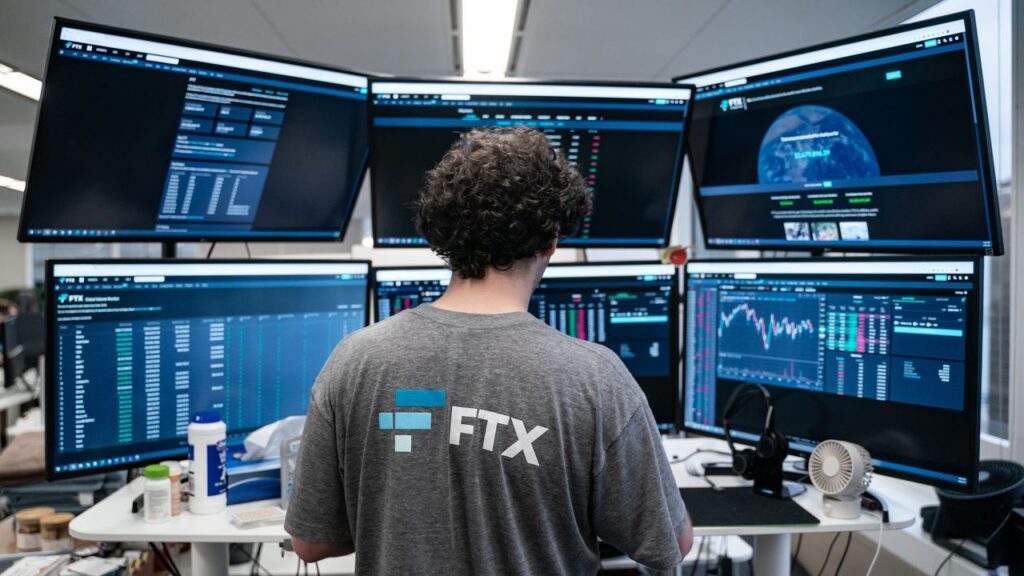
US prosecutors have chosen to drop the remaining charges against Sam Bankman-Fried, which include allegations of foreign bribery and bank fraud.
The decision, however, has stirred significant concern within the crypto community, particularly concerning the dropped charge of unlawful political donations, given Bankman-Fried’s extensive contributions to politicians from both major parties.
Prosecutors had asserted that he misused customer funds, diverting approximately $100 million for political contributions.
The decision drew sharp criticism from Coinbase’s Chief Legal Officer, Paul Grewal, who condemned it as a “miscarriage of justice.”
Grewal stressed the importance of public accountability, particularly in cases related to campaign finance charges, stating, “The public interest in a public airing of charges almost always matters.
Campaign finance charges are at the very top of this list.” He also emphasized the need for transparency regarding what politicians and others knew and when they knew it.
Scheduled for March 28, 2024, Sam Bankman-Fried’s sentencing remains on the horizon, surrounded by controversy.
Independent presidential candidate Robert F. Kennedy, Jr., voiced concern, noting that this case underscores the broader issue of normalized corruption, saying, “No one is even surprised.
READ MORE: Bitcoin ETF Race Heats Up as Top Contenders Submit Final Applications
THAT is a bigger problem than the fraud itself. It shows how normalized corruption has become.”
The sentiment found resonance within the community, with figures like Elon Musk expressing agreement with a simple “!!” in response.
Prosecutors, led by U.S. Attorney for the Southern District of New York Damian Williams, also opted not to pursue the charge of unlawful political donations, which had been separated from the initial indictment due to an extradition dispute with the Bahamas.
In their explanation, prosecutors cited the presentation of evidence related to several charges during Bankman-Fried’s original trial, where he was found guilty of all seven counts of fraud and conspiracy associated with his leadership of FTX and Alameda Research, its sister trading firm.
They indicated that the forthcoming sentencing would address critical aspects, including forfeiture and restitution for the victims.
Looking ahead, Bankman-Fried faces the prospect of a potentially lengthy prison sentence, with US District Judge Lewis Kaplan presiding over the case in Manhattan.
The prosecution believes that a second trial would be redundant, as most relevant evidence for the additional charges had already been presented in the first trial.
Despite his conviction, Bankman-Fried intends to appeal, maintaining that while he made operational errors in managing FTX, such as neglecting risk management, he did not steal customer funds.

Bitcoin has surged above the $45,000 mark for the first time in almost two years, driven by market anticipation of a forthcoming approval for a spot Bitcoin exchange-traded fund (ETF).
The digital currency has experienced a rapid ascent from $42,000 at the beginning of the year, with a remarkable 6% increase in the last 24 hours and an impressive 170% gain over the past year, according to CoinMarketCap data.
This milestone places Bitcoin at a price level exceeding any seen in 2023, signifying a notable start to 2024.
The surge in Bitcoin’s price coincides with the cryptocurrency community’s hopeful outlook for the potential approval of one or more of the 14 pending applications for a spot Bitcoin ETF product, currently awaiting a decision from the Securities and Exchange Commission (SEC).
The last time Bitcoin surpassed the $45,000 mark was nearly 20 months ago on April 5, 2022, before it entered a prolonged bear market, eventually reaching a low of $15,600, as indicated by TradingView data.
Market experts hold differing opinions on how an ETF approval would impact Bitcoin’s short-term price.
Analysts at crypto options trading platform Greeks.live anticipate that Bitcoin might not witness a significant immediate rally, citing diminishing implied volatility in Bitcoin options.
READ MORE: VanEck Launches Pro-Crypto Ad Campaign Amid Pending Bitcoin ETF Application
Conversely, traders such as Scott Melkor, with a substantial following of 925,000, believe that Bitcoin is currently forming a “bull pennant” after a month of consolidation around the $40,000 range.
Melkor envisions the possibility of Bitcoin surging to as high as $54,000 in the days following the SEC’s potential approval.
Meanwhile, Gabor Gurbacs, an advisor at VanEck, predicts that the initial days of a spot Bitcoin ETF may be considered somewhat of a “letdown” by broader market standards.
Nevertheless, he anticipates that these products will eventually attract trillions of dollars in inflows over the next few years, emphasizing their long-term significance.
In conclusion, Bitcoin’s remarkable price increase to over $45,000 marks a significant milestone, driven by optimism surrounding the pending spot Bitcoin ETF approvals.
As the cryptocurrency market awaits the SEC’s decision, the community remains divided on the short-term and long-term implications of this potential development.

Leading Bitcoin mining companies are emphasizing the importance of efficiency to stay profitable and operational following the upcoming halving in 2024.
Bitcoin’s protocol mandates a reduction in the BTC rewarded to miners for adding blocks to the blockchain every 210,000 blocks, occurring roughly every four years.
The next halving, the fourth of its kind, will cut mining rewards from 6.25 BTC to 3.125 BTC. This reduction in rewards has significant implications for miners’ profitability and return on investment in hardware and operational costs.
Efficiency will be a key factor during the halving, according to Jaime Leverton, CEO of Hut8. Miners will need to optimize their operations to continue mining, leading Hut8 to develop specialized software for their Canadian mining sites.
They also plan to purchase four power plants in Ontario to power their operations, totaling 310MW.
Hut8 recently completed a merger with US mining firm USBTC, significantly increasing their hash rate from 2.6 EH/s to 7.3 EH/s in November 2023.
Taras Kulyk, CEO of SunnySide Digital, highlights the direct connection between the 50% reduction in block rewards and the price of BTC and transaction fees.
Lower-efficiency miners may need to shut down if these economic incentives don’t compensate for their costs.
Colin Harper, head of research at Luxor, also emphasizes efficiency and suggests that smaller miners may need to power down their machines due to reduced BTC rewards, unless there is a surge in Bitcoin’s price to boost profitability.
Core Scientific CEO Adam Sullivan states that the halving’s impact will depend on Bitcoin’s price and will directly affect how many miners can remain operational.
Lower Bitcoin prices could lead to more machines coming offline, reducing the network’s difficulty.
READ MORE: Bitcoin ETF Race Heats Up as Top Contenders Submit Final Applications
However, Sullivan believes that Bitcoin’s protocol inherently encourages mining, and the network will adjust as miners exit the industry.
This view is shared by others, with a consensus that as long as Bitcoin holds value, mining will continue.
Kulyk is optimistic about the influence of Bitcoin Ordinals and increased scarcity of new Bitcoin in 2024, which could sustain profitable mining.
Contrary to past concerns about a “Bitcoin death spiral,” Blockstream CEO Adam Back believes such a scenario is unlikely.
He points out that mining profitability has increased significantly, and sophisticated mining firms have prepared for the halving’s potential effects.
Back contends that the least efficient miners are likely to drop out, but Bitcoin’s price appreciation and increased hash rate may prevent a significant drop in hash rate during the halving.
2024’s outcome will hinge on Bitcoin’s price performance and mining efficiency.
In summary, the upcoming Bitcoin halving in 2024 is prompting miners to focus on efficiency to maintain profitability, with the hope that Bitcoin’s price will continue to rise and offset the reduction in mining rewards.
The mining industry remains adaptable, with experienced miners prepared for the challenges ahead.
Greeks.live, a cryptocurrency options trading platform, has cast doubt on the possibility of a significant price surge following the approval of a spot Bitcoin exchange-traded fund (ETF) by the U.S. regulator, the SEC.
The platform has analyzed data from its trading platform, revealing that despite widespread speculation about the SEC granting approval for the Bitcoin Spot ETF application in the near future, there has been minimal volatility in major term implied volatilities (IVs) and prices.
Term IV is a metric that measures the market’s expectations regarding future price movements in options contracts.
While the crypto market eagerly awaits the SEC’s decision, Greeks.live’s tweet pointed out the unexpectedly subdued market activity in response to the news.
Their options data showed that the implied volatility for Jan12 options, closely linked to the ETF, has actually decreased rather than rising.
Furthermore, the trading volume for these options accounted for only 2% of the day’s total turnover.
From these observations, Greeks.live has concluded that the market may have already factored in the potential approval of the spot Bitcoin ETF.
READ MORE: Avalanche Foundation Allocates $100 Million NFT Incubator Fund to Purchase Memecoins
Essentially, market participants might have anticipated this event and adjusted their positions accordingly, resulting in the actual approval having a limited impact on prices and volatility.
Several prominent asset managers, including BlackRock, Valkyrie, and Van Eck, submitted amended S-1 forms to the United States Securities and Exchange Commission on December 29, which was the final day for the SEC to consider such applications in January 2024.
Invesco Galaxy, Bitwise, WisdomTree, and Fidelity have also submitted their Form S-1 applications subsequently.
BlackRock’s updated filing has named Jane Street and JPMorgan Securities as “authorized participants” in their proposed spot Bitcoin ETF application.
BlackRock has already specified that it will utilize a cash-only model for the ETF.
Interestingly, BlackRock was the first entity to settle a trade on JPMorgan’s Tokenized Collateral Network service on October 11, highlighting the increasing collaboration and integration within the cryptocurrency ecosystem.

Artificial intelligence (AI) may play a pivotal role in the possible scenario where Bitcoin’s price surges to $100,000 in 2024, as suggested by GPT-4, the latest iteration of the AI chatbot ChatGPT.
Inquiries directed at ChatGPT on January 1, as reported by Cointelegraph, sought insights into the feasibility of Bitcoin reaching this milestone and the potential contributions of AI to this outcome.
ChatGPT cautiously deemed it “theoretically possible” for Bitcoin to achieve $100,000 in 2024, contingent on several favorable factors aligning.
Nonetheless, it emphasized that this remains within the realm of high speculation.
The AI chatbot went on to enumerate a series of general factors that could propel such a surge.
These factors encompassed positive regulatory developments, an upswing in retail and institutional adoption, as well as currency devaluation or inflation.
ChatGPT underscored the significance of a potential approval of a spot Bitcoin exchange-traded fund (ETF) in influencing the price.
It contended that the greenlighting of a spot BTC ETF could significantly bolster accessibility and liquidity for the asset, potentially luring institutional investors into the market, interpreting it as a sign of regulatory acceptance.
READ MORE: Indonesian Authorities Shut Down Ten Bitcoin Mining Operations Over Electricity Theft Allegations
Subsequently, Cointelegraph inquired about the role AI might play in propelling Bitcoin to $100,000 in 2024.
ChatGPT elucidated that AI could indeed be a catalyst in this hypothetical scenario.
AI’s contributions would be seen through its influence on market analysis, trading strategies, and broader technological innovations in blockchain technology.
The AI chatbot elaborated on the capabilities of AI algorithms, which are adept at processing extensive market data, discerning trends and patterns that might elude human analysts.
Furthermore, it underscored the potential of AI-driven trading bots to execute trades precisely at optimal moments, contingent on market conditions.
ChatGPT stressed that these bots could outpace human reactions in a fast-paced market environment.
Nonetheless, the implementation of AI in trading came with inherent risks, according to ChatGPT.
It highlighted the vulnerability to hacking and cyberattacks, citing a 2022 incident where a trading bot netted $1 million through an arbitrage trading opportunity.
Unfortunately, a hacker manipulated the bot into authorizing a malicious transaction, resulting in a complete drain of the funds.
In conclusion, while ChatGPT acknowledges the potential role of AI in Bitcoin’s ascent to $100,000 in 2024, it cautions against underestimating the risks associated with deploying AI in the cryptocurrency market.

Investors might have a tough time during a bear market, but these downward cycles are often seen as a great opportunity for innovators to double down and refine their ideas. This is especially apparent in the Web3 industry, where the long and drawn out crypto winter that began at the tail end of 2021 has weeded out many of its flawed projects. Those that are left standing are now primed to usher in some exciting new use cases as the crypto industry looks set for a strong rebound heading into 2024.
As optimism builds over the prospect of a new bull market for crypto, now seems like a great time to take stock of some of Web3’s most exciting new developments.
Distributed Validator Technology
DVT is gaining momentum as a superior approach to blockchain validator security due to the way key management and signing responsibilities are split across multiple parties, increasing the resilience of the network.
With DVT, the private keys used to secure a validator are shared across multiple clusters of computers. This means it becomes exponentially more difficult for hackers to gain access to that private key, as they would have to attack numerous machines separately. Another benefit is that some nodes can go offline, without the validator being affected, as the key signing can be performed by a subset of machines within the larger cluster.
DVT therefore delivers three main benefits to Proof-of-Stake blockchains – it increases security, it means there’s no single point of failure for a validator, and it accelerates decentralization by making it simple to establish numerous independently operated validators.
One of the leading lights in the DVT space is SSV.Network, which provides the significant advantage of allowing validators to remain anonymous, helping to reduce hacking and coercion attempts. SSV makes it much more difficult for cyberattackers to target a specific validator, and simultaneously makes validation much more accessible as users can participate in a node with minimal financial resources.
SSV is tipped to gain substantial momentum in 2024 following the launch of its permissionless mainnet in December. With its launch, anyone can participate in Ethereum’s network by staking a minimal amount of ETH, validating transactions to earn a share of the rewards on offer. The project has gotten off to a great start, with more than $160 million worth of ETH being staked by over 2,200 validators across 74 SSV nodes.
Zero-Knowledge Proofs
Although ZK-Proofs is a relatively old technology within the Web3 sphere, it’s set to make a big splash in 2024 as it reaches a new level of maturity.
The basic idea of ZK-proofs is that they allow one party in a transaction to prove to a second party that it has specific knowledge regarding the details of that transaction, without revealing any specifics. The technology has profound implications for blockchain as it addresses headaches around the opposing needs for transparency and privacy. With ZK-proofs, it becomes possible for crypto transactions to be verified without anyone knowing the transaction details. This ensures full transaction privacy, while preventing anyone from cheating the system.
ZK-proofs were first popularized by the privacy-focused cryptocurrency ZCash, but the technology is now being used for additional use cases, such as verifiable off-chain computing.
With ZK-proofs we can build a verifiable web that enables users to make informed decisions, because they can verify exactly what the systems they interact with are doing, promoting greater trust. In a blog post, ChainLink cites three main benefits to the verifiable web. First, users will know what they’re getting into because they can proactively verify everything about a system and confirm it won’t change. Second, they’ll be able to understand what is happening within any system by using ZK-proofs to verify any events or data. Third, users can proactively decide if and when they want to leave a system, as the verifiable web clearly defines how to do so.
Several projects are working hard to make the verifiable web a reality. They include Space and Time, a decentralized data warehouse startup that uses ZK-proofs to verify queries against both on- and off-chain data. Space and Time has developed a technology called Proof-of-SQL, which makes it possible to cryptographically secure database queries. In turn, this means smart contracts now have a way to verify off-chain data, opening the door to more sophisticated decentralized applications that can respond to real-world events. Space and Time has notably integrated its technology with Google Cloud’s BigQuery to private queries to off-chain data stored in the cloud.
A second major player driving greater adoption of ZK-proofs is Cronos. In December, Cronos announced the launch of its third major network in testnet – a Layer-2 known as the Cronos zkEVM chain – which is built using Matter Labs’ tools for spinning up so-called “hyperchains” that sit above existing networks.
The Cronos zkEVM chain is expected to launch its mainnet in the second quarter of 2024, and brings benefits such as its low hardware requirements and lower transaction fees. By using ZK-proofs, it also facilitates native account abstraction, where transaction fees can be paid using alternative cryptocurrencies.
Fully Homomorphic Encryption
Even as ZK-proofs gain momentum, others in the blockchain industry are working on what they believe is a superior alternative to facilitate private transactions. Fully Homomorphic Encryption, known as FHE, makes it possible to perform computations on data that remains encrypted in ciphertext format, ensuring it remains protected at all times. This is important, because in traditional computing it is necessary to unencrypt data before it can be used by any application.
FHE provides significant benefits, for example by allowing untrusted networks to access data that remains fully encrypted, preventing any misuse.
One of the biggest proponents of FHE is Google, which offers an extensive toolkit for developers looking to build applications that leverage the technology. In the crypto realm, Fhenix is one of the leading players in FHE, building an EVM-compatible blockchain that’s said to be the first network of its kind to implement the technology.
Fhenix argues that FHE can provide big benefits to a blockchain industry that’s known for its transparency due to the public nature of decentralized networks. The startup, which raised $7 million in funding in September, announced the launch of its testnet earlier in the year, followed by a private devnet that launched in June.
Because Fhenix’s FHE blockchain is EVM-compatible, the startup says it can improve the utility of Ethereum-based dApps, supporting capabilities such as private voting for DAOs, private real-world asset tokenization, blind auctions, on-chain identification and more.
Super Apps
The concept of the Super App has its roots in the world of Web2. Super Apps are basically just one application that offers users multiple, diversified services for everyday life. They’re usually built atop of a single function, such as a chat or financial payments platform, which integrates with various other services and makes them easier for their users to access.
Super Apps first emerged in China, with the likes of WeChat and Alibaba amassing millions of users on their respective chat and e-commerce platforms, before expanding to include other offerings. These days, WeChat is far more than just a chat app, as it also offers social media, hotel bookings, transportation services such as taxi bookings, e-commerce marketplaces, video games, financial services, online dating and everything else you can imagine.
Kresus is now looking to bring the concept of the Super App into Web3 with the launch of a crypto wallet that doubles as a portal to the world of decentralized applications. Besides just being a wallet, Kresus offers functionality such as minting and transferring NFTs, numerous on- and off-ramps to fiat, access to DeFi protocols and more.
One of the best things about Kresus that’s likely to help with its growth is its simplicity, which overcomes one of the major hassles in crypto. Whereas other non-custodial wallets require users to carefully store their seed phrase to ensure they can access their digital assets if they lose their wallet, Kresus is completely idiot-proof. It’s simple to set up a wallet, and no seed phrase is created. Instead, it employs traditional account recovery techniques such as email or SMS to ensure users can always access their wallets, even if they forget their password.
Kresus also gives each user a free Web3 identity that’s powered by Unstoppable Domains, which can be used to easily and securely login to any dApp, metaverse or blockchain game in a single click.
Kresus was recently named by FinBold as one of the easiest apps to buy and store crypto with, noted for its ability to provide the same level of security as a hardware wallet, without needing to buy any actual hardware.
Ethereum Virtual Machine
Progress continues to accelerate in the world of EVMs, which are virtual machines that power the smart contracts so critical to the Ethereum network. The EVM is what makes it possible for developers to write smart contracts in the Solidity programming language, and is the key enabler for every autonomous dApp deployed on the network today.
The overwhelming dominance of Ethereum in DeFi and Web3 today means that many other networks are now looking to create their own EVMs to tap into its ecosystem. One of the most prominent examples is the EOS EVM, which was launched in 2022 and has been the focus of much innovation ever since. Although Ethereum has the biggest ecosystem of dApps by far, many developers believe that EOS is a superior network, with faster transaction processing times and lower fees just some of the major benefits.
The EOS EVM effectively bridges the gap between the two ecosystems, providing a way for developers to deploy Solidity-based smart contacts on the EOS network, where they can benefit from its superior performance. It allows developers to use Ethereum’s battle-tested code, libraries, SDKs and other tooling to build dApps that can run on EOS.
With the latest update to the EOS EVM in December, it gained support for WebSocket, which is a key tool for building more sophisticated dApps that rely on real-time, bidirectional communication. With WebSocket, dApp developers can establish two-way and real-time communication between their apps and a remote server, with minimal latency. It improves on the older HTTP communication standard, which is unidirectional, meaning that the client can only send requests, and the server can only respond.
By using WebSocket instead, dApps can maintain a two-way connection that facilitates a continuous exchange of data. This paves the way for instantaneous updates for Web3 chat dApps, messaging tools, trading platforms, blockchain games, NFT tracking tools, DeFi notifications and more.
Web3 Streaming
The concept of livestreaming is taking on a new life in Web3 thanks to the power of Azarus, a streaming platform that changes the very nature of how content creators and their fans interact.
Azarus sits at the forefront of Web3 streaming, with its innovative wallet feature that layers over the video player to enable direct interactions between streamers and viewers. With Azarus, esports players and other content creators have a simple, seamless way to stream and engage with their viewers, using blockchain tokens to provide incentives that enhance the viewing experience.
The beauty of Azarus’s technology is that it provides gamers and other creators with a new source of revenue together with the ability to reward their most loyal audiences, motivating them to spread the word about their gaming exploits. Its platform also provides a way for creators to encourage viewers to visit off-stream destinations such as e-commerce portals, brand properties and more.
Web3 streaming is looking set to become all the rage following the acquisition of Azarus by Animoca Brands, one of the biggest Web3 game developers. Animoca intends to integrate Azarus’s streaming technology into its own games to provide richer experiences for gamers and fans alike.
Ultimately, Animoca believes that Web3 streaming will lay the groundwork for the creation of a player-owned economy that will give gamers, content creators and streamers full control over their digital property and the ability to monetize their expertise.

Hackers have managed to exploit Orbit Bridge, the cross-chain bridging service of the Orbit Chain protocol, just hours before the new year, making off with a staggering $82 million.
This shocking breach was brought to light on December 31st by a pseudonymous Twitter user known as Kgjr, who raised the alarm regarding significant outflows from the Orbit Chain Bridge protocol.
Subsequently, blockchain investigators Officer CIA and cybersecurity firm Cyvers corroborated these findings.
Based on data from the blockchain analytics platform Arkham Intelligence, the hackers successfully siphoned off a grand total of $81.68 million.
This sum was divided among five separate transactions, involving $30 million in Tether, $10 million in USD Coin, $21.7 million in Ether, $9.8 million in Wrapped Bitcoin (WBTC), and $10 million worth of the algorithmic stablecoin DAI, all of which were swiftly moved to new wallets.
The Orbit Chain protocol is closely intertwined with the Klaytn network (KLAY), a modular layer-1 blockchain.
READ MORE: Bitcoin ETF Race Heats Up as Top Contenders Submit Final Applications
Notably, Klaytn’s block explorer indicates that eight of the highest-valued assets on the Klaytn network are actually wrapped assets that rely on the Orbit Bridge for cross-chain transfers.
Despite the gravity of the situation, the exact nature of the exploit remains shrouded in mystery. Attempts to solicit comments from Orbit Chain and Klaytn regarding this incident yielded no immediate response, leaving the crypto community in suspense.
Orbit Chain, which was launched in South Korea in 2018, is a versatile multi-asset blockchain primarily designed for facilitating cross-chain transfers across various decentralized networks.
Its typical use case involves the seamless transfer of assets between EVM-compatible networks and the Klaytn network.
It is crucial to distinguish Orbit Chain from another cross-chain bridging protocol called Orbiter Finance, which shares a somewhat similar name but operates independently.
As the crypto space grapples with the fallout from this high-profile breach, security measures and risk assessments across the ecosystem are expected to be scrutinized and enhanced.
The impending launch of Bitcoin exchange-traded funds (ETFs) is generating a buzz, but VanEck advisor Gabor Gurbacs suggests that their initial impact on Bitcoin might be more subdued than anticipated.
In a recent post on X (formerly Twitter), Gurbacs contended that the immediate influence of a Bitcoin ETF might be overestimated, projecting that it could attract around $100 million in net inflows, primarily from institutional investors reshuffling their existing investments.
Nonetheless, Gurbacs is more optimistic about the long-term implications of these ETFs on the Bitcoin market. He drew a parallel with the gold market, recalling how the introduction of gold ETFs in 2004 led to a remarkable surge in gold prices.
Over eight years, gold’s value surged from $400 to $1,800, while its overall market capitalization expanded from $2 trillion to an impressive $10 trillion.
Comparatively, Bitcoin’s current market cap stands at $834 billion, roughly 41% of gold’s market capitalization in 2004.
Gurbacs speculates that once a spot Bitcoin ETF is approved in the United States, it could potentially emulate gold’s growth trajectory but at a much faster pace due to Bitcoin’s fixed supply and periodic halving events.
READ MORE: Major Asset Managers Revise Bitcoin ETF Applications as SEC Deadline Nears
Furthermore, Gurbacs underscores the significance of a Bitcoin ETF in legitimizing and destigmatizing the cryptocurrency in the eyes of institutional investors and nation-states, which could pave the way for substantial investment and adoption.
Eric Balchunas and James Seyffart, ETF analysts at Bloomberg, share Gurbacs’ sentiment.
Seyffart emphasized that many observers are fixated on short-term data points, such as the immediate influx of funds into the ETF upon approval, without fully grasping the enduring impact such a financial product could have.
As for the current state of the Bitcoin market, it is trading at $42,525, having risen 1.1% in the last 24 hours, according to TradingView data.
While some believe that the anticipated ETF approval will trigger a substantial and sustained price increase, others argue that it might be a “sell the news” event, potentially leading to a different market response.

VanEck, a prominent asset manager known for its pending application for a Bitcoin exchange-traded fund (ETF) with the United States Securities and Exchange Commission (SEC), recently unveiled a pro-crypto advertising campaign.
On December 29th, the company shared its “Born to Bitcoin” video on X (formerly Twitter). Interestingly, the video did not explicitly endorse a BTC exchange-traded product.
This move came approximately two weeks after VanEck expressed a preference for “buying and holding” BTC due to the high costs associated with advertising.
In a trend seen among various asset managers seeking SEC approval for spot Bitcoin or Ether ETFs, VanEck’s advertising initiative aligns with an effort to increase public awareness and support ahead of potential approvals.
For instance, Bitwise enlisted actor Jonathan Goldsmith to reprise his iconic “Most Interesting Man in the World” persona in a December marketing campaign promoting Bitcoin.
Similarly, Hashdex introduced an ad spot highlighting the potential use cases of innovative technologies like cryptocurrencies.
READ MORE: JPMorgan CEO Jamie Dimon Under Scrutiny Over Bitcoin ETF
However, VanEck’s advertising campaign faced criticism online, primarily centered on the perceived low production quality of the ad, considering the firm’s substantial assets under management, exceeding $76 billion as of September.
The campaign mainly featured a silhouette of a figure walking in front of a city skyline, with a nod to the iconic “Buy Bitcoin” sign displayed behind Janet Yellen in 2017.
It’s worth noting that, as of the publication date, the SEC had not granted approval for a spot Bitcoin or Ether ETF to be listed on any U.S. exchange.
Nevertheless, the commission had taken steps to allow investment vehicles linked to crypto futures in 2021. Speculation abounded among experts that the SEC might begin approving multiple spot crypto ETFs as early as January 2024.
VanEck’s pro-crypto advertising effort, while not explicitly endorsing an ETF product, reflects the industry’s eagerness to engage with regulators and the public to secure approval for cryptocurrency-based exchange-traded funds, potentially opening up new avenues for investors in the crypto market.

The United States Department of Justice’s recent decision to forgo a second trial against Sam Bankman-Fried has ignited controversy within the crypto community.
In a letter filed on December 29th, prosecutors argued that the case’s significant public interest necessitated a “swift resolution.”
This choice implies that Bankman-Fried will not be subjected to further charges related to his alleged involvement in unlawful campaign contributions.
The document states, “Much of the evidence that would have been presented in a second trial was already presented in the first trial and can be considered by the Court at the defendant’s March 2024 sentencing.”
This decision has been met with widespread criticism among crypto enthusiasts. Paul Grewal, Coinbase’s chief legal officer, branded it a “miscarriage of justice,” emphasizing the importance of a public airing of charges, especially those involving campaign finance.
He stressed that questions about what politicians knew and when they knew it are crucial and must be answered.
Simon Dixon, co-founder of BnkToTheFuture.com, an online investment platform, pointed out that the decision also shields U.S. politicians from further scrutiny concerning campaign contributions and clawbacks during the upcoming 2024 election season.
READ MORE: US Prosecutors Hint at No Second Trial for Ex-FTX CEO Sam Bankman-Fried
Bankman-Fried himself admitted to being a “significant donor” to both sides of the political spectrum leading up to the 2022 midterm elections. Court documents revealed that he contributed over $100 million to politicians.
During his trial in October, he explained that these donations made in his name were funded by loans from Alameda Research, FTX’s sister company.
The aim was to influence U.S. government policies on cryptocurrency regulation. Before FTX’s collapse in November 2022, Bankman-Fried had plans to donate $1 billion for political causes by 2024.
In addition to the campaign contribution allegations, Bankman-Fried has also been cleared of charges related to a conspiracy to bribe Chinese officials.
Prosecutors argue that a second trial would not impact the U.S. Sentencing Guidelines range for him.
It’s worth noting that Bankman-Fried had previously been found guilty of all seven fraud charges by a jury during his criminal trial.
These charges included wire fraud, wire fraud conspiracy, securities fraud, commodities fraud conspiracy, and money laundering conspiracy.
His sentencing is scheduled for March 28, 2024, and he could potentially face a maximum sentence of 115 years in prison.