


A group of investors is set to gain control of CoinDesk, a prominent media company focused on cryptocurrency.
Led by Matthew Roszak from Tally Capital and Peter Vessenes from Capital6, the investor syndicate aims to finalize the transaction in the upcoming weeks, as reported by The Wall Street Journal (WSJ) on July 20.
Digital Currency Group (DCG), the parent company of CoinDesk, will retain a stake in the media business, events, data, and indexes, valuing the pending deal at approximately $125 million.
DCG had acquired CoinDesk in 2016 for $500,000 but recently faced financial challenges due to the bankruptcy of its lending arm, Genesis Global Capital, along with the closures of its institutional-trading platform Tradeblock and wealth-management unit HQ.
These issues occurred amidst a broader downturn in the crypto industry, marked by successive bankruptcies and a significant drop in token prices last year.
READ MORE: Nigerian Social Payments App Bundle Ceases Crypto Exchange Services
CoinDesk generated $50 million in revenue the previous year, primarily from online advertising, events, and indexes.
Despite its financial success, the company had been exploring the possibility of selling itself earlier in the year.
CoinDesk CEO Kevin Worth revealed that the company had engaged investment bankers from Lazard Ltd. to explore options for a full or partial sale, responding to numerous expressions of interest from potential buyers.
DCG had received unsolicited offers of over $200 million for CoinDesk in the preceding months, according to reports from January.
However, as several high-profile banks in the crypto and tech industries collapsed, DCG faced challenges in securing new bankers for its portfolio companies.
Upon the completion of the deal, CoinDesk’s existing management team is expected to continue leading the company.
This development signifies a significant shift in ownership for the media company and underscores the ongoing volatility and consolidation in the cryptocurrency sector.
Other Stories:
SEC Contemplates Appeal Over Controversial XRP Ruling
Bitcoin Laundering Couple Reach Plea Agreement with U.S. Authorities

Ripple, a payments network and technology company, has taken significant steps towards regulatory compliance by applying for registration as a crypto asset firm with the UK’s Financial Conduct Authority (FCA).
Additionally, the company is seeking a payments license in Ireland, indicating its commitment to investing in the region.
The decision to pursue registration and licensing comes in the wake of a partial victory for Ripple against the United States Securities and Exchange Commission (SEC).
The SEC’s classification of Ripple’s XRP token as a security has been a subject of contention.
The recent ruling determined that while the XRP token could be considered a security when sold to institutional investors, it did not apply to retail investors. Nevertheless, the case remains open to potential appeal by the SEC.
Amid a series of enforcement actions by the SEC in the United States, more crypto firms are turning their attention to the UK for regulatory clarity and a supportive business environment.
READ MORE: SEC Contemplates Appeal Over Controversial XRP Ruling
Andreessen Horowitz (A16z), a prominent venture capital firm, has even established its first overseas office in London, citing the region’s predictable business environment as a key factor in the decision.
The UK has been actively working on creating a crypto-regulated environment, passing laws that bring cryptocurrencies under the same rules applied to traditional assets.
This legislation received royal assent in June, granting authorities like the UK Treasury, the FCA, the Bank of England, and the Payments Systems Regulator the power to introduce and enforce regulations for crypto businesses.
Furthermore, lawmakers in the UK have been exploring ways to enhance their ability to target cryptocurrencies used for illicit purposes.
Drafts of new legislation propose provisions that allow authorities to have greater flexibility in confiscating and recovering crypto assets associated with illegal activities.
In summary, Ripple’s move to register as a crypto asset firm with the FCA and pursue a payments license in Ireland reflects its commitment to complying with regulations and expanding its presence in the UK and the broader European market.
The region’s efforts towards regulatory clarity and a favorable business environment are attracting more crypto firms seeking stability and growth opportunities amid evolving global regulatory landscapes.
Other Stories:
OpenAI Unveils Android Version of ChatGPT
Nigerian Social Payments App Bundle Ceases Crypto Exchange Services
Bitcoin Laundering Couple Reach Plea Agreement with U.S. Authorities
London, England, July 24th, 2023, Chainwire
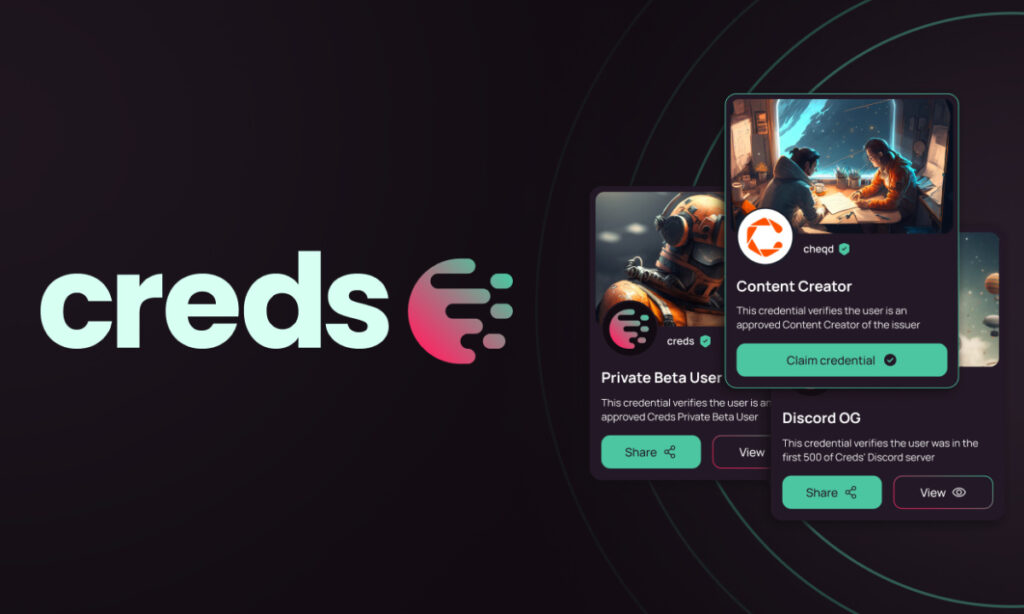
cheqd, a start-up creating the trusted data economy, where users and organizations have full control and portability of their data, is launching Creds – a platform for issuing, holding and sharing digital credentials to build portable reputation.
Announced at the Nebular Summit today in Paris, Creds, is a platform to issue digital credentials, or “creds”, which are a portable, reusable, privacy-preserving, and a secure way to prove identity, build decentralized reputation, and establish trust.
Creds addresses a number of Web3 challenges, in particular, community security, engagement, trust, the wave of distrust created by generative AI, and privacy concerns.
Community security, portable trust and decentralized reputation
One of the biggest challenges in Web3 is security. One report shows that crypto scams wiped out nearly $150M in a single week and mass scale distrust in communities. With Creds, projects can confirm personhood and ownership of handles, wallets, and reputation, proving admin and moderator role/status across platforms, including Discord and Telegram, and preventing impersonation, Sybil attacks, and scams. Fake content, news and even people are being supercharged with the advent of generative AI, compounding the issues.
The way to combat this issue is through trust and reputation. Meaning that individuals should be able to build their verifiable reputation and port it across different communities and platforms. Creds allows exactly that with the added feature of privacy, whereas individuals can choose to share one or a collection of credentials for others to verify as real.
Community engagement and gamification
Gamification enhances user engagement and drives customer acquisition and retention. Companies that use gamification are more profitable than those that don’t. Creds adds a reputation layer to community strategy enabling projects and individuals to explore gamification mechanics, such as incentivized quests and learn-to-earn, create unique reputation and trust systems, and increase real engagement.
“More and more organizations are looking to become community-focused to take advantage of the rising community economy. As an example, it’s preferable to have a smaller number of real active community members, or superfans, than to have a group with thousands of bots.”, expands Eduardo Hotta, Head of Marketing & Community at cheqd.
Privacy-preserving
Trust and reputation systems have been tried with the use of Non-Fungible Tokens (NFTs) and SoulBound Tokens (SBTs) with varying levels of success. Creds are different to NFTs and SBTs, as they are private, revocable, and can be taken to different platforms and ecosystems, since all personal data is off-ledger, where it remains private and secure. Data is cryptographically signed and verified by decentralized identifiers (DIDs) on-chain, making it a trusted data.
Fraser Edwards, CEO and Co-founder of cheqd explains: “Creds offers a privacy-preserving alternative to the surveillance enabling tech of SBTs and NFTs where you have little control over your privacy, as activities and other information are written on the ledger making it public and immutable. Creds are collectable, portable, secure and verifiable; it has all the best things that the NFT and SBT have with the addition of everything else they are missing.”
Launch
cheqd kicked off the launch of Creds and its verifiable credentials by issuing creds to attendees at the Nebular Summit. Attendees, with their creds, have a verifiable way to prove they were at the event, without giving up any personally identifiable information about themselves. And, just like an NFT, their creds are collectable and can be kept as a memoir of the event they attended.
Sebastien Couture, Founder of Nebular Summit and Interop Ventures says: “Our goal for Nebular Summit is to showcase the innovative technology emerging from the interchain ecosystem, and offering credentials to all attendees is a really unique and personalized experience to showcase these innovations. We’re excited to build from this first edition and use them to offer future benefits, like early registration to our events throughout the year.”
For further questions or interview requests, please contact Avishay Litani at [email protected].
creds.xyz
About cheqd
cheqd (cheqd.io) is a privacy-preserving payment and credential network that allows users and organisations to gain control and portability of their data. cheqd builds upon Decentralised Identity, Self-Sovereign Identity (SSI), and Digital or Verifiable Credentials (VCs) with payment infrastructure to create Trusted Data markets as an entirely new industry category. Put simply, you can now issue credentials and get paid to do so.
With its technology, cheqd is creating a new paradigm around Trusted Data economies such as lending markets in Web3, preference data markets, and others where the user is at the centre. It empowers consumers and businesses with full ownership, portability, and control over their data and identities. In addition, this data can be transacted within a cutting-edge payment network that prioritises individual privacy and market-first principles. The scale of distribution is unmatched as cheqd engages with organisations across Lending, Supply Chain, eCommerce, Education, Manufacturing, Gaming and other sectors.
cheqd also features a decentralised reputation platform (creds.xyz) to incentivise and engage Web3 communities though learning credentials, as well as protect users from fraud and scamming across Discord, Telegram and beyond.
cheqd.io
Contact
Avishay Litani
MarketAcross
[email protected]
Pro-XRP lawyer John Deaton has reassured XRP holders that any potential appeal by the United States Securities and Exchange Commission (SEC) would not significantly impact the XRP market.
Following the judge’s ruling that the sale of XRP tokens through exchanges does not classify them as securities, concerns arose about the legal implications if the SEC were to challenge the decision.
Representing over 75,000 XRP tokenholders, Deaton explained the possible scenarios and complexities surrounding the enforcement of the summary judgment.
The SEC’s recent filing regarding the case against Terraform Labs CEO Do Kwon indicated their intention to request a review of the Ripple lawsuit decision, as Kwon aimed to use it as a precedent to argue against digital assets’ classification as securities.
Deaton suggested that the appeal process could extend over two years, during which the summary judgment would continue to be the governing law.
However, the timing of the SEC’s initiation of the appeal process remains uncertain.
READ MORE: OpenAI Unveils Android Version of ChatGPT
Stuart Alderoty, chief legal officer at Ripple, weighed in on the ongoing discussion about the SEC’s authority over tokens, asserting that the agency’s jurisdiction should be limited to securities.
He argued that if a token is not classified as a security, the SEC should not have a regulatory role over it. Attempting to claim jurisdiction where none exists would be a political power move with no real benefits and potentially harm everyone involved.
Judge Analisa Torres’ ruling on July 13 clarified that XRP tokens are not securities when sold on retail digital asset exchanges.
Nevertheless, the decision was not entirely in Ripple’s favor, as they were found to have violated securities laws when offering XRP to hedge funds and other institutional buyers.
In conclusion, despite the SEC’s potential appeal, Deaton believes that the summary judgment will continue to hold during the appeal process, providing a favorable outcome for XRP and its holders.
Meanwhile, the debate over the SEC’s authority over tokens and digital assets remains ongoing, with stakeholders emphasizing the importance of clear regulatory boundaries to foster a healthy crypto market.
Other Stories:
Bitcoin Laundering Couple Reach Plea Agreement with U.S. Authorities
Nigerian Social Payments App Bundle Ceases Crypto Exchange Services

Effective January 1st, 2024, a significant change will take effect for businesses operating in the United States. The Corporate Transparency Act (CTA) now requires both domestic and foreign companies to report their beneficial owners to the Financial Crimes Enforcement Network (FinCEN). This move aims to increase transparency and combat financial crimes such as money laundering and terrorist financing.
Shining a Light on Beneficial Owners
The CTA aims to combat financial crime by identifying the individuals who ultimately control companies. These “beneficial owners” are those who hold at least 25% of the company’s equity or exert substantial control through other means. Prior to the CTA, such information often remained shrouded in secrecy, making it easier for criminals to launder money or finance illicit activities through shell companies.
Reporting Requirements and Deadlines
Companies existing before January 1st, 2024 have a grace period until January 1st, 2025 to submit their initial reports. Newly formed companies have 90 days after registration to comply. The reports require detailed information about the company itself, including its legal and trade names, address, and tax ID number.
For beneficial owners, companies must disclose names, dates of birth, addresses, government-issued ID numbers, and even a photo of the ID. This level of detail aims to create a clear picture of who truly wields power behind the scenes.
Failure to Comply Comes at a Cost
The CTA isn’t without teeth. Individuals who willfully violate the reporting requirements can face hefty fines of up to $500 per day for the duration of the non-compliance. Additionally, criminal penalties including imprisonment and even larger fines are possible. Violations can include failing to file a report altogether, submitting false information, or neglecting to update information when ownership structures change.
Keeping Up-to-Date Crucial
Companies are also responsible for updating their reports within 30 days of any major changes to their ownership structure or company information. This ensures FinCEN maintains an accurate and up-to-date database of beneficial owners.
Transparency: A Step Towards Financial Security
The Corporate Transparency Act represents a significant step forward in the fight against financial crime. By shedding light on the true owners of companies, law enforcement will have a more powerful tool to identify and disrupt criminal activities. Businesses that operate legally have nothing to fear, and the benefits of increased transparency can help foster trust and stability within the American financial system.
To provide further insights into this change, we consulted Claudemir Ramos, a widely recognized accountant specializing in both Brazilian and American regulations. As the Owner and Founder of CR Accounting & Consulting LLC, Claudemir is a renowned professional within the field who provides insights from current tax law. Regarding this matter, he states:
“As specified in the Corporate Transparency Law, a person who willfully violates the BOI’s reporting requirements may be subject to civil penalties of up to US$ 500 for each day the violation persists. That person may also be subject to criminal sanctions of up to two years in prison and a fine of up to US$ 10,000. Possible violations include willfully failing to file a beneficial ownership information report, willfully filing false beneficial ownership information, or willfully failing to correct or update previously reported beneficial ownership information.”
When investigating financial crimes, law enforcement often needs to trace the flow of money. The CTA provides a valuable tool for investigators by allowing them to quickly identify the beneficial owners of companies involved in suspicious transactions. This can lead to faster and more effective investigations, ultimately helping to recover stolen funds and hold criminals accountable.
According to the specialist Claudemir Ramos:
“By requiring disclosure of beneficial owners, the goal of the CTA is to make it more difficult to hide behind layers of bureaucracy. Law enforcement will have a clearer picture of who is truly behind a company, making it easier to identify and investigate suspicious activity.”
It’s important to note that the CTA is just one piece of the puzzle in combating financial crimes. Other regulations and law enforcement efforts are still needed. However, by increasing transparency in corporate ownership, the CTA provides a valuable tool for law enforcement and can significantly hinder the ability of criminals to operate in the shadows.
For more information on Beneficial Ownership Reporting and how to comply with the CTA, visit the FinCEN website at https://boiefiling.fincen.gov/.

On July 20, the Bank of Japan (BOJ) began a series of discussions with 60 companies as part of a pilot program aimed at developing a digital yen.
This move reflects a growing trend among central banks worldwide to explore the issuance of digital versions of their currencies for retail purposes.
According to a statement by the central bank, the discussions will encompass a range of topics, including the business and technological aspects of conducting retail settlements using a central bank digital currency (CBDC).
It is important to note that the BOJ has not yet made a final decision on whether Japan will proceed with the issuance of a digital yen.
This determination lies with the government and parliament, which will need to evaluate the implications and potential benefits of such a digital currency.
However, the fact that numerous major Japanese companies have been included in the list of 60 firms selected for these discussions is a clear indication that Japan is making significant strides towards potentially launching a digital yen.
Among the participants are well-known entities such as Sony, a leading electronics giant, Lawson, a prominent convenience store operator, the financial division of auto giant Toyota, and East Japan Railway.
READ MORE: Bitcoin Laundering Couple Reach Plea Agreement with U.S. Authorities
The global interest in CBDCs stems from central banks’ desire to remain relevant in the rapidly evolving financial landscape, where digital payments are becoming increasingly popular, and cash usage is declining.
By developing their digital currencies, central banks aim to ensure that digital payment systems are not solely controlled by private sector entities.
According to a recent survey conducted by the Bank for International Settlements (BIS), approximately two dozen central banks from both emerging and advanced economies are expected to have their digital currencies in circulation by the end of this decade.
As the BOJ engages in these discussions and other central banks accelerate their efforts towards digital currencies, the financial world is witnessing a paradigm shift in how money is conceptualized and used.
The successful implementation of a digital yen or any other CBDC will undoubtedly have far-reaching implications for the global economy and the future of financial transactions.
However, until a final decision is made, Japan and other countries will continue to closely monitor the developments and possibilities of digital currencies in the years to come.
Other Stories:
Nigerian Social Payments App Bundle Ceases Crypto Exchange Services

Bitcoin (BTC) faced downward pressure over the weekend, and its ticker dipped to $29,906 as traders anticipated the July 23 candle close.
With BTC/USD acting below $30,000, this level became intraday resistance, and concerns grew among traders that further losses might be in store.
Prominent trader Crypto Tony analyzed the 3-day chart and observed a double top rejection, signaling potential further declines. He highlighted two critical psychological levels to watch, $25,000 and $20,000, in case of a drop.
Another trader, Nebraskan Gooner, shared the sentiment that downward price action was likely, as BTC/USD had fallen below the narrow range that had been in play for the past month.
However, traders were divided on whether Bitcoin would break out or break down to revisit previous price levels from earlier in the year.
Toni Ghinea, a popular trader and analyst, foresaw a decisive move for Bitcoin in the coming week. He identified $31,000-$32,000 as resistance and $29,000 as support, urging caution not to get carried away if there’s a break above the range high.
In the event of a significant drop, he pointed out the key area to watch at $27,000-$28,000, and if it holds, buyers should be prepared for a potential pullback. However, a further breakdown to the $19,000-$23,000 range remained a possibility.
READ MORE: SEC Contemplates Appeal Over Controversial XRP Ruling
Market analysis earlier noted the importance of various trend lines that acted as support and resistance for Bitcoin.
The following week was expected to be crucial for Bitcoin’s price action as markets reacted to macroeconomic policy cues.
The US Federal Reserve’s Federal Open Market Committee (FOMC) was scheduled to meet to decide on interest rates before the Bitcoin monthly close.
It was widely predicted that interest rates would return to a hike after a previous pause, with odds standing at 99.2% as of July 23, according to CME Group’s FedWatch Tool.
Overall, uncertainty loomed over the Bitcoin market, and traders were closely monitoring key levels and macroeconomic developments to gauge the cryptocurrency’s future direction.
Other Stories:
Nigerian Social Payments App Bundle Ceases Crypto Exchange Services
Bitcoin Laundering Couple Reach Plea Agreement with U.S. Authorities

On July 20, Reuters reported that a hacking group backed by the North Korean government successfully infiltrated an American IT management company, JumpCloud, and exploited it as a launching point to target cryptocurrency companies.
JumpCloud, based in Louisville, Colorado, disclosed the breach in a blog post, stating that the hackers gained unauthorized access to their systems in late June. The attackers then focused their efforts on fewer than five of JumpCloud’s clients.
Though JumpCloud did not reveal the affected customers’ identities, cybersecurity companies CrowdStrike Holdings and Mandiant, who are assisting JumpCloud and one of its clients, respectively, confirmed that the hackers were known for their interest in cryptocurrency theft.
Notably, the specific targets of the attack were cryptocurrency companies, according to individuals familiar with the matter.
This incident underscores the evolving tactics of North Korean cyber spies, who have shifted from targeting digital currency firms one by one to adopting a “supply chain attack” strategy.
By exploiting a company like JumpCloud, which provides services to multiple clients, the hackers gained access to multiple potential victims downstream.
CrowdStrike identified the hacking group responsible as “Labyrinth Chollima,” which is just one of several groups believed to operate on behalf of North Korea.
On the other hand, Mandiant attributed the attackers to North Korea’s Reconnaissance General Bureau (RGB), the primary foreign intelligence agency.
The cyber intrusion into JumpCloud was first brought to public attention when the company sent emails to its customers, warning them of a credential change due to an ongoing incident.
READ MORE: OpenAI Unveils Android Version of ChatGPT
It’s worth noting that North Korea’s involvement as a suspect in the hack was previously suggested by the cybersecurity-focused podcast, Risky Business.
Labyrinth Chollima, known for being one of North Korea’s most active hacking groups, has been responsible for audacious and disruptive cyber intrusions.
In particular, their cryptocurrency thefts have resulted in significant financial losses, with an estimated $1.7 billion worth of digital cash stolen across multiple hacks, as reported by Blockchain analytics firm Chainalysis.
Cybersecurity experts and firms like SentinelOne share concerns that North Korean supply chain attacks will likely continue.
The hackers’ ability to evolve their techniques and target entities with access to numerous potential victims poses an ongoing challenge for the cybersecurity community.
Despite the mounting evidence, North Korea’s mission to the United Nations in New York has not responded to requests for comment.
The country has consistently denied any involvement in digital currency heists, even in the face of compelling evidence, including United Nations reports confirming their activities.
As the sophistication and audacity of North Korean hackers continue to grow, the cybersecurity landscape must remain vigilant to combat their persistent and evolving threats.
Other Stories:
SEC Contemplates Appeal Over Controversial XRP Ruling
Nigerian Social Payments App Bundle Ceases Crypto Exchange Services
Bitcoin Laundering Couple Reach Plea Agreement with U.S. Authorities

Gabriel Bankman-Fried, sibling of former FTX CEO Sam Bankman-Fried, had devised a controversial survival plan for a potential global catastrophe, utilizing funds from the now-defunct cryptocurrency exchange.
According to a recent filing with the United States Bankruptcy Court for the District of Delaware, Gabriel’s scheme involved purchasing the island nation of Nauru, located in the Pacific, using funds that were allegedly misappropriated through the FTX Foundation.
Court documents revealed that the Foundation had engaged in various projects, which seemed to serve little purpose beyond enhancing the public image of the defendants.
These projects included a $300,000 book grant focused on “humans’ utility function” and a $400,000 grant to a YouTuber.
Gabriel’s ambitious plan to prepare for a potential apocalypse involved transforming Nauru into a refuge. He intended to build a bunker to safeguard “effective altruists,” anticipating a catastrophic event in which a substantial portion of the global population might perish.
The plan also involved establishing a lab dedicated to human genetic enhancement, further raising eyebrows about the venture’s intentions.
READ MORE: Vermont Department of Financial Regulation Issues Stark Crypto Warning
Prior to FTX’s demise in November 2022, Gabriel had been instrumental in founding “Guarding Against Pandemics,” a non-profit organization that aimed to be proactive in preparing for future pandemics, like the COVID-19 outbreak.
However, amid the cryptocurrency exchange’s bankruptcy, Gabriel reportedly stepped down from his role as executive director of the organization.
Meanwhile, Sam Bankman-Fried, the former CEO of FTX, was facing serious legal challenges.
His first criminal trial in the United States, scheduled for October 2, was set to address charges related to fraud, specifically concerning the commingling of funds between FTX and Alameda Research, another company associated with him.
It remained uncertain whether Gabriel would testify against his brother in the trial, but creditors in the FTX bankruptcy case considered the possibility of subpoenaing him to shed light on any financial benefits he might have received from the exchange.
In conclusion, Gabriel Bankman-Fried’s ambitious and ethically questionable plan to utilize Nauru as a survival haven in the face of a global catastrophe has brought significant scrutiny and legal consequences to the Bankman-Fried brothers and their involvement with FTX and the FTX Foundation.
The case continues to unfold, with the upcoming trial of Sam Bankman-Fried set to shed more light on the allegations surrounding the now-defunct cryptocurrency exchange.
Other Stories:
China’s Digital Yuan Soars: Business Travelers Can Now Pay for Flights with CBDC
Britain’s Financial Services Minister, Andrew Griffith, has rejected the idea of treating cryptoassets as a form of gambling.
He argues that such a classification would not only put Britain at odds with global and EU regulators but also fail to address the risks posed by the crypto sector.
In a report released in May, Parliament’s Treasury Select Committee suggested that cryptocurrencies like bitcoin and ether should be regulated as gambling due to the significant risks they pose to consumers.
However, Griffith firmly disagrees with this recommendation, asserting that it could lead consumers to mistakenly believe that investing in crypto is safer than it actually is.
UK regulators have been warning investors about the potential to lose all their money in the volatile crypto market.
The UK government has ambitious plans to establish itself as a global hub for cryptocurrencies and blockchain technology.
Nevertheless, Griffith maintains that regulating cryptoassets as gambling would not be an appropriate solution to ensure the safety and stability of the sector.
Moreover, such an approach would contradict internationally agreed-upon recommendations from standard-setting bodies like the International Organization of Securities Commissions (IOSCO) and the G20 Financial Stability Board (FSB).
READ MORE: Nigerian Social Payments App Bundle Ceases Crypto Exchange Services
Both organizations have been actively working on establishing standards for the crypto sector, with IOSCO having proposed the world’s first set of rules for cryptocurrencies in May.
Griffith emphasizes that adopting a gambling regulation model would also risk creating confusion and overlapping mandates between financial regulators and the Gambling Commission.
This misalignment could hinder the growth and development of the crypto industry in the UK.
The European Union has already approved a comprehensive set of rules for trading cryptoassets, scheduled to take effect in mid-2024.
However, buying or selling cryptocurrencies is not currently classified as gambling under the UK’s Gambling Act.
The UK’s gambling watchdog previously investigated a fantasy sports company called Sorare, which uses cryptocurrency for buying and selling non-fungible tokens (NFTs) representing sports stars.
The investigation aimed to determine whether the game amounted to gambling.
Looking ahead, Britain is working on regulations for stablecoins, a type of cryptocurrency backed by underlying assets to maintain a stable value.
These regulations will differentiate stablecoins from the more volatile “unbacked” cryptocurrencies like bitcoin and ether.
In conclusion, the debate over how to regulate cryptoassets continues in the UK, with the government aiming to strike a balance between fostering innovation in the sector and protecting consumers from potential risks.
Other Stories:
OpenAI Unveils Android Version of ChatGPT
Bitcoin Laundering Couple Reach Plea Agreement with U.S. Authorities