


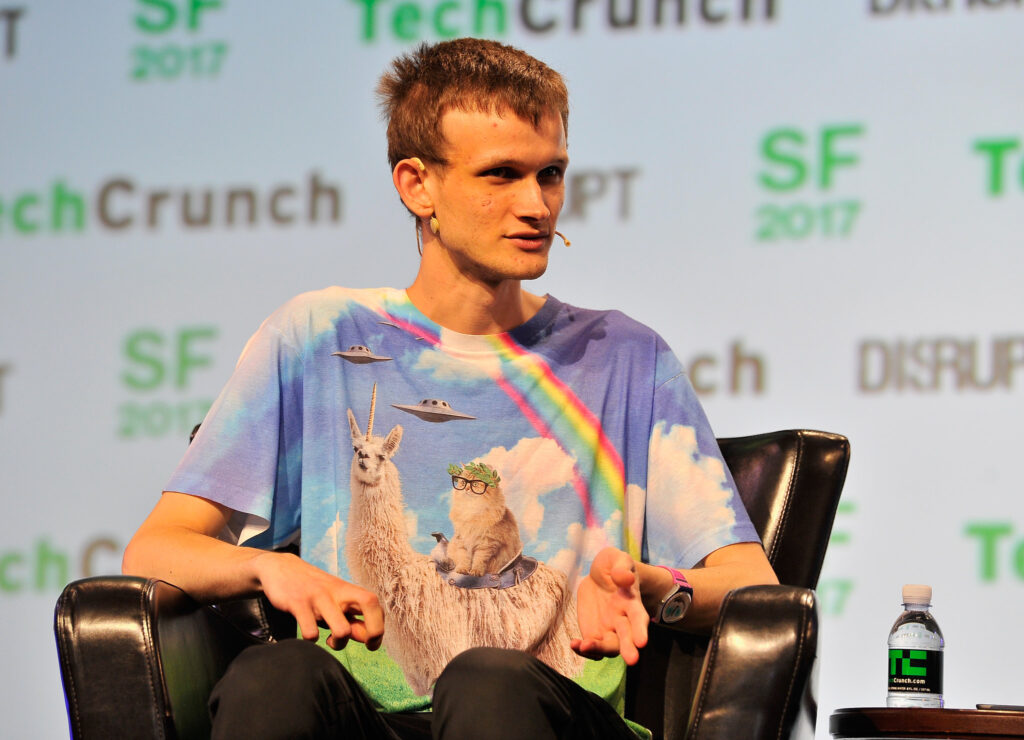
Ethereum co-founder Vitalik Buterin recently expressed his belief that the Bitcoin network requires scalable solutions, such as zero-knowledge rollups (ZK-rollups), in order to transcend its current role as a payment network.
Buterin shared his thoughts during a Twitter Space event hosted by Bitcoin developer Udi Wertheimer, where the focus was on Ethereum’s scaling experiments.
ZK-rollups are off-chain protocols that operate on the Ethereum blockchain and are managed by on-chain Ethereum smart contracts.
They offer a faster and more scalable approach to verifying transactions without compromising critical user information.
READ MORE: Digital Currency Group Dismisses Gemini Lawsuit as “Publicity Stunt” by Winklevoss Twins
Buterin highlighted how Ethereum has implemented various scaling solutions over the years to enhance throughput.
He pointed to Optimism and Arbitrum as successful examples of rollups that could serve as case studies for Bitcoin.
He stressed the need for additional scaling solutions if Bitcoin aims to expand beyond its current payment-centric role, stating, “I think if we want Bitcoin to be more than payments, it needs more scaling solutions.”
Scalability has long been a topic of discussion for both Bitcoin and Ethereum. Ethereum has transitioned from a proof-of-work to a proof-of-stake network and is actively exploring layer-2 solutions like ZK-rollups and Plasma to address scalability challenges.
Bitcoin, on the other hand, has relied on its layer-2 solution, the Lightning Network, to improve scalability.
More recently, the emergence of Bitcoin Ordinals has played a significant role in transforming the Bitcoin network into more than just a payment layer.
Buterin praised the rise of Ordinals and believes they have revitalized the builder culture within the Bitcoin ecosystem.
Bitcoin Ordinals represent the latest layer-2 solution enabling decentralized storage of digital art on the Bitcoin blockchain.
Their popularity has skyrocketed, with trading volume for Bitcoin Ordinals inscriptions surpassing $210 million by the end of June.
To commemorate this significant moment in history and support independent journalism in the crypto space, you can collect this article as an NFT (non-fungible token).
By preserving this article as an NFT, you contribute to the preservation of this important milestone and express solidarity with the world of independent crypto journalism.

According to recruitment executives, despite the excitement surrounding crypto firms entering Hong Kong, there has been a lack of in-country hires in the industry.
On June 1, approximately 150 companies applied for a local crypto license to operate a trading platform, with some reportedly spending up to $25 million to obtain one.
Sue Wei, managing director of recruitment firm Hays, mentioned that while exchanges aim to establish a presence in Hong Kong, the industry’s recruitment needs are currently low.
READ MORE: ZachXBT’s Research Cited in $3.1 Million NFT Rug Pull Lawsuit Against Boneheads
She expects an increase in job openings as Web3 companies continue to develop and expand.
However, there has been a decline in demand for technical talent since the crypto market dip, especially after numerous layoffs, which has made candidates hesitant to work for crypto companies due to the business’s instability tied to crypto prices.
Neil Dundon, founder of crypto recruiter Cryptorecruit, also noted a lack of significant activity in Hong Kong despite regulatory changes.
He believes that the venture activity is currently low but anticipates an upward trend in the future. Olga Yung, managing director of Michael Page Hong Kong, shared similar sentiments, stating that there hasn’t been a significant increase in job seekers interested in Web3 despite the government’s recent support.
However, Yung observed a slight increase in Web3 companies seeking legal and compliance hires in the second quarter of 2023.
Looking ahead, Kevin Gibson, founder of Web3 recruitment firm Proof of Search, expects a surge in crypto talent to take around six months as companies wait for license approvals.
He also mentioned that the local talent pool in Hong Kong is limited, and companies establishing themselves there may face intense competition for talent.
Gibson believes that the talent squeeze will persist until 2024, with Web3 companies potentially relocating their headquarters to pro-crypto jurisdictions if their plans align.
Hong Kong’s demographics data indicate a negative population growth rate since 2020.
Employment statistics for the first quarter of 2023 show a nearly 38% increase in job vacancies compared to the previous year.
One of the main challenges is attracting candidates interested in the crypto and Web3 sectors. Many candidates remain risk-averse due to the current market sentiment.
However, Neil Tan, chair of the FinTech Association of Hong Kong, noted that he has encountered several individuals who have recently transitioned from traditional finance to crypto.
Some are approached directly by crypto firms, while others search for roles through platforms like LinkedIn.
The instability and shedding of headcount in traditional finance have made the stability of crypto more appealing to some candidates.
According to a recent report from crypto analytics platform Messari, The XRP Ledger (XRPL) has shown significant growth in various aspects of its protocol during the second quarter of 2023, despite concerns over the Ripple vs. SEC lawsuit.
The report reveals that the circulating market cap of XRP has increased by 42.5% year-to-date, although there was a 10.7% decline in Q2, from $27.8 billion to $24.8 billion.
The initial growth was driven by a surge in the asset’s price in the first quarter. While the transaction volume on the XRP platform decreased quarter-over-quarter, there was a noteworthy 12.7% increase in average daily nonfungible token (NFT) transactions, rising from 13,800 to 15,500.
Although Ethereum and Solana overshadow the XRPL in the decentralized finance (DeFi) and NFT ecosystems, there are indications that this trend is shifting.
READ MORE: ZachXBT’s Research Cited in $3.1 Million NFT Rug Pull Lawsuit Against Boneheads
A key development in the XRP ecosystem highlighted by the Messari data is the expansion of XRPL sidechains.
Two notable protocols, Coreum and Root Network, were recently introduced, providing XRPL developers and users with desired programmability. Coreum focuses on ecosystem security, while Root Network drives metaverse innovations.
The XRPL also experienced a significant increase in the total new address count, reaching 138,790, a growth of 31.8% compared to the same period in 2022.
Additionally, quarterly revenue surged by 220.3% to $188,376.
Despite the ongoing SEC lawsuit, Ripple has seen efforts from developers within its ecosystem to drive utility adoption.
The progress made in essential operational aspects of the XRPL reflects its journey toward delivering sustainable value and utility.
Ripple’s distinct fundamentals, including its focus on real estate tokenization and dedicated research in blockchain technology, position it for substantial long-term growth and innovation.
While challenges persist, the growth witnessed in the XRPL’s protocol and ecosystem signifies progress in providing value and utility to its users.
Bitcoin (BTC) is currently experiencing a significant price discrepancy on Binance.US, offering a tempting opportunity for arbitrage. The cryptocurrency is being sold at a nearly $3,000 discount compared to global spot prices.
This phenomenon has been referred to as a “depeg” of cryptocurrencies, as the prices listed on the United States crypto exchange deviate from the global average.
At present, Bitcoin is trading at $27,536 against the U.S. dollar on Binance.US, representing an 8.5% markdown from the global spot price of $30,106.
Other digital assets, including Ethereum, are also being traded at discounted rates.
READ MORE: South Korean Regulator Takes Action After ‘Coin Gate’ Scandal
Ethereum is priced approximately $200 lower on Binance.US, with a current trading value of $1,695.
Even stablecoins like Tether (USDT) are affected, trading below their intended peg with Tether being valued at $0.915 on the exchange.
However, it is important to note that these discounts are only applicable when trading cryptocurrencies against fiat USD on Binance.US.
Unfortunately, most investors will not be able to take advantage of this opportunity due to the suspension of new USD deposits on the platform since June 9.
As a result, only those who already possess USD funds in their Binance.US accounts can purchase the discounted cryptocurrencies.
Moreover, concerns have arisen that Binance.US may soon halt USD withdrawals, prompting some users to sell their cryptocurrencies below market value in order to exit their positions in USD.
An email from Binance.US to customers, which has circulated on Twitter, states that the last day for USD withdrawals will be July 20.
This situation mirrors a similar incident that took place in late May at the Australian branch of Binance, where the company’s third-party payments provider ceased offering fiat on- and off-ramps.
Consequently, the price of BTC on Binance dropped by 20% when traded against the Australian dollar.
As a testament to the significance of these events, readers are encouraged to collect this article as a non-fungible token (NFT).
This unique digital asset will preserve this moment in history and demonstrate support for independent journalism in the cryptocurrency space.

Today, the most significant cryptocurrency gaining traction on Uniswap is Elon Musk (MUSK).
However, caution is advised as DEXTools reveals that this new meme token incorporates a blacklist function within its smart contracts.
As of the time of writing, $MUSK has experienced an astronomical surge of approximately 30,000%.
It is crucial to note that such substantial percentage gains over a short period are often attributed to low liquidity rather than genuine buying volume and demand.
READ MORE: Former BitMEX CEO Says Bitcoin Will Reach $760,000 as Currency of Artificial Intelligence
What is the Elon Musk (MUSK) Token?
The Elon Musk cryptocurrency asset made its debut on Uniswap on July 1st and currently boasts a liquidity pool of approximately $130k, with a 24-hour trading volume of $70k.
The market capitalization stands at $1.2 million, with 180 holders. Furthermore, it possesses a DEXTscore of 86/99.
Blacklist Function and Past Concerns
It is essential to acknowledge that previous rugpull incidents, such as the case of PepeHub earlier this week, involved the utilization of a blacklist function.
This particular function prevents specific wallet addresses from engaging in normal trading activities.
Therefore, it is plausible that some holders may be unable to sell, which could potentially account for the continuous price surge of $MUSK.
These circumstances contribute to the token’s status as one of the leading gainers in the cryptocurrency market.
At present, $MUSK coin has yet to secure a listing on CoinMarketCap.
However, it is worth mentioning that other unrelated assets associated with Elon Musk (MUSK) have appeared, and unfortunately, many of these have turned out to be scams.
The DEXTools description of $MUSK coin states, “$MUSK – Risk-taking and imagination are keys to success. Take a chance or regret it!”
Although Elon Musk, a long-time advocate of Bitcoin, Dogecoin, and cryptocurrencies in general, has not directly addressed the $MUSK token, he has recently engaged with another meme coin known as Wall Street Memes (WSM).
Musk has responded to tweets featuring memes from the @wallstmemes account on Twitter on three separate occasions.
While it remains unclear whether Elon Musk is aware of the upcoming launch of the $WSM token on Uniswap, his interactions with the @wallstmemes account indicate his involvement in the meme coin sphere.

New York, United State, July 10th, 2023, Chainwire
WOW EARN, a new mining DeFi platform, has released a multi-chain crypto wallet on smartphones.
Launched on May 29th, WOW EARN Wallet is now available for download on Google Play Store and App Store. The platform facilitates the purchase, exchange, and trading of cryptocurrencies.
Since its release, the platform has been downloaded more than 300,000 times with a rating of 4.6 on Google Play Store.
What is WOW EARN Wallet?
Established in 2022, WOW EARN is focused on developing crypto wallets and crypto asset mining services that can provide users with a smooth Web3 transaction experience. The goal is to build a secure, diversified and easy-to-use Web3 platform, so that users can freely buy, trade and exchange crypto assets without any limitations.
One notable program currently offered is the WOW EARN Wallet, a crypto wallet that serves as a tool for users to manage funds and transactions within the WOW EARN ecosystem. This wallet has various features to manage crypto assets by prioritizing user protection. Users can easily store and manage their digital assests just by using the WOW EARN Wallet.
“With its cutting-edge features and focus on user safety and security, the WOW EARN Wallet will redefine how crypto assets are managed. It will enable individuals to take complete control of their digital assets and herald a new era for crypto asset security,” according to Yara G, WOW EARN’s spokesperson.
WOW Earn Wallet supports more than 100 payment methods available in over 150 countries and regions worldwide. It currently supports 13 public chains, including Bitcoin, Tron, Ethereum, and Polygon, as well as over 80 digital assets. This means users no longer need separate wallets for each chain.
What Benefits Does the WOW EARN Wallet Offer?
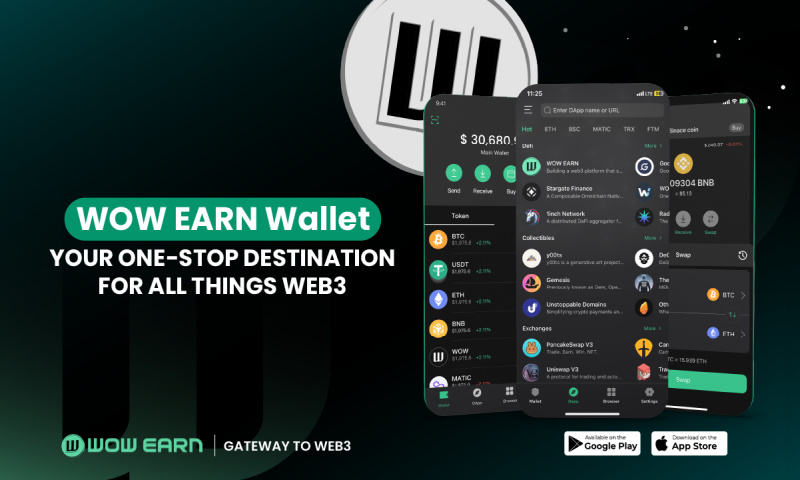
Friendly user interface: WOW EARN Wallet comes with a user-friendly UI with the latest updates to its platform. According to the company, the redesigned UI is designed to make it easy for anyone to manage their digital assets with full control.
Swift transactions: With WOW EARN Wallet, users can enjoy lightning-fast transactions ensuring quick cryptocurrency transfers. The simplified interface and optimized transaction procedures enable easy navigation and instant transfers, avoiding long waiting times.
Enhanced security services: WOW EARN Wallet offers multi-factor authentication in an effort to protect users’ privacy and security. Through facial recognition and biometric fingerprint identification technology, only authorized users are allowed to access their wallets and assets.
Furthermore, the wallet provides users with full control over their assets. Private keys are stored in encrypted form on the user’s local device, and password settings and passphrase features are provided to offer additional security to users.
Wallet customization: WOW EARN Wallet also gives users the option to change the view mode to light or dark, as well as the color of the wallet display according to their taste.
Blockchain explorer and cross-chain bridge swap features: This wallet has its own blockchain explorer, allowing users to check transaction records, address balances, and other related information on the blockchain. Additionally, the wallet supports cross-chain bridge swap feature, which helps users easily exchange assets between different blockchains. Whether on different main networks or other blockchain networks, users can quickly and efficiently convert assets, enhancing liquidity and management convenience.
Investment opportunities and rewards: To attract more users, WOW EARN Wallet offers an airdrop facility for users to earn WOW coins as rewards by using this wallet. Furthermore, users have the opportunity to explore investment opportunities and receive rewards on the WOW EARN platform. Users can increase their income and expand their network in the crypto community through the incentive-based referral program offered by WOW EARN Wallet.
Providing dApps for Web3 exploration: WOW EARN Wallet offers over 20,000 built-in decentralized apps (dApps) from various main networks, giving users the chance to explore and participate in a diverse array of Web3 applications directly from their wallets. With WalletConnect support, users can easily connect to other dApps for various transactions and operations, opening up opportunities to engage with various DeFi projects, explore NFT marketplaces, and join decentralized social networks.
NFT Integration: Currently, WOW EARN Wallet is in the process of developing a feature to support non-fungible tokens (NFTs). Once the integration is complete, users will have the ability to purchase, trade, and manage NFTs, including virtual items, artwork, in-game assets, and virtual land, directly from their wallets.
Thus, WOW EARN Wallet is claimed as an application that provides a one-stop-shop service for crypto asset management. Through this platform, users can enjoy various essential features integrated into one place. As a result, users can easily manage their digital assets efficiently and effectively.
A Guide to Creating a WOW EARN Wallet Account
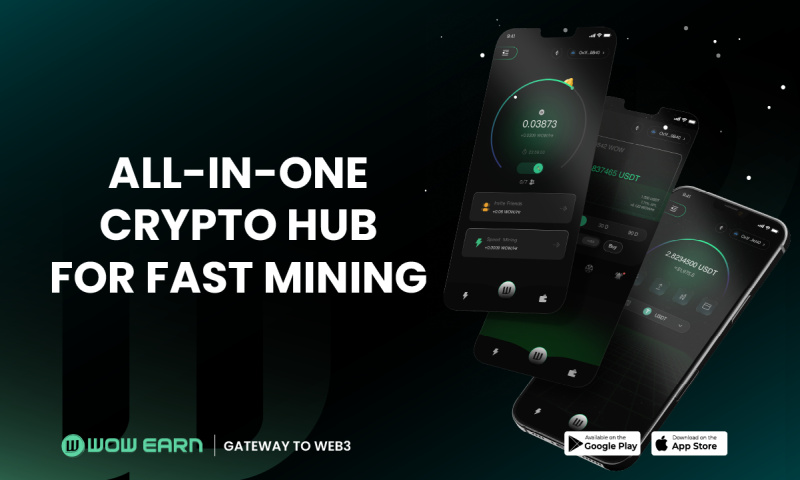
- The user should click on the option “Create Identity Wallet.”
- The user will be prompted to generate a mnemonic, which is a code resembling a keyword. It is important to note that mnemonics are highly confidential. In this step, users have the option to choose a 12-bit to 24-bit mnemonic and can modify the code group.
- Following that, the user needs to verify the mnemonic code based on the previously provided numbers.
- A transaction password, consisting of a 6-digit number, must be created by the user.
- The process of setting up a WOW EARN Wallet account is now complete.
A Guide to Starting Mining WOW Token
- The user should access the “Dapp” tab located on the main page of the app. They can find WOW EARN listed under the DeFi category.
- Users will be redirected to the wowearn.com website, which facilitates the mining of WOW tokens. Within this interface, users can create mining teams consisting of one to seven members. Each user has the option to invite friends by sharing a link or QR code.
- To initiate the mining process, users can simply click the designated button displayed on the screen.
- To access the “Menu” tab, users can tap on the WOW logo situated at the top left corner.
- Presently, wowearn.com supports multiple languages, including Bahasa Indonesia, thereby catering to users primarily located in Indonesia.
About WOW EARN
WOW EARN connects users to the blockchain, providing decentralized mining, earning, and trading mechanisms. The startup’s unique mining model allows anyone to participate in the mining process, making it a key player in driving the DeFi ecosystem’s growth.
In early June, WOW EARN announced that the company successfully raised USD 30 million in Series A funding, equivalent to IDR 451.6 billion. This funding round was led by prominent venture capital firms, including Pinnacle Innovations Capital, Blue Horizon Ventures, Ascendant Growth Partners, Nexus Pioneers Capital, and Quantum Leap Ventures.
The recent financial support has strengthened WOW EARN’s vision of bringing democratization to cryptocurrency mining by providing easy, profitable, and secure access. The platform offers an Annual Percentage Yield (APY) of up to 13.39% and has partnered with Hacken, a leading blockchain security auditor in the industry.
Contact

Digital Currency Group (DCG) has dismissed the lawsuit filed by Gemini as a “publicity stunt” orchestrated by Cameron Winklevoss.
Gemini recently announced that it has taken legal action against DCG and its CEO, Barry Silbert, accusing them of defrauding creditors.
According to Gemini, Silbert pressured the continuation of the Earn program despite knowing about Genesis’ insolvency.
READ MORE: Investors Chase Second Coming of Popular Coins, Such As Pepe 2.0 and Floki 2.0
Cameron Winklevoss alleges that Silbert and DCG executives repeatedly lied to conceal the truth from Gemini and other creditors.
Genesis, a subsidiary of DCG, reportedly owes nearly $1 billion to Gemini’s Earn program users and other creditors.
DCG responded to the lawsuit by issuing a statement last night, dismissing it as baseless and defamatory.
The company labeled the legal action as another attempt by Cameron Winklevoss to deflect blame from himself and Gemini.
DCG emphasized that any suggestions of wrongdoing by the company or its employees are completely false.
The statement revealed that DCG has been actively engaged in negotiations with the representatives of the Official Unsecured Creditors Committee and Ad Hoc committee to reach a resolution.
DCG criticized Gemini’s leadership, accusing them of being “missing in action” and making press statements while DCG has been working tirelessly to find a solution.
DCG’s statement clarified that neither of the Winklevoss twins was involved in any of the in-person meetings related to the mediation process.
The statement concluded optimistically, expressing an expectation to bring the Genesis Chapter 11 case to a close soon.
In response to DCG’s statement, Tyler Winklevoss, co-founder of Gemini, tweeted that DCG and Barry Silbert failed to address or deny any of the allegations made in the 33-page complaint.
Tyler questioned which parts of the complaint DCG considers “baseless, defamatory, and completely false.”
Gemini asserts that DCG and Silbert were directly involved in misleading creditors about Genesis’ financial condition.
The lawsuit claims that when Three Arrows Capital (3AC) collapsed in June 2022, it created a $1.2 billion deficit in Genesis’ balance sheet.
Gemini alleges that DCG intentionally lied to reassure them that they would absorb the losses.
The Winklevoss twins have repeatedly warned DCG of potential legal action if the issue remained unresolved.
The lawsuit between Gemini and DCG continues to unfold as both parties present their arguments and evidence in court.
Discover the Best Crypto Marketing Agencies

According to a report by Bloomberg News on July 5, investigators from the Commodity Futures Trading Commission (CFTC) have concluded that Celsius, a bankrupt crypto lender, and its former CEO Alex Mashinsky violated U.S. regulations prior to the company’s collapse.
Sources familiar with the matter stated that attorneys in the CFTC’s enforcement unit found evidence that Celsius had misled investors and should have registered with the regulatory body.
If the majority of the CFTC’s commissioners concur with this determination, the agency may initiate legal proceedings in federal court as early as this month.
Neither Celsius nor the CFTC provided an immediate response when approached by Reuters for comment.
READ MORE: Source: Logan Paul Has Changed His Mind About Refunding CryptoZoo Investors
The downfall of TerraUSD last year triggered market turmoil that resulted in the failure of numerous prominent cryptocurrency companies, including Celsius Network.
As a consequence, the company filed for bankruptcy, leaving its clients with substantial losses.
As part of Celsius’ bankruptcy proceedings, an independent examiner was appointed to investigate allegations that the firm had functioned as a Ponzi scheme.
The examiner’s task was to scrutinize how Celsius had managed its cryptocurrency assets and produce a report on their findings.
Earlier this year, the Attorney General of New York filed a lawsuit against Alex Mashinsky, the founder of Celsius.
The lawsuit alleged that Mashinsky had defrauded investors of billions of dollars in digital currency by concealing the deteriorating state of the lending platform.
These developments underscore the challenges and risks associated with the crypto industry.
Regulatory bodies such as the CFTC play a crucial role in ensuring compliance and protecting investors from potential misconduct.
The outcome of the CFTC’s investigation and any subsequent legal action will shed further light on the alleged wrongdoing by Celsius and its former CEO.

According to a report by SlowMist on July 7, a staggering $30 billion worth of cryptocurrency has been hacked in 1,101 documented incidents from 2012 to the present.
This represents approximately 2.5% of the total market capitalization of cryptocurrencies. SlowMist, a blockchain security firm, identified the top five most common types of hacks as smart contract vulnerabilities, rug pulls, flash loan attacks, scams, and private key leaks.
Among the documented incidents, there were 118 exchange hacks, 217 hacks within the Ethereum ecosystem, 162 within the BNB Smart Chain ecosystem, 119 within the EOS ecosystem, and 85 hacks related to nonfungible tokens (NFTs).
Exchange hacks accounted for the largest losses, with over $10 billion lost over the past decade.
READ MORE: Vitalik Buterin Fires Warning About Bitcoin’s Future
Notable early attacks in the history of Bitcoin include the infamous 2014 Mt. Gox hack and the 2016 Bitfinex hack.
Mt. Gox, once the largest Bitcoin exchange in the world, filed for bankruptcy in 2014 after discovering that 850,000 BTC (valued at $25.2 billion at the time) had been stolen through discreet hacks over several years.
Since then, Mt. Gox has managed to recover 200,000 BTC (worth $6.1 billion) and is in the process of redistributing them to creditors.
Similarly, in 2016, Bitfinex experienced a security breach that resulted in the loss of 119,576 BTC, valued at around $70 million at the time and approximately $3.7 billion now.
On February 8, 2022, special agents from the United States Department of Justice managed to recover 94,000 of the stolen BTC.
Interestingly, the report indicates that hack events with losses exceeding $1 billion peaked in the early 2010s and between 2019 and 2021.
Since 2022, there has been a decrease in the number of security incidents, aligning with findings from other reports.
These alarming figures highlight the ongoing challenges of securing cryptocurrencies and the need for robust security measures within the crypto ecosystem.
As the industry continues to evolve, it is crucial for individuals, exchanges, and projects to prioritize cybersecurity to safeguard against potential attacks and protect the investments of users.
The DeFi ecosystem has been facing an increasing number of hacks, but there is some good news on the horizon.
A smart contract developer has introduced a new Ethereum request for comment (ERC) proposal that could potentially reduce losses from hacks by 70%.
This proposal suggests the implementation of a circuit breaker, which would help prevent suspiciously large token outflows from DeFi protocols.
However, the security concerns continue as certain Multichain contracts on Ethereum experienced significant withdrawals, raising fears of a possible exploit.
READ MORE: BarnBridge DAO Halts Operations Amidst SEC Investigation
The Poly Network, a cross-chain bridge platform, was also targeted by hackers due to a compromise in a private key.
This exploit affected 57 different crypto assets, prompting the platform to request users to withdraw their funds.
In a separate incident, the BarnBridge DAO, a decentralized autonomous organization, faced regulatory scrutiny from the United States Securities and Exchange Commission (SEC). As a result, members of the DAO were advised to halt all project-related activities.
Shifting gears to new developments, the decentralized social media protocol DeSo has offered a $1 million bounty for the creation of a Reddit competitor built on its native blockchain.
This initiative aims to foster innovation and competition within the decentralized social media space.
Taking a look at the market performance, the top 100 DeFi tokens had a mixed week.
While most tokens traded within a similar range as the previous week, a minor bearish correction was observed.
In summary, a new ERC proposal for a DeFi circuit breaker could potentially reduce losses from hacks by 70%.
However, the DeFi ecosystem continues to face security challenges, as demonstrated by recent exploits and regulatory scrutiny.
On a positive note, DeSo’s bounty program seeks to drive innovation in decentralized social media.
The overall performance of the DeFi market remained relatively stable, with the total value locked in DeFi protocols remaining below $50 billion.