


Solana-based meme token Bonk’s (BONK) experienced a 7% surge shortly after reports emerged suggesting the potential listing of the Solana-based meme token on Revolut’s trading platform.
According to a note from BonkDAO, the decentralized autonomous organization behind Bonk, a proposed collaboration aims to initiate a Bonk “Learn and Earn Campaign” to bolster the meme token’s user base by 500,000.
Revolut presently boasts 38 million users and holds a banking license across over 50 countries, as noted by BonkDAO.
This indicates that merely 1.3% of Revolut users need to be engaged to meet the set target.
Reportedly, Revolut users will be motivated to partake in the Learn and Earn campaign, with rewards totalling $1.2 million on offer.
Following this development, BONK’s price stands at $0.000025, marking a 7.2% increase within the past five hours and a 13.1% surge over a 24-hour period, as per CoinGecko.
BONK gained substantial attention in late 2023, witnessing a staggering 14,000% surge to $0.000025.
Despite a subsequent 60% decline from its peak, it remains one of the most traded meme tokens by volume.
READ MORE: Ledger and Coinbase Join Forces to Simplify Crypto Transactions and Enhance Self-Custody Options
However, the campaign is pending official endorsement from BonkDAO. Presently, seven out of 12 Bonk voting members have voted in favour of the campaign, with one more vote required to achieve approval quorum.
No dissenting votes have been recorded yet, with the remaining five voters having four days to cast their vote.
If sanctioned, the Learn and Earn campaign will be executed in two phases.
The first phase will mark BONK’s debut on Revolut, focusing on fostering “organic growth” for the initial one to two months, followed by the launch of the Learn and Earn campaign.
Cointelegraph attempted to reach out to Bonk community members for their input but received no immediate response.
Meanwhile, speculations are rife regarding BONK’s potential listing on Robinhood, although no official confirmation has been made by either party.
Cointelegraph has reached out to Robinhood for comment.
Stockholm, Sweden, February 16th, 2024, Chainwire
The partnership aims to empower users of the Chromia ecosystem Web3 games like ‘My Neighbor Alice’ to create and leverage in-game wearable digital assets.
Chromia announces its strategic partnership with RSTLSS, a platform that streamlines the creation of digital wearables and accessories. The news, accompanied by a video release from RSTLSS, garnered attention across various channels associated with both projects. This partnership signifies a significant step in expanding the possibilities of the on-chain digital worlds of Chromia games like ‘My Neighbor Alice.’
Chromia is a Layer-1 relational blockchain platform that uses a modular framework to enable the creation of complex, fully on-chain decentralized applications (dapps). With a mainnet launch scheduled in 2024, Chromia’s ecosystem has extended across several verticals, including gaming, real-world assets, digital collectibles, sports, and fashion.
RSTLSS emerges as a next-gen digital wearables enterprise, offering a user-friendly platform for the creation and monetization of game-ready accessories, including clothing, skins, and weapons. It utilizes 3D templates, patterns, textures, and artwork, which enable users to craft and mint their creations as NFTs that can be used across multiple games and platforms.
The partnership between Chromia and RSTLSS is driven by their shared goal of enhancing accessibility within the blockchain space. Chromia simplifies decentralized applications, while RSTLSS emphasizes accessibility by providing design tools that require no coding. RSTLSS will integrate with My Neighbor Alice, Chromia’s flagship game, enriching the gaming experience by giving players the opportunity to create and use their own digital assets.
Commenting on the partnership, RSTLSS Founder Charli Cohen said, “The ethos of Web3 and decentralization are very important to me, and Chromia’s approach reflects those ideas. Digital assets are all about ownership and putting power in the hands of the users. Chromia’s fully on-chain dapps align with this idea, and we are excited to work with them.”
Chromia Co-Founder Henrik Hjelte added, “We are thrilled to collaborate with RSTLSS. Their technology empowers users to envision and design their creations while retaining control over their work. This aligns perfectly with Chromia’s presence in both gaming and fashion, and I am confident that this partnership will bring significant value to our ecosystem.”
In preparation for an eventful 2024, both companies are diligently gearing up for significant milestones. RSTLSS is on track to launch the beta version of their User-Generated Content (UGC) platform in March, while Chromia anticipates the launch of their mainnet later this year. The projects will begin technical collaboration in the forthcoming months, laying the groundwork for their shared vision of innovation and progress.
Users can stay connected with Chromia and get the latest updates from the following official Twitter: https://twitter.com/Chromia
About Chromia
Chromia is a Layer-1 relational blockchain platform that uses a modular framework to empower users and developers with dedicated dApps chains, customizable fee structures, and enhanced digital assets. By fundamentally changing how information is structured on the blockchain, Chromia provides natively queryable data indexed in real-time, challenging the status quo to deliver innovations that will streamline the end-user experience and facilitate new Web3 business models.
About RSTLSS
RSTLSS is the future of game-ready interoperable assets. RSTLSS platform allows anyone, whether a 2D or 3D creator, to easily build and trade digital merchandise – wearables, accessories, and more that can be loaded onto avatars cross-platform and cross-game engines.
Contact
Fati Hakim
[email protected]
New York City, New York, February 16th, 2024, Chainwire
Introducing Kadena SpireKey, a human-friendly and secure way to seamlessly interact with any application by removing complex signing processes.
Kadena Spirekey
“Unlike complex Web3 wallets today where you have to remember every wallet you’ve ever created, Kadena’s SpireKey uses WebAuthn, a technology that has been developed by Google and Apple over the last 20 years, to help anyone securely digital assets directly on your phone or computer. It’s as easy as receiving a prompt on your mobile device and providing a fingerprint as a signature. Even that uncle who asks you about crypto every family holiday dinner can do it. With Kadena, we’ve made using applications accessible to everyone, no matter if you’re an experienced “degen” or using blockchain for the first time,” said Kadena CMO, Mike Herron.
SpireKey creates a seamless interaction between humans and technology, providing a Web2 experience with Web3 innovation. With SpireKey, users can sign transactions and Web3 applications, just like how it works on Apple Pay or Google Pay. However, it can be done directly on the user’s device without opening multiple windows or copying and pasting keypairs, which eliminates potential vulnerabilities seen in traditional wallets.
Added Security with Built-in Multi-sig
“Kadena’s built-in multi-sig signing enables an additional layer of security for SpireKey that only we can provide through our original language, Pact. With multi-sig, SpireKey allows for multiple signatures to be required for certain transaction types. For example, if you want to send over $10,000, you can set up parameters to require signatures from three different devices – your phone, laptop, and cold storage wallet. The multi-sig feature reduces the risk of compromised accounts because a bad actor would need access to three devices. It mitigates the risk of another attack vector, and adds to the overall security,” said Stuart Popejoy, Kadena Co-Founder and CEO.
SpireKey displays how Kadena thinks about the level of usability that Web3 technology should be at. At its core, SpireKey connects humans to interact with the blockchain, and with one another. SpireKey believes that showing working examples will inspire all humans alike to see how Spirekey can impact the rest of the world beyond Web3.
About Kadena
Kadena is a blockchain technology protocol that was founded in 2017 by Stuart Popejoy and Will Martino. Kadena is the industry’s only scalable Layer-1 Proof of Work (PoW) blockchain. This scalability enables Kadena to deliver infrastructure-grade performance for any blockchain project. Along with Kadena own smart contract language Pact, Kadena’s platform provides the world with the tools and environment to turn ideas and ambitions into reality. Founded by Stuart Popejoy and William Martino, who created JP Morgan’s first blockchain and led the SEC’s Crypto Committee, Kadena aims to allow for true blockchain mass adoption.
For more information, users can follow Kadena’s: Twitter | Telegram | Discord | YouTube
Contact
Kadena Press
[email protected]
Cryptocurrency liquidity is the lifeblood of efficient trading, fair price discovery, and the overall health and growth of the crypto market. However, not all digital assets are as liquid as popular Bitcoin. How is it possible to generate sufficient trading volume and liquidity for less popular assets? The answer is crypto market making. This article will explain who market makers are and how they work.Who is a Market Maker?
When you trade on a crypto exchange, you don’t reflect on who is there on the other side of the order. But what if there is no organic counterparty for your order? What if no one is willing to buy your tokens at your desired price? In this case, you have two options:
- on a low-liquidity market, you have to wait long until there is someone ready to execute your order;
- on high-liquidity markets, your order will be executed immediately, despite the market conditions.
Market makers stand behind quick and efficient order execution at a fair price. They are financial entities, specialized companies, or high-frequency traders that cooperate with a market-maker trading platform to supply liquidity to its markets.
A market maker is a market participant who places orders on buying and selling assets, and this order stays in an order book until someone wants to match it. So, a market maker stands always ready to fulfill emerging orders (from other traders) on a crypto exchange.
Here is what market makers do:
- Provide continuous liquidity by placing buy and sell orders.
- Narrow the bid-ask spread by offering competitive buy and sell prices.
- Facilitate the formation of fair and accurate market prices.
- Enable large transactions by absorbing large orders without significantly impacting the market price.
- Stabilize market volatility by dampening price fluctuations and creating a more stable market environment.
- Support new tokens, helping to kickstart trading activity and market interest.
Market Maker Strategies
Here are the most common cryptocurrency trading strategies that market makers use:
- Cross-exchange liquidity mirroring
- Two-legged trading
- Market making without hedge
- Delta neutral market making
- Grid trading.
Let’s drill down on a two-legged trading strategy. The idea of this strategy is to buy and sell tokens simultaneously. It involves opening two limit orders with different prices. A buy order price is set lower than the current market price, and a sell order price is higher than the market price. When these two orders are executed, a market maker profits from their price difference.
Market makers are crucial in providing liquidity and stability to the cryptocurrency market. Their strategies and techniques help to create a favorable trading environment for other market participants.
Grand Cayman, Cayman Islands, February 15th, 2024, Chainwire
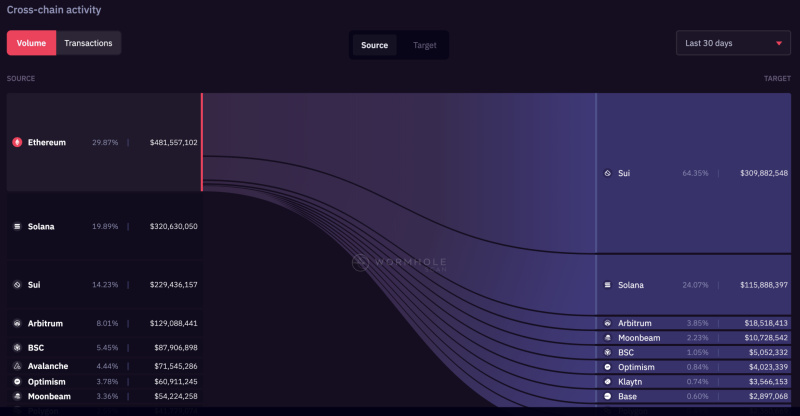
Wormhole data shows nearly $310 million in assets bridged from Ethereum to Sui over the last month — more than all other blockchains combined.
Sui, a Layer 1 blockchain that has experienced explosive growth since its inception nine months ago, is seeing a substantial migration of funds from Ethereum to the Sui ecosystem, with nearly $310 million worth of assets flowing through the Wormhole Portal in the past 30 days. The data is issued by wormholescan.io, which tracks the flow of funds through Wormhole, one of the most important cross-chain bridges for wrapped tokens and NFTs, and the one most used on the preeminent decentralized exchange, Uniswap.
As the Sui ecosystem has been gaining remarkable traction during the past month – surpassing $600M in Total Value Locked and entering the top 10 of DeFi ecosystems – the data from Wormhole shows that the origin of a lot of these funds is Ethereum. Of the almost $500M worth of funds that were bridged from Ethereum through Wormhole in the last 30 days, over 64% of it was moved to Sui — more than all of the funds sent to Solana, Arbitrum, Polygon, and every other chain combined.
According to the Wormhole data, most of these bridged assets are stablecoins, with USDC and USDT bridged to Sui accounting for $134M and $78M of the volume respectively.
 source: wormholescan.io
 source: wormholescan.io
“The prevalence of users migrating assets to Sui demonstrates a growing belief in the strength of Sui’s underpinning technology and the community of builders, developers, and enthusiasts that power the ecosystem,” said Greg Siourounis, Managing Director at the Sui Foundation. “The Sui community looks forward to continuing to push the boundaries of DeFi and offering an industry-defining experience for users and builders alike.”
source: Sui Internal Data
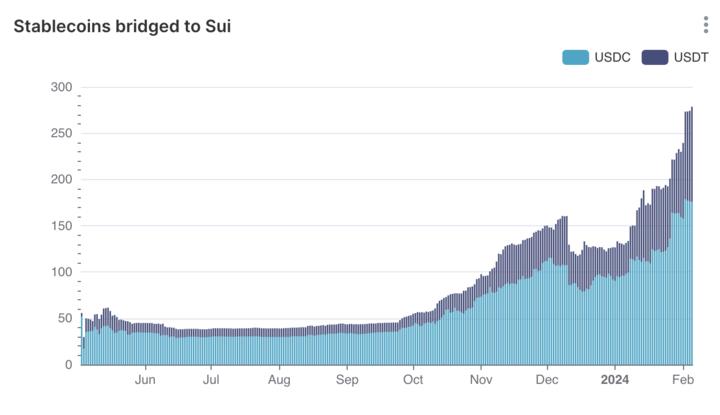
Also notable in the context of Sui’s emergence in DeFi, Sui’s internal data reflects the acceleration of the growth in bridged stablecoins USDC and USDT to the Sui ecosystem that began in Q4 of 2023. TVL of USDC and USDT went from hovering below $50M to spiking well beyond $250M, a rise of over 400% in less than five months.
In recent months, in addition to the empirical data, there is also a qualitative trend that points to Sui becoming a primary hub of DeFi’s excitement and activity — top projects choosing to build on Sui. In December 2023, two leading projects that began on other protocols chose Sui for expansion or complete migration.
Solend, which remains the top lending protocol on Solana at nearly $180M in TVL, has devoted a full team to launching a new lending protocol on Sui that will be called Suilend. Likewise, Bluefin, a decentralized derivatives exchange that had already achieved over $1B in transaction volume on its v1 application on Arbitrum, shuttered its initial implementation to focus entirely on the newest version built on Sui, reaching $2.3B in volume in its first four months on the network. Both projects cited the performance capabilities of Sui in explaining their moves.
More recently, Sui announced two more important steps in turning Sui into the DeFi platform of choice for builders, developers, and their users. First, together with Ondo Finance—the third-largest platform bringing tokenized real-world assets onto public blockchains, Sui announced the launch of interest-bearing stablecoin substitutes on Sui. Just as important, a new partnership with Banxa, a leading payments infrastructure provider for the crypto-compatible economy, will enable on and off-ramps via the Banxa platform. Combined, these steps will broaden the appeal of the Sui platform to include a far wider audience.
Contact
Sui Foundation
[email protected]
Solana’s SOL token has overtaken Binance’s BNB token to secure the position of the fourth-largest cryptocurrency by market capitalisation.
Over the span of 24 hours leading up to 1:50 pm UTC, SOL experienced a notable surge of 7.56%, reaching a trading value of $112.52, surpassing BNB.
According to CoinMarketCap data, SOL now boasts a market capitalisation of $49.36 billion, which is 1.74% greater than BNB’s $48.5 billion.
This rise in SOL’s price coincided with the Crypto Fear and Greed Index reaching its highest level since November 2021, when Bitcoin soared to $69,000.
Notably, this index surged a day after Bitcoin exceeded $50,000 for the first time since December 2021.
Despite encountering a network outage on February 6, SOL managed to outpace BNB.
The approval of the Pyth DAO Constitution on-chain likely served as a catalyst for this rally.
The proposal aimed to establish the Pyth DAO Constitution as the governing framework for the Pyth DAO, an autonomous organisation overseeing the Pyth Network.
READ MORE: Blockchain Academy Initiative Gains Traction Among Young Entrepreneurs in UAE
Despite the recent setback, SOL has gained 19.99% over the past seven days, albeit remaining 57% lower than its all-time high of $260.06, recorded on November 6, 2021.
Solana Mobile’s Chapter 2 smartphone garnered 100,000 pre-orders by February 12, within a span of less than 30 days.
In contrast, it took Solana nearly a year to sell 20,000 units of its inaugural Solana Saga smartphones.
Following this achievement, the pre-order window for purchasing the new Solana phone for $450 is set to close on February 14, as announced by Solana Mobile.
Shipments of the smartphones are expected to commence in early 2025.
Meanwhile, BNB has been grappling with challenges amid Binance’s regulatory issues.
On February 12, the sentencing date for Binance founder Changpeng Zhao was postponed from February 23 to April 30. Zhao, currently on a $175 million bond, is residing in the United States.
Investors of the Hector decentralised autonomous organisation, HectorDAO, on the Fantom network are demanding control of the protocol’s remaining funds after the team allegedly halted all communications following a Jan. 16 hack that led to $2.7 million in losses.
In a conversation with Cointelegraph, a HectorDAO investor who wishes to remain anonymous stated that the HectorDAO team stopped communicating with its community on Jan. 19.
According to the source, all project social channels were muted in September 2023.
At that time, the HectorDAO team still allowed contact through a Google Group email address. However, the DAO allegedly deleted this group sometime before Jan. 19.
To make matters worse, the hack occurred just as the protocol planned to dissolve itself and return assets to investors. Prior security warnings were allegedly ignored.
According to blockchain security firm CertiK, its researchers informed the HectorDAO team of the “centralisation” risk posed by the “addEligibleWallet” function, the root cause of the exploit, and recommended steps to mitigate this risk.
The HectorDAO team allegedly chose not to implement the recommended changes for unknown reasons CertiK referred Cointelegraph to its official audit report, which stated that the function could be called by any account with moderator privileges.
HectorDAO tells a different version of the story, claiming that the protocol engaged with CertiK to conduct a thorough smart contract security analysis and that, contrary to CertiK’s statement, “all assets were secured in a Redemption Vault prior to the launch of the production claim process.”
Blockchain analysis has since shown that the attacker allegedly had access to the team’s deployer account, implying that the exploit was either an inside job or the result of a private key compromise.
The development team’s last known communication to investors was on Jan. 18, before going quiet.
The story of HectorDAO begins in 2021, when its early investors were allowed to buy the DAO’s token, HEC, at a discount through DAO bonds.
The funds raised through this process went into the DAO’s treasury, where, theoretically, each HEC token represented ownership of a portion of the treasury, which could be reinvested to produce yield for tokenholders.
At its height, the HectorDAO treasury held over $100 million in digital assets.
But troubles began with the onset of the crypto winter.
By 1st May 2023, HEC’s price had collapsed by nearly 99%, according to data from CoinMarketCap. At the same time, the HectorDAO treasury also declined in value.
These difficulties accelerated when the $1.5 billion Multichain bridge hack on 6th July 2023 caused contagion in the Fantom ecosystem.
This led to another $8 million in losses for HectorDAO, as some of its treasury assets depegged from their Ethereum collateral.
After this incident, HectorDAO investors decided to call it quits, voting in July 2023 to liquidate the DAO and return its funds to users.
Despite the vote, however, most of the $16 million held by the treasury at the time of the vote had yet to be distributed to investors by 15th Jan 2024, on the eve of the HectorDAO hack.
On 15th Jan, the HectorDAO team attempted to finally distribute treasury funds by moving them into a new contract from which they could be redeemed.
However, a malicious account immediately transferred $2.7 million worth of assets to itself after depositing only 0.0001 HEC.
READ MORE: Crypto.com Defends Major Sponsorship Deals with F1 and UFC
Shortly afterward, the team shut down the redemption platform, and all remaining assets were moved back to the treasury contract. The redemptions have not been reopened since.
On 18th Jan, the HectorDAO team announced that the redemption platform had been hacked.
“Hector Network regrets to inform you that there has been a security breach when the protocol was redeeming token holders as part of liquidation, and approximately USDC 2.7 million have been stolen on 15 January 2024,” it stated.
The team claimed it was “actively investigating” the breach and would provide updates in the future. In the meantime, it stated, “the redemption process is postponed for now.”
In the wake of the hack announcement, some tokenholders squarely blamed the development team, claiming that the hack was either the work of a rogue developer or a compromised private key.
They argued that the team could no longer be trusted to secure the DAO’s funds.
On 19th Jan, blockchain analyst Lilbagscientist released a detailed post-mortem report on the attack, citing data from Etherscan.
According to them, preparations for the attack began on 16th Dec 2023, when the HectorDAO deployer account sent 0.0001 HEC to the attacker. This 0.0001 HEC sat in the account until 15th Jan.
From 12:32 am UTC through 12:43 am on 15th Jan, a series of 14 transactions were submitted to Ethereum by the HectorDAO team’s Treasury Multisig Wallet.
When confirmed, these transactions resulted in some of the treasury funds being moved to the HectorDAO Temporary Treasury Multisig, while others were sent to the Hector Liquidation Manager.
The Hector Liquidation Manager then swapped some of the tokens for others on a decentralised exchange before sending them to the Temporary Treasury Multisig.
At the end of this process, the entirety of the HectorDAO treasury had been sent to the Temporary Treasury Multisig.
Between 3:14 am and 4:19 am on 15th Jan, an additional 16 transactions were performed by the Temporary Treasury Multisig, moving the funds to the Hector Redemption Treasury contract.
At 5:12 am, the attacker made a token approval, allowing up to 1 HEC to be spent by the Hector Redemption Contract. Immediately afterward, they deposited 0.0001 HEC into the contract.
One minute later, the team’s deployer account whitelisted the attacker’s wallet by calling the addEligibleWallet function on the platform’s Token Vault contract.
This transaction also set the rate of redemption at $2.7 million worth of USD Coin.
At 5:59 am, the attacker called mintWithdraw on the Token Vault contract.
This caused the Hector Redemption Contract to send $2.7 million in USDC to the attacker and burn the 0.0001 HEC that had been deposited. This transaction completed the attack.
The HectorDAO website’s most recent update was posted on 18th Jan. The last paragraph states that the redemption process is “postponed for now.”
“Hector Network is working tirelessly to address this, is committed to maintaining transparency throughout this process and will keep you updated on any developments,” the team wrote.
Meanwhile, HectorDAO investors say that they are considering legal action amid repeated failed efforts to contact the protocol’s developers.
Originally, payments were scheduled for March to compensate investors as the DAO liquidates. An investigation into the hack continues.
Cointelegraph attempted to contact the HectorDAO team for comment but did not receive a response by the time of publication.
Bitcoin (BTC) suffered sudden losses ahead of the Feb. 13 opening on Wall Street, as United States inflation data delivered a blow to risky assets.
Data from Cointelegraph Markets Pro and TradingView tracked a 3.8% decline in BTC price for the day, reaching a low of $48,435 on Bitstamp.
Bitcoin reacted negatively to the January Consumer Price Index (CPI) data, which surpassed expectations.
The month-on-month CPI stood at 0.3%, with the year-on-year figure at 3.1% — exceeding predictions by 0.1% and 0.3%, respectively.
“The index for shelter continued to rise in January, increasing 0.6 percent and contributing over two-thirds of the monthly all items increase.
The food index increased 0.4 percent in January, as the food at home index increased 0.4 percent and the food away from home index rose 0.5 percent over the month,” read an official press release from the U.S. Bureau of Labor Statistics.
“In contrast, the energy index fell 0.9 percent over the month due in large part to the decline in the gasoline index.”
Markets promptly began reevaluating the probability of the Federal Reserve reducing interest rates, postponing expectations from March to later in the year.
The latest figures from CME Group’s FedWatch Tool indicated only an 8.5% likelihood of a rate cut in March, compared to 17.5% on Feb. 12.
READ MORE: Crypto.com Defends Major Sponsorship Deals with F1 and UFC
“This inflation reading was much hotter than expected all around the board,” commented trading resource The Kobeissi Letter on X (formerly Twitter).
“Core CPI was expected to fall and it didn’t while CPI inflation came in 20 bps above expectations. A March rate cut is likely gone.”
Kobeissi noted that avoiding a premature rate cut, which would bolster risky assets including crypto, was the Fed’s “top priority.”
The resurgence of inflows into spot Bitcoin exchange-traded funds (ETFs) did little to stabilize Bitcoin’s situation.
$49,000 remained elusive, while outflows from the Grayscale Bitcoin Trust (GBTC) amounted to around 2,400 BTC ($117 million), according to data from crypto intelligence firm Arkham.
Despite this, popular trader Daan Crypto Trades noted positive trends in ETF flows, which were absorbing BTC supply around twelve times faster than new coins entered the market.
GBTC’s net asset value (NAV) flipped positive relative to Bitcoin for the first time in almost three years last week.
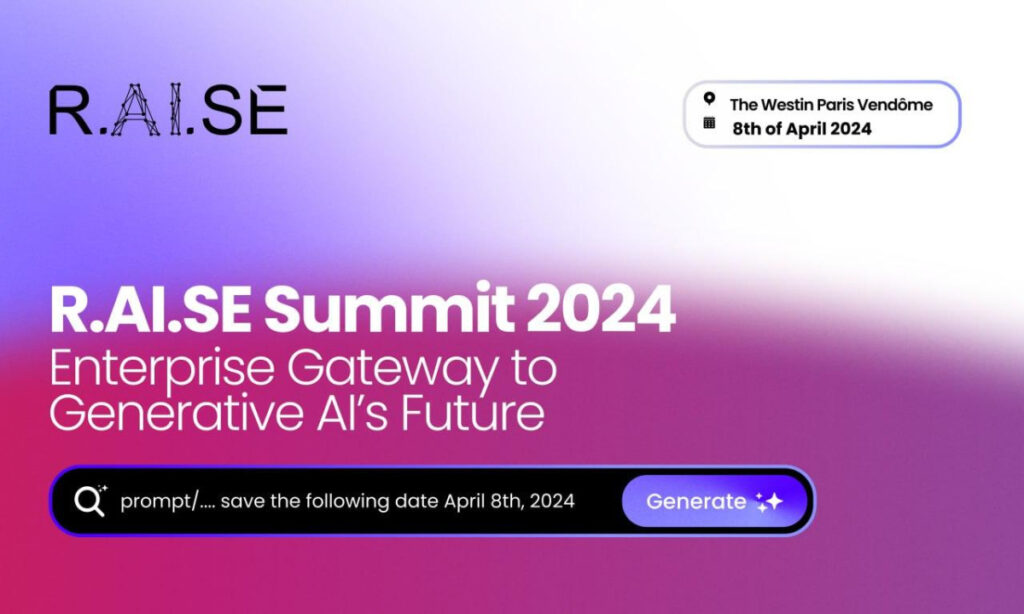
Paris, France, February 14th, 2024, Chainwire
The R.AI.SE Summit, a global reunion of 1,500 global leaders and Generative AI pioneers, is set to take place on April 8th, 2024, at the prestigious Westin Paris Vendôme, Paris, France. The landmark conference will bring together the corporate world and the top artificial intelligence builders to share first-hand insights on using Generative AI to address essential business and societal challenges.
“Excited to discuss Generative AI advancements at RAISE Summit, showcasing Mistral AI’s innovations” comments Arthur Mensch, Co-Founder and CEO of Mistral AI.
Featuring more than 90 expert speakers and 100 partners, the R.AI.SE Summit looks to welcome its 1,500+ attendees with an array of keynotes, panels, and workshops delving into the latest advancements and applications of Generative AI. The event promises to be a hub for corporate executives, entrepreneurs, developers, and investors, offering the opportunity to participate in groundbreaking discussions and networking sessions. The Co-Founders & CEOs of flagship Gen AI companies like Mistral AI, Cohere, Sambanova Systems & Perplexity AI, among many others, will be here to unveil their latest insights and advancements in the field.
“AVEVA is committed to harnessing the power of all types of artificial intelligence, machine learning, advanced analytics and generative capabilities to build comprehensive digital ecosystems that boost collaboration, enable higher efficiency and drive competitive advantage. At RAISE, we are pleased to share how leading companies are using such technologies, including Generative AI, to shape a more sustainable future for global industries.” asserts Caspar Herzberg, CEO of AVEVA and board member of Schneider Electric.
The R.AI.SE Summit is held by Chain of Events, the company behind the biggest European event in Web3 and blockchain, Paris Blockchain Week. The full-day conference, with its exclusive agenda, will serve as a platform for leaders and innovators to converge, share insights, and lay the foundation for future developments in the world of AI.
The Summit aims to provide a comprehensive overview of the current Generative AI revolution, with a focus on 3 main themes: Corporate innovation & transformation, Generative AI builders and Responsible AI activation. In addition to the main Summit, R.AI.SE Dev Arena and R.AI.SE Startup Agora events will provide unique platforms for builders and investors of the AI ecosystem.
The Dev Arena is a first-of-its-kind AI hackathon, sponsored by Mistral AI and organized with our operating partner Sia Partners, that will assemble the crème de la crème of developers in the field to become the epicenter for companies seeking to shape the future of Generative AI. The hackathon will feature over 150 participants under the guidance of field-expert mentors and will work on Mistral AI’s open-source models and tech stack. The hackathon will be featuring 4 different industries-focused tracks delving into the current hottest business issues.
Mistral AI comments “The Mistral hackathon at RAISE in France marks a significant stride forward in championing the open-source ethos across Europe”.
The Startup Agora is a pioneering platform set to showcase innovative startups’ cutting-edge solutions with its Startups Competition and Investors Zone. The future gems of the Generative AI industry will be displayed in the Startup Competition, where over 500 startups will vie to prove the value of their project to an elite cohort of global investors. Participants will get a chance to meet industry leaders, venture capitalists and investors to present their ideas and technologies to a diverse and worldwide audience.
Paris was chosen as a venue for the Summit due to France’s leadership in AI innovation, with President Macron having placed a strategic focus on AI development with a series of initiatives and investments. Among multiple initiatives led lately, Meta opened an AI Research (FAIR) lab in the historic capital, while local firm Mistral AI recently raised 385 million euros in a funding round led by Andreessen Horowitz and LightSpeed Ventures.
In addition, President Macron has unveiled a bold €1.5 billion initiative dubbed “France 2030” to accelerate French investments in strategic industries and propel the nation as a global AI leader. This ambitious plan mirrors the recent launch of “Kyutai,” an open-source AI research lab backed by tech heavyweights like Xavier Niel, Rodolphe Saadé, and Eric Schmidt.
About The R.AI.SE Summit
The R.AI.SE Summit is a cutting-edge gathering of 1,500+ global leaders dedicated to exploring the transformative power of Generative AI on businesses. Organized by the company behind Paris Blockchain Week, the full-day conference features a buzzing agenda, workshops, exhibitions and networking to bring together some of the brightest minds in the artificial intelligence industry in person in Paris, France.
Learn more: https://www.raisesummit.com
Contact
Hadrian de Cournon
[email protected]
London, UK, February 14th, 2024, Chainwire
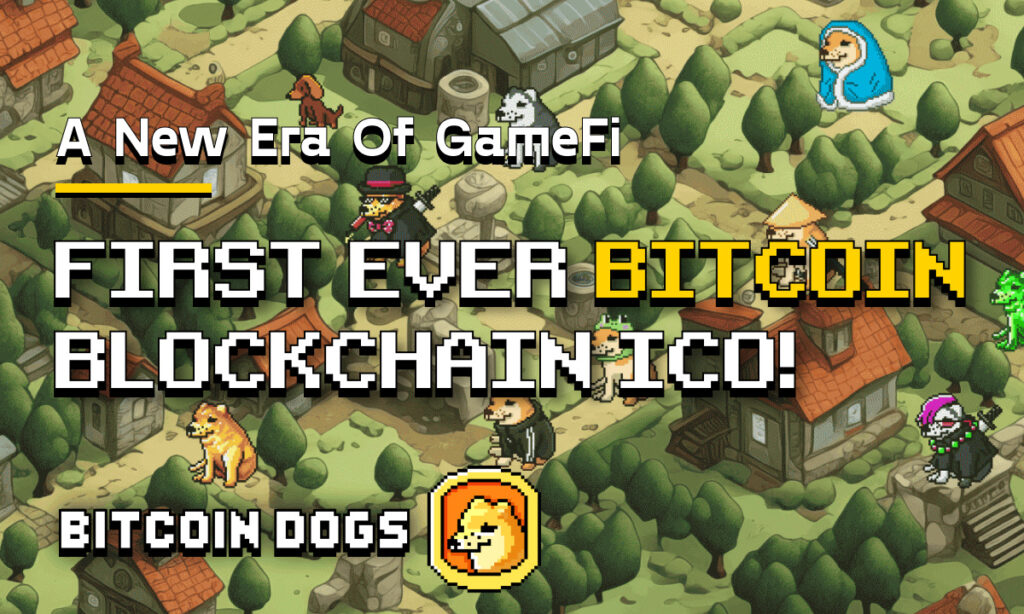
Bitcoin Dogs will make history in less than two hours’ time as the world’s first ICO on the Bitcoin blockchain gets underway.
$0DOG tokens are available to presale buyers for a price of $0.015, beginning at 11:00 AM GMT on the BitcoinDogs.club website. Prices will increase every 72 hours throughout the 30-day presale, ending at $0.0404 per token on the 15th of March.
The ground-breaking ICO represents the beginning of a new era for the Bitcoin ecosystem and will be the only way to purchase $0DOG before Bitcoin Dogs becomes available for trading.
The $0DOG presale takes place exclusively on the BitcoinDogs.club website.
A New Era Of GameFi
$0DOG is a BRC-20 token: a brand-new type of cryptocurrency built on Bitcoin. The Ordinals protocol, which went live in 2023, allows developers to create coins like $0DOG that are secured on the BTC blockchain.
Ordinals also bring NFTs to Bitcoin, and Bitcoin Dogs capitalizes on this breakthrough, too. The project incorporates a collection of 10,000 exclusive NFTs, the largest collection on Ordinals to date.
These NFTs, along with the $0DOG token, constitute the main components of the forthcoming Bitcoin Dogs game. The game, which begins its beta in Q2, fuses Tamagotchi-style gameplay with play-to-earn (P2E) mechanics, bringing a much-loved gaming experience into the GameFi era.
Social media integration is a core element of gameplay. Players have the chance to earn in-game currency by sharing their progress on social channels — a system bound to expand the game’s player base — and Twitter/X will also be home to Dog Showdown events, where players pit their virtual pets against each other in competition.
The Journey Ahead for Bitcoin Dogs
Beyond the historic $0DOG ICO, the road ahead for Bitcoin Dogs is set to be momentous.
Other BRC-20 tokens made headlines last year with impressive price action. $ORDI, one breakout token, managed a rally of 3,000% between September 2023 and January of this year. Other BRC-20 coins include Orange, whose ORNJ token rallied by 677% in three days last week.
Bitcoin Dogs’ proximity to the Ordinals NFT market also puts it in strong company. Bitcoin-based NFTs fared well in 2023 while the rest of the NFT market floundered, leading experts to believe they’ll continue to outperform the wider market as a “roaring comeback” for NFTs takes shape.
The growth of Bitcoin itself is also likely to provide fuel for $0DOG’s ascent: the OG cryptocurrency has enjoyed a positive start to the year, with the SEC approving Bitcoin ETFs in the United States already. Furthermore, the next halving event takes place in April, with 84% of investors expecting this to push BTC to new all-time highs, according to a CoinTelegraph study.
$0DOG tokens are available to presale buyers for a price of $0.015, beginning at 11:00 AM GMT. Prices will increase every 72 hours throughout the 30-day presale, ending at $0.0404 per token on the 15th of March.
$0DOG tokens are available to purchase on the BitcoinDogs.club website.
About Bitcoin Dogs
Bitcoin Dogs is breaking new ground in the Bitcoin ecosystem. For the first time ever, NFTs, gaming, and new token types come together to offer the first ICO on the original Bitcoin blockchain. The truly permissionless immutability of Bitcoin is being harnessed to create the $0DOG token, while a play-to-earn (P2E) gaming experience and NFT collection is being developed exclusively for $0DOG holders.
Website | Whitepaper | Socials
Contact
Bitcoin Dogs
[email protected]